Written by: Zhang Yaqi, Wall Street News
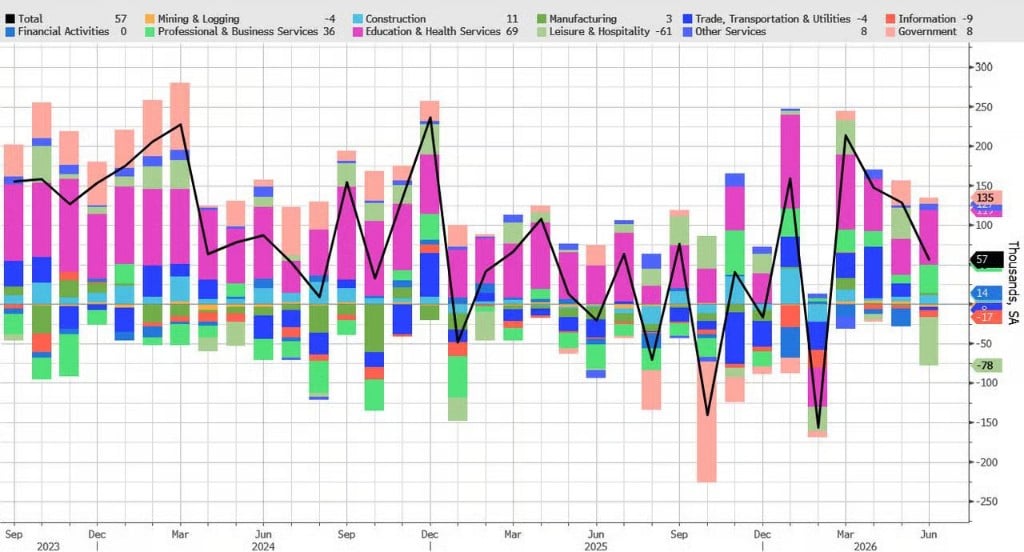
The U.S. July non-farm payroll report will be released tonight Beijing time, with market consensus predicting an increase of about 80,000 jobs. However, multiple leading indicators have sent mixed signals, with some institutions providing forecasts far below consensus. Whether the "weak July" curse can be broken has become the biggest suspense in the current market.
The expected range in the market is unusually wide, ranging from the highest of 157,000 to the lowest of 40,000. Goldman Sachs predicts an increase of 75,000 jobs, slightly below consensus; while Vanguard offers a very low forecast of only 18,000, believing that the employment data from this spring was artificially inflated due to weather, World Cup labor demands, and local governments hiring early, thus July faces considerable downward pressure. Meanwhile, ADP's private sector employment data only increased by 44,000, significantly below expectations, further exacerbating concerns about downward risks.
For the Federal Reserve, the current policy focus has clearly shifted to inflation rather than employment. Several officials have recently described the labor market as "stable," and a strong employment report would reinforce expectations for "maintaining high interest rates for a longer time," thereby applying pressure on interest rate-sensitive assets; conversely, if the data is weak, it may push market pricing toward a moderate rate cut.
The "Weak July" Curse: Three Years of Continuous Underperformance
One of the backgrounds most closely watched by the market in this report is the consistently disappointing pattern of July employment data in recent years.
According to Goldman Sachs' research report, in the past three years, the U.S. July non-farm employment increase has averaged 66,000 below the three-month average at that time, and 35,000 below the market consensus average. These weaker-than-expected figures have also been accompanied by significant downward revisions in the data for the previous two months, with an average downward revision of 112,000.
Goldman Sachs economists Ronnie Walker and Jessica Rindels list this pattern as one of the core reasons for downward risk in their report. The alternative employment growth indicators they tracked averaged 65,000 in July, down from 79,000 in June.
Additionally, Barclays analysts pointed out that the June employment data itself has a significant risk of revision – the data is based on only about half of the usual survey response rate, with the U.S. Bureau of Labor Statistics (BLS) heavily relying on model estimates rather than actual reported data. Barclays expects this revision will be substantial, but the direction remains unclear.
The World Cup Effect and Low Layoff Levels as Support
Not all signals point downward. Several data points provide temporary support for the employment market.
The World Cup labor effect is an important positive factor in Goldman Sachs' forecast. Data from Homebase shows that during the survey reference week from June to July, the employment growth rate in World Cup host cities was notably faster than in other areas, with Goldman estimating this effect may contribute about 10,000 jobs to the July non-farm figure, primarily concentrated in the leisure and hospitality, professional business services, and trade and transportation sectors. However, the same data also shows that this effect began to wane after the reference period in July.
Layoff data also shows positive signals. Initial claims for unemployment benefits fell to 210,000 in July during the BLS survey window, down from 224,000 in June; and in the week coinciding with the survey window, it dropped as low as 188,000, the lowest level since September 1969. The number of layoffs announced by companies according to the Challenger, Gray & Christmas report decreased by 12,000 in July to 33,000, the lowest since July 2024.
Government hiring also shows signs of recovery. After a continuous contraction of about a year and a half, government employment has averaged an increase of 12,500 jobs per month over the past four months, and government job vacancies have also experienced a recent rebound.
Labor Participation Rate and Unemployment Rate: Potential Concerns
One of the cores of the employment report is the trend of the unemployment rate and the changes in the labor participation rate behind it.
Goldman Sachs expects the July unemployment rate to rise slightly from 4.2% to 4.3%, higher than the consensus expectation of being flat. Goldman believes that this is partly due to a reversal of the significant decline in the labor participation rate in June—June's participation rate plunged to 61.5%, the lowest since March 2021 and the lowest outside of the COVID-19 pandemic since June 1976; among them, the participation rate of core working age (25 to 54 years) recorded the largest monthly decline in history since April 2020.
Economists from Vanguard expect that as this group of workers who exited the labor market re-enter the job search, but the speed of finding jobs is slower than their willingness to return, the unemployment rate will face upward pressure, with their year-end unemployment rate forecast at 4.6%.
Citi economist Veronica Clark pointed out that the labor market currently shows a "low recruiting, low layoffs" equilibrium state, which is particularly unfavorable for job seekers. She expects the unemployment rate to break above 4.5% in the coming months, at which point market focus will shift back to rate cut expectations, with Citi's baseline scenario for a resumption of rate cuts in the fourth quarter of this year.
Federal Reserve Position: Inflation Priority, Employment Stability as a Supplement
This non-farm data will mainly serve to guide monetary policy in strengthening or easing the baseline expectation of "maintaining high interest rates for longer."
Federal Reserve Chairman Waller described the labor market as "robust and stable," Logan called it "robust and slightly improving," Schmid deemed it "generally balanced," Paulson and Hammack indicated it has stabilized, while Barkin was the most cautious, stating that the market "does not feel tense." Officials generally view inflation as a more urgent policy challenge than employment.
It is worth noting that the Oxford Economics Institute pointed out that even if the hourly wage in July rises by 0.4%, the annual rate would only be 3.6%, still in line with the Federal Reserve's 2% inflation target, and wage pressure is currently not seen as a significant inflation risk. According to Bloomberg reports, analysts believe that a strong employment report may raise real yields, especially given that Waller previously stated "the market has to some extent done some tightening work for the Federal Reserve."
Good News Becomes Bad News?
J.P. Morgan's market intelligence department believes that this non-farm data will be traded based on the "good news is bad news" logic—a strong employment figure will strengthen pricing for "maintaining high rates longer," raising interest rates and suppressing interest rate-sensitive sectors; if the data is moderately weak, it may lead to a decline in yields, and market pricing could shift slightly toward a dovish direction, with equity markets potentially reacting positively.
J.P. Morgan's detailed scenario analysis is as follows:
- If non-farm exceeds 150,000, the S&P 500 index is expected to drop by 50 to 175 basis points, with a probability of 10%;
- If non-farm is between 100,000 and 150,000, the index will fall 50 basis points to rise 25 basis points, with a probability of 25%;
- If non-farm is between 60,000 and 100,000, the index will fall 25 basis points to rise 50 basis points, with a probability of 30%;
- If non-farm is between 20,000 and 60,000, the index will rise 25 to 75 basis points, with a probability of 25%;
- If non-farm is below 20,000, the index will drop 125 basis points to rise 50 basis points, with a probability of 10%.
The options market has priced the upcoming non-farm data relatively conservatively, with contracts expiring on August 7 implying a volatility of only about 0.7%, reflecting that the market has partially digested uncertainty against the backdrop of prior easing of geopolitical tensions. As of midday on August 6, the yield on two-year U.S. Treasuries had fallen from a recent high of 4.35% to about 4.24%.
免责声明:本文章仅代表作者个人观点,不代表本平台的立场和观点。本文章仅供信息分享,不构成对任何人的任何投资建议。用户与作者之间的任何争议,与本平台无关。如网页中刊载的文章或图片涉及侵权,请提供相关的权利证明和身份证明发送邮件到support@aicoin.com,本平台相关工作人员将会进行核查。


