
Author: Nancy, PANews
The story of Bitcoin mining companies transforming into AI is no longer new, and is gradually becoming a standard in the industry. However, as more mining companies rush into this field, Wall Street has begun to reduce the valuation premium on AI transformation narratives.
Blocksbridge Consulting recently analyzed that as more mining companies invest in AI/HPC infrastructure, the market's response to related transformation stories is clearly cooling down. Even large AI hosting contracts are becoming increasingly difficult to replicate the market stimulation brought in the early days. Data shows that early AI business announcements often triggered significant stock price fluctuations, with the average absolute change after related company announcements reaching 24.1%; whereas the average absolute change after similar transactions announced recently has dropped to about 10.2%.
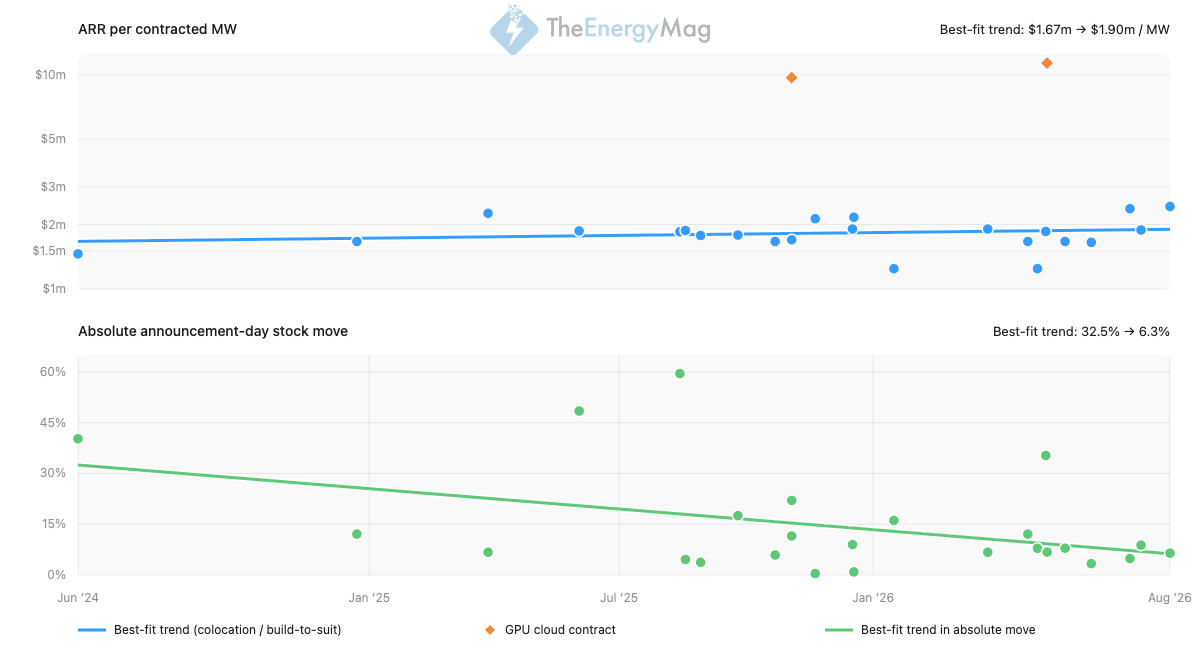
Meanwhile, the commercial value of AI/HPC hosting itself continues to rise. Data indicates that the annualized revenue level for related leases has increased from about $1.67 million per megawatt in the early days to about $1.9 million.
This change suggests that the market is no longer simply buying into the slogans of AI transformation, but is beginning to focus on tenant quality, project delivery capability, capital investment, and future cash flow realization. For Bitcoin mining companies, the key to AI transformation has shifted from "telling stories" to "proving business models."
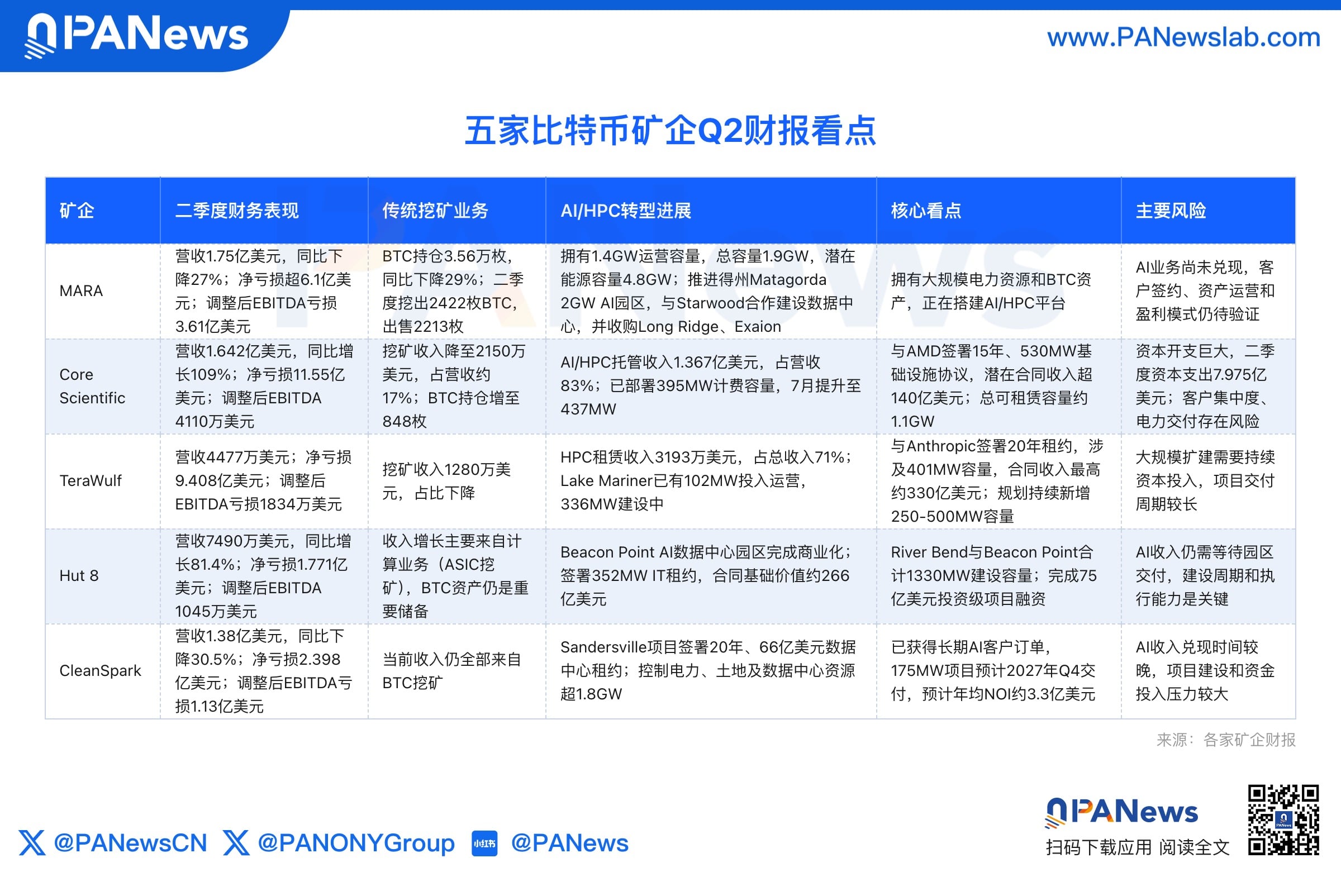
As second quarter financial reports have started to be released, the AI transformation of Bitcoin mining companies has entered a new round of examination. PANews reviewed the latest financial reports of five leading Bitcoin mining companies, and from the progress and results of the transformation, some companies are still in the construction phase, with AI business not yet contributing revenue; while some companies have already gained additional revenue through AI/HPC hosting business, even starting to reshape their business structure. Overall, most mining companies still face declining revenue, widening losses, and pressure from high capital investment, with the transformation story still far from delivering cash flow.
From the performance in the secondary market, investors' attitudes towards mining companies' AI transformation have also become more rational. In the past month, most Bitcoin mining companies' stock prices have experienced varying degrees of correction, also affected by the overall correction in the global AI sector. But even when some mining companies announce large AI/HPC leases or achieve business progress, the market response remains relatively tepid.
MARA: Losses widen, AI transformation has yet to contribute revenue
Data shows that in the past month, MARA's stock price has dropped by about 11.6%, and fell about 5.25% on the day the second quarter financial report was announced.
From the latest quarterly financial report, MARA's traditional mining business continues to be suppressed by the industry cycle, with profit margins continuously narrowing; and the AI/HPC infrastructure they bet on remains largely in the platform building phase, with the commercialization story not yet realized.
In the second quarter of this year, MARA achieved revenue of about $175 million, a year-over-year decline of 27%, significantly down from $238.5 million in the same period last year. In terms of profit, MARA reported a net loss exceeding $610 million in the second quarter, whereas in the same period last year it achieved a profit of about $810 million; the adjusted EBITDA loss was $361 million, a significant drop from the previous year's profit level of $1.245 billion, mainly impacted by about $343 million in digital asset impairment due to the decline in Bitcoin prices.
In this financial report, MARA explicitly proposed a "three major infrastructure" strategy, including Bitcoin mining, electricity resources, and AI computing infrastructure.
Regarding mining operations, as of the end of the second quarter, MARA held 35,577 BTC, a 29% decrease from 49,951 BTC in the same period last year. They mined a total of 2,422 Bitcoins this quarter and sold 2,213 at an average selling price of about $73,000. Currently, their cash and BTC assets total about $2.5 billion.
In terms of AI/HPC transformation, by the end of June 2026, MARA will have 1.4GW of operational capacity, with the current total capacity reaching 1.9GW, and potential energy capacity of about 4.8GW. Notably, the project located in Matagorda County, Texas, is an important node in their future transformation, with planned peak electricity capacity reaching 2GW, intended to be developed into an AI/HPC computing park, with construction expected to start in 2027; meanwhile, MARA is also collaborating with Starwood to establish a data center and acquired the Long Ridge energy asset and the French HPC operator Exaion (with expected annual revenue below eight digits, or between several million to twenty million dollars).
It's worth noting that to support the expansion of energy infrastructure, MARA has established a new $100 million credit line and set 18,750 BTC as initial collateral. This means the company is enhancing the liquidity and capital utilization efficiency of Bitcoin assets, providing funding support for subsequent infrastructure investments.
However, currently, AI/HPC's contribution to MARA's revenue is almost zero. In the financial report conference call, MARA's management acknowledged this reality, stating that their core tasks in the first half of this year are to scale up and promote platform transformation, with the second half entering the execution stage, including signing customer agreements, promoting new asset operation, and validating the platform's profit potential.
Core Scientific: AI revenue accounts for more than eight percent, begins to increase BTC holdings
Data shows that in the past month, Core Scientific's stock price has dropped about 3.04%, and increased about 0.05% on the day the second quarter financial report was announced.
From the latest quarterly financial report, Core Scientific's traditional mining business's proportion has significantly shrunk, with revenues from the AI/HPC infrastructure now dominating, and the commercialization story has largely been realized.
In the second quarter of this year, Core Scientific achieved revenue of about $164.2 million, a year-over-year increase of about 109%. In terms of profit, the company still recorded a net loss of about $1.155 billion, but the adjusted EBITDA reached about $41.1 million, with a gross profit of about $70 million and a gross margin of about 43%.
In terms of business structure, Core Scientific is rapidly escaping reliance on mining revenue. In the second quarter, mining business revenue dropped to about $21.5 million, accounting for about 17% of total revenue. Meanwhile, Core Scientific's Bitcoin holdings increased from 547 BTC at the end of the first quarter to 848 BTC, an increase of 301 BTC in a single quarter. Previously, they had sold BTC in large quantities to support the transformation into AI and high-performance computing, but in the second quarter began to rebuild their BTC holdings.
The real driver of revenue growth is the AI/HPC infrastructure business. Second quarter hosting revenue reached about $136.7 million, far exceeding the $10.6 million in the same period last year, accounting for about 83% of total revenue. Currently, the company has deployed billing capacity of about 395 megawatts, which improved to 437 megawatts by mid-July, corresponding to annualized hosting revenue of about $635 million. Meanwhile, Core Scientific announced a 15-year infrastructure agreement with AMD, covering a capacity of 530 MW across five data center parks, with potential base contract revenues exceeding $14 billion. Currently, Core's total leaseable customer electricity capacity stands at about 1.1 gigawatts, with potential contract revenues exceeding $24 billion.
Of course, transformation also comes with high capital investment. The company's capital expenditure in the second quarter was $797.5 million for data center construction and land acquisitions, with net cash outflow from investment activities exceeding $1.18 billion in the first half of this year. They also supplemented funds through the issuance of $3.3 billion of priority guaranteed notes, but the interest burden increased, and leverage on the balance sheet also rose significantly. Shareholders' equity remains negative, along with ongoing volatility in warrant liabilities. Additionally, hosting revenue is highly concentrated among a few customers, and the pace of construction, electricity acquisition, and supply chain stability will directly impact delivery rhythm and revenue realization capability.
Core Scientific's management pointed out in the second quarter conference call that the transformation inflection point has passed, and the company now has the capability to continuously create value for customers and shareholders. The subsequent focus will be on efficiently delivering computational capacity, strictly controlling project schedules, and responsibly allocating capital.
TeraWulf: Transformation expectations move towards performance realization, HPC business becomes revenue mainstay
Data shows that in the past month, TeraWulf's stock price has fallen about 12.97%, and dropped about 4.29% on the day the second quarter financial report was announced.
In the same quarter, TeraWulf's traditional mining business also faced a decline in contributions due to industry cycles, but the AI/HPC transformation is beginning to yield significant revenue.
The second quarter financial report shows that TeraWulf achieved total revenue of about $44.77 million in a single quarter, with Bitcoin mining revenue only about $12.8 million, while HPC leasing revenue reached about $31.93 million, accounting for about 71% of total revenue. The net loss has widened to about $940.8 million, mainly due to changes in the fair value of warrants (a loss of $755.7 million); adjusted EBITDA was a loss of $18.34 million. As of June 30, cash and restricted cash totaled about $3 billion, indicating relatively ample liquidity.
On the operational front, the Lake Mariner data center park is progressing well, with 102 MW of critical IT capacity already operational as of early July, and another 336 MW under construction, with the cost per MW maintaining within the guidance range of $8 million to $10 million; after the delivery of CB-3, Google's $600 million credit support for Fluidstack's leasing obligations has officially taken effect. At the same time, TeraWulf is also advancing requests for an additional 250 MW of electricity capacity. The Lake Hawkeye park spans about 183 acres, with a potential capacity of around 320 MW of critical IT load and is not expected to be operational until before 2029.
Post-quarter, TeraWulf signed a 20-year data center lease agreement with Anthropic, involving approximately 401 MW of critical IT capacity at the Justified park in Kentucky, with total contracted revenue of about $19 billion during the contract period. If Anthropic exercises two five-year renewal options, the total could reach about $33 billion, with the first deliveries expected to begin in the second half of 2027.
Additionally, TeraWulf sold a 50.1% stake in the Abernathy joint venture for about $530 million and acquired the Muskie Data Campus in Kentucky, securing a power service agreement of up to 1 GW. FERC has approved the acquisition of the Morgantown power plant in Maryland, clearing the main regulatory hurdles for its subsidiary Chesapeake Data Campus, which can expand up to 1 GW, with data center operations expected to start around 2030. TeraWulf reiterated its goal of adding 250 to 500 MW of critical IT capacity annually, emphasizing priorities on opportunities with stable electricity, clear customer demand, and scalable infrastructure.
TeraWulf CEO Paul Prager noted that the company is transitioning from platform construction to scalable execution, the model is replicable, and the core is in controlling power-advantage infrastructure, locking in long-term credit-supported customers, and delivering capacity in stages.
Hut 8: Revenue surges but still faces losses, completes commercialization of first AI park
Data shows that in the past month, Hut 8's stock price has fallen about 6.3%, and dropped about 9.74% on the day the second quarter financial report was announced.
In the second quarter, Hut 8 achieved revenue of about $74.9 million, a year-over-year increase of 81.4%. The main source of revenue growth came from computational services (especially ASIC mining), reaching about $72.5 million, while digital infrastructure revenue was $1.3 million, and electricity revenue was $1.2 million. Despite strong revenue performance, the company recorded a net loss of about $177.1 million this quarter, primarily due to an unrealized loss of $138.6 million in digital assets. Adjusted EBITDA was $10.45 million, a year-over-year increase of 149%.
In terms of commercialization, Hut 8 completed the commercialization of its first gigawatt-level AI data center park, Beacon Point, and signed a second 352 MW IT lease agreement after the end of the quarter, with a total contract base value of about $26.6 billion, and an expected average annual net operating income (NOI) exceeding $1.75 billion, covering 949 MW of signed IT capacity, with tenants mostly being investment-grade counterparties. Meanwhile, the River Bend and Beacon Point parks have a combined power capacity under construction of 1,330 MW, aiming to complete the first data rooms for delivery in the second and third quarters of 2027, respectively. As of the end of the second quarter, Hut 8 has a total development pipeline of about 8,660 MW, mainly dragged down by an unrealized loss of $138.6 million in digital assets.
In terms of financing, Hut 8 completed $7.5 billion in investment-grade project financing in a single quarter, including $3.3 billion for the River Bend park and $4.25 billion for the first phase of Beacon Point, both being non-recourse and non-dilutive arrangements, setting a precedent for investment-grade construction financing for single sponsor data center projects, providing solid funding support for large-scale construction.
Hut 8 CEO Asher Genoot emphasized that the company's core task has now shifted from securing orders to project delivery, aiming to quickly convert signed capacity into actual operations and stable cash flow, further solidifying the foundation for the transition from mining to AI infrastructure.
CleanSpark: Declining mining revenue, $6.6 billion lease becomes the biggest highlight
Data shows that in the past month, CleanSpark's stock price has increased by about 2.16%, and fell about 5.56% on the day the second quarter financial report was announced.
In the third quarter of the fiscal year 2026, CleanSpark's revenue was $138 million, a year-over-year decline of 30.5%; with a net loss reaching $239.8 million, whereas it had achieved a net profit of $257.4 million in the same period last year; adjusting EBITDA also plummeted from $377.7 million in the same period last year to a loss of $113 million.
As of June 30, CleanSpark held cash of $202.6 million, Bitcoin assets valued at about $814.9 million, and a net long-term debt of $1.78 billion, with a working capital scale of $761 million. Overall, CleanSpark still maintains strong asset reserves and financing capacity, but the continuous expansion of data centers and computational infrastructure also requires significant capital investment.
Notably, this quarter, all of CleanSpark's revenue still came from Bitcoin mining, with AI/HPC-related businesses yet to contribute actual revenue.
However, the biggest highlight of this quarter is that CleanSpark's Sandersville project signed a 20-year, $6.6 billion data center leasing agreement with a globally recognized technology company, the name of which has not been disclosed. According to CleanSpark, the project employs high-spec data center construction plans, with a construction cost of about $10 million to $12 million per MW, and a capacity of 175 MW corresponding to a total investment of about $1.75 billion to $2.1 billion, with expected average annual net operating income (NOI) of about $330 million. However, this revenue will still need to await project completion, anticipated to commence delivery no sooner than the fourth quarter of 2027. CleanSpark also stated that equity funding required for the project has been secured, and key long-cycle equipment procurement and advance payment arrangements have been completed to ensure further timely operation as planned.
Compared to some mining companies still focusing on telling AI stories, CleanSpark's advantage lies in its accumulation of large-scale electrical resources, land reserves, and experience in data center operations. Currently, it controls resources of electricity, land, and data centers in the U.S. exceeding 1.8GW.
From the report cards of various mining companies, this AI transformation is entering a watershed stage. For investors, the focus is no longer on who has the biggest AI story, but rather on more concrete operational metrics; for Bitcoin mining companies, possessing electricity, land, and computational resources is just the ticket to enter, and the ultimate determinant of valuation reevaluation lies in project delivery capabilities, client quality, and future cash flow realization abilities.
免责声明:本文章仅代表作者个人观点,不代表本平台的立场和观点。本文章仅供信息分享,不构成对任何人的任何投资建议。用户与作者之间的任何争议,与本平台无关。如网页中刊载的文章或图片涉及侵权,请提供相关的权利证明和身份证明发送邮件到support@aicoin.com,本平台相关工作人员将会进行核查。


