The Black Swan Breached, the "Safest" Iron Box Became an ATM
In the cryptocurrency market landscape, if centralized exchanges (CEX) are bustling "commercial banks," then hardware wallets represented by Coldcard are regarded as the absolute sanctum of countless "Bitcoin fundamentalists," a "private cellar."
However, an unprecedented black swan storm is sweeping the globe with devastating force.
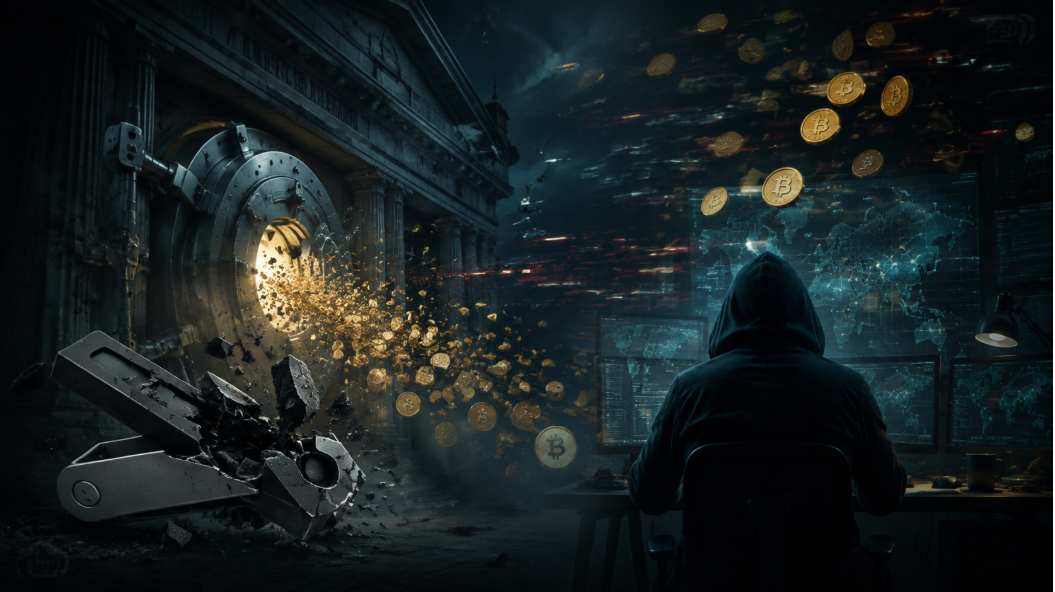
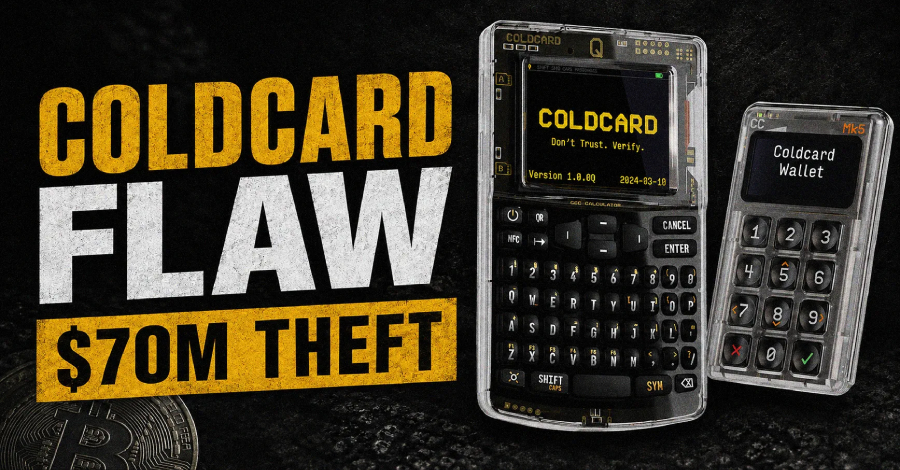
Starting from the end of July 2026, Coinkite's flagship hardware wallet product Coldcard was found to have a critical vulnerability. Hackers exploited a firmware pseudo-random number generation defect (PRNG Entropy Defect) that had been buried five years earlier (in 2021), and with the powerful support of AI computing power, achieved systematic inference cracking of the offline wallet mnemonic phrase.
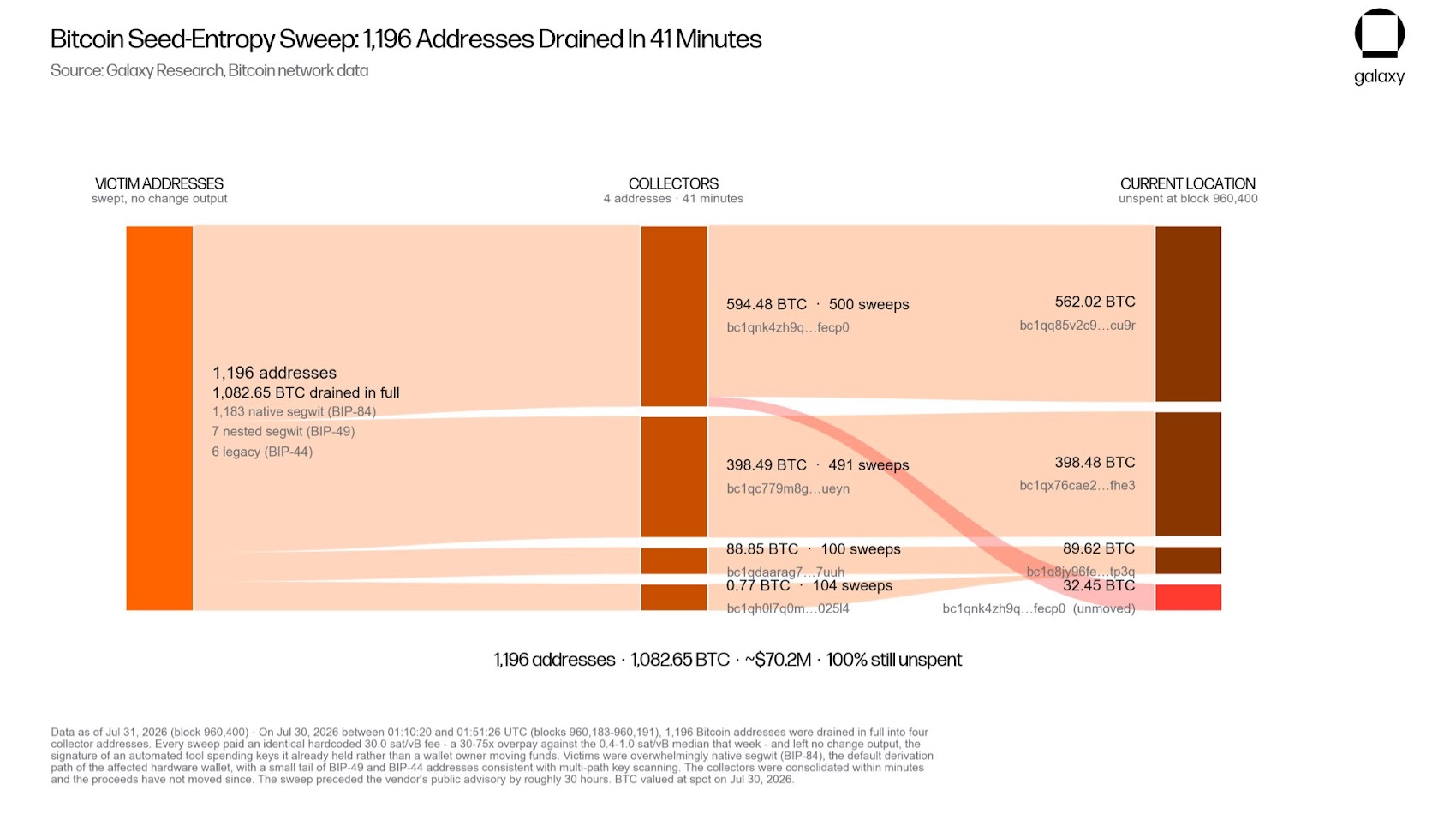
Accompanied by four waves of precise and brutal "serial thefts," the stolen funds skyrocketed. As of now, over 5,000 affected wallet addresses have been instantly drained, with total losses nearing and estimated to exceed $180 million. Even Coinkite's CTO and core development team have been caught up in the whirlpool of public opinion and regulatory investigation.
The "ancient Bitcoin whales" that had been dormant for 13 years were forced to move urgently, shaking the cornerstone of market trust in "self-custody." How did this trust crisis of hardware wallets sweep through the crypto space? What far-reaching impacts will it have on the market situation in the future?
1. Event Background: Five Years of Buried Risks and Four Waves of Bloodshed with AI Assistance
To understand the background of this disaster, we need to turn the clock back five years.
Phase One: The Root of the Problem Is Buried (March 2021)
In the firmware updates for Coldcard Mk2 and Mk3 released in March 2021, the development team made an extremely subtle engineering error in the entropy generation logic. When generating 12 or 24 mnemonic phrases, the device's random number generator did not provide true physical-level randomness, resulting in severe "entropy pool collapse."
In simple terms, what should theoretically have $2^{256}$ possible mnemonic combinations was reduced to a very small range that is "exhaustible" in the face of modern computing power due to the algorithmic flaw.
Phase Two: AI Breakthrough and Fatal Surprise Attack (Late July 2026)
According to tracking reports from security agencies PANews and Galaxy Research, in late July 2026, hackers used an optimized AI reverse inference model and completely decrypted five years' worth of underlying code in just 8 minutes. The hackers, through offline collision, pre-calculated tens of thousands of possible generated private keys and marked Coldcard addresses with large amounts of BTC on-chain with precision.
Phase Three: Serial Attacks and Four Waves of Emptying (July 30 - August 4)
The first and second waves of attacks (July 30 - July 31): The hackers began testing the waters, secretly stealing about $38 million in BTC from nearly a thousand affected wallets.
Then came the third wave of large-scale looting (July 31 - August 1): The attacks erupted! In just 18 hours, hackers ruthlessly breached 4,585 addresses, stealing 1,367 bitcoins in a single wave, worth nearly $86.7 million.
Finally, the fourth wave of a lethal strike (August 3): As Coinkite urgently issued a vulnerability warning and called for upgrades, hackers entered a frenzy mode. They packed transfers at a density of up to 13.8 transactions per block, fully enabling the RBF (Replace-By-Fee) mechanism to squeeze block space with exorbitant Gas fees, completely blocking victims' escape routes to transfer assets first.
As of now, the confirmed number of stolen bitcoins has exceeded $88.6 million (based on partial trading prices at the time), and with the emergence of hidden hacker addresses and subsequent black market laundering, the related losses and forced selling impact have cumulatively exceeded $180 million. Coinkite's CTO and technical team now face not only class-action lawsuits from global victims but have also been subjected to in-depth investigations by U.S. law enforcement and compliance departments.
2. Deep Market Dump and Market Earthquake: Impact on Prices Under Data Perspective
This security storm quickly spilled out from the "technology circle" and evolved into a macro market event causing severe impacts on the entire cryptocurrency market. Its impacts are reflected in the following three dimensions:
1. On-Chain "Ancient Whales" Awakening, Wave of Selling Pressure Looms
Data presents a chilling picture of victims: the average dormancy period of the stolen addresses' bitcoins is up to 3.18 years, with a median of 3.55 years. They are mostly early entrants who firmly believe that "cold storage is absolutely safe" and are long-term holders (HODLers).
Even more concerning is the "whale panic migration" caused by risk aversion: According to data from Whale Alert and Lookonchain, on August 3, an ancient wallet (address 18TExP...) that had been dormant since 2013 for 12.7 years urgently transferred all 500 BTC (approximately $31.3 million) due to concerns about the safety of its Coldcard mnemonic phrase.
From specific data comparison:
- BTC with dormancy over 5 years changes: Before the crisis broke out (before July 30), the daily movements were less than 100 BTC; however, during the crisis (August 3 - August 5), the daily movement surged to over 3,200 BTC. This indicates that long-term holders' confidence was severely damaged, leading to a scramble to transfer or shift assets.
- Net inflow of BTC at exchanges: Before the crisis, there was a continuous net outflow; after the crisis occurred, there were large net inflows at exchanges for three consecutive days, with cumulative inflows exceeding 18,000 BTC, indicating rapidly rising spot sell-off pressure.
- Withdrawal rate of self-custody wallets: Previously maintained at a historically high level, but after the crisis broke out, it dropped by 42% in a short time, reflecting that many users were no longer willing to transfer assets to personal hardware wallets.
2. Spot Prices Experience Pressure, Short-Term Volatility Intensifies
Due to continuous money laundering and selling by hackers (through mixers and decentralized exchanges sequentially cashing out) and the dual pressure of whales transferring assets to CEX for potential cashing out, Bitcoin bore significant pressure in a matter of days. The market's concern about "when thousands of potentially stolen BTC in hackers' hands will be dumped" directly suppressed the bullish momentum.
3. "Self-Custody Belief" Shattered, Hardware Wallet Sector Tokens Plummet
In the past, whenever incidents occurred at centralized exchanges (like the FTX collapse), hardware wallet sales would surge; however, this attack directly breached the "underlying security logic" of self-custody. Not only is the Coinkite brand facing devastating blows, but the entire network has developed deep doubts about the random number generation mechanisms of other brands like Trezor and Ledger, triggering a chain reaction of lost trust.
3. Panic Questions from the Masses: Objective Clarifications and Core Technical Risk Analysis
Faced with overwhelming disaster news, ordinary investors and holders have generated significant anxiety. We have compiled the top 5 concerns currently receiving the highest attention online and provided objective answers:
Q1: Are all hardware wallets unusable now?
Answer: Not all.
The root cause of this incident is a "software code logic vulnerability" (insufficient entropy in pseudo-random number algorithms) in certain specific versions of Coldcard firmware under Coinkite, rather than a physical chip being violently cracked, nor does it mean that encryption algorithms (like ECDSA or Secp256k1) themselves have been broken. If you are using wallets from other unaffected brands (or using firmware with no vulnerabilities) and the mnemonic phrase generation logic is normal, your assets remain safe.
Q2: How did the hackers calculate the private keys out of thin air?
Answer: They exploited the mathematical vulnerability of "pseudo-random numbers."
True security relies on "unpredictable randomness." Good randomness is like randomly grabbing a grain from $10^{77}$ sand grains; however, due to code defects in the vulnerable firmware, the range of generated random numbers was limited to a very small mathematical interval (for example, only a few million combinations). Hackers only needed a few high-performance servers combined with AI algorithms to exhaustively traverse all possible generated private keys within a short time and find corresponding wealthy addresses on the chain.
Q3: Is the mnemonic phrase I generated with Coldcard a long time ago still useful after upgrading the firmware?
Answer: Simply "upgrading the firmware" won’t save your assets!
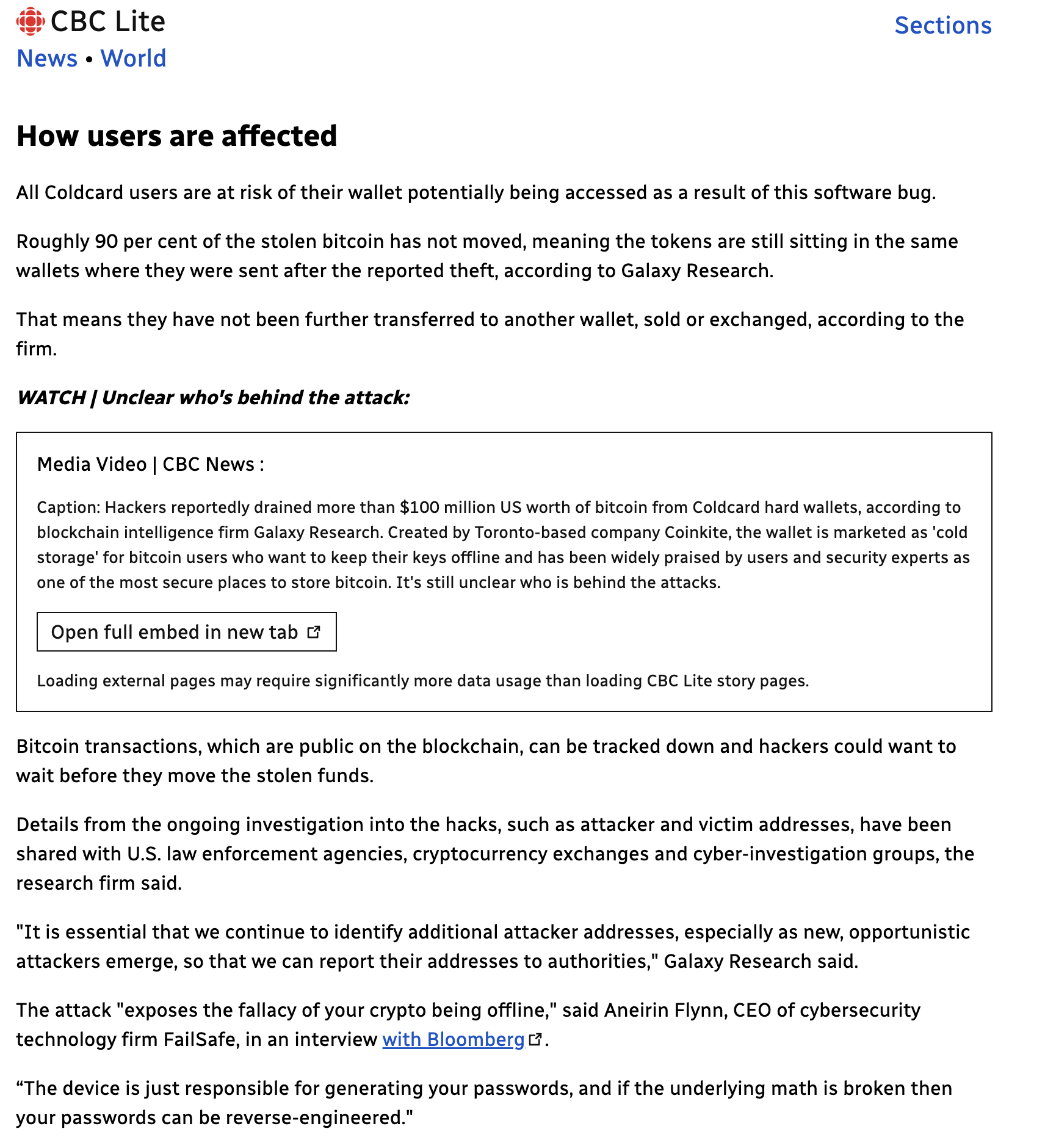
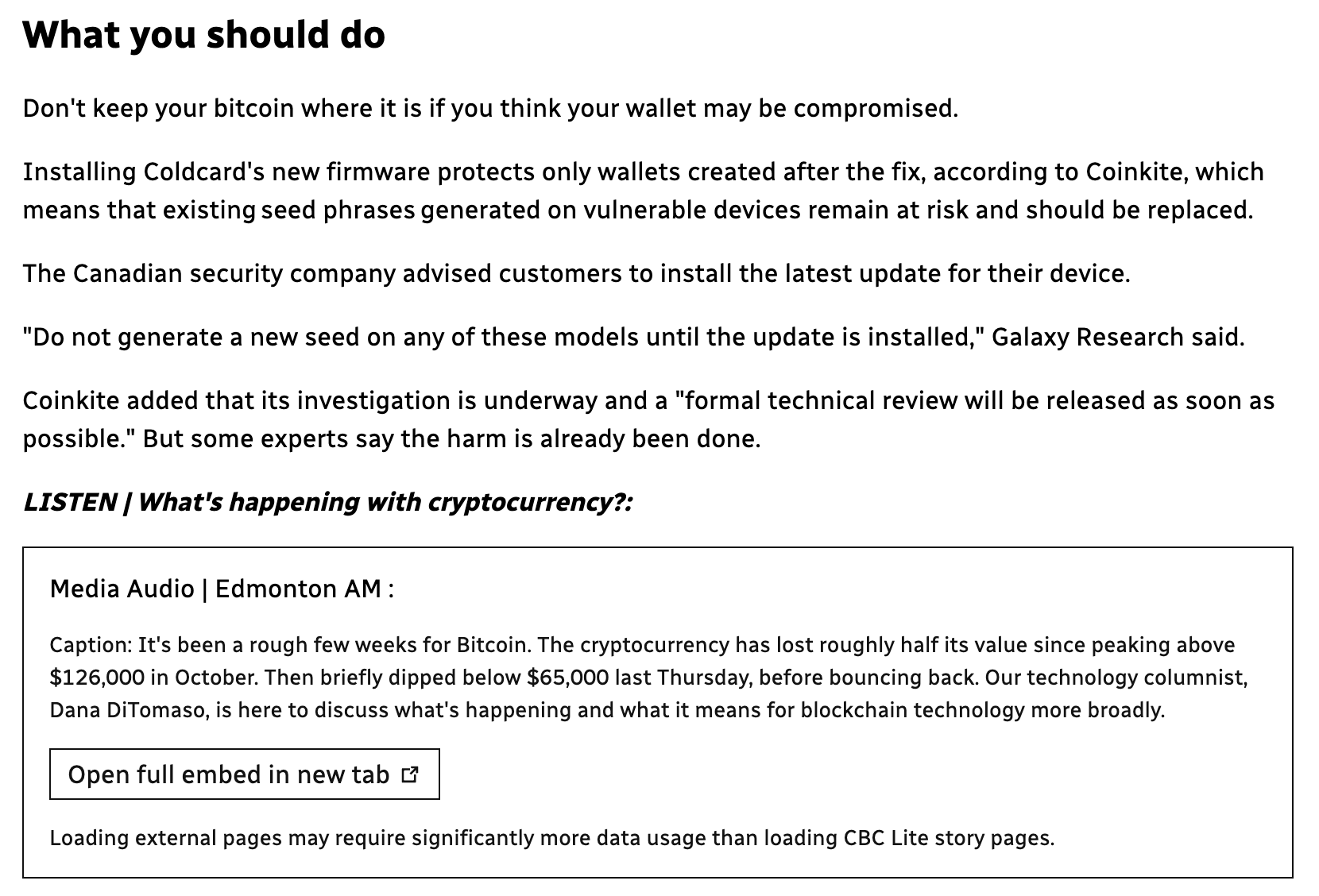
This is a pit that the vast majority of victims have fallen into! Because your mnemonic phrase (Seed Phrase) was generated under the old vulnerable firmware, its root is already an insecure gene. Even if you upgrade your hardware wallet to the latest firmware without vulnerabilities, your mnemonic phrase remains in the hacker's "calculated dictionary"! The only correct approach is to generate a brand new mnemonic phrase on a secure device and immediately transfer assets from the old address to the new address.
Q4: Did multi-signature (Multi-Sig) play a role in this attack?
Answer: It provided decisive protection!
On-chain monitoring indicates that during this bloodbath, accounts using multi-signature (such as 2-of-3) and signing devices from different manufacturers (e.g., Coldcard + Ledger + old mobile phone) were almost entirely unscathed. Because even if hackers calculated Coldcard's private key, they only obtained one key, which could not meet the multi-signature threshold and could not access the funds at all.
Q5: Is it safer to store assets at centralized exchanges (CEX) or in a hardware wallet?
Answer: There is no absolute safety, only different types of risks.
Self-custody (hardware wallet) avoids risks of platform collapse or freezing, but individuals must bear all technical risks such as firmware vulnerabilities, improper mnemonic phrase custody, and single point failures. Major CEXs avoid risks of personal operational errors and code entropy defects, backed by professional security teams and reserve compensation mechanisms, but require trust in the platform's compliance and operational status.
4. Risk Aversion Survival Guide: Essential Precautions Traders Must Execute Now
If you currently hold cryptocurrency assets, whether or not you use Coldcard, it is recommended to strictly follow the steps below for asset safety checks and risk aversion during this sensitive period:
1. Urgent Check and Transfer (For Coldcard Users)
You must immediately stop using old addresses: If your mnemonic phrase was generated between March 2021 and July 2026 using affected devices, do not hesitate to prepare for a transfer immediately.
Also, do not directly deposit assets into the updated address of the original wallet: You must completely abandon the old mnemonic phrase!
Additionally, increase Gas fees to prevent front-running: When transferring assets, be sure to raise network transaction fees (Gas/Priority Fee) to prevent hackers from monitoring and front-running transactions using RBF.
2. Reconstruct Protection System: Diversified System and Multi-Sig Configuration
Break the "single point of failure": Do not concentrate all assets under a single hardware wallet or a single mnemonic phrase.
Deploy multi-signature wallets (Multi-Sig): It is strongly recommended to structure large assets as multi-signatures and use devices of different brands and firmware environments as signing nodes.
3. Tiered Asset Custody: Never Put All Your Eggs in One Basket
For large funds held in long-term cold storage, adopt a multi-signature + complete physical isolation scheme.
For daily trading and risk aversion funds, in the current rampant crisis of hardware wallet safety trust, transferring part of the funds that need to be liquid or used for risk aversion to top global centralized exchanges is the most direct method to avoid "personal self-custody code risks."
5. Asset Safe Haven: Let Professional Security Teams Ensure Your Protection
As the "invincible myth of hardware wallet code" collapses, more and more seasoned investors are starting to re-evaluate the underlying logic of asset security: for the vast majority of non-code experts, relying on the professional security of top institutions is often more prudent than personally bearing the unknown risks of hardware vulnerabilities.
As a global leading cryptocurrency trading platform, OKX always prioritizes the safety of user funds:
- Proof of Reserves (100% Reserve Proof): OKX has consistently released monthly zero-knowledge proof (zk-STARKs) reserve reports for over ten months, ensuring 1:1 real compensation and custody of user assets.
- Military-grade cold and hot wallet isolation architecture: OKX adopts a multi-signature scheme (Threshold Signature Scheme, TSS) and physically isolated private key management system, completely eliminating single point code vulnerabilities and random number generation defects.
- Billions in security reserve funds: With industry-leading risk reserve guarantees, building an unyielding "digital firewall" for the security of every trader's assets.
In this murky world of self-custody, choosing OKX provides you with a fast trading experience along with institutional-level security protection to safeguard your cryptocurrency wealth.

🎁 Exclusive Registration Benefits from AiCoin Are Here!
Register for OKX through the AiCoin exclusive link for a permanent 20% rebate
👉 Register for OKX now:
https://jump.do/zh-Hans/xlink?checkProxy=true&proxyId=2
📢 Join the AiCoin community for more information on new coins and earnings
Official Telegram community:
AiCoin Chinese Twitter:
OKX benefits group:
https://aicoin.com/link/chat?cid=l61eM4owQ

The Growing Pains and Evolution of the Self-Custody Era
The $180 million tragedy of Coldcard rings a heavy alarm bell for the entire Web3 industry. It tells us: in this rapidly changing technological era, there is no absolute "safe haven." Code is written by people and may inherently carry hidden dangers; the rise of AI is making the speed of hackers breaking these vulnerabilities fast enough to be "measured in seconds."
For many traders, blindly worshiping a certain "tool" is dangerous. Only by maintaining a sense of awe towards technology, establishing a layered defense system of "exchanges + hardware wallets + multi-signature," and staying attentive to security warnings can one navigate to truly safe shores in the turbulent sea of crypto.
This article reflects the author’s personal opinions and does not represent the platform's stance. The views, conclusions, and suggestions in this article are for reference only and do not constitute any investment advice related to this platform. The market has risks, and investment should be cautious.
免责声明:本文章仅代表作者个人观点,不代表本平台的立场和观点。本文章仅供信息分享,不构成对任何人的任何投资建议。用户与作者之间的任何争议,与本平台无关。如网页中刊载的文章或图片涉及侵权,请提供相关的权利证明和身份证明发送邮件到support@aicoin.com,本平台相关工作人员将会进行核查。