Author: Qin Xiaofeng, Senior Writer of Odaily
Original text from: Tony Edward
Translated by: Odaily Planet Daily Qin Xiaofeng
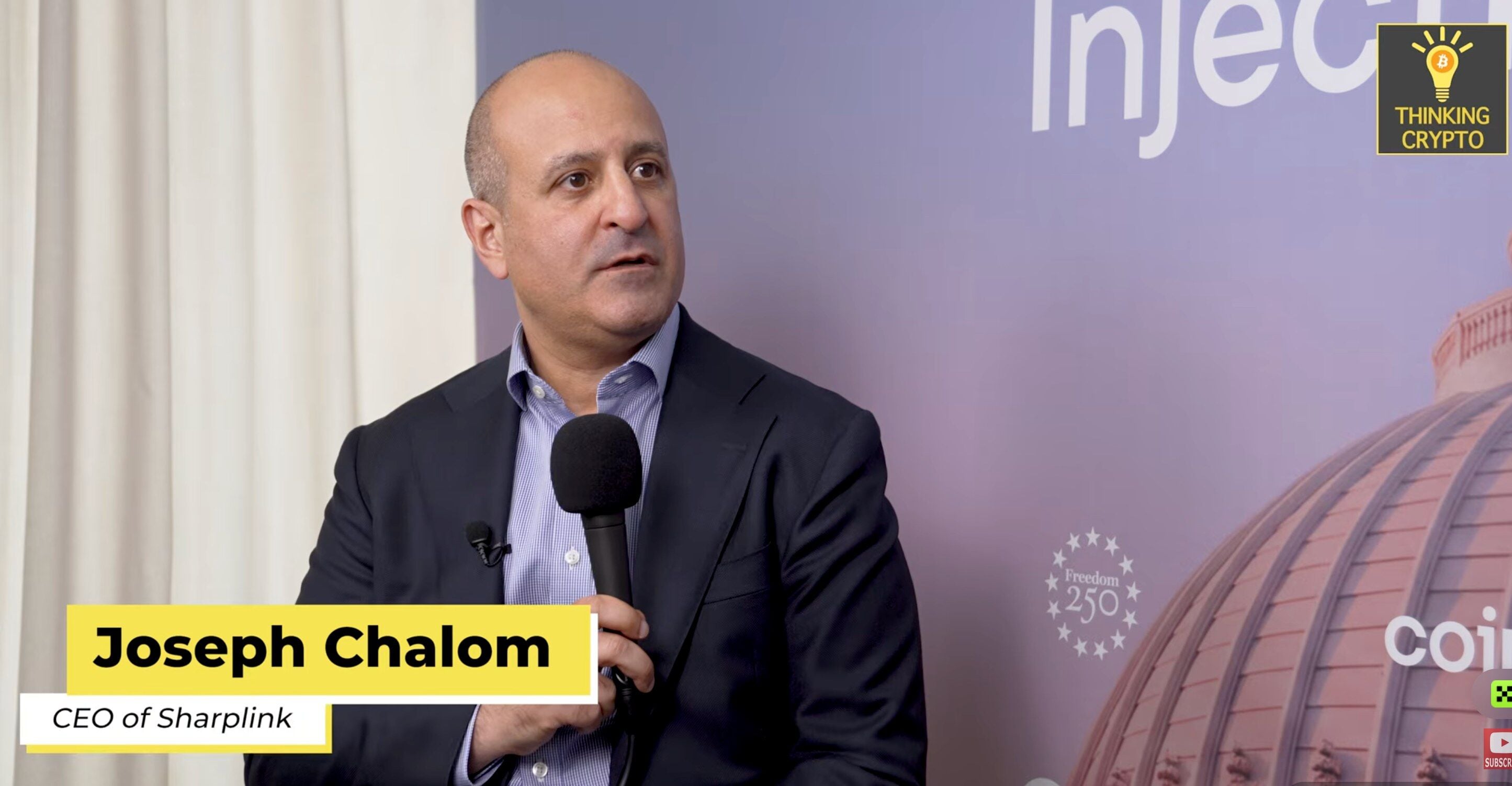
Editor's note: At the recent Washington Injective Summit 2026, SharpLink Co-CEO Joseph Chalom gave an exclusive interview.
He stated that the current market is pessimistic about Ethereum, but there is a divergence between reality and market sentiment. In fact, several metrics of the Ethereum ecosystem indicate its bright future: over 50% of stablecoin trading volume, nearly 60% of tokenized RWA, and no challenge to its DeFi dominance. He mentioned, "Ethereum is winning, but communication has failed," and SharpLink has partnered with giants like ConsenSys, investing in three core teams split off from the Ethereum Foundation, focusing on institutional-grade scaling, privacy compliance, and market promotion. More importantly, they have maintained zero leverage and no debt during the bear market, insisting on generating "productive" income from ETH and predicting that tokenization and 24/7 trading will ignite the next wave of institutional rush.
This week, ETH nearly approached $2000, and the ETH/BTC exchange rate also reached 0.03, hitting a nearly three-month high, which seems to indicate that things are improving. Additionally, after nearly 8 months without significant new purchases, SharpLink bought 10,000 ETH again in June of this year at an average cost of about $1611; after buying, total ETH holdings reached 886,725 ETH.
The following is the original text of the interview dialogue, Enjoy~
Host (Tony Edward/Thinking Crypto): Everyone, we are recording at the Injective policy summit in Washington D.C., and today with me is SharpLink CEO Joseph Chalom. Joseph, it’s great to see you.
Joseph Chalom: Great to talk to you again. First, let me introduce ourselves; we are a digital asset fund management company. We have raised billions of dollars to purchase Ethereum (ETH) and make it very efficient. The two most interesting things over the last month are: first, we returned to the public market for equity financing and actually bought back ETH again at a very good price, along with repurchasing some stock. Second, together with Joe Lubin from ConsenSys and Tom Lee from Bitmine, we started to support and invest in spin-off projects within the Ethereum ecosystem, which will be very positive for the new narrative of Ethereum in this new era.
Host: Recently, there has been a lot of negative sentiment surrounding ETH, including some questions regarding the Ethereum Foundation. Do you think this negative sentiment is just a symptom of the bear market?
Joseph Chalom: In fact, I believe that for about the past year and a half, there has been a divergence between reality and market sentiment.
The reality is, let's start from a very positive angle. The Ethereum ecosystem accounts for over 50% of all stablecoin trading volume and nearly 60% of tokenized real-world assets, with the majority of DeFi built on Ethereum. So if you look at the report card, they are winning. The sentiment being so negative is largely due to an industry slump and the Ethereum Foundation – which has done well for the last decade or so – making the decision to streamline and allow more ecosystem participants to support the roadmap. And this way of communication has led to a lack of clarity and confidence in the ecosystem, even though it is actually winning.
As a result, some of us have stepped up as guardians of the ecosystem and large holders of ETH, and we are taking action to support our position. I would be happy to share some of the things we have done as a collective in the industry.
Host: Let's dive deeper into the specific measures taken?
Joseph Chalom: Let's start with the positives. Ethereum is the longest-running blockchain besides Bitcoin, has never gone down, and is the most secure, trusted, and liquid. It also has a multi-year, very aggressive scaling roadmap.
Today, their mission and principles are returning to the fundamentals. The Ethereum Foundation will focus on privacy, anti-censorship, and some core principles to ensure Ethereum maintains a trusted neutrality for decades to come. But this means that some of the most critical talents and functions within the foundation have been spun off. In the past three weeks or so, three teams have split from the Ethereum Foundation and have received support from Joe Lubin, myself, and Tom Lee from Bitmine. These are very important for institutional adoption.
Let me tell you who they are. The first is ETH Labs, which consists of some of the strongest developers in the Ethereum ecosystem who are building the scaling capabilities necessary for institutions. The second is Ethereum Institutional, which is the market-facing front end and business development activities of Ethereum, spun off from the foundation with our support. Just earlier this week, the three of us also funded EthSystems, which is building next-generation privacy and compliance capabilities on Ethereum, an absolute necessity for large institutions to trade and ensure their data privacy. Although they sound like three independent nodes in the ecosystem, they are actually the three most important things that will drive institutional adoption in the coming year and beyond.
Host: That’s interesting; I see that many institutions start with Ethereum when preparing to tokenize and delve into DeFi and other areas, and then they ultimately expand to other chains.
Joseph Chalom: That’s indeed the case. As I mentioned earlier, Ethereum has the characteristics that institutions need. I worked at BlackRock for 20 years, and I know that before you want to migrate financial rails that are 40, 50, or 60 years old, you would want to migrate to a trusted, never-down, secure, and most liquid system. Most importantly, people don’t talk enough about decentralization.
A truly decentralized blockchain means that once you make a decision, the rules cannot be changed. Therefore, having a fully distributed decentralized chain, controlled by no single person or single treasury, is very important for institutions as they are making a once-in-a-generation infrastructure migration.
Host: I fully agree. So during the bear market, how has SharpLink created value for shareholders? Is it through staking DeFi protocols to generate passive income?
Joseph Chalom: Certainly. During the digital asset fund management craze last summer, about six or seven Ethereum digital asset management companies were launched, and possibly five Solana management companies. Only a few of us were able to raise billions of dollars and achieve scalability. In this competitive industry, you need scale.
What we did was to first use all this funding to purchase ETH and then generate returns from day one, because ETH itself is a productive asset. You can stake it and earn 2.5% to 3% yield. We have been doing this and making it more efficient than that benchmark. We have also participated in DeFi. We announced a partnership with another public company, Galaxy, to establish a $125 million fund to deploy our ETH into new protocols to help them launch and acquire what is known as TVL (Total Value Locked) or initial capital. So we make the output of ETH higher than native staking.
Lastly, I want to say that when you encounter integration periods, winter, and cycles three months after starting a business, you can truly see who is operating a public company in an institutional manner. We did not borrow money, did not issue preferred stock, and did not use our ETH as collateral for loans. We decided to be conservative during the winter. A few of us survived, holding ETH worth billions of dollars. That’s how we protect investors.
Honestly, going through a winter is not fun, but respecting and treating investors well has always been our motivation. You know, after winter comes spring and summer. When the market recovers, we will be in a very good position. And we are starting to see a recovery in ETH. Since these recent announcements, ETH has risen about 20% from its low. The short-term situation is indeed challenging, but the long-term adoption narrative has never been so optimistic.
Host: It's really great to hear that. I love that you guys have not gone into debt, because I think that’s risky and somewhat against the spirit of cryptocurrency.
Joseph Chalom: Yes. You know, I respect Michael Saylor, who has indeed invented a new asset exposure tool. You can have a public company and gain exposure to Bitcoin.
The challenge in the Bitcoin space is that it is not productive in and of itself; the only way to continuously accumulate and generate returns from your Bitcoin is to financialize your stock, issue convertible debt or preferred stock. Then you might run into trouble and end up having to sell your reserve assets. This has always been a challenge for the Bitcoin community, as digital asset fund management firms, including Michael Saylor, have transitioned from being massive net buyers of Bitcoin to sellers now, which is very unfavorable for short-term price movements.
Host: Absolutely correct. Joseph, with your background at BlackRock and in traditional finance, you have a wealth of experience. How do you view the institutional adoption prospects of this technology? It seems like everyone on Wall Street is looking to tokenize and is getting involved in stablecoins and DeFi.
Joseph Chalom: Yes, I believe the tokenization space, whether it's tokenizing the dollar into stablecoins or tokenizing government bonds or real-world assets, is a phenomenon that has existed for about 8 to 9 years.
Progress has actually been quite slow so far, due to a lack of regulatory clarity. I would like to describe in very simple terms how these things work together and how they stack up.
You can think of stablecoins as the dollar or value layer of future finance, tokenized assets as the exposure layer, and DeFi as the execution layer. If you have the currency layer, exposure layer, and execution layer, you can start running. What you are beginning to see is not only the tokenization of new funds, but also the tokenization of existing billions of dollars in funds and stocks. A bit more complex is a layer where you have cash, assets, and execution layer. Agentic (intelligent agents) will be the automation layer.
I think we are still in the second half of the first inning. We are waiting for more regulatory clarity, but institutions have moved from the learning stage to the experimentation phase and are now entering the production phase. It is now a race not to fall behind.
Host: Do you think that once the Clarity Act passes, it will provide a catalyst or confidence for institutions to innovate and invest more?
Joseph Chalom: 100% agree. I believe the Clarity Act is very important for two reasons. First, it clarifies that if you are a DeFi developer, you are a software provider and you are not responsible for what happens on your software, but if you hold customers’ assets as a DeFi protocol, then you are regulated and responsible for everything that happens. So the future of DeFi will be much brighter because of the Clarity Act.
The second point is that I think it will also affect market sentiment and momentum. In the cryptocurrency space, even a little tailwind can lead to massive growth.
The third point is that if you are at a large institution and your leadership is interested in digital assets, then with the government's stamp of "good governance," you will have more leeway to do those things that would otherwise be done slowly, at a faster pace. I think we will see a lot of momentum this summer. And I think we are going to reach a point where tokenization will become the norm, not the exception.
Host: Do you think there will be significant challenges when some companies tokenize while traditional markets still exist? For example, you might have a tokenized version of Tesla stock, but traditional stocks are still available on the stock market. What differences do you think there will be, and what potential issues could arise?
Joseph Chalom: I think the biggest challenge is the existence of different liquidity pools. For tokenization to succeed, we need to ensure that the digital version of the stock or fund has comparable trading volume and liquidity to the traditional version. But whenever there are technological advances, there will be coexistence of the simulated and digital. It is like slow trains and fast trains running on parallel tracks; eventually, they will all turn into fast.
But I think the more important inflection point is this: Imagine a world where your government announces a war in the Middle East on a Friday night, and assume you own a simulated version of a stock in your portfolio and want to sell it. If you own the digital version, you can trade 24/7 and express your view. You want to go long on an oil company, you can. You want to sell cyclical stocks, you can.
At some point, trustees who decide whether to buy a simulated version or the digital blockchain version will almost certainly prefer to buy and hold the chain version, because it can be traded 24/7, is programmable, and can settle instantly. So trustees will reach a point where they say to themselves: I cannot hold the slow simulated version because I cannot express my view over the weekend. So at some point there will be a tipping point, and I think it will take a few more years.
Host: This perspective is very good. As the market shifts to 24/7 trading, if you are still using the simulated version, you are almost at a disadvantage. You must switch to the tokenized digital version.
Joseph Chalom: Yes. But you need liquidity to tilt towards versions that favor liquidity, as that is also important.
Host: I think that’s why exchanges, large institutions, and banks are moving towards a 24/7 market, which makes perfect sense.
Joseph Chalom: Yes. Nasdaq and the New York Stock Exchange are transitioning to trading 23 hours a day, 7 days a week or 24 hours. Just this week, DTCC (Depository Trust and Clearing Corporation) – the clearing and settlement institution that processes approximately $400 trillion in transactions each year – has just launched on-chain collateral tokenization. So, I find this very exciting. You can see those announcements becoming so commonplace, whereas three or four years ago, they were enough to shake the market. That’s when you know the momentum is coming.
Host: Absolutely correct. It feels like this asset class is maturing. We are entering a new phase of adoption. That’s amazing. As a final point, can you share your roadmap?
Joseph Chalom: I believe the most important thing SharpLink is currently doing, besides accumulating ETH and making it yield (we have always been the digital asset fund management company with the highest ETH productivity), is stepping up to do something we never anticipated needing to do, which is to become guardians of the ecosystem. Not just verbally, but putting funding into new abilities, funding the spin-off projects from the Ethereum Foundation, and basically helping Ethereum reach the market.
I am often asked: Whose interest does this serve? The answer is, it serves our shareholders' interests, and they are completely aligned. So, we want to help Ethereum win, whether it is Layer 1 or Layer 2, and tell the story of why the ETH token will become a highly sought-after settlement and trust commodity, which is actually in the interest of our investors. Therefore, we will invest alongside our ecosystem partners and strive to be very good guardians. What we will not do is participate in the core protocol; that is completely decentralized. We will not participate in the governance of Ethereum, but we will participate in funding talent and market promotion capabilities, which aligns with our investors' long-term interests.
(End)
免责声明:本文章仅代表作者个人观点,不代表本平台的立场和观点。本文章仅供信息分享,不构成对任何人的任何投资建议。用户与作者之间的任何争议,与本平台无关。如网页中刊载的文章或图片涉及侵权,请提供相关的权利证明和身份证明发送邮件到support@aicoin.com,本平台相关工作人员将会进行核查。


