Compiled by: Xu Chao
AI computing power and infrastructure trading are undergoing a severe bubble burst. Recently, the hedge fund Situational Awareness LP (SALP), founded by former OpenAI employee Leopold Aschenbrenner, suffered a dramatic liquidation due to high leverage on AI concept stocks and Anthropic equity during a market correction, prompting Wall Street giants to compete for its remaining assets.
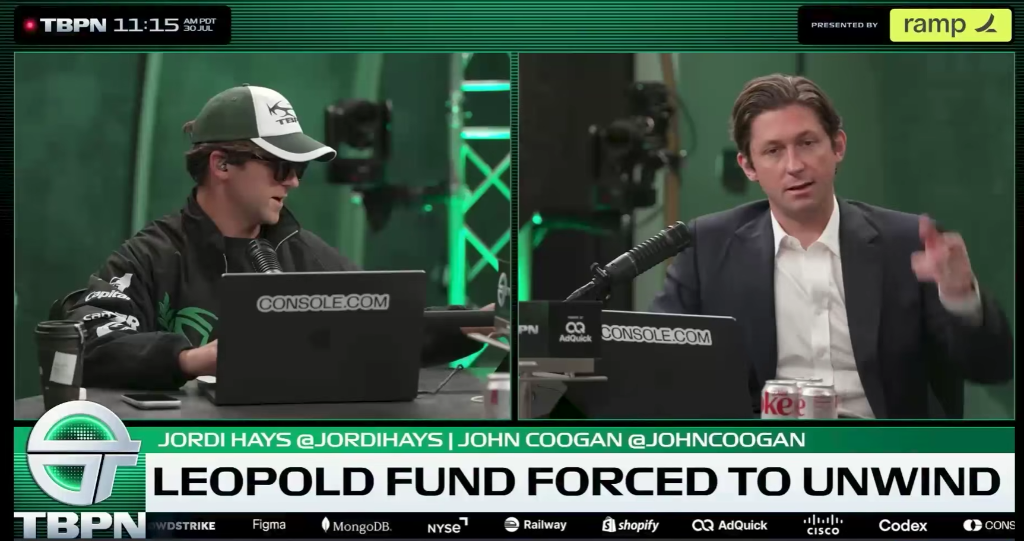
In the latest podcast interview, former hedge fund manager and well-known financial commentator Martin Shkreli provided an in-depth analysis of the liquidation incident's ins and outs, Wall Street's short selling hunting "Darwinian rules," the underlying mechanisms of closing out large positions, and the deep reasons why traders repeatedly fall victim to leverage and the Kelly Criterion.
Key points compiled by Wall Street Insights:
4x leverage triggered severe liquidation: The SALP fund has assets totaling $45 billion (including $10 billion in Anthropic equity) and through its prime broker added 4x leverage, bringing its total market value (GMV) to as high as $120 billion. Faced with a 25% drop in publicly traded stocks, its net equity quickly shrank and even faced negative risk, forcing it to trigger the prime broker's liquidation.
Wall Street's Darwinian short selling: When the market learned that the fund was forced to liquidate, several hedge funds adopted a "shooting against a fund" strategy—selling off similar holdings and aggressively shorting, accelerating its bankruptcy process.
Citadel and giants' brutal asset acquisition: Citadel, Millennium, and Jane Street participated in a closed-door auction for SALP's remaining assets. Buyers like Citadel acquired its stock book at a massive discount of 20%-50%, reaping immediate paper gains of billions of dollars.
Discrepancy between AI fundamentals and marginal traders: Although OpenAI, Anthropic, and tech giants delivered strong performances, the short-term price movements are determined by that 5% of marginal buyers that added leverage; when the weakest funds panic and flee, even the slightest negative news can trigger a crash.
The ultimate warning of leverage and the Kelly Criterion: Most traders tend to overbet severely. According to the Kelly Criterion, even if a single trade has a 60% to 40% probability advantage, as long as the position size exceeds a reasonable proportion (overbetting), it will inevitably lead to bankruptcy under probabilistic variance.
Wall Street's Darwinian rules: rumors land and short selling hunts
Martin Shkreli pointed out in the interview that Wall Street experienced a severe shock triggered by a liquidity crisis in the past 24 hours. He compared this incident to the historical collapses of Long-Term Capital Management (LTCM) and Amaranth.
According to Martin, rumors about the SALP fund's troubles began circulating as early as the beginning of the week. Some hedge fund firms sharply picked up on this signal and quickly executed a "shooting against a fund" shorting strategy. When it became known that a certain firm was forced to liquidate, the market players engaged in the "Darwinian rules" of survival of the fittest, first selling overlapping positions and building large short positions, thus accelerating the fund’s collapse.
Deconstructing 4x leverage: how $100 billion in assets swiftly went to zero
Regarding the reasons for the AI sector's correction, Martin Shkreli emphasized that the fundamentals were not the core determining factor for short-term stock prices; rather, the marginal willingness of buyers and sellers is key.
He analyzed that SALP previously managed about $45 billion in assets (including about $10 billion in Anthropic equity) and retained about $30 billion cash in its bank account while obtaining up to 4x leverage through its prime broker, causing its total market value (GMV) to skyrocket to $120 billion. When the publicly traded stocks it held faced about a 25% correction, although this seemed limited relative to the $120 billion base, its net equity plummeted from $35 billion to $5 billion. The prime broker, in order to prevent net equity from falling below zero and incurring losses, quickly took over the portfolio and forcibly liquidated it.
Discount acquisition and asset buying spree: Citadel and other giants' arbitrage frenzy
During the liquidation process, Jane Street, Millennium, and Citadel were invited to participate in a closed-door auction for the remaining assets of the fund. Martin stated that buyers like Citadel eventually acquired the fund's stock assets at discounts ranging from 20% to 50%.
According to insiders, the acquirers disposed of these assets without disrupting the market, gaining instant paper gains of up to $3 billion to $4 billion. Additionally, SALP's fund manager had attempted to contact multiple parties to liquidate its holdings of Anthropic private equity to supplement liquidity, and the offers at the time were benchmarked against the company's estimated total valuation of about $1.1 trillion. Martin pointed out that such large-scale crisis management further solidified Citadel's position as Wall Street's "ultimate savior" and shadow bank.
Narrative frenzy amid the bubble: FOMO sentiment and disconnect from fundamentals
Martin Shkreli reviewed the patterns of evolution in past financial bubbles, noting that from the 2000 internet bubble to Cathie Wood's innovation fund, every market cycle features traders who place all their bets based on an overblown narrative (like the arrival of AGI).
He noted that while companies like OpenAI and Anthropic delivered strong performances and the capital expenditures of tech giants remained high, when the market is dominated by that 5% marginal buyer who has added leverage, the weakest hands will panic and flee first at the market's peak. At this point, any small negative signal—such as a giant announcing a modest reduction in capital expenditures—will cause the entire trading structure to collapse.
The large-scale liquidation mechanism: the unwinding dilemma under the liquidity trap
In response to the question of "why large institutions can't directly liquidate in the secondary market," Martin detailed the process of handling large positions.
He explained that selling directly into the screens exposes intentions and can trigger quantitative algorithms and front-running by peer institutions. Therefore, the prime broker typically discreetly inquires using a four-digit market maker code (like Goldman Sachs' GSCO) or packages the asset book for a major sell-off. In cases where the prime broker forcibly controls the situation, the goal of the clearinghouse is to quickly cut off risks rather than wait for a market rebound; this large-scale sale brings sustained intense downward pressure on the market for weeks.
The leverage curse and the Kelly Criterion: inevitable bankruptcy from overbetting
When discussing the trading mentality of fund managers, Martin cited the "Kelly Criterion" proposed by Bell Labs scholars.
He pointed out that most traders generally exhibit severe overbetting tendencies, often reaching 2 to 10 times the reasonable position-building criteria. Simulations show that even if a trade has a 60% to 40% probability advantage, any overbetting in violation of the Kelly Criterion will inevitably lead to capital going to zero under long-term variance fluctuations. Martin summed up that regardless of how talented a trader is, once they ignore position management and leverage risk, the market will ultimately teach everyone to remain humble.
The following is the full interview:
Host: Let's connect with Martin Shkreli for an in-depth analysis. I think he’s online. How's it going, Martin? Great to see you again.
Martin Shkreli: Hey, guys, I’m doing great. How about you?
Host: Fantastic, just perfect. Uh, give us an insight into how your last 24 hours went? What was the experience like for you?
Martin Shkreli: It’s been very interesting. I invest myself, so… this is probably one of the craziest months in Wall Street history. Um, last night I was chatting with some friends about Long-Term Capital Management (LTCM), Amaranth, and other notable liquidations triggered by liquidity crises.
Well, this incident absolutely ranks high. Yes, it's just an incredibly crazy situation. We heard rumors as early as mid-last week, and then last night and this morning, those rumors really started to solidify.
It’s obvious that it almost became a “fait accompli.” I think they did a pretty good job at keeping it under wraps, relatively quiet. But I believe some players had already begun to position themselves earlier in the week (Monday, Tuesday), wanting to do what my old boss Jim Cramer used to call “shooting against a fund.” If you know someone is being forced to liquidate, unfortunately and cruelly, from a Darwinian perspective, the best move for you is to sell off all positions you share with them and start shorting every asset they own.
Yes, that would accelerate their downfall as fast as possible. When these things happen, it’s a pretty common operation. Um, of course, I’m not saying I had overlap with their positions, so I wouldn’t do that; but I know many funds were shorting all these stocks in hopes of inducing panic and collapse.
Host: How do you trace back the origin of this correction? Was it because of the war? Was it oil? Anxiety over open source, or simply the capital expenditures of hyperscalers? There are so many different opinions on why AI infrastructure trades and bottleneck trades might be weakening. But in the meantime, it feels like the models are making very solid progress, and progress is generally on track. Yes, yes. Laboratory companies are experiencing one of the most brilliant months in business history. Yes, but all infrastructures are in a correction.
Martin Shkreli: Yes, those things don't matter at all. [Laughter] The only important factor is the willingness of buyers and sellers to buy or sell. What actually happened is that the smart people got in early, started buying, saw prices rise, and then bought more.
Then the less smart people noticed and said, "I want to do that too, I want to make 400% this year."
People like me were buying right near the top. [Laughter] It was like, "Hey, this is great, I love memory chips, I love the bottleneck concept." [Laughter]
Then, the weakest hands bought at the top. So they’re also the first to sell. Of course, first to panic. Yes.
This creates a… you know, every bubble is basically the same. You go through this frenzy, the peak, and then everyone panics at the same time. You know, the fundamentals basically don’t matter. I know they will determine the buyers and sellers at the margins, but you know, 80% or 90% of asset shareholders don’t change hands. It's that 5% of marginal trading that determines the price. If that 5% is in a leveraged state of 3x or 4x—as we’ve heard, SALP (Situational Awareness LP, Leopold’s fund) is a 4x leveraged fund—then that’s quite high leverage. You know, a 25% drawdown will just drive you to bankruptcy.
Martin Shkreli: Yes. Well, interestingly, we heard three companies were bidding for these assets.
So, Jane Street, Millennium, and Citadel were pulled into a closed circle late Friday to bid on the sale of the agency's remaining assets. We were given a chance to see a $100 million stake in Anthropic stock, which confused us. You know, sometimes you see these SPV (special purpose vehicle) equities trickle out, and we thought it was interesting. Um, I raised an eyebrow, thinking, "Is this Leopold?" Because sometimes, when you want to sell $4 billion of some asset, you don’t usually just say you want to sell $4 billion. [Laughter]
You would run out and say you want to sell $100 million worth of it. Typically, someone looking to buy $100 million has the means to buy $500 million or even more.
You kind of probe them saying, "Here’s $100 million, what do you think, do you happen to want $500 million?" And then your eyebrow starts to raise, realizing he might have more.
Um, of course, this is a very strange situation. So, we heard that Millennium indeed made a bid. Citadel's bid was better. You know, I think Ken (Griffin, founder of Citadel) wants to be the person everyone turns to when they get in trouble. It’s like… you know, Buffett is getting older, and frankly, this isn’t something Buffett would want to do.
But Citadel has done this in the Amaranth trade. You know, when Amaranth blew up on natural gas futures, I think Citadel took over that portfolio. In fact, they’ve stepped up to rescue almost every collapse event in the financial world. For example, Enron, they directly bottom-fished and absorbed all the top talent.
Host: Yes, they also wanted to take Enron.
Martin Shkreli: Yes, Ken is a very smart guy. He just shows up and demonstrates, "How can I become the partner of Goldman Sachs, Bank of America, and other major banks when they need to get rid of super high-risk positions?”
They mostly take over the asset book, right? So, if you… let me give you an example to respond to your earlier question.
Assume you have a $45 billion scale, trying to trace this process back, of which $10 billion is, as we know, invested in Anthropic. So you’ve got $30 billion cash in your bank account. Operating with 4x leverage means your total market value (GMV) has reached $120 billion. Oh.
So, if your GMV drops, say, by 25%. At the $120 billion base, 25% sounds not too bad. Well, that’s about $30 billion. Your GMV drops to $90 billion. But that's not your net equity. So your principal net equity drops sharply from $35 billion to $5 billion. Yes. No prime broker would allow you to hold a total market value of $90 billion with only $5 billion left in net equity, because once your net equity falls below zero, it’s the broker that bears the losses, not you.
After the Archegos and other similar liquidation events, brokers would never lose another cent again; that’s not their duty. They fundamentally have the right to take over your portfolio, and you know, I hope no one ever needs to experience that. But they basically call you over and say, “Look, these assets now belong to us, and we will decide how to dispose of them.” Rumor has it that over the weekend, he contacted around 10 parties to liquidate Anthropic, attempting to supplement liquidity, and the reported offer to sell the Anthropic equity was based on an estimated overall valuation of $1.1 trillion. Um, I think that's probably its current trading valuation. Um, it’s currently unclear whether it was wholly sold off or half was sold; our reports indicate it was half. Currently, who bought it and exactly what happened remains somewhat vague, but this is the latest information we have. Then, you know, speaking of…
On the topic of publicly traded stock books, it sounds like the buyers of that stock book, according to what we learned, essentially gained an instant markup of $3 billion to $4 billion.
So, they now need to gradually liquidate/dispose of this $3 billion to $4 billion. Yes. Uh, far more than $3 billion to $4 billion, much more. But essentially, if they can dispose of these positions without disturbing the market, they can wind up making $3 billion to $4 billion from this trade, which is really rare, interesting, but also very exciting. One party among the three reached out to me last night, interestingly, after I published the report. They said, essentially, yes, Leopold flew too close to the sun (Icarian arrogance), but your numbers are slightly off. I asked if it was too high or too low, and they refused to confirm or deny. Regarding my report, whether privately or publicly, I received a lot of denials/rebuttals; as you said, they claimed things weren't that bad, he only lost 30%. A 30% loss you can barely withstand.
But if Anthropic's valuation marks didn't change, it would mean you lost 60% on your publicly traded stock book.
If you added 4x leverage, you know, it means you effectively lost 15% on the public stock book.
Um, this sounds a bit too good to be true. If you trade these stocks, they drop 15% in a day. Yes.
So we also heard other AI funds are suffering. They might not be in the same dire straits, but they are definitely also feeling the effects. So where does this fund go from here?
It offers a good cover for all those funds that are effectively copy trading him. Oh, of course.
They might even be risk-seeking and entered positions later, because if you want to copy someone else's work and try to catch up, you are inherently lagging behind; you know. Yes, you want to catch up. Yes.
Martin Shkreli: Yes, higher leverage, you’re entering these trades at a much later time. Um, do you remember… for example, around 2000, what did you think of Ryan Jacob? Because you were at Cramer’s company then. I remember you joined just before Ryan's Internet Fund began to collapse. Yes, at that time, there was also the Amarin Fund.
There was also a fund called Manhattan Fund in the 60s, which Warren Buffett criticized as the kind of fund that seeks immediate gains, managed by a person named Gerald Tsai. So, like every generation, you’ve seen the meme of Cathie Wood; you know… every generation has these types of people who firmly believe in a grand narrative (cycle) and then bet their whole lives on that narrative.
Listen, I have immense respect for those willing to do so. I once told a friend who did the same thing, and he started to follow that trade, but he entered very early, so his numbers once shone bright like Leopold's.
And he seemed to have hedged at close to the top—that’s just miraculous trading; he's the best trader I know. I joked with him saying, "If Leopold sold at the top and turned to shorting, I would absolutely consider him the greatest trader of all time (G.O.A.T.).” [Laughter]
Just, you know, when you’re completely enchanted by that narrative (whatever happens, in this case, AGI, general artificial intelligence) outside, there are indeed people who say, “Listen, AGI has arrived or is about to arrive. When it arrives, the entire financial world will no longer matter.” Yes.
You know, "Let’s blow it up, and witness the end of the world this way." Of course, for someone sitting at a Goldman trading desk, you would think, "These people are really crazy." [Laughter] You know, it’s just stock trading, you know.
Host: Considering that Leopold had worked at FTX until just before its collapse, have you ever thought that despite his high risk appetite, he might think, "You know, I really can’t go through another collapse like that"? He wouldn’t necessarily have direct ties to any illegal activities at FTX, but he definitely witnessed and experienced everything firsthand, and I believe he resigned on the day of the collapse. Yes… I thought he would not bounce back so soon and repeat the same mistakes. You might think…
Host: You would think even if… you know, first have ten years of normal and brilliant career, then return to the leveraged market saying, “I’m ready to dance again.” But now there are many questions, such as one question is: what about his performance fee (Carry)? You know, in the hedge fund industry, believe it or not, many institutions have clawback provisions for carry, such as high water mark provisions, right? You have to exceed a certain standard…
Host: Everyone has a high water mark, but increasingly common are clawback provisions: if you experience a severe drawdown, you must return any previously earned "2/20" (2% management fee, 20% performance fee), you know, this could really put you in a very tough spot. Moreover, as you all know, this guy is getting married this weekend, you know, it feels a bit tragic and victorious intertwined. Um, but, obviously…
Host: Um, but how common are these clawback provisions? Because you can imagine that in this fundraising, he has extremely large leverage and bargaining power; you know, the demand is incredibly high. The demand is very high. This sounds like a… the numbers are too good. Yes, this is more of something aimed at institutional investors. Speaking of which, you know, obviously this guy was basically inexperienced.
Martin Shkreli: I want to emphasize, at this moment, no one wants to kick someone when they’re down, and I don’t want to either. But I have some institutional investor friends, like one of New York’s largest fund of funds, who turned down investing in Leopold back then, basically laughed at him saying, “You know, there’s no way I’m investing in that.” Of course, he later soared and earned around 20 times since inception or whatever amount, performing extremely well, which made that friend feel a bit embarrassed; but after all this happened, he ultimately felt he got some level of vindication.
So, you have an inexperienced fund manager who is basically a pure long or extremely biased towards being long, then starts to get involved in private equity, which can often be a death knell for many hedge funds. You know, when hedge funds wear their VC hats and try to do what venture capital firms do, it rarely ends well. This can be traced back over the past 50 years of hedge fund history.
Very few can balance both. Another point I want to make is that we will soon see a lot of hedge funds that participated in the same trade release their July data. Of course.
So this not only concerns Leopold's $100 billion total position, but potentially 5 to 10 times that number. Even though the market has liquidity, bearing such immense downward pressure in just a few weeks… you know, seeing all this compress and burst in just a month is astonishing, while the tech bubble took three or four years to patiently rise and patiently fall. Um, seeing such a momentary compression is very interesting. What happens next will be very captivating. One theory suggests that all this liquidity has been cleared, and we may see historical highs again. Another theory suggests that we have just entered a substantial downtrend, and this liquidity rebound will fade, leading us to further decline.
Um, no one knows what will happen, but one thing is certain… while you’re right that Anthropic and OpenAI are having their best business performance in history, Microsoft, Google, and Meta are the same.
But I think there are still some sharper questions: is this capital expenditure investment (CapEx) worth it? Of course.
You know, they rewarded Microsoft for its prudence while punishing Meta and Google's lack of prudence.
So people want to know what the future holds. But this is probably one of the craziest moments on Wall Street in years.
Probably the craziest at least since FTX, definitely crazier than the venture capital frenzy brought by Tiger and SoftBank in 2021, and you could even say it's the craziest since the chaotic years of the 08 financial crisis. So this…
This is definitely a spectacle. I think, no matter how much people want to learn the lesson of leverage time and time again, it seems we are constantly repeating it. Um, that's just how it is. But I think it’s very interesting to see the phenomenon where hedge funds like Jane Street, Citadel, Millennium gradually evolve into some sort of “shadow bank.” You know, normally the banks would take on such shocks, but now there are others… like Jane Street used to be a limited partner in that fund, but reportedly they are not interested in bidding, which is interesting. But they may have taken shares of Anthropic, very uncertain. Over the next few days, we are clearly going to learn more, but this is an unprecedented time, an extremely crazy story, and as we grasp more details, it could become even crazier.
Host: Is there a chance for this fund to continue to exist? Because I’m listening to these numbers, it’s like… you know, at the peak there was $45 billion, and if you liquidated the principal entering the fund, it may only be around $5 billion. Is there a possibility: ultimately you end up with $10 billion cash in your bank account, and the LPs say, “Well, we gave you $5 billion at that time, keep going, get back to the battlefield.” You know…
Martin Shkreli: I hope so, for those exceptional LPs, and for that fund manager who obviously bore a huge psychological whiplash. But you know, ultimately, as you all know, there is a notion on Wall Street: once there’s blood in the water (implying there are injured/weak), those positions will be smashed to zero. Like, “I’ll drive Micron down to $5, just to sweep this guy out at $3,” right? [Laughter] This is… the craziest part is, this is the nature of Wall Street when such things happen. When someone has to sell $100 billion, there is $1 trillion of capital sitting there thinking, “Let’s see how this guy begs for mercy.” It's the most tragic and Machiavellian thing, but he has to blow up, you know, the tragedy is there’s no other ending. Yes.
It’s because the leverage levels are too high. As long as there’s a little slip… I remember my former boss, who was a portfolio manager at Tiger, reminding me of when there was an incredibly slight change in tone from a supplier of optical components in the 2000s, and he and his partner at Soros decided to short as wildly as possible.
Because they knew after the bubble's easiest days ended, the weakest money was sitting there. You would think, “Okay, what’s next? Things have to get crazier.” You saw Dwarkesh's tweet. Something similar has to occur to generate a big enough second derivative (acceleration) to shock everyone.
You know, everyone knows AI is booming; everyone knows chips are booming. What else can shock the upside? Not much. So if you hear any small sound, like, “Uh, we won’t be spending that much anymore,” the whole thing collapses—everything is too weighted down. So I’m really wondering, are we… you know, are we facing a longer, more protracted decline. Today feels pretty good.
You know, having gone through a tremendous boom, a relief rally. Um, a lot of bubbles have been cleared from the system, but what comes next? You know, I don’t know if a patient and calm market will emerge, because hyperscalers and large companies also have FOMO. Their FOMO sentiment is as intense as Leopold’s, right? If not stronger. So this isn’t just him alone.
This is the entire world collectively saying, “Damn, I have to go all in on AI.” Aside from Tim Cook sitting in the back saying, “I won’t do it, doing nothing,” who else has the guts to do that? Yes.
Host: Yes, really, it's Tim Cook.
Martin Shkreli: Yes.
Host: Funny enough, you know, we were joking in the fourth quarter, back when the Code Agent was about to explode, that OpenAI’s revenue growth was slowing a bit, and the market was a bit anxious. A lot of those things weren’t public back then, but you could tell some crossover investors were starting to get a bit nervous, right? They were looking forward to seeing metrics like MAU (monthly active users), DAU (daily active users), you know. Yes.
Host: And then the data indeed peaked and stabilized, then there was a round of adjustments lasting about 8 weeks. Everyone felt like “Okay…” and then it started to explode again. Back then, we even celebrated a “victory lap,” saying, “Great, AI has corrected, the bubble has burst, we can rebuild sustainably now, and it’s all bright from here.”
Host: Smooth sailing.
Martin Shkreli: Yes, I completely agree. I think the most unexpected thing is if we see the whole sector reach new historical highs. I think almost everyone on Wall Street is skeptical of this, which means there could actually be a bullish possibility.
Host: So you mean there’s hope? I like that saying. Can you… can you give us a little more insider baseball about what it takes as a major shareholder to liquidate a huge position? Because many people outside the hedge fund circles might be confused, like, “Okay, you have $50 million of stocks in a $10 billion chip company; can’t you just dump them to retail?” Can’t you just market sell on E*TRADE or Robinhood? In fact, when you get to this scale, even in the public market, it’s much more complicated. It’s not as simple as pressing a big button. Can you walk us through what it takes to sell a large position at that scale?
Martin Shkreli: Yes, the interesting thing is that there are a lot of nuances in this. Firstly, it’s about the advertisement systems. If you just sell into the market directly, you can try, that’s called “selling into the screens.” The screens are those market numbers you see on your screen. Anyone can trade through platforms like Robinhood.
So if you can avoid it, you typically don’t do that. Selling into the screens is at least somewhat quiet; you can slowly drip your orders out. But there’s always some conspiracy theory that when I’m selling into the screen, someone can see my screen and think, “This guy has a VWAP (volume-weighted average price) market order selling 10 million shares; I need to tell others.” This information is extremely valuable. There’s even crazier conspiracy theories that quantitative funds can sniff out what’s happening with various crazy ideas.
So everyone is quite afraid of this. Then you can pick up the phone—that’s the most conventional approach; you call Goldman and say, “Listen, I need to sell 5 million shares of Microsoft.” They’ll say, “Well, are we taking it down ourselves, or shall we find a buyer who wants to take it?” They’ll try to evaluate. Selling Microsoft is easy, but if you’re trying to sell Sharon AI (a nobody Australian emerging cloud vendor) stock, it’s difficult. The shares you hold might represent its trading volume over ten days. If you attempt to sell into the screen, you would need to take up the entire ten days of volume to clear it, which might crash the stock price by 50% or more, and you absolutely don’t want to do that.
So you try to engage in this “advertisement announcement process.” Um, you can essentially put out an announcement in the stock market stating you are a seller of a certain stock and can put out your four-digit market maker identifier. Goldman Sachs's code is GSCO. Thus GSCO would show as a seller of a stock (like Nebius, which is one of its holdings).
You would call them and say, “Okay, Goldman, I'm one of your clients. What’s the market looking like on Nebius?” The trader would say, “Listen, we have quite a big seller here.” You would ask, “How big? 500,000 shares?” He would say, “Much larger.” You might think, “Um, okay.” Because they have to disclose they’re handling your order; they have to inform everyone there is a seller present. They try to remain discreet on the scale but won’t wast
免责声明:本文章仅代表作者个人观点,不代表本平台的立场和观点。本文章仅供信息分享,不构成对任何人的任何投资建议。用户与作者之间的任何争议,与本平台无关。如网页中刊载的文章或图片涉及侵权,请提供相关的权利证明和身份证明发送邮件到support@aicoin.com,本平台相关工作人员将会进行核查。


