Key Takeaways
- Lummis said U.S. crypto rules are “not working,” urging a Senate vote on CLARITY before August 8.
- Prediction markets put 2026 passage odds near 30%, down sharply from over 80% in February.
- The Senate needs 60 votes; Republicans hold 53, requiring at least seven Democrats to cross over.
Lummis made her case earlier today, arguing that the patchwork of existing rules governing digital assets fails everyone it touches, i.e. companies building in the space, everyday holders, and the agencies meant to police fraud. The senator has taken to the Senate floor repeatedly in recent days to press colleagues on the bill, telling reporters she plans to keep speaking on it as the calendar runs down.
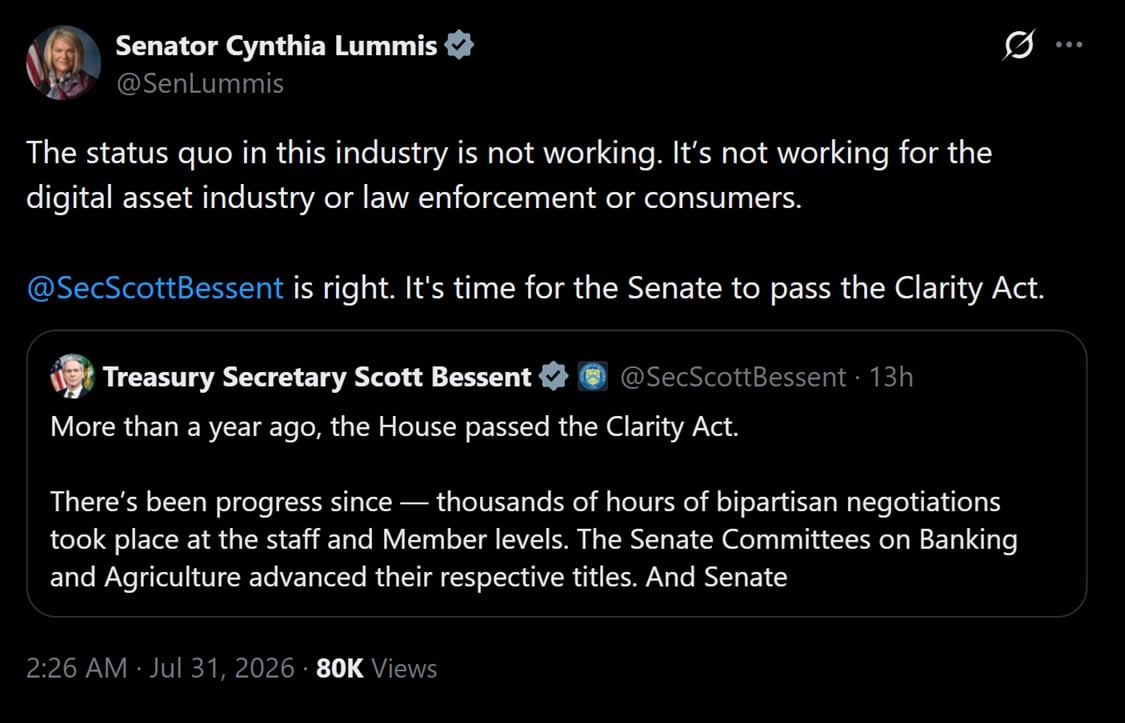
Image source: X
The Digital Asset Market Clarity Act, formally H.R. 3633, would split oversight of digital assets between the Securities and Exchange Commission (SEC) and the Commodity Futures Trading Commission (CFTC). Lummis has separately warned that the bill’s current momentum “will not come around again this decade,” noting that further delays would mean the legislation dies for the year.
She has also cast the standoff in more concrete terms, telling colleagues that a prolonged pushback could leave crypto custody rules exposed just as the industry scales further into mainstream finance.
The Senate is set to begin its August recess on August 8, and Majority Leader John Thune has not yet allocated floor time for the bill. If lawmakers fail to act before then, debate would not resume until September, cutting further into the shrinking legislative window before the midterm elections.
That timeline pressure has shown up in betting markets with prediction platforms now putting the odds of CLARITY becoming law in 2026 at roughly 30%, down sharply from above 80% in February. The bill needs 60 votes to clear the Senate floor. Republicans control 53 seats, meaning at least seven Democrats must cross over for passage, a bar that has proven difficult given unresolved objections from within the Democratic caucus.
Beyond the ethics provisions governing federal officials’ crypto holdings, which Senate negotiators have been working separately to resolve, opponents have raised concerns about how the bill treats decentralized finance (DeFi) protocols and whether its consumer-protection language goes far enough. Sen. Elizabeth Warren has argued the bill would weaken oversight enough to threaten the broader financial system, a position she has repeated since the committee vote in May.
Crypto industry groups have pushed back hard on the delay as well, with more than 200 organizations, including Coinbase, Ripple, Kraken and Circle, urging Senate leaders to bring the bill to the floor, arguing that continued uncertainty pushes innovation and jobs offshore while leaving US consumers without clear protections.
Lummis has tied the urgency directly to consumer safeguards, arguing the bill’s custody and disclosure requirements are needed precisely because existing law leaves gaps that bad actors can exploit.
That said, with floor time still unscheduled and the recess deadline days away, the bill’s fate now rests on whether Thune carves out time this week or lets it slide into the fall session. A September restart would keep CLARITY alive but push any final vote closer to the midterm campaign season, when legislative bandwidth typically shrinks further.
免责声明:本文章仅代表作者个人观点,不代表本平台的立场和观点。本文章仅供信息分享,不构成对任何人的任何投资建议。用户与作者之间的任何争议,与本平台无关。如网页中刊载的文章或图片涉及侵权,请提供相关的权利证明和身份证明发送邮件到support@aicoin.com,本平台相关工作人员将会进行核查。


