Part 01
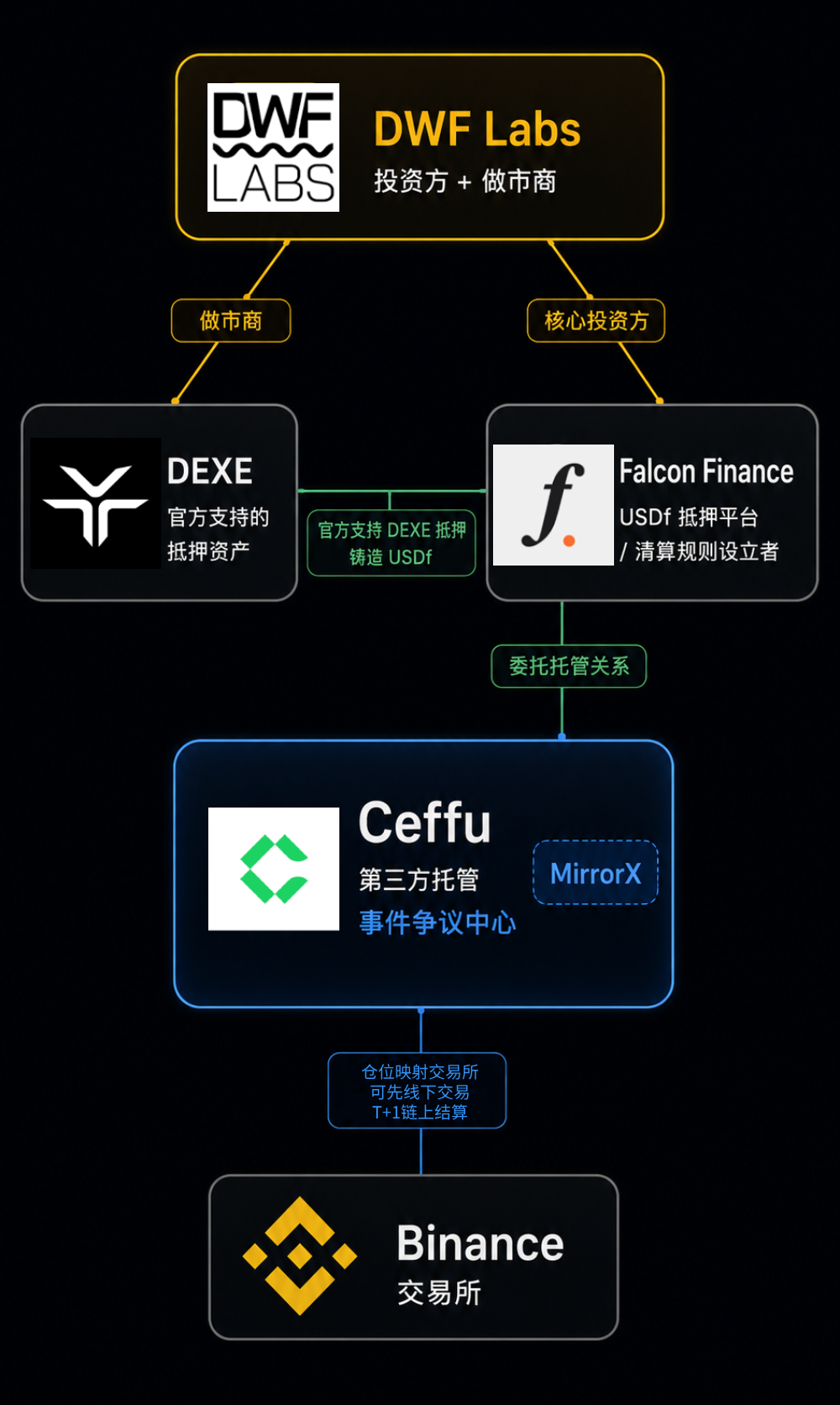
Before telling this story, let's get to know the "5 Kind People" in the story:
🐳 DWF (the dealer)
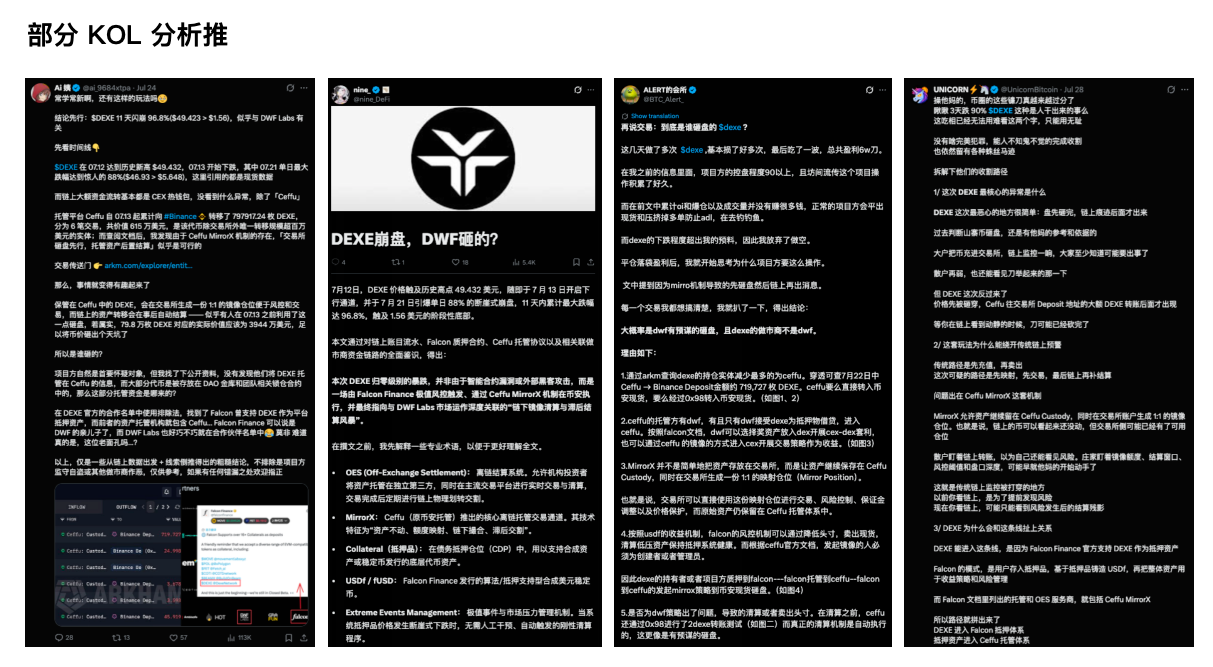
A well-known institution in the crypto circle, engaged in both investing in projects and providing market-making services. The market has doubted its conflict of interest for quite some time; in 2024 it was exposed for allegedly manipulating the market. This time it's even more absurd. It is both a market maker for DEXE and a core investor in Falcon. After the incident, it was immediately subjected to questioning by several KOLs, such as Ai Yi and nine_.
💀 DEXE (the sacrificed)
The most mythical coin of 2026. From $2 it surged to $48+, then fell back to single digits in just a few days. It is the asset that was collateralized and crashed on Falcon. In less than two weeks, the mythical coin transformed into a sacrifice.
🏦 Falcon (the sacrificial platform)
A collateral platform issuing synthetic dollar stablecoin USDf, with DEXE as its officially supported collateral asset. However, when the price of the collateral triggers a risk threshold, its automatic liquidation mechanism will immediately reduce exposure, sell spot, and liquidate collateral to preserve USDf repayment ability. In simple terms, it is the "high priest".
🔪 Ceffu (the knife bearer)
The technical dark box behind the bloodshed. It originated from Binance's own custody department Binance Custody, now claimed to be an independent third-party custody service, but who knows? The market, including the U.S. SEC, does not believe it. It holds a knife called "MirrorX," which is a custody trading channel specially serving Binance institutional users, and is also a direct factor in this tragedy.
🔴 Binance (the exploited loophole)
Every transaction in this massacre occurred on the Binance order book. Ceffu used MirrorX to bring mirror positions in, allowing institutions to trade on Binance first, then settle on-chain with a delay. This is akin to Ceffu handing over the knife, leaving Binance's door wide open, while the knife quietly falls, and retail investors lose all their capital. As the exchange with the most global users, its risk control fell silent, with warnings unheard; it was present throughout the massacre, remaining utterly mute.
Part 02
🐻 The bear market is already painful enough, then DEXE finally skyrockets over 1,000% against the wind. The result, however, is a "feast of Hongmen." $DEXE's market capitalization evaporated approximately $3 billion overnight, leaving retail investors with nothing. What chills the spine even more is that the bloodbath is driven by a set of off-chain custody mechanisms that rendered retail investors almost "blind" during the crash.
First, let's take a look at this timeline that can be verified both on-chain and on the order book:
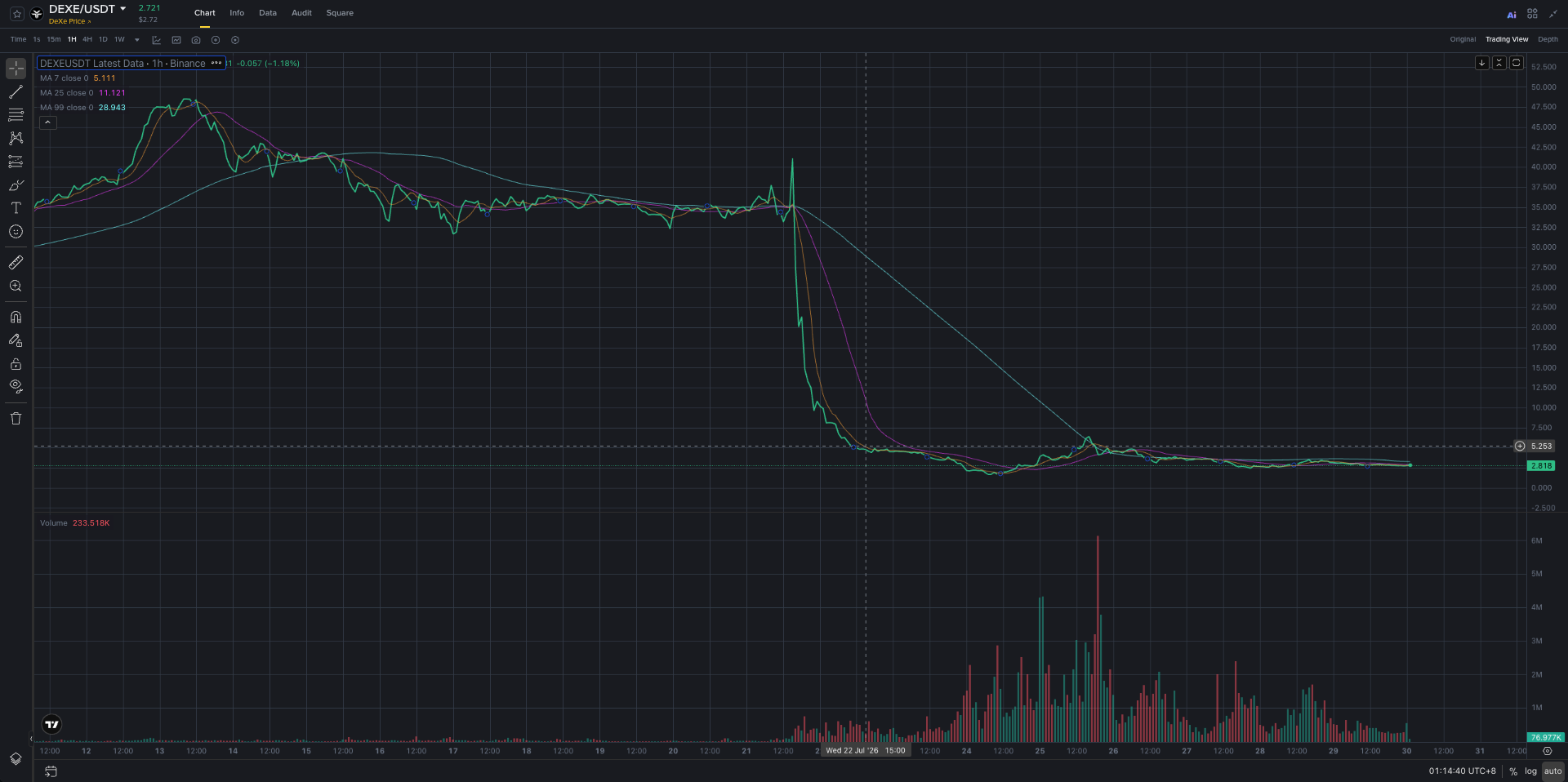
📅 Starting from July 21, 16:20, the price of $DEXE began to plummet, dropping rapidly from a high of $46+ to under $10;
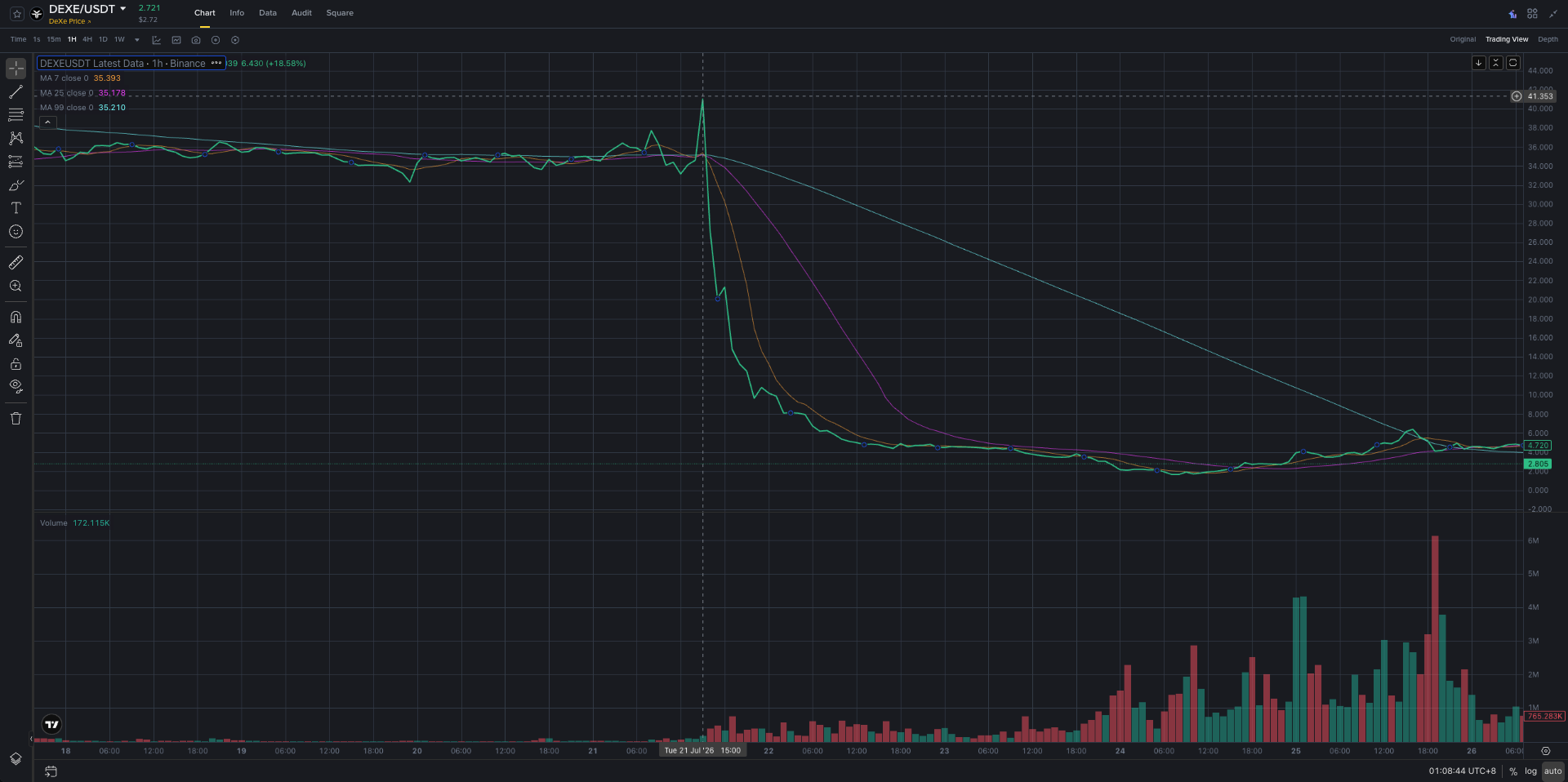
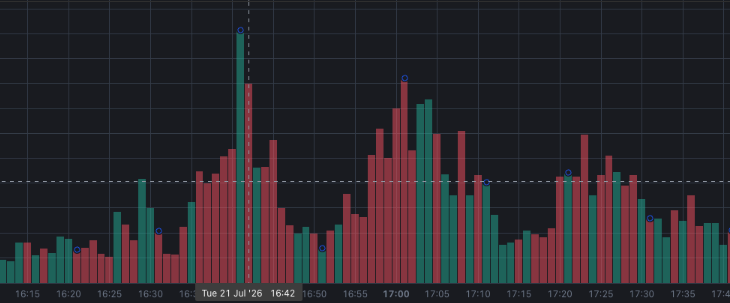
📅 Between July 21, 16:20 and 17:00, estimated sell volume exceeded 240K;
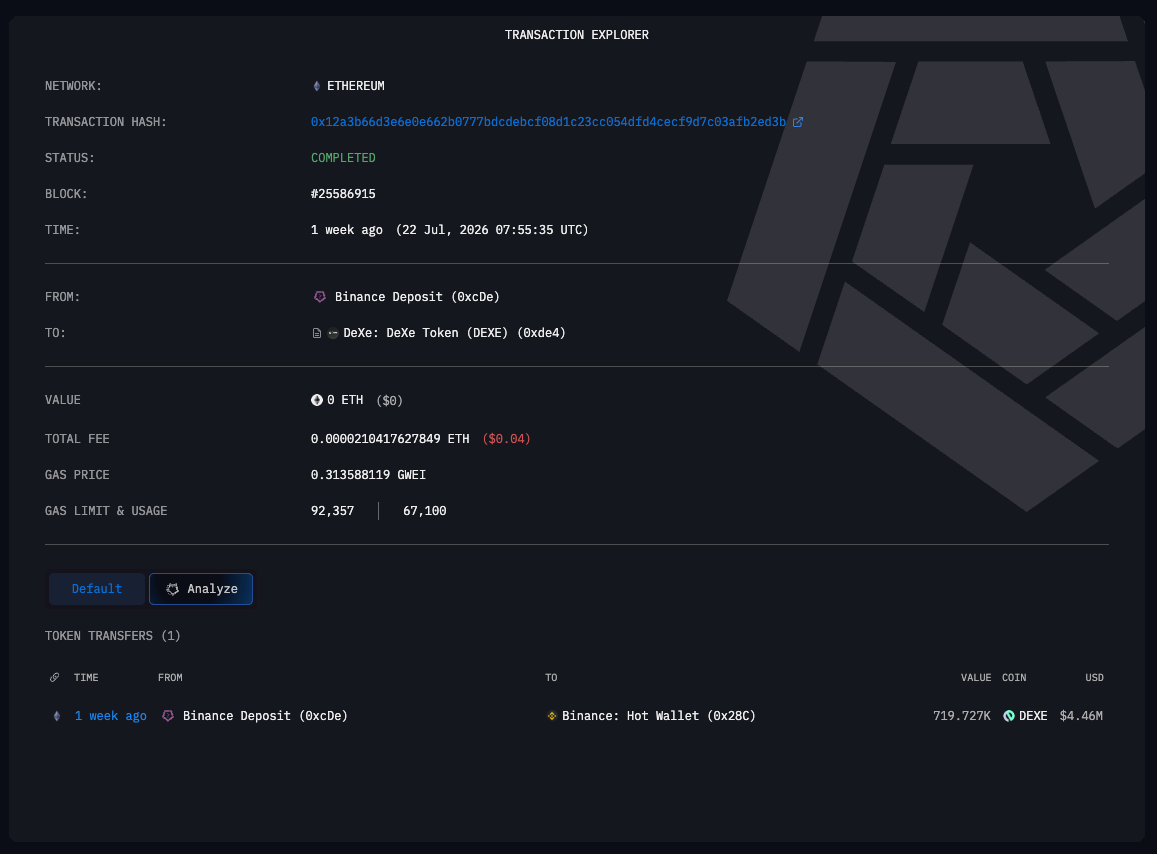
📅 On July 22, 15:42:47, on-chain shows that the Ceffu wallet transferred 719.727K $DEXE to Binance;
📅 On July 22, 16:00, the price of $DEXE completed a round of plummeting, with a price of only $4.
So, who is selling?
First of all, retail investors cannot be the ones. The chips that can genuinely trade DEXE on the order book are incredibly thin, with the vast majority locked in DAO treasuries, team contracts, and cross-chain bridges; there are only a handful of independent whale wallets holding over a million dollars. This level of selling pressure cannot be produced by retail investors.
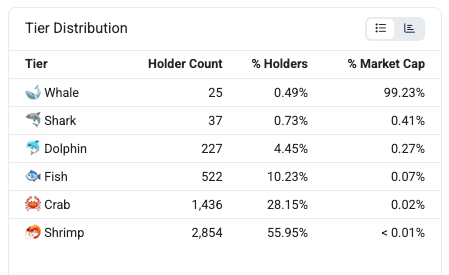
🕵️ Where, then, did the selling money come from? Strictly speaking, all large funds flowing into Binance within the crash window are suspicious. But to create such a level of drop, the selling pressure must come from someone holding a large number of chips.
If we review these suspicious objects on-chain, the situation becomes clear:
🔹 A transfer of 900K, moving from Binance cold wallet to hot wallet, both ends being its own address. Internal dispatch, purpose unclear, temporarily a question mark.
🔹 An external whale moving money from their wallet to Binance? Nothing found on-chain recently for amounts over a million.
Filtering down to the end, only Ceffu remains, one outside the exchange system, with over 97% of the original holding amount flowing out on-chain. Moreover, this is not the first time it has acted.
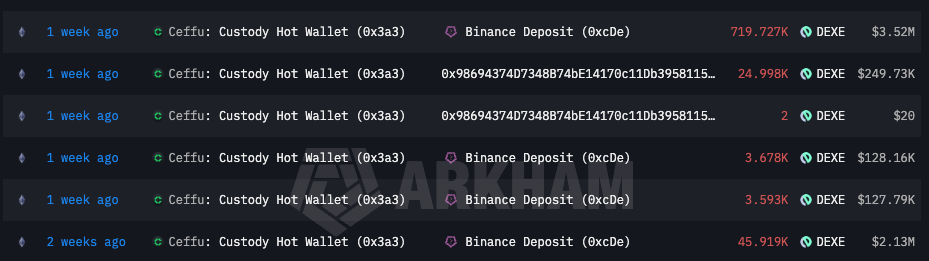
An on-chain analyst noted that long before this crash, around July 12-13 when $DEXE reached its historical peak, the custodian Ceffu had made multiple large transfers to Binance. However, the most striking transaction occurred right after the crash.
Part 03
Opinions are divided online, but no one can provide a definitive conclusion. Back and forth, it’s all "possible" and "speculation,” some statements are rife with loopholes.
Ultimately, there is no evidence to prove whether Ceffu's behavior in this tragedy was normal liquidation based on rules or if someone maliciously exploited the time difference of MirrorX.
If it is the former, then $DEXE first plummeted, broke the red line triggering Falcon's liquidation, and Ceffu sold the collateralized $DEXE as per rules. In this case, the liquidation occurs during or at the end of the plunge; even if MirrorX is used, the harm to retail investors is limited — the coin is already dropping, retail investors can see it, and those who should run away will run. However, as the market maker for $DEXE, why did DWF take no action and remain silent during this situation? This raises deep questions.
But if it is the latter, the nature changes. Someone exploited MirrorX’s time difference of "first trading on the order book, then T+1 settlement on-chain," crashing the coin and burying retail investors. By the time the on-chain traces appear the next day, the people have already gone cold. This is the real malicious harvesting. And MirrorX is exclusively for Binance institutional clients, so which institution is it exactly? Those in the know understand.
To be honest, the reason this matter remains unclear is still due to the mechanism of MirrorX. (This is also a key reason KOLs primarily suspect it was a malicious attack.)
It is inherently a "black box." In the exchange, positions are mirrored, allowing for order book trades first, with on-chain T+1 settlement, thus normal custody withdrawals and post-plunge settlements appear identical on-chain. In other words, as long as one goes down the path of Ceffu custody, the ultimate outcome — whether normal or malicious — cannot be distinguished by outsiders.
Regardless of whether it is the first possibility or the latter, the ever-present figure in the middle, frequently criticized by the market but continuing its own course, is still the familiar face of DWF. In this storm, it stands at the top of the food chain, likely the first to pick up the largest benefits while leaving the mess to those discarded pieces (projects and retail investors), the behind-the-scenes winners.
Part 04
Thus, at the end of this bloodbath, it is impossible to identify the true culprit. But there are four questions that must be asked.
These four questions are not only for the retail investors involved in this incident, but also for the future of the entire industry.
First question of truth: Why did DEXE crash?
From an abnormal surge to a cliff-like drop, then to that late huge transfer... what exactly happened throughout the process? Which transactions, decisions, and mechanisms contributed to this tragedy?
Second question of responsibility: Who should be held accountable for this tragedy?
When MirrorX enables institutions to trade on the order book first and then go on-chain the next day, when abnormal selling pressure cannot be perceived in real-time by retail investors, and when everyone only understands what happened after the crash ended, should Ceffu — the owner of this mechanism — come out and explain something? And should DWF, the market maker for DEXE and the core investor in Falcon, clarify what role it played in this entire incident?
Third question of governance: Why should such players sit at the poker table?
Investing in projects with one hand and providing market-making with the other, now deeply binding with the collateral platform, one institution monopolizes the table without ever establishing firewalls against conflicts of interest. What gives a role like DWF the right to be both referee and player, while not having to disclose a single word to the market?
When the platform's rules and institutional privileges extend far beyond what ordinary investors can understand or verify, who can still play at such a table?
Fourth question of value: Is Crypto still adhering to its original principles?
Crypto is deemed "superior" to traditional finance not because it operates on-chain, but because it promised a public, transparent, and verifiable market. However, if key transactions cannot be verified in a timely manner and critical relationships cannot be understood, leaving ordinary people to rely on institutions to "open their mouths to explain" the truth, then is this decentralization, transparency, and verifiability truly the baseline all share, or merely a slogan shouted for outsiders?
DEXE needs an explanation, and this market needs an answer!
免责声明:本文章仅代表作者个人观点,不代表本平台的立场和观点。本文章仅供信息分享,不构成对任何人的任何投资建议。用户与作者之间的任何争议,与本平台无关。如网页中刊载的文章或图片涉及侵权,请提供相关的权利证明和身份证明发送邮件到support@aicoin.com,本平台相关工作人员将会进行核查。


