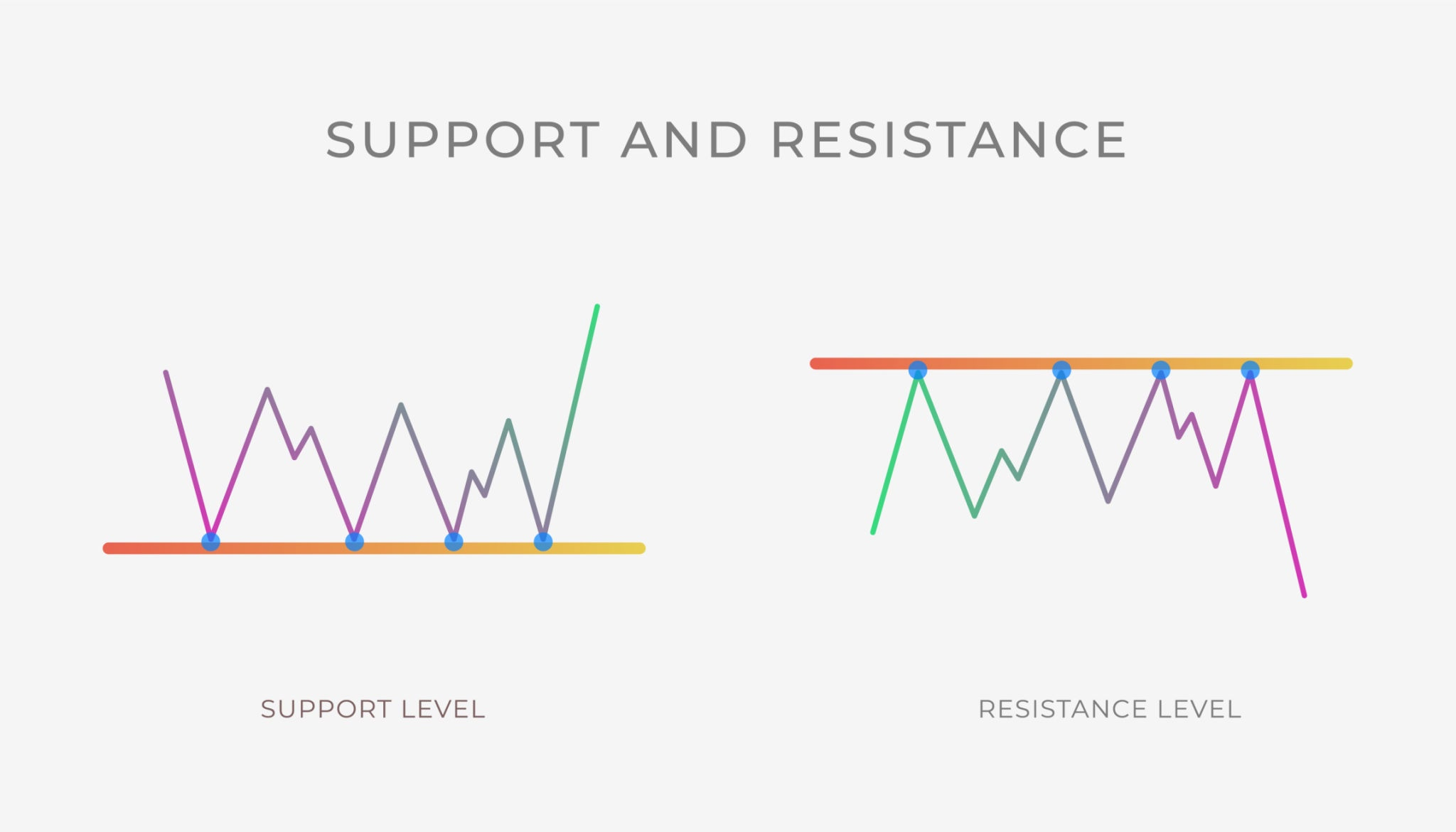
Many people engage in trading, and the hardest part is not actually judging the rise or fall.
Instead, it's the behavior of entering a position after prices have risen and clearly reached a resistance zone, driven by the emotion of "the bulls are back"; when the market retraces, one begins to regret not taking profits earlier.
Last week during a live broadcast in the Language Community, BTC rebounded all the way up to around 67,000, and voices in the market about "the bulls are back" grew stronger.
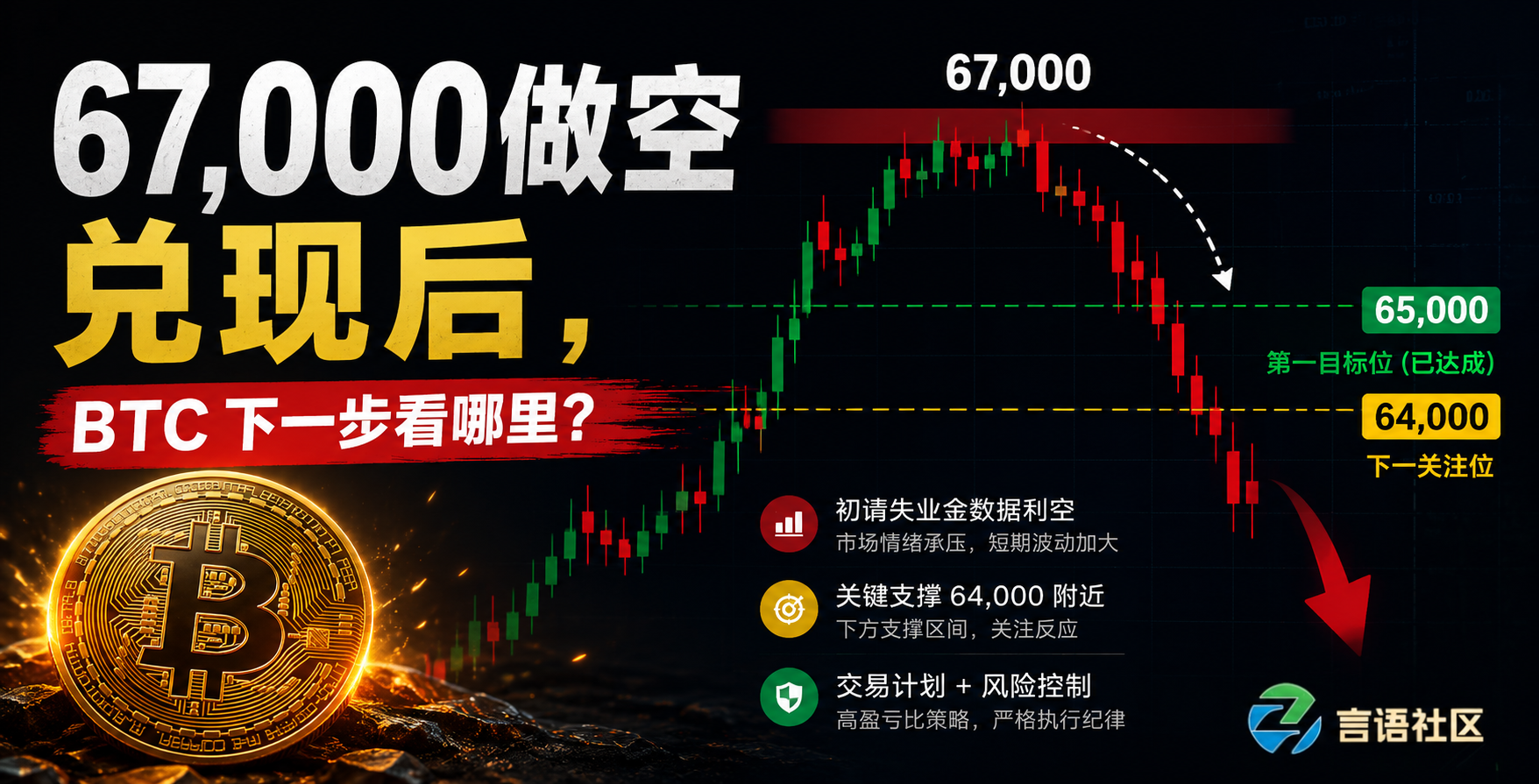
However, our thoughts at that time were clear: Focus on short positions in the 66,700—67,000 area, with defense placed near 68,500.
Subsequently, BTC fell back, and the first target of 65,000 was successfully reached.
This trade was successful not because we guessed the highest point, but because we clearly thought through the resistance zone, risks, and target positions before entering.
After the unemployment claims data is released tonight, the market will experience fluctuations again. How will the market move next? This article will revisit the core logic discussed in the live broadcast of the Language Community.
1. Why near 67,000?
Many people see a profitable trade and only ask:
“How did you know it would fall?”
But the truly important question is:
If the market continues to rise, what is the maximum loss for this position? If the market retraces as expected, what is the potential profit margin?
We chose to focus on short positions around 66,700—67,000 primarily for the following reasons.
1. There is clear resistance above
From the previous market structure, the area around 66,700—67,000 has already entered a zone of dense prior transactions and volatility.
Once prices rebound to this level, to continue breaking upwards, stronger buying support is needed.
If there isn’t sufficient incremental capital, profit-taking and selling pressure can arise above, which may lead to a retracement.
So, it’s not about “shorting as soon as it hits 67,000,” but rather recognizing an area worth observing for resistance.
2. The risk boundary is clear
At the time, the defense level was set around 68,500.
This means that before entering, we knew:
If the price effectively breaks through the resistance above, it indicates a potential error in the original judgment, necessitating a timely adjustment.
On the downside, we could look at levels around 65,000 and 64,000.
Trading does not require guessing the direction correctly every time.
What’s more important is controlling risk when experiencing losses, and allowing profits to maximize when the market moves favorably.
3. Market sentiment has clearly warmed up
After BTC rebounded from 57,000 to 67,000, market sentiment noticeably warmed.
Previous CPI and PPI data were relatively mild, prompting many investors to trade ahead of expectations of improved liquidity.
However, a rebound does not mean a trend reversal.
When the market starts to widely discuss "the bulls are back," it instead requires more attention to:
Is there enough capital above to push prices for a continued breakout?
In trading, the more consensus there is in sentiment, the more one should be cautious of the potential for counter-moves.
2. What is the market trading after the initial jobless claims data is released?
The initial jobless claims data released tonight showed a relatively strong performance, indicating a degree of resilience in the U.S. labor market.
This could affect the market's judgment on subsequent monetary policy.
If the employment market remains strong, the urgency for the Federal Reserve to loosen policy significantly in the short term may decrease, potentially impacting liquidity expectations for risk assets.
BTC and ETH do not generate interest themselves, so the market will be sensitive to changes in interest rates, U.S. dollar liquidity, and risk preferences.
However, it is also important to distinguish between short-term and long-term.
A weekly data point can affect short-term sentiment, but it is hard to solely dictate larger trend levels.
A pullback after the data release does not mean that prices will continue to drop; similarly, a rebound does not imply that the bearish structure has ended.
Further observation is needed, incorporating inflation, employment, interest rate expectations, and capital flows.
3. Policy expectations also need to be reassessed
Previously, the market held high expectations for the advancement of legislation related to cryptocurrencies.
If there are reversals in policy progress, the previously anticipated positive expectations may cool, and some capital may shift to a wait-and-see approach.
However, policy news typically affects market expectations and does not immediately change price trends.
In the short term, it’s essential to monitor whether relevant advances continue; in terms of price action, it’s vital to observe whether capital continues to flow in and whether critical resistance points can be effectively broken.
News can affect sentiment, but ultimately it comes back to price and capital itself.
4. What key levels to focus on next?
Trading is not about prematurely declaring “where BTC will definitely rise,” nor is it about asserting “the market will definitely drop to somewhere.”
A more practical approach is to prepare strategies in advance for different market movements.
1. 65,000 has been reached, start taking profits
Previously, we focused on short positions around 66,700—67,000, and the first target of 65,000 has been reached.
If there are already profits, consider taking partial profits to lock in some gains.
The remaining positions should be held according to one’s risk tolerance, while moving the defense level down.
Don’t let a profitable trade turn into a loss.
2. Pay attention to 64,000 area below
If BTC continues to weaken below 65,000, the area around 64,000 will become the next major level to observe closely.
However, reaching support does not guarantee a rebound.
It is necessary to assess trading volume, candlestick structure, and short-term trends.
3. If it strengthens again, observe the resistance above
If BTC re-establishes itself above 66,000 and continues to advance towards 67,000, we need to observe whether it can effectively break through.
If the price can hold after breaking, the original bearish view needs to be reassessed.
The market will not follow our bearish expectation just because we held that view.
Recognizing deviations and adjusting promptly is more important than stubbornly holding on.
5. How to observe if looking for a short-term rebound?
The Fibonacci retracement tool was also mentioned during the live broadcast.
From a smaller timeframe perspective, the area around 65,000 and 64,900—65,000 is a key area to watch for short-term trading.
If prices pull back to this level and show signs of stabilizing, consider lightly participating in the rebound.
However, the most important aspect of short-term trading is discipline:
- A rebound does not equal a trend reversal.
- If there are profits, they can be taken in portions; do not allow a short-term trade to evolve into a long-term hold.
- If the price continues to fall below critical levels, be sure to cut losses according to plan.
Participation in short-term trades is possible, but position and risk must surely be matched.
6. Why do many people always "make small profits but incur big losses"?
During the live interaction, many friends mentioned:
When they make a profit, they can't hold on, but after incurring a loss, they always think, “just wait a little longer.”
This problem often isn’t due to inadequate skills, but rather an incomplete trading plan.
1. Mistaking normal fluctuations for trend reversals
Support and resistance usually are not precise points but rather areas.
For example, resistance around 67,000 can fluctuate hundreds of points above and below.
If one is trading short to medium term but is fixated on 5-minute or 15-minute candlesticks, it's easy to be influenced by normal fluctuations and exit early.
Before entering a trade, one should clearly think about:
Are they trading short-term or swing trading?
Different timeframes come with different tolerances for fluctuation.
2. Using holding positions instead of stop-losses
Some people have previously managed to turn a losing position into a profitable one by holding, so they begin to believe:
“As long as I don’t sell, I won’t lose.”
However, the market does not always offer opportunities.
An extreme market event could wipe out all the previously accumulated profits, even impacting the principal.
Stop-losses do not signify admitting failure.
They merely set a limit on how much a trade can lose at most.
Consistent trading success is not about making money on every trade, but about controlling losses and allowing profits to expand.
7. The Language Community is developing quantitative indicators
Many friends have also asked:
When there are no regular live broadcasts on Mondays, Wednesdays, and weekends, how should the market be observed?
Currently, the Language Community is organizing and coding some of the trading logic used in live broadcasts, attempting to develop a set of quantitative indicators to assist in judgment.
After continuous testing, it will gradually be open to community members.
We hope to help everyone identify key areas, trend changes, and risk positions in the market through a more intuitive approach, reducing emotional trading.
However, it needs to be clear:
No indicator is an "automatic money-making machine," nor can it replace position management and stop-losses.
Indicators are meant to provide reference; trading plans need to be crafted by oneself, and risk must be controlled personally.
Finally
The short position near 67,000 has completed its first phase target.
However, the conclusion of a trade does not signify that the market has provided a final direction.
Going forward, continue to focus on the performance around 65,000 and 64,000, while also paying attention to macro data, market liquidity, and capital changes at key levels.
The market changes daily, but some principles in trading remain constant: Think through risks before entering, protect profits in a timely manner after making gains, and adjust according to plans when judgments deviate.
The Language Community holds live review sessions every Tuesday and Thursday at 20:00, focusing discussions around market hotspots, market structure, and key positions.
Live broadcast link:https://meeting.tencent.com/p/9850662513
Live meeting number: 9850662513
During non-broadcast periods, the community will also continue to update market observations and strategic thoughts. If you wish to follow subsequent live broadcasts, obtain market interpretations, or participate in community discussions, you can join the Language Community via the link below.
Community link: https://qm.qq.com/q/OLIZgoEwgA
This article is an arrangement of content from the Language Community live broadcast and a sharing of market perspectives. It does not constitute any investment advice. The prices of digital assets are highly volatile; please participate cautiously based on your own risk tolerance, and ensure proper position management and risk control.
免责声明:本文章仅代表作者个人观点,不代表本平台的立场和观点。本文章仅供信息分享,不构成对任何人的任何投资建议。用户与作者之间的任何争议,与本平台无关。如网页中刊载的文章或图片涉及侵权,请提供相关的权利证明和身份证明发送邮件到support@aicoin.com,本平台相关工作人员将会进行核查。