Written by: imToken
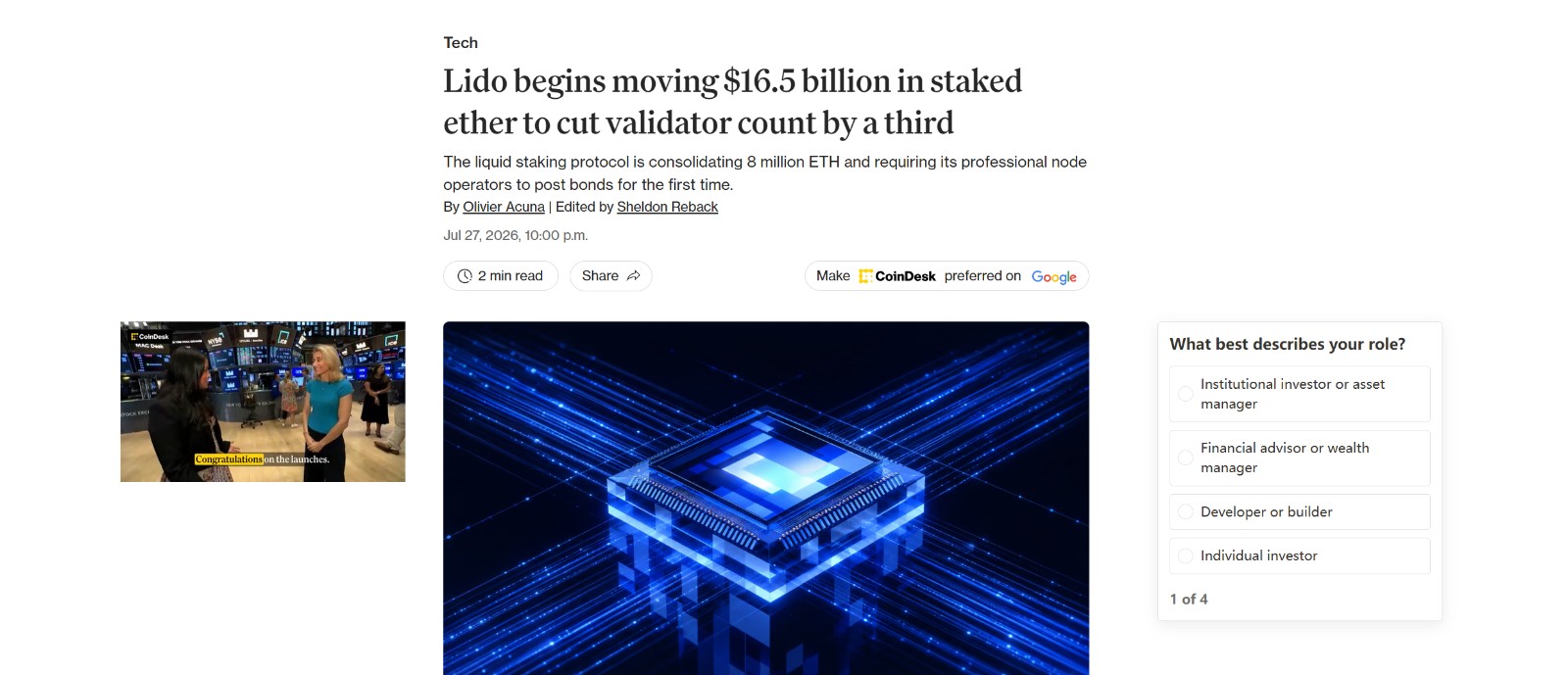
Recently, there has been a major news story overlooked by the market, which is that Lido is "moving" over 8 million ETH (about $16 billion).
Of course, this is not about transferring funds from Lido to another new protocol, but rather about gradually migrating hundreds of thousands of traditional validators supporting stETH into a new validator architecture launched after the Pectra upgrade.
According to Lido's plan, over 265,000 validators using the old 0x01 withdrawal credential will be successively merged into fewer validators with higher balances using the 0x02 credential. After the migration is completed, the number of validators on the Ethereum network is expected to decrease from about 880,000 to approximately 628,000, a reduction of nearly one-third, and the number of proof messages that need to be propagated each Epoch may also decrease by about 29%.
This will not directly lower the Gas fees paid by ordinary users, nor will it suddenly speed up transaction confirmation times. In fact, to complete the migration, Lido estimates that the temporary rewards loss caused by migration is roughly equivalent to 0.28% of the protocol's annual staking rewards.
So, since the increase in returns is limited, and the migration itself has costs, why does Lido still push for this "move" worth tens of billions of dollars?
The answer lies in an important change brought about by the Pectra upgrade in May 2025 – compounded validators.
1. What is Lido "moving" with 8 million ETH?
On May 7, 2025, the Pectra upgrade officially launched on the Ethereum mainnet.
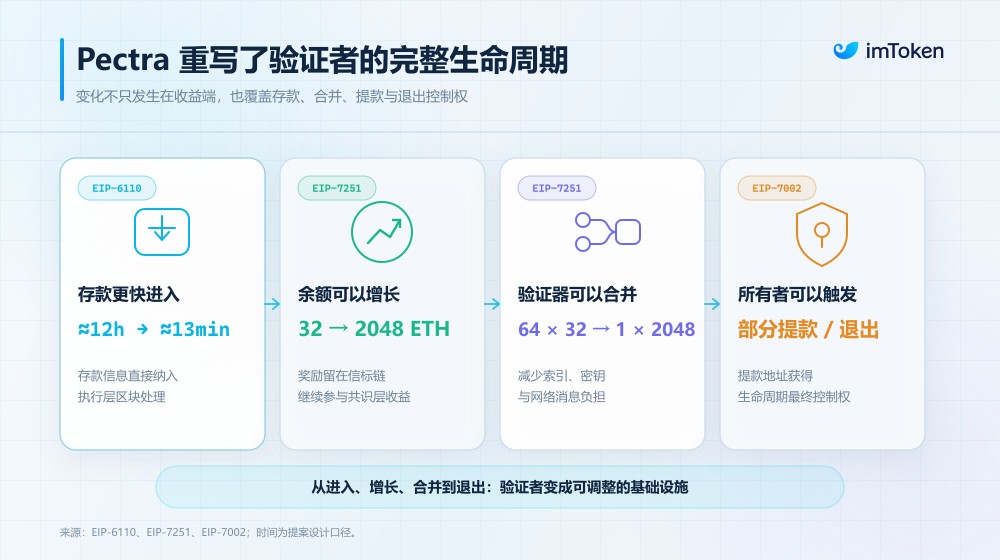
Among them, EIP-7251 raises the maximum effective balance of a single validator from 32 ETH to 2048 ETH and introduces withdrawal credentials starting with "0x02". Validators using the new credential can retain their consensus layer rewards in the beacon chain balance, gradually increasing their effective balance and generating new yields, hence they are also called "compounding validators".
On the surface, this just writes "automatic reinvestment of rewards" into the protocol, but the deeper change lies in breaking the long-standing fixed structure of Ethereum validators being 32 ETH.
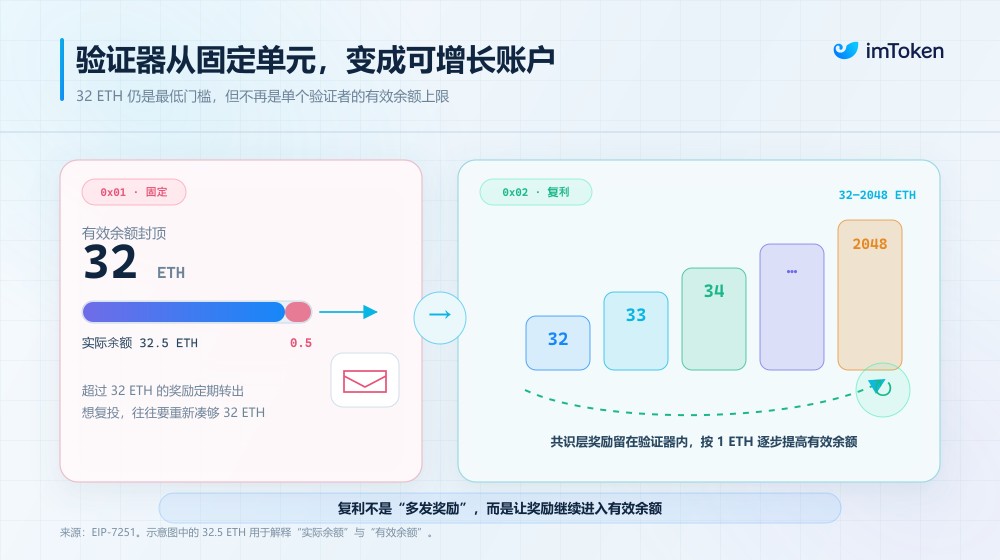
As we all know, the effective balance limit for Ethereum validators has always been fixed at 32 ETH. Whether it later grows to 33 ETH or higher, the actual effective balance that participates in the calculation of consensus rewards always remains capped at 32 ETH. Any excess portion does not continue to increase its validation weight but is periodically transferred to the execution layer’s withdrawal address.
For individual stakers who operate only one or a few validators, if they want the rewards to continue participating in native staking, they must gather scattered rewards from different validators again to reach 32 ETH. The reinvestment threshold is relatively high, and small balances may remain outside the staking system once transferred to the withdrawal address.
At the same time, for Lido, major exchanges, and professional staking service providers, while they can aggregate large volumes of scattered rewards from many users and quickly gather a new 32 ETH, they also face another cost – for every additional 32 ETH, they usually need to create and maintain a new validator.
As Ethereum's staking scale continues to grow, the number of validators is also expanding, leading to increased operational maintenance costs from the rising index, keys, signatures, and proof messages.
The introduction of EIP-7251 aims to change this structure.
In the new 0x02 model, the minimum threshold for starting a validator remains at 32 ETH, but the maximum effective balance of a single validator has increased to 2048 ETH, meaning that awards no longer need to be automatically transferred out but can remain within the validator, continuing to increase the effective balance and generate new yields.
Meanwhile, several original validators can be merged; for instance, 2048 ETH originally distributed across 64 validators can be consolidated into one high-balance validator, with the overall staking weight unchanged, but the number of validators, keys, and network messages that need to be maintained significantly reduced (see also: A Year Later, "Lean Ethereum" Resumes: What Does Ethereum Want to Deliver?).
Ultimately, funds do not exit Ethereum, and the economic security they provide does not diminish, but operational burdens decrease significantly.
Lido is pushing for this kind of consolidation.
So, strictly speaking, the "compounding" in compounding validators actually only explains half of its value; the other half lies in the fact that validators can finally be recombined from a large number of standardized 32 ETH small units into a more streamlined infrastructure better suited for large-scale operations.
2. What kind of yield improvements can be achieved?
Interestingly, from a yield perspective, the improvement brought by compounding is not evenly distributed.
Theoretically, both individual stakers and large institutions can reduce idle balances with 0x02, allowing rewards to participate more directly in subsequent staking, but due to the differing fund management capabilities of different participants, the marginal gains from the upgrade are not the same.
The paper "When Staking Rewards Compound: Measuring the Impact of Ethereum's Pectra Upgrade," released in June 2026, compares the yield performance of 0x01 and 0x02 validators.
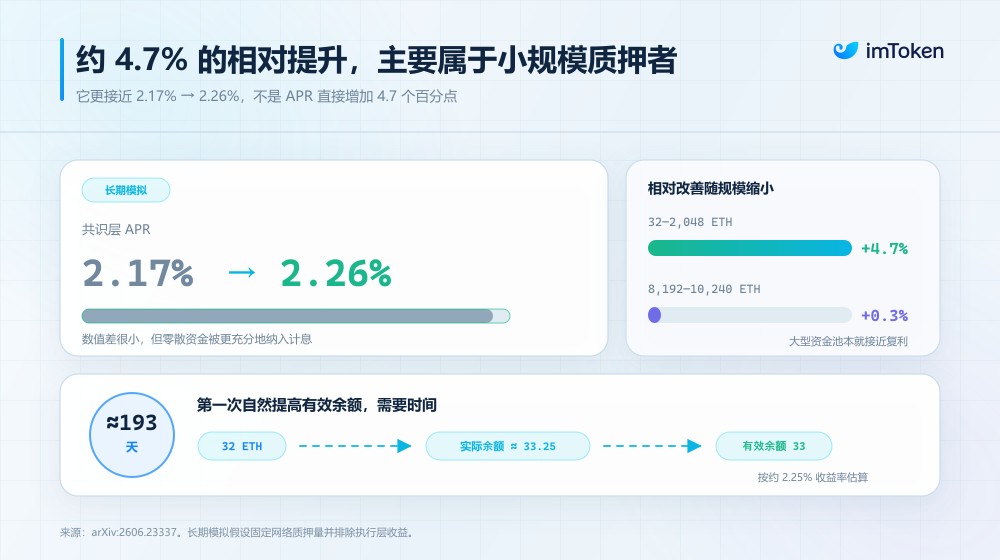
Simulation results show that in the balance range from 32 ETH to 2048 ETH, the consensus layer APR of 0x01 validators averages about 2.17%, while that of 0x02 validators is approximately 2.26%, indicating a relative improvement of about 4.7%. However, as the staking scale reaches 8192 ETH to 10240 ETH, the relative difference between the two narrows to about 0.3%.
It is particularly important to note that the "about 4.7%" mentioned in the paper does not mean the APR directly increases by 4.7 percentage points; rather, it indicates a relative improvement of about 4.7% based on the existing consensus layer APR of approximately 2% to 3%.
And the reason that smaller-scale stakers see more pronounced improvements is not that they have some exclusive yield, but that they have historically found it more challenging to reinvest.
For example, a user with only one 32 ETH validator would need to continue accumulating rewards for a long time after they are automatically transferred to the withdrawal address, or combine them with other funds, to reach 32 ETH again and activate the next validator. Any insufficient portion under 32 ETH remains scattered across different addresses, naturally resulting in a low intention to aggregate.
However, 0x02 validators allow these funds to continue increasing the effective balance within the same validator, thus reducing idle funds created by the "under 32 ETH" issue. Ultimately, what smaller-scale stakers were previously missing was not only the desire to reinvest but also the capacity to reinvest scattered ETH back into native staking.
Large staking service providers can also benefit from native compounding, but they already have stronger fund aggregation capabilities, allowing them to quickly gather new 32 ETH and launch the next validator. From the perspective of the entire fund pool, they can achieve a funding allocation effect close to compounding.
Thus, the larger the staking scale, the lower the proportion of scattered balances in the total funds, and the marginal improvements brought by 0x02 naturally become smaller.
But this does not mean that 0x02 is unimportant for large institutions.
On the contrary, the core issue faced by large institutions is shifting from "how to allow rewards to continue generating returns" to "how to manage more ETH with fewer validators."
For them, the value of 0x02 is manifested in two aspects: on one hand, rewards can remain in validators for continued compounding, reducing the need for frequent aggregations, redeposits, and validator creations; on the other hand, many existing 32 ETH validators can be merged, significantly lowering the management costs of nodes, keys, and consensus layer messages.
Of course, this change will also bring new trade-offs.
Traditional 0x01 validators automatically transfer rewards exceeding 32 ETH to the withdrawal address without the need to initiate on-chain operations actively; 0x02, on the other hand, by default retains rewards in the validators, meaning that large service providers need to actively initiate partial withdrawals to meet user redemption or liquidity scheduling, and redesign accounting, reward distribution, and fund buffer mechanisms.
Thus, for small-scale stakers, the most direct value of 0x02 is lowering the reinvestment threshold and reducing idle funds; for large institutions, while the yield improvement may be smaller, the consolidation of validators and the efficiency of infrastructure become more crucial.
Both benefit from the same mechanism, but the sources and priorities of their returns differ.
3. The Changes and Constants in the Ethereum Staking Ecosystem
Therefore, if viewed solely from the APR perspective, Lido's migration does not seem like a particularly enticing business.
After all, the yield improvement that large service providers gain from compounding might be less than 1%, and there will be brief reward losses during the migration process, along with the need to adjust the existing accounting, withdrawal, and liquidity management systems.
Nevertheless, Lido has still decided to promote this largest core architecture upgrade since the 2023 V2. This is because, once the funds managed by the protocol reach over 8 million ETH, the number of validators begins to become a cost in itself.
Especially after the Pectra upgrade, a 2048 ETH validator can carry a staking weight equivalent to 64 traditional validators, which means more capital can be managed more efficiently with fewer validators.
In fact, Lido’s upgrade is not just about merging validators.
After migrating to Curated Module v2, its professional node operators will need to lock ETH as collateral for the first time. If there is an interruption in operation, penalties, reward mismatches, or other attributable issues, the collateral can be used to cover losses.
In the past, Lido's selected node operators primarily relied on historical performance and reputation to gain trust; now, while reputation is still retained, an additional layer of real capital constraints is introduced. The existing 34 selected node operators are expected to migrate to CMv2 and have not chosen to exit due to collateral requirements.
This change might be more noteworthy than compounding itself and signifies that the standards for staking competition after Pectra are undergoing structural changes, meaning that future staking services may differ more in how they enhance effective fund utilization, manage withdrawals and liquidity, allocate validator risks, and achieve a balance between asset control, operational complexity, and returns.

For user entry points such as wallets, the value is no longer just showing users a yield number; it is essential to help users see the funding paths and risk structures behind different staking methods. For instance, with imToken Stake:
- Currently, users can directly enter the staking function from the ETH asset page, selecting corresponding services based on fund size and needs. For users looking to participate with a smaller amount, integrated staking services within the wallet can complete the operation;
- For users holding over 32 ETH who wish to retain asset control, they can opt for non-custodial validator solutions that allow them to participate in Ethereum native staking without maintaining nodes themselves;
As compounding validators gradually become more mainstream, the content that such entry points need to present will also increase, such as whether rewards are automatically reinvested, when rewards can be withdrawn, which withdrawal credentials are used by validators, who controls the funds, and what technical and liquidity risks different solutions may bear.
This also means that wallets no longer connect to just a Staking yield page but to a set of increasingly differentiated validator services.
Final Thoughts
Overall, from The Merge to the Shanghai upgrade, and then to the Pectra upgrade, Ethereum is gradually completing the life cycle of staking.
The Merge positioned validators as the core of network security, the Shanghai upgrade resolved issues regarding how to exit staked funds, while the Pectra upgrade began to further optimize how funds enter, accumulate, and reorganize.
Of course, compounding validators will not yield equal improvements for all participants:
- For small-scale stakers, it can reduce idle balances and allow the long-held ETH to participate more fully in consensus;
- For large institutions, their more significant value may not be in increasing APR but in reducing the number of validators and operational burdens.
Thus, the migration to 0x02 validators will inevitably be gradual, with different participants choosing to either retain their existing validators or gradually shift to the compounding model based on their fund size, liquidity needs, and operational structure.
However, the way Ethereum organizes staking capital is undergoing structural changes step by step, especially as validators are no longer fixed at 32 ETH. The staking ecosystem is also starting to shift from standardized yield products to more segmented fund management and infrastructure competition.
This is a paradigm shift in Ethereum Staking that is worth tracking in the long term.
免责声明:本文章仅代表作者个人观点,不代表本平台的立场和观点。本文章仅供信息分享,不构成对任何人的任何投资建议。用户与作者之间的任何争议,与本平台无关。如网页中刊载的文章或图片涉及侵权,请提供相关的权利证明和身份证明发送邮件到support@aicoin.com,本平台相关工作人员将会进行核查。


