
The financial boundaries between countries seem complex, but when it comes to individual accounts, it often boils down to just a button.
After June 12, 2026, users of the largest Chinese brokerages, Futu and Tiger, opening their US stock brokerage accounts will find their holdings and assets still intact, and they can sell and transfer funds, but they will be unable to recharge, buy, or increase their positions.
When capital begins to show a tendency to detach from state control, the first restrictions imposed by tightened regulations are often on personal choices and the space for asset allocation.
This recent clean-up of cross-border brokerage US stock operations in China harks back to the crypto crackdown nearly a decade ago. Both actions have fully tightened financial exposure that has a long-term adverse impact on local liquidity, clearly delineating the asset channels for onshore users.
For many Chinese families, this channel does not only fulfill investment needs. As wage growth slows and the value of Chinese real estate plummets, allocating to global quality enterprises might be one of the few remaining avenues to change the wealth trajectory of Chinese families in the next twenty years. Now, this path is also beginning to narrow.
China's Capital Great Wall
The "Comprehensive Plan for the Rectification of Illegal Cross-Border Securities, Futures, and Fund Business Activities" jointly issued by eight departments including the China Securities Regulatory Commission states clearly: all illegal cross-border investment activities will be completely shut down within two years, and starting today, no new accounts may be opened, and capital inflows are prohibited; only existing capital can be fully withdrawn within two years, and all supporting facilities and services related to cross-border investment, including information exposure on domestic networks, are also fully prohibited aside from financial services.
At the same time, Futu and Tiger were each fined 1.85 billion (270 million USD) and 410 million (60.7 million USD) yuan, with their stock prices plummeting by 45% and 30% respectively in pre-market trading, marking the official end of the era when Chinese users could trade US stocks with regulatory leeway.
In fact, this is not a single sudden event; China has been gradually tightening the paths for legal RMB outbound investments over the years, starting with warnings to brokers:
- 2021/11: The China Securities Regulatory Commission interviewed senior executives of Futu (FUTU) and Tiger (TIGR).
- 2022/12: Both companies were classified as illegally operating and prohibited from opening new accounts in the mainland.
- 2023/5: The app was removed from mainland app stores.
- 2026/5: Official investigations were initiated + joint rectification by eight departments.
To maintain the RMB exchange rate and autonomy of monetary policy, capital controls have long been a strategic framework for China to counter dollar hegemony, with restrictions on cross-border investment being just one aspect. The goal of the Beijing authorities is clear: money made within China should benefit the local economy and cannot flow out indefinitely.
Any financial activity contradicting national strategy, even if it involves the best domestic innovative companies, the priority of Beijing authorities is always financial stability and the power of onshore currency over everything:
- Complete ban on cryptocurrency: Compelling Chinese miners holding advanced data center designs and energy integration capabilities to go abroad; forcing the world’s largest crypto to go offshore.
- Intervention in Byte’s sale of TikTok in the US: Compelling Byte to divest its best assets and indefinitely postpone its parent company's IPO plans.
- Veto of Manus's acquisition: Compelling Manus to seek support from Chinese local capital and explore the possibility of going public on the Hong Kong stock exchange.
Strict regulations not only limit capital flows but also block critical resources such as technology, talent, data, and supply chains from moving abroad. Keeping these core elements onshore and supporting local enterprises with domestic funds is crucial for enhancing national competitiveness from the ground up.
In the last round of globalization, China could rely on manufacturing supply chains to stand out; but in the AI era, China is not only facing OpenAI and Anthropic but also technology giants like Nvidia, Microsoft, Amazon, and Alphabet, which have experience from the dot-com bubble. They not only have decades of technological accumulation but also enjoy the backing of the vast US capital market, likely differing from Chinese enterprises by more than two orders of magnitude in financing and leveraging capabilities. Therefore, keeping liquidity and private capital onshore and concentrating funds to support local tech companies is an urgent necessity for China.
The strong regulatory rectification, along with a series of support measures for Hong Kong and A-share tech innovation boards, strategically encourages enterprises with core technologies and data sensitivity to prefer listing on A-shares or in Hong Kong rather than issuing ADRs in the US. As a result, Chinese entrepreneurs are beginning to follow Beijing’s choice of “the East rises while the West sets” in capital operations: In 2025, Hong Kong's total IPO amount was approximately 285 billion HKD (36 billion USD), reclaiming the title of the largest globally since 2019, far surpassing Nasdaq’s 27.5 billion USD. The proportion of companies listed on both A-shares and Hong Kong's stock exchange has also been continuously rising, reaching nearly 60% by the first half of this year.
Press enter or click to view image in full size
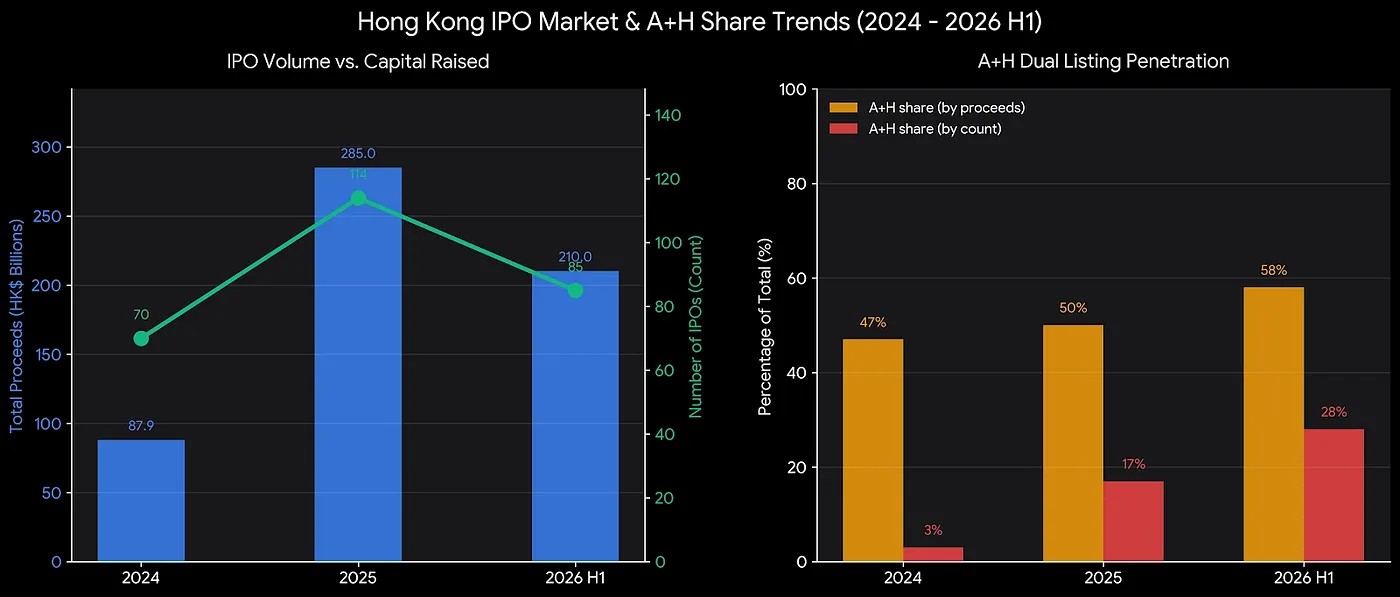
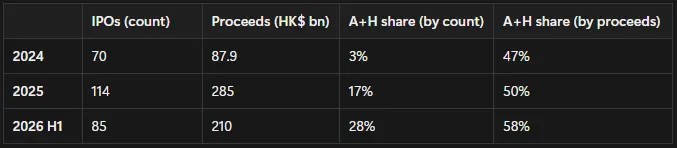
It is evident that the Hong Kong Stock Exchange is being developed into a center for Chinese enterprises to absorb global liquidity, while firmly holding governance in Chinese hands.
Therefore, this comprehensive withdrawal of US stock brokerages is not only to block domestic funds from continuously providing valuation premiums to the US capital market. Against the background of China having missed the AI industry first-mover advantage, the strategic significance represented by this step may far exceed all past capital control measures.
Anxious Chinese Retail Investors
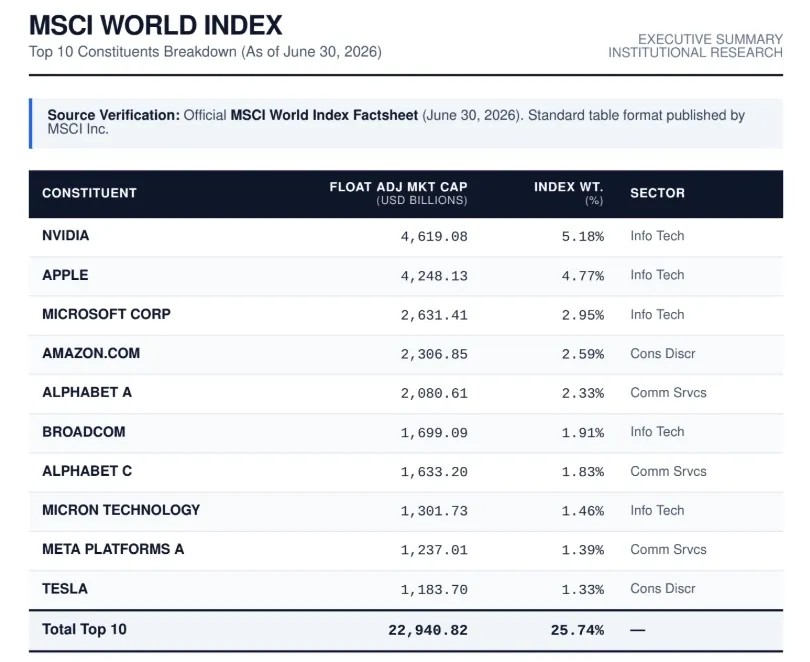
According to the MSCI World Index factsheet at the end of June 2026, the top ten constituents accounted for 25.74% of the index weight, almost all of which are US technology and AI-related companies. These companies control AI computing power, cloud platforms, chips, advertising networks, operating systems, consumer entry points, electric vehicles, and satellite internet, all the ownership of future cash flows concentrated in a few companies. This extreme concentration leads to a "siphoning effect" of global passive funds. Because passive index funds are strictly configured according to market capitalization, in any new global liquidity influx (such as pension fund contributions or sovereign wealth fund allocations), nearly 26 USD flows mechanically into these 10 US tech companies for every 100 USD. This further increases their valuation premium, granting them nearly unlimited low-cost financing advantages in the real world to acquire, research and ultimately lock down future core digital and physical assets.
Get Wildon Wu’s stories in your inbox
Join Medium for free to get updates from this writer.
Remember me for faster sign in
When a quarter of global economic growth is captured by these companies, ordinary Chinese people have no simple means to grasp this most conspicuous era beta.
Press enter or click to view image in full size
The industrial distribution of Chinese A-shares is entirely different. Historically, the financial sector (Financials) has long held a dominant position in the CSI 300, with its weight often maintained between 20% and 30%. However, at the end of 2025 and the beginning of 2026, the information technology (Information Technology) sector’s weight achieved a historic surpass, officially overtaking the financial sector to become the largest weight industry in A-shares.
Press enter or click to view image in full size
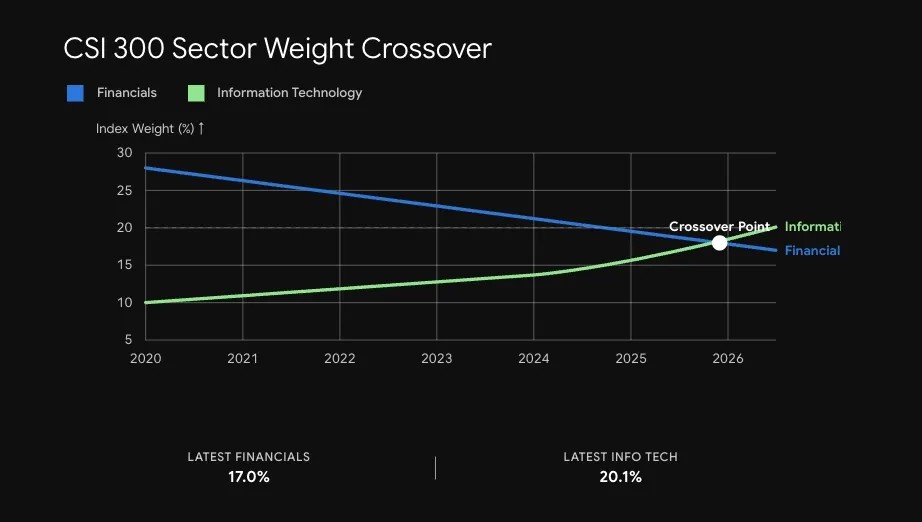
For the past twenty years, the engine of China's economic growth has been "real estate + infrastructure," which requires massive credit expansion. Banks and non-bank financial institutions have become the largest cash flow centers, dominating the index. However, in recent years, the macro structure has undergone fundamental changes, reflecting the resonance between national strategic will with Chinese characteristics and structural liquidity guidance:
- Turning of the credit cycle: With control over local government debt and real estate leverage, the expansion rate of traditional financial sector balance sheets has significantly slowed, and valuation centers have moved down.
- Central bank structural liquidity: In the past year, a large number of structural monetary policy tools (like relending for technological innovation) have been precision-targeted. Liquidity has been directly injected into hard technology, semiconductor domestic substitution, and high-end manufacturing fields.
- Capital pricing for "new productivity": The capital market is re-evaluating for "self-controlled" and "technological self-reliance." Companies in areas such as computing infrastructure, semiconductor equipment, and high-end materials have received extremely high valuation premiums and capital biases.
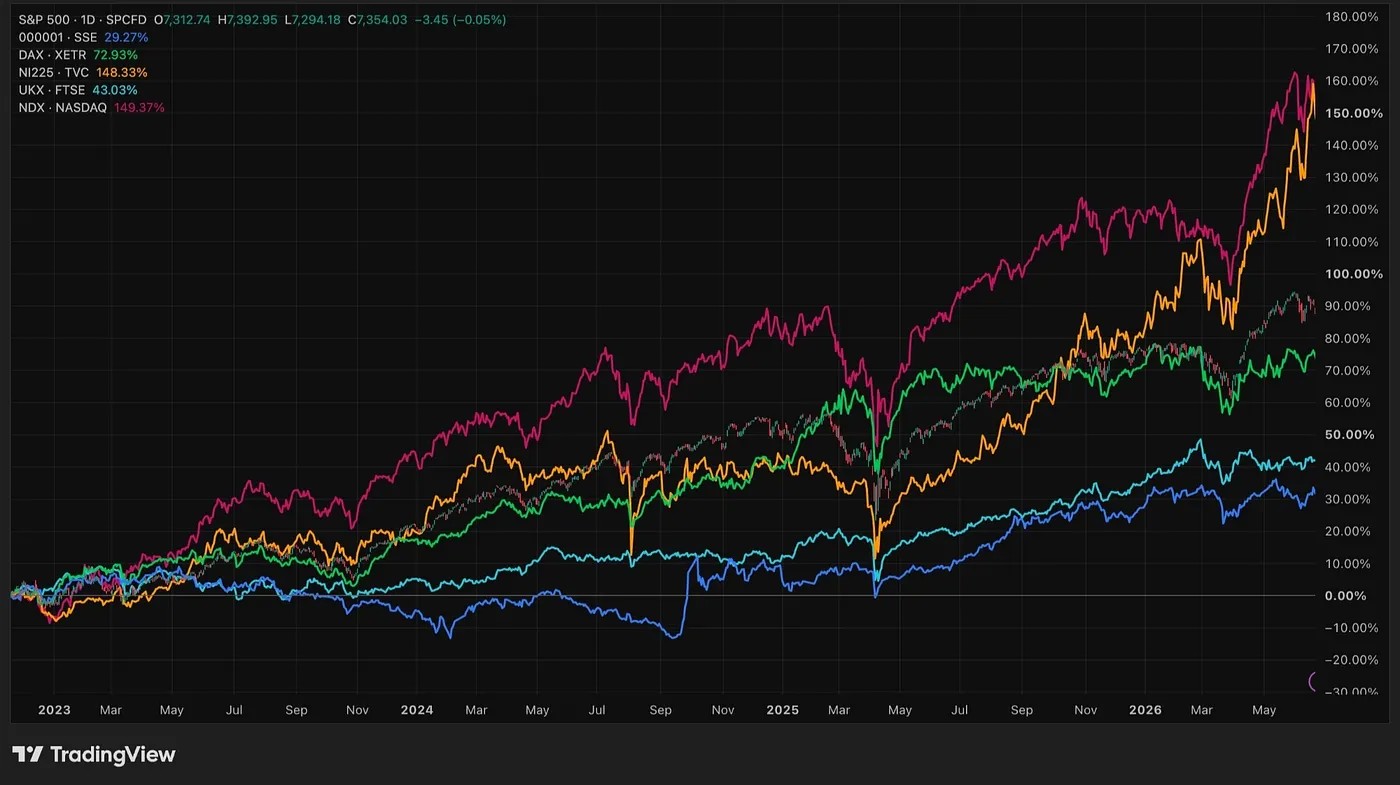
This delayed reaction is reflected not only in the industrial structure in index proportions but also in stock market performance. Since the launch of ChatGPT in 2022, China, as the world’s second-largest economy, has the lowest stock market gains among the top five economies. Chinese retail investors can only hold onto their limited investment quota in their accounts while watching themselves be excluded from the new wealth system.
Press enter or click to view image in full size
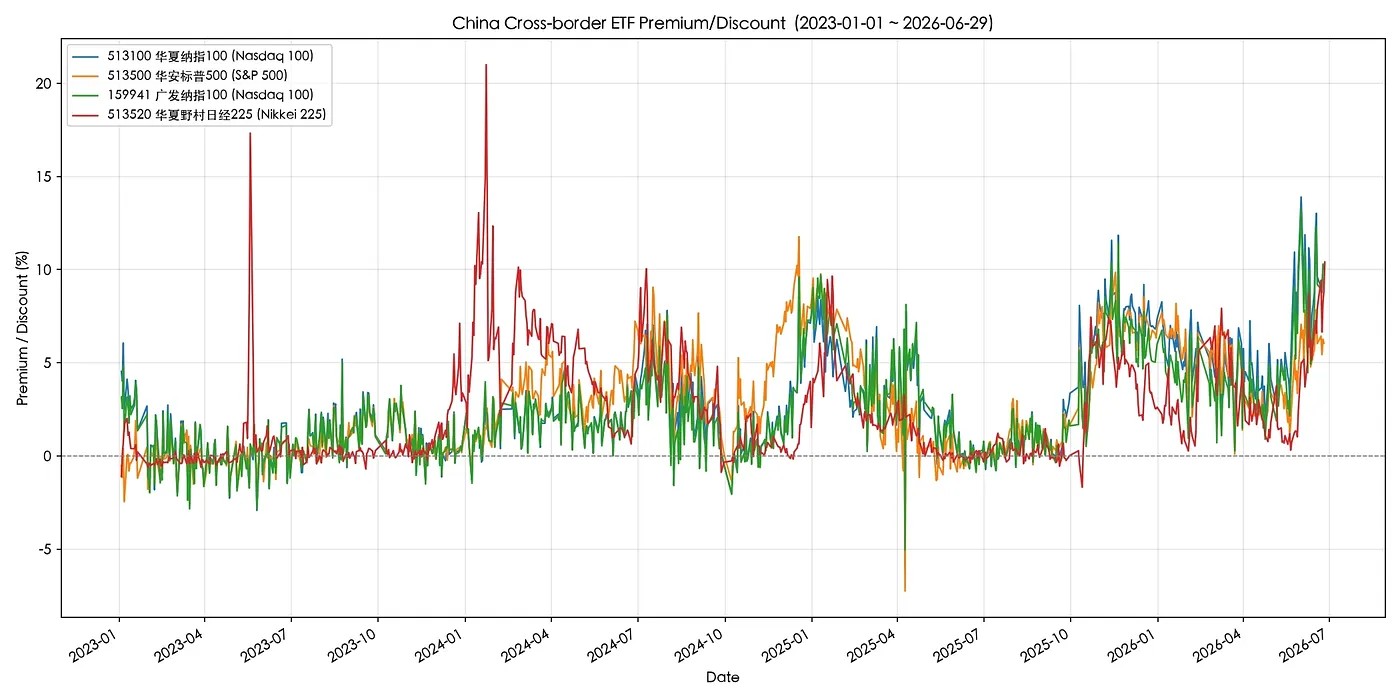
The demand for cross-border investment within China is not merely a so-called "worship of foreign things," but arises from the mediocre performance of local tech companies and the drastic shrinkage of real estate, pushing the relative sense of deprivation in wealth to the peak, resulting in retail investor anxiety. Tracking ETFs of overseas markets have appeared in A-shares this year with premiums as high as 10%.
Press enter or click to view image in full size
From a national perspective, capital controls can prevent domestic liquidity from bolstering foreign enterprises and instead support the growth of “local enterprises,” thereby avoiding the monopolization of the AI supply chain by foreign entities and retaining asset pricing power domestically; however, for individual investors, the country from which quality productive assets originate is not important. They only care about whether they can acquire those targets.
When the demands of the state and the individual diverge, this gap just provides a new development opportunity for crypto.
Brokering the unbrokered
For the past 15 years, the narrative of crypto has been to bank the unbanked: to allow those without bank accounts to access payment, savings, lending, and advanced currency systems. This narrative remains important, but the next frontier opportunity is to enable these unbanked individuals to further enter the distribution system of global core assets.
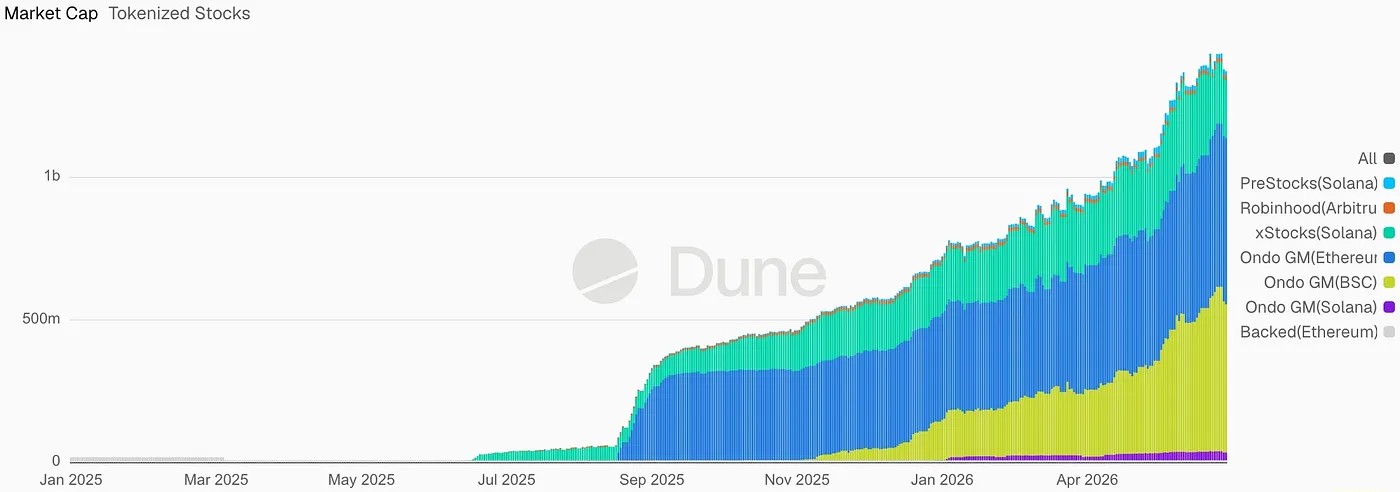
In the past year, the market capitalization of tokenized stocks has grown over 1.3 billion USD. By June 2026, SpaceX drove the monthly trade volume of tokenized stocks to exceed 3.4 billion USD; daily trading in RWA perpetual contracts on trade.xyz even surpassed 6 billion USD.
Press enter or click to view image in full size
Press enter or click to view image in full size
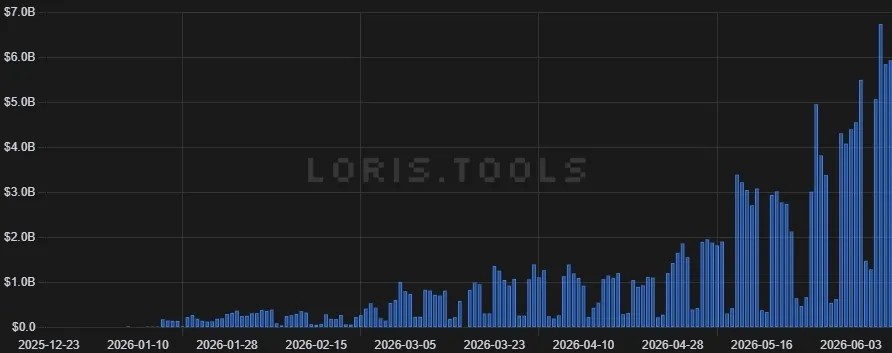
Even though this scale still has a significant gap compared to the traditional US stock market, it is enough to demonstrate that the liquidity of tokenized assets on the blockchain has begun to become more active, accessible to global users, traded around the clock, and continuously priced even when traditional markets are closed.
Given time, these tokenized assets may also be used for collateralization, lending, and forming new asset structures, growing into an alternative asset distribution layer to provide a new brokerage system for those excluded from traditional finance.
Today, the ones being shut out are Chinese retail investors; tomorrow it could be Latin American users without US brokerage accounts, Asian users without accredited investor status, Middle Eastern users limited by their national capital controls, or simply a young person who does not want local financial systems to dictate their asset boundaries. Hence, the next big opportunity for crypto might not be about creating a faster wallet or a cheaper exchange, but rather about developing new asset entry points, repackaging, pricing, and distributing global productive assets.
Capital Flows in the AI Era
In the AI era, brokering the unbrokered works both ways.
This also applies to businesses, as those who can secure future capital investments, scarce physical resources, and market attention globally ahead of their competitors will be more likely to establish a competitive moat first. US companies have long enjoyed preferential treatment as first-class citizens in asset issuance, enjoying privileges in financing worldwide.
Large US tech companies possess balance sheets and credit ratings that surpass those of many sovereign nations. They are leveraging this privilege to act as "macro hedge funds." When the Bank of Japan (BOJ) or other central banks maintain a relatively loose interest rate environment for extended periods, and the cost of USD capital is high, they engage in enterprise-level carry trades, locking borrowing costs at 1% or even lower. The lending entities are typically local pension funds, insurance companies, and other institutional investors. The national savings of other countries are directly providing the cheapest ammunition for the expansion of US technology giants.
Since last year, large US cloud service providers have been issuing foreign currency bonds extensively. In 2026 alone, Alphabet issued bonds worth 576.5 billion yen (3.6 billion USD) in Japan and 30.55 billion Swiss francs (3.9 billion USD) in Europe; Amazon also completed bond trades worth 2.82 billion Swiss francs (3.6 billion USD). In just two years, the ratio of external debt for these enterprises has grown from zero to 30%.
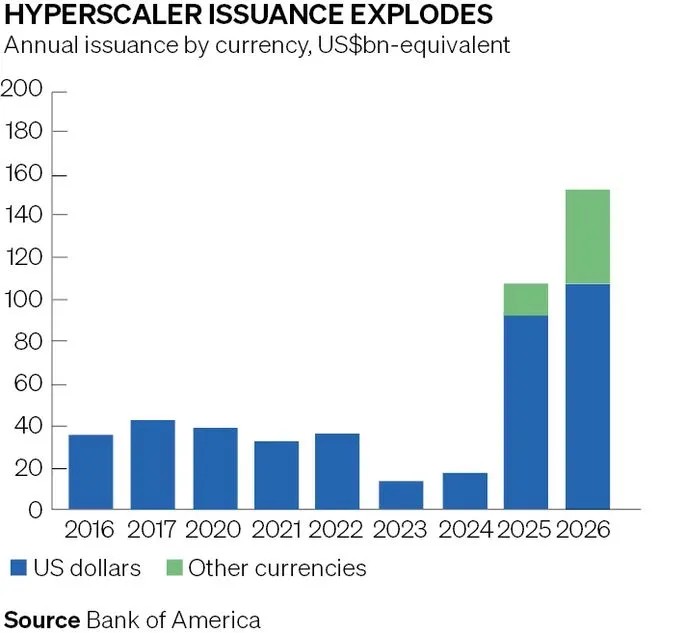
However, as the AI supply chain structure creates many emerging non-USD assets, the asset issuance privileges enjoyed solely by US companies may not be maintained for long.
The importance of South Korean and Taiwanese semiconductors in the global supply chain is highlighted, as well as Changxin, which recently listed and received 500 times oversubscription, all occupying a position in the AI supply chain. Many quality companies are still excluded from the USD capital market. This is also why Changxin launched Hyperliquid ahead of time, primarily to access global liquidity.
Press enter or click to view image in full size
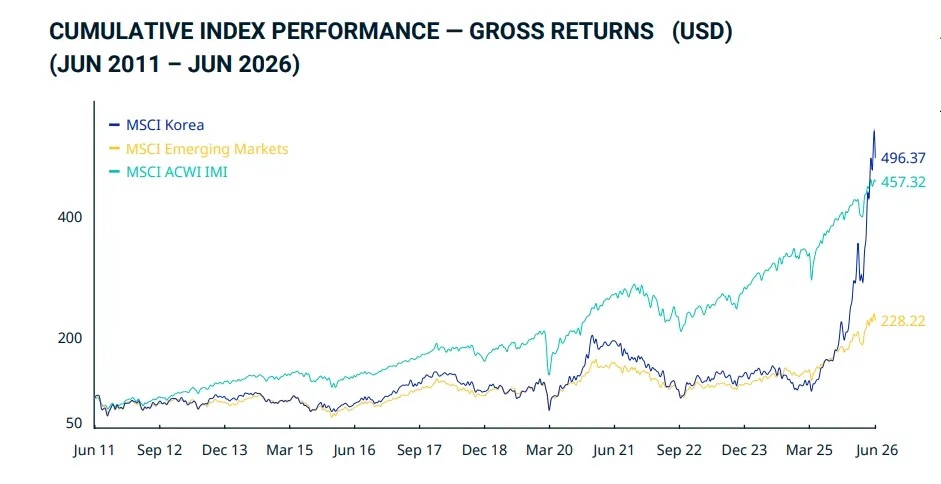
The gap between China and the US in the AI race may be smaller than we think. From the launch of DeepSeek in February last year to the recent stunning Kimi K3, it must be acknowledged that China is quickly catching up with the US, not to mention its considerable lead in the industrialization of humanoid robots. Currently, all eyes are on the US big tech and the IPOs of OpenAI and Anthropic, but in the future, when DeepSeek and Moonshot land on A-shares, it might be the American investors regretting missing out.
The demand side for assets is increasingly globalized, but asset ownership and issuance rights are confined by national borders.
This is why brokering the unbrokered will be more important than banking the unbanked in the next 15 years: the former solves how an individual can access a robust monetary system; the latter determines who can have future low-cost financing rights and who will possess advanced productive capabilities.
In 1914, Ford began to implement an eight-hour workday and a five-day work week; for nearly a century, modern society has revolved around the institutionalization of work and work ethics. Who you are often equates to what job you do.
A hundred years later, the fourth industrial revolution driven by AI continues to compress the marginal value of intellectual labor; the wage growth of the vast majority of intellectual workers will increasingly struggle to keep pace with asset prices and monetary expansion, especially for assets that can bear technological dividends, monetary dividends, and monopoly dividends. Asset allocation rights are no longer just a traditional "wealth management issue," but have become a new mechanism for social stratification.
The essence of finance is "selling hope" (finance is in the business of hope). May hope always be present.
免责声明:本文章仅代表作者个人观点,不代表本平台的立场和观点。本文章仅供信息分享,不构成对任何人的任何投资建议。用户与作者之间的任何争议,与本平台无关。如网页中刊载的文章或图片涉及侵权,请提供相关的权利证明和身份证明发送邮件到support@aicoin.com,本平台相关工作人员将会进行核查。


