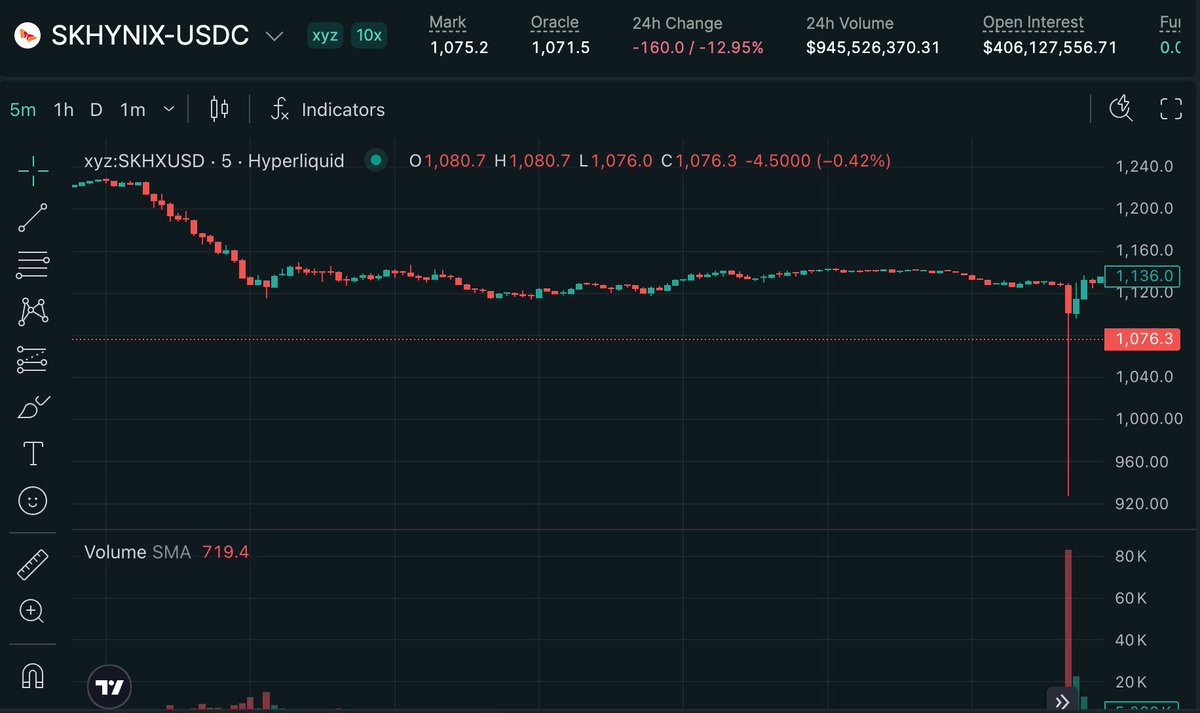
Many people probably lost money on this needle on Hyperliquid, and I wonder if there will be compensation. Logically, users have no responsibility, and the platform doesn't seem to have responsibility either. So where does the responsibility lie?
The situation is roughly as follows: Today in the pre-market of the Korean NXT, SK Hynix's stock price dropped nearly 30% after a single transaction of only 1 share, worth about 867 USD, due to poor liquidity, which then triggered a trading halt.
The SKHYNIX token on Hyperliquid is a perpetual contract deployed by http://trade.xyz, and its oracle price refers to the price of SK Hynix common stock in Korean won in the Korean market, then converted to USD according to the exchange rate.
After the abnormal trading in the Korean pre-market, the price was relayed to the chain by the oracle, with SKHX dropping about 17.9% at one point, leading to a liquidation of a large number of high-leverage long positions.
So, this incident wasn't because of an unexpected fundamental problem with SK Hynix but rather: thin liquidity in the pre-market + an anomalously low transaction + direct relay by the oracle + concentrated high-leverage positions on-chain: ultimately leading to a chain liquidation across markets.
So whose problem is it?
The initial abnormal price came from the Korean NXT pre-market; however, whether the on-chain contract should directly use such a single transaction price during periods of extremely low liquidity is a question for the oracle and risk control design to answer.
Especially since SKHX belongs to the HIP-3 third-party deployment market, according to Hyperliquid's rules, the market deployer is responsible for defining the contract, the oracle source, and specific parameters.
In other words, we cannot simply assign all the responsibility to the underlying Hyperliquid, nor can we blame all of it on the users.
What everyone is most concerned about is whether the users who were liquidated can receive compensation.
My judgment is: it is possible, but the current probability does not seem high.
If this transaction in the Korean market is ultimately deemed real and valid, and the SKHX oracle updates completely according to the established rules, then the platform is highly likely to consider the liquidation as a normal occurrence, making it difficult for users to receive compensation.
However, if it is subsequently proven:
* The original transaction was an erroneous trade and has been revoked;
* The oracle referenced an unusual price that should not have been referenced;
* There were technical errors in the data source, exchange rate conversion, or marking price;
* The platform did not execute the promised mechanism for protecting against anomalous prices;
Then users would have more ample grounds for compensation, and the platform might choose partial compensation or use special funds to address the situation.
So the key is not whether the price later recovers but rather how officials ultimately classify it: is this a genuine market fluctuation, or should it have been filtered as an abnormal price?
So you see, trading what is called "on-chain stocks," you are not actually buying real stocks, but a price mapping constructed by the oracle, contract rules, and settlement system.
When a transaction of 867 USD can trigger over a hundred million dollars in positions, the real vulnerability may not be the market, but the entire price transmission mechanism, with risks still existing in an intangible way, even in places we cannot see.
免责声明:本文章仅代表作者个人观点,不代表本平台的立场和观点。本文章仅供信息分享,不构成对任何人的任何投资建议。用户与作者之间的任何争议,与本平台无关。如网页中刊载的文章或图片涉及侵权,请提供相关的权利证明和身份证明发送邮件到support@aicoin.com,本平台相关工作人员将会进行核查。


