Author: danny
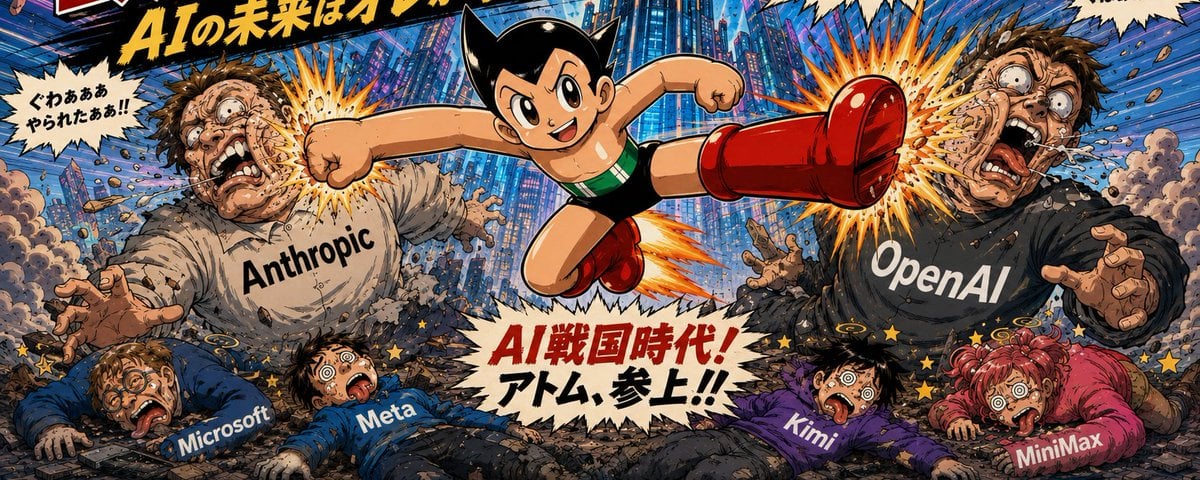
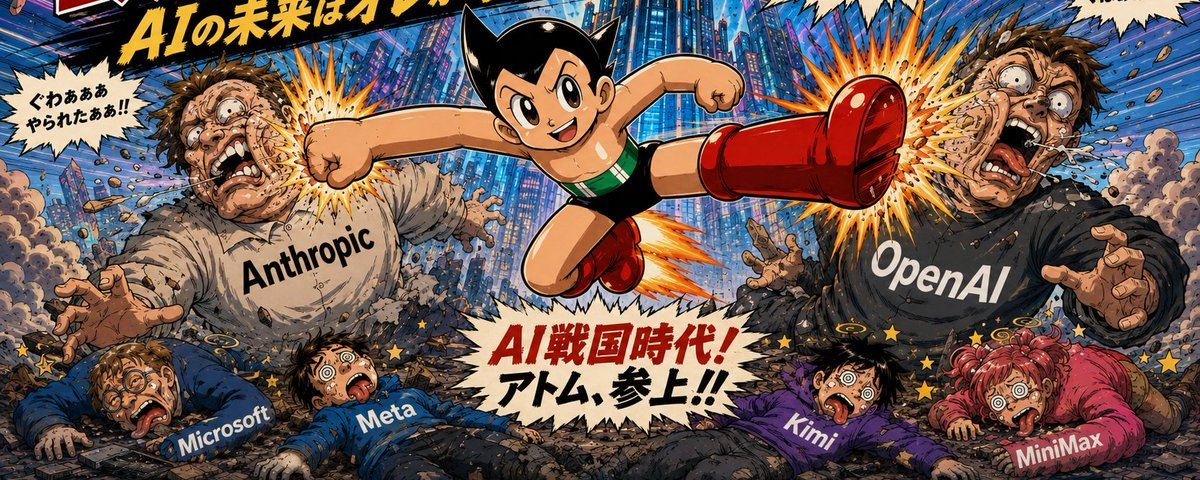
The wool comes from the pig, not just a proprietary term in the Chinese business world; the Japanese animation industry has been practicing it for sixty years. In 1963, "Astro Boy" entered Japanese households, establishing a model for thirty-minute weekly television animation. TV stations purchased programs, sponsors bought children's attention, and animation brought Osamu Tezuka's comic characters into living rooms across the country..
Japanese animation has long proven one thing: a long-lasting business model is to gather people with the first product and gather wealth with subsequent products.
Sixty years later, AI is repeating this logic.
While model companies are still figuring out how to make money through APIs, subscriptions, and tokens, Meta, Google, Microsoft, and Amazon can already reduce model prices, bundle them, or even offer them for free while earning money through advertising, cloud computing, and enterprise software.
Therefore, the most dangerous enemy for purely model companies is not another stronger model, but a company that doesn't need to make money from models at all.
1. The most difficult price war is when the competitor does not rely on this product to make money
The AI industry discusses the same question every day: OpenAI, Anthropic, Google, Meta, which model is stronger? This question is certainly important, but the strength of the model can only determine who users choose today, not who will still be at the table in five years.
For a purely model company, the real dangerous opponent may not be another laboratory that creates a stronger model, but a company that can give away models for free and then charge for advertising, cloud computing, enterprise software, and e-commerce.
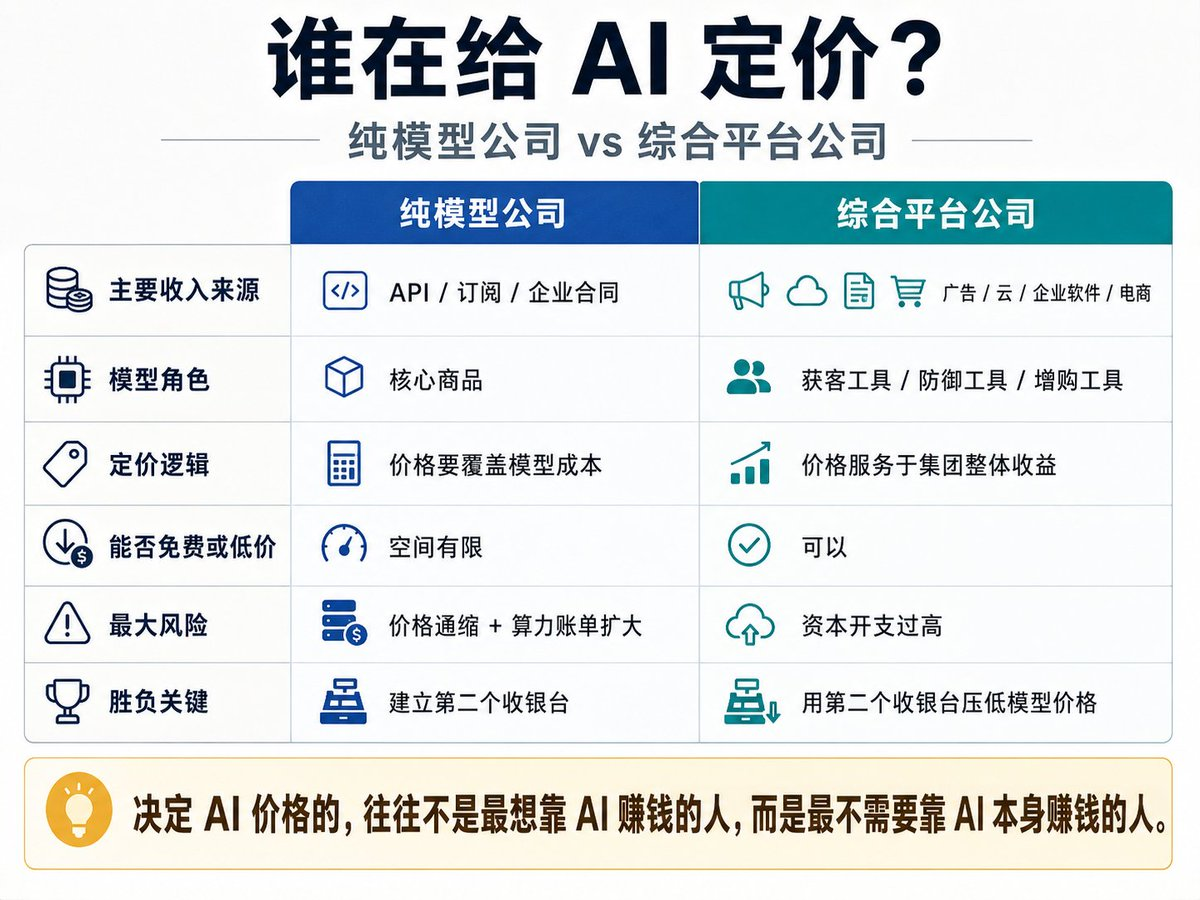
Both parties seem to be providing AI, but they are not in the same business. Model companies treat models as products, and the training, inference, and research and development costs need to be recouped from APIs, subscriptions, and enterprise contracts. Comprehensive platforms can treat models as costs, as long as the model can hold the user entrance, improve advertising efficiency, drive cloud computing consumption, or reduce customer churn, the profitability of the model business itself is not important. When one side needs to derive gross profit from each call, while the other can treat calls as customer acquisition costs, this is no longer ordinary product competition because the two companies use two different profit and loss statements.
The most troublesome aspect of this war is here. Pure model companies think they are competing with another type of intelligence, but platform companies do not need to win in "selling intelligence." They only need to make intelligence cheap enough so that pure model companies cannot make enough money from it.
2. Japanese animation has long faced this issue
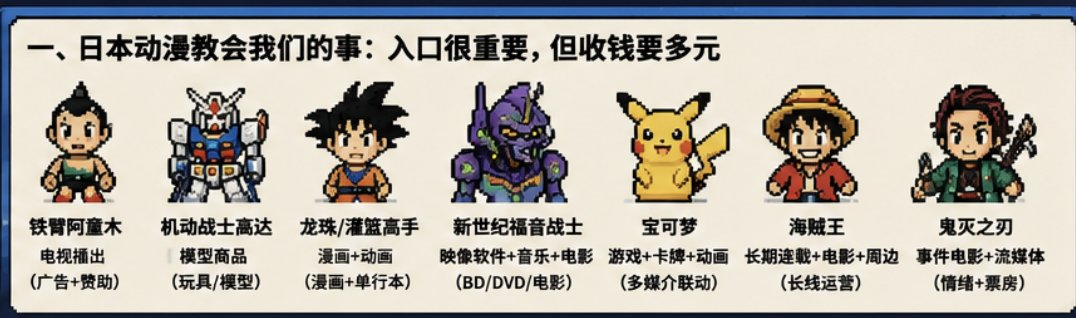 The wool comes from the pig, not just a proprietary term in the Chinese business world; the Japanese animation industry has been practicing it for sixty years. In 1963, "Astro Boy" entered Japanese households, establishing a model for thirty-minute weekly television animation. TV stations purchased programs, sponsors bought children's attention, and animation brought Osamu Tezuka's comic characters into living rooms across the country. The problem is that the animation production fee provided by the TV station for "Astro Boy" (550,000 yen) was lower than the actual cost, and the money paid by the TV station could not cover production expenses at all.
Osamu Tezuka was willing to accept this price because he did not rely solely on animation for profit. He also had comic manuscript fees, graphic novels, overseas distribution, and character licensing. Earning a little less from animation, or even temporarily losing money, could exchange for more comic readers and a larger merchandise market. He was not simply selling animation at a loss but was buying distribution.
Animation is the entrance, while comics and licensing are the real cash registers.
The various business models later found by Japanese animation are all extensions of this logic. "Mobile Suit Gundam" (also known as Gundam) had mediocre viewership in its early days, but the theatrical versions and plastic models changed its fate. The model numbers, factions, weapons, and paint jobs are not just story settings; they can also convert into a continuously updated product line. "Dragon Ball" and "Slam Dunk" relied on the Jump system, first testing characters and stories through a comic magazine, and then expanding the audience through animation, with movies, games, and licensing carrying the subsequent monetization. "Neon Genesis Evangelion" turned television broadcasts into the customer acquisition channels for videotapes, LDs, music, and movies, while Pokémon allowed games, cards, and animation to transfer users to each other. The television animation and streaming of "Demon Slayer" created character groundwork, with the movie concentrating on revenue after audiences had developed emotional investment.
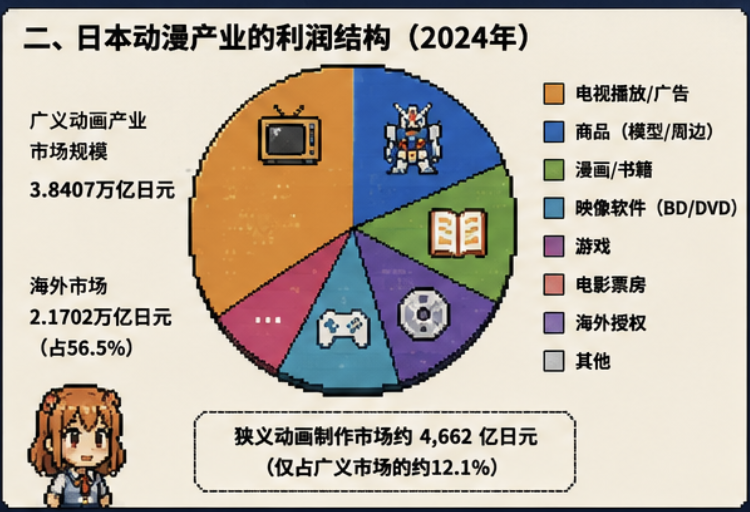
The Japanese animation industry is growing larger not because each episode's production costs are becoming more profitable, but because animation no longer needs to independently bear all commercial returns. Gundam animation can acquire customers for figures/models, Pokémon animation can acquire customers for games and cards, and television animation can also prepare characters for films in a way that cannot be completed within two hours. Animation shifted from being a product that needed to independently turn a profit to an entrance to other products.
This also changed who determines the price.
Those who hold income from comics, models, games, cards, and movies can accept lower animation returns; only companies that rely solely on production fees must operate under prices subsidized by others from the second profit pool.
The market will remember low prices, but will not hand over the profit sources needed to maintain low prices to later entrants.
3. AI models are also transitioning from products to entrances
Pure model companies want to sell intelligence. Users subscribe to ChatGPT, enterprises purchase Claude, and developers call APIs per token. The stronger the model, the higher the usage; the lower the inference costs, the higher the gross profit. This is a normal business logic, but Meta, Google, Microsoft, and Amazon do not need to calculate returns based on the same logic.
Meta can open up models because its main revenue comes from advertising. Even if the model itself is free, as long as AI can improve content recommendations and advertising efficiency, or prevent another model platform from controlling the developer ecosystem, this investment could be justified. Google can recoup AI costs from search, YouTube, Workspace, and Google Cloud. Gemini can be a paid product and also a tool for protecting search entrances, selling cloud resources, and promoting self-developed chips. Microsoft puts Copilot into Office, GitHub, and Azure, and the returns obtained are not only from Copilot subscriptions but also include software price increases, cloud computing consumption, and higher customer migration costs. Amazon invests in model companies to gain equity benefits and sell AWS computing power to labs and end customers.
These companies are not ignoring costs; rather, they do not need to require models to be profitable on their own. Models can be low-cost, can be bundled, and in some cases can even be free, as long as they can protect existing businesses, drive the growth of another business, or even just ensure users do not switch to competitors. Pure model companies must ask how much gross profit each user can contribute to the model business for every user they serve; comprehensive platforms, facing the same user, are asking how much that user is worth (LTV), and where they should keep them in their ecosystem, not looking at their ARPU.
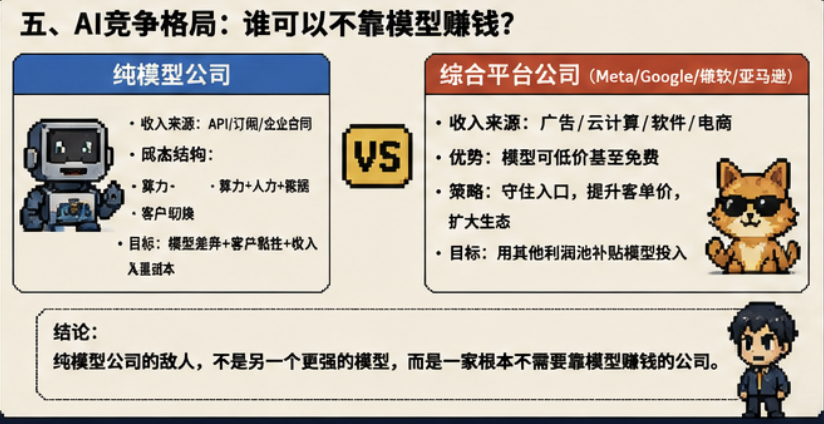
The problems are different, and the acceptable prices are different as well. When Meta opens the model, it is not just to compete in the model market, but also to lower the foundational price of future intelligence, preventing the next generation of applications from being built on competitors' paid interfaces. Microsoft adding Copilot to enterprise software is not just adding a feature, but also increasing the costs for enterprises to leave Office, GitHub, and Azure. Google integrating AI into search does not need to charge for every search; what it wants to do is to prevent users from bypassing the search entrance.
These platforms do not need to account for models separately; they only need the entire group's accounts to be positive.
The biggest threat faced by pure model companies is not a competitor with a price 10% lower or performance 20% better, but a competitor that does not need this revenue.
4. Prices are falling, but bills are expanding
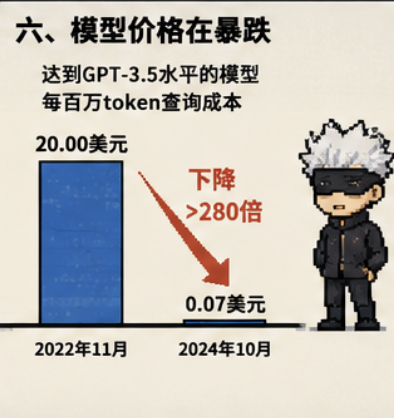
According to the Stanford AI Index, the cost per million token queries for models reaching approximately GPT-3.5 levels has fallen from 20 dollars in November 2022 to 0.07 dollars by October 2024, a decline of over 280 times in 23 months. Model capabilities continue to improve, but the wholesale prices for equivalent capabilities have dropped significantly. Open weights models, major factory subsidies, and improvements in chip efficiency will continue to pressure prices.
Meanwhile, capital expenditure in the AI industry has not decreased. In 2026, the capital expenditure of Microsoft, Alphabet, Amazon, Meta, and Oracle is expected to reach hundreds of billions of dollars, with many new investments flowing into data centers, servers, networks, and power infrastructure. AI requires GPUs, HBMs, switches, optical modules, cooling equipment, transformers, land, and electricity, and data centers need several years from planning to operation; procurement contracts, leasing obligations, and electricity agreements must be signed in advance.
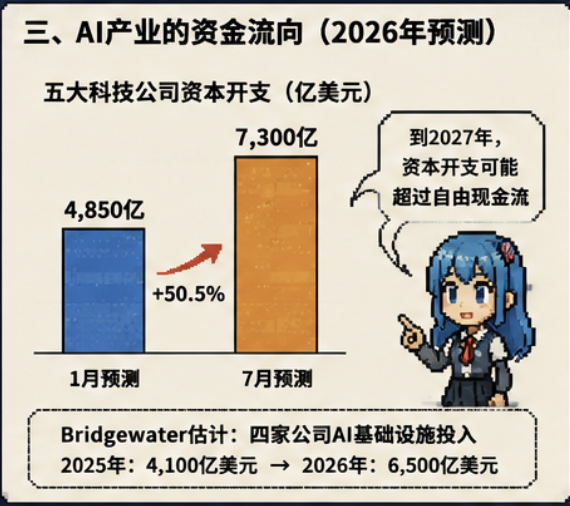
This creates the most difficult scissors gap for pure model companies: the unit price of models is declining, while infrastructure obligations are rising. Each call becoming cheaper does not mean total computing power demand is necessarily decreasing because falling prices will bring more usage. In the past, users only asked one question; future agents might run for half an hour, reading documents, calling tools, modifying code, and checking results. Enterprises will also integrate AI into more departments and workflows. The unit costs of old tasks are decreasing, but the number and complexity of new tasks are increasing.
For cloud vendors, this change may lead to increased computing consumption; for application companies, reduced model prices may lower product costs; but for pure model companies, the issue is more complicated. They must participate in the infrastructure war while facing model price deflation. If their main revenue always comes from tokens, then as prices become more transparent and capabilities easier to compare, the cost for customers to switch vendors will decrease.
This is also why pure model companies cannot just wait for models to become stronger. Stronger models can bring a temporary premium but are unlikely to stop the entire industry from moving toward lower prices. Especially when competitors have advertising, software, and cloud computing businesses as a second cash register, the profit window resulting from technological leadership may be shorter than the training period.
5. Model companies must move away from selling only tokens
GPT and Claude are not Astro Boy; OpenAI and Anthropic are also not Tezuka Production. They own models, brands, direct users, APIs, and enterprise clients and can define product forms. Unlike outsourced production companies that charge by the hour, they have the opportunity to establish their customer entrances and ecosystems. But they also understand that if they only sell tokens long term, they will still fall into a dangerous position: bearing the most expensive research and development and infrastructure costs while selling a product with a continuously declining price that can easily be replaced by suppliers.
Therefore, the task of model companies is not simply to sell tokens at a higher price but to change what they sell. OpenAI and Anthropic are forming Forward Deployed Engineering teams, essentially pushing models from API interfaces into clients' production systems. Only selling tokens means selling raw materials; once integrated into workflows, they are selling business results, and people will pay for results.
A model that generates code can be replaced, but an engineering system that understands the company’s codebase, testing environment, permission system, and deployment processes is not easily replaced; a model that answers customer service questions can be replaced, but a customer service platform that has integrated orders, inventory, payments, and after-sales policies is not easily replaced; a financial analysis model can be replaced, but a product that can connect accounts, execute transactions, and assume risk control responsibilities is not easily replaced.
Charging methods will also change accordingly. Charging by token is transparent, making it easy for clients to compare different models' prices and capabilities; charging by seat indicates that the product is beginning to enter organizations; charging by task, transaction, or result means that the model has been embedded into the client's business processes. Only when model companies reach this step will they no longer just be selling a continually decreasing raw material but will have their second printing press.
Whether they will become this era's Tezuka Production depends on three questions:
Can model differentiation maintain a premium?
Is customer entrance in their hands?
Can they establish new profit sources outside of models?
When model capabilities converge and customer entrances are controlled by platforms, while research and computing costs are still borne by laboratories, pure model companies will fall into the most dangerous position – responsible for producing the most scrutinized products in the industry, while the price is decided by others.
6. Opportunities at the application layer are not in the models themselves
This conclusion does not mean giants will definitely win, and model companies will definitely lose. It means that the profits of the AI industry will not equally reside at the layer with the strongest technology. Application companies do not need to train the strongest foundational models, nor do they need to remain loyal to any particular model supplier. They can use OpenAI, switch to Anthropic, Kimi, Google, or open-source models.
The more intense upstream competition, the lower the price for the application layer to purchase intelligence.
However, application companies also cannot just do a simple rebranding. If the product merely forwards user questions to the model and presents the answers on a different interface, then if the foundational model adds a feature, it will disappear. The application layer needs to control things that model companies cannot easily obtain, including customer relationships, proprietary data, industry processes, distribution channels, regulatory responsibilities, and final transactions; otherwise, it will just be a blood bag for model companies, with model companies merely working.
Therefore, the most important principle at the application layer is not which model to choose but to make upstream models replaceable while ensuring their customer relationships are irreplaceable. Whoever can switch suppliers holds bargaining power; whoever owns the customers possesses a second cash register; whoever bears the business results is qualified to charge based on outcomes.
7. The truly dangerous competitors are those who don’t need to profit on your battlefield
Looking back at Japanese animation, Tezuka Production pioneered television animation but did not capture the majority of profits in this industry. Gundam did not solely make money from animation, Pokémon did not rely only on animation, and "Demon Slayer" did not focus only on television animation for profits. They all built new cash registers outside of animation, thus allowing animation to bear the roles of distribution, customer acquisition, and maintaining user relationships.
AI will also move toward a similar structure. Foundational models may increasingly resemble electricity; everyone needs it, but users may not care where the electricity comes from. Once models become infrastructure, profits will migrate to customer entrances, workflows, data, and transactions. Model capabilities remain important, but model capabilities no longer automatically equal commercial value, and certainly do not equate to profits remaining with the model companies.
It does not need to profit on your battlefield; it only needs to make it impossible for you to profit.
The outcome of this war will not just depend on model scores, capital expenditures, or cash on hand but on who possesses the second cash register. Because those who have the second cash register can treat the first product as a cost, and only such people have the authority to decide how much the first product should sell for.
免责声明:本文章仅代表作者个人观点,不代表本平台的立场和观点。本文章仅供信息分享,不构成对任何人的任何投资建议。用户与作者之间的任何争议,与本平台无关。如网页中刊载的文章或图片涉及侵权,请提供相关的权利证明和身份证明发送邮件到support@aicoin.com,本平台相关工作人员将会进行核查。


