Now, if you want to directly become an Ethereum validator, you have to wait in line for more than a month.
As of July 22, there are still about 2.5 million ETH in the Ethereum staking queue, with an expected wait time of over 43 days. In contrast, the wait time to exit the queue is only a few minutes, almost negligible.
From the numbers alone, it is clear that an increasing amount of ETH staked is siphoning off market liquidity.
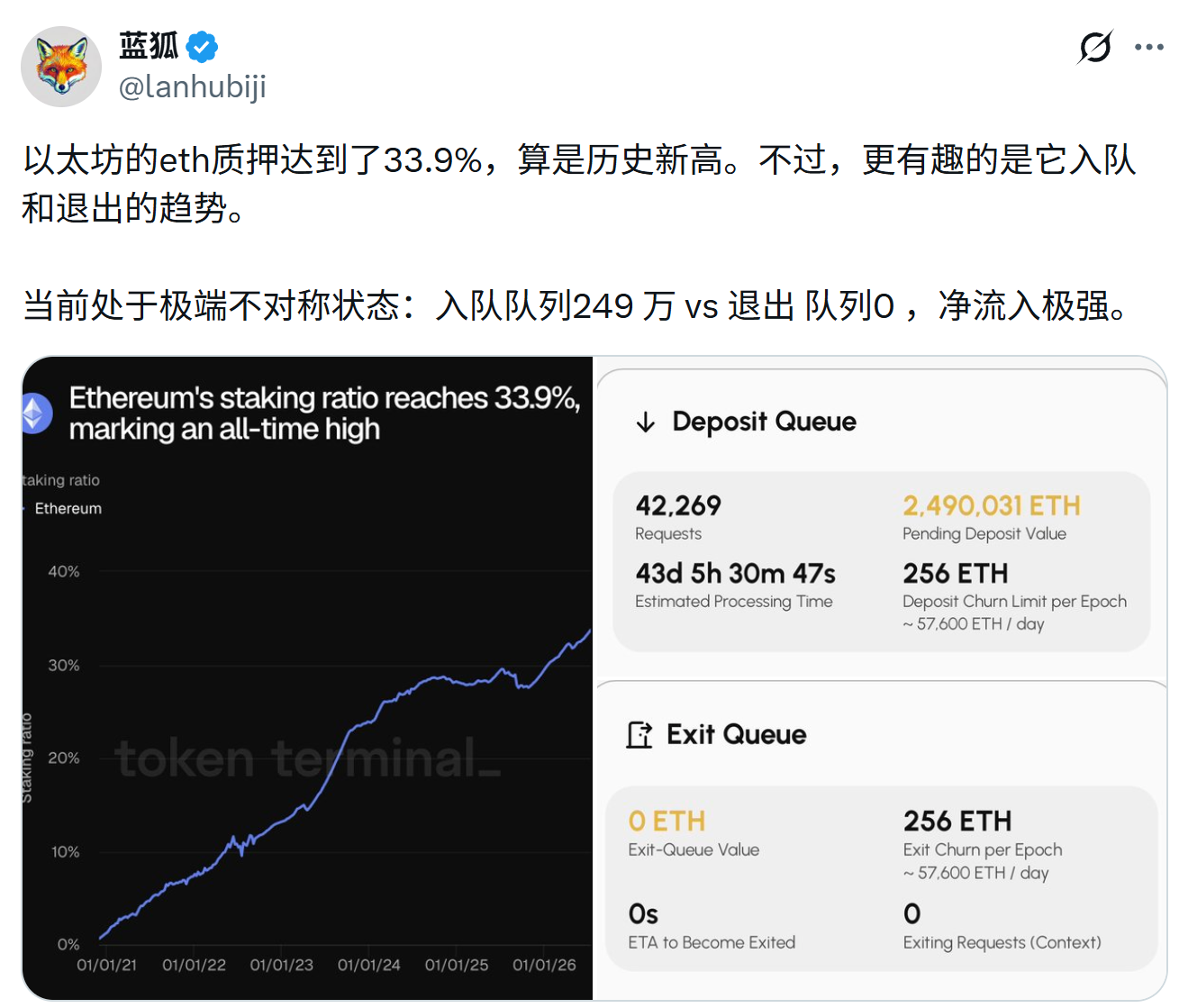
However, more noteworthy than the growth of staking scale is that queuing is starting to become an issue of capital efficiency. After all, for ETH treasury companies and institutions opting for the native staking route, a wait of over 40 days means a considerable amount of assets temporarily cannot generate staking rewards, requiring recalculation of asset allocation, liquidity arrangements, and opportunity costs.
Ultimately, when ETH is more deeply integrated into the balance sheet, the challenges faced by Staking are no longer just "how to get more people to participate," but instead evolve into a set of more traditional and complicated asset management issues.
1. Staking Rate Hits New High, How Should We Understand the Queue?
The current high staking rate of Ethereum did not form suddenly at any one point in time.
In 2023, the Shapella (Shanghai + Capella) upgrade opened up the staking withdrawal feature, allowing validators to retrieve their staked principal and rewards at the protocol level, thus forming a relatively complete loop for entry, operation, and exit in ETH Staking. Subsequently, the derivative market based on LSD quickly expanded, pushing the ETH staking rate to continually rise.
As of the writing, the amount of ETH staked has surpassed 40 million, roughly translating to about 140 billion dollars at current prices, accounting for over 33% of the total supply, a significant increase from around 10% a few years ago, setting a historical high.
In other words, currently, out of every 3 ETH, more than 1 is participating in staking.

With the staking rate at an all-time high, the persistently high entry queue also exposes a new problem.
As is well known, the entry and exit queues for Ethereum are essentially a throttling mechanism designed to protect consensus stability. New ETH cannot enter the pool of validator nodes indefinitely at the same time, and exits cannot occur in a concentrated manner within short time frames. The protocol sets the number of ETH that can be processed each Epoch based on the current size of validators, so when the requests to enter or exit exceed the processing capacity, a queue forms.
From this perspective, the 2.5 million ETH queued for entry primarily indicates that market demand for staking capacity far exceeds the rate at which the protocol can currently release it—this could include newly entering long-term funds, as well as treasury companies deploying existing holdings, staking service providers adjusting validator structures, and institutions transferring ETH from custody accounts into the staking system.
Therefore, this actually sends a clear signal: at least at the current stage, the funds willing to let ETH enter the staking system far exceed those actively withdrawing from the validator pool.
This signifies a marked departure from the staking logic seen in the early days of the Beacon Chain.
Early ETH Staking was more about network participation mechanisms aimed at technical users, independent validators, and long-term Ethereum supporters; participants operated nodes, maintained the network, and bore technical risks in exchange for protocol rewards.
However, with the rise of liquid staking, it gradually became a product for ordinary holders to earn on-chain returns. For example, exchange staking, staking-as-a-service, and staking pools have lowered the technical barrier, while liquid staking protocols like Lido and Rocket Pool have further released the availability of staked funds, allowing users to receive liquid staking tokens like stETH or rETH after staking ETH, which can not only be transferred and traded but also entered into lending, liquidity pools, and other DeFi protocols.
Today, as a large amount of ETH flows into corporate treasuries, fund products, and professional custody systems, Staking is undoubtedly entering a third phase, transitioning from "who can participate in staking" to "how should large-scale ETH be managed."
Of course, the institutional nature discussed here does not imply that early staking was completely dominated by retail investors, nor does it suggest that institutions will replace ordinary users. More accurately, it indicates that the focus of market discussion is shifting:
Previously, the focus was on how ordinary users could earn staking rewards; now it is turning to how staking becomes a standardized financial management capability when hundreds of thousands or even millions of ETH enter company balance sheets.
2. Structural Changes Behind Institutions Like BitMine
The emergence of ETH treasury companies is making these changes more intuitive.
Because the core logic of Bitcoin treasury companies is to continually accumulate BTC through financing and capital market operations, increasing the number of bitcoins per share; but for ETH treasury companies, holding assets is not the endpoint of the strategy.
After all, BTC itself does not have the protocol's native staking rewards, and holders seeking additional returns typically need to introduce lending, custody, derivatives, or other counterparty risks, whereas ETH can directly participate in Ethereum's consensus to obtain protocol rewards without selling the asset.
This provides ETH treasuries with an additional layer of operational space, namely, beyond deciding how much ETH to buy, they also need to determine how these ETH will be deployed.
The actions of BitMine represent a concentrated reflection of this institutional language.
According to their latest disclosed data, as of July 19, BitMine held a total of 5,777,468 ETH, which accounts for approximately 4.8% of the total ETH supply, out of which 4.917 million ETH is staked, representing 85% of its total ETH holdings, worth about 9.2 billion dollars.
Based on the ETH price at that time and BitMine's own 2.67% seven-day annualized staking yield, the company expects to earn approximately 247 million dollars in staking income per year; if all of its ETH is staked, the expected annualized reward may reach about 290 million dollars.
What is more noteworthy is the speed of this change in numbers.
By early February this year, BitMine had about 2.8975 million ETH participating in staking, accounting for about 67% of its holdings; by mid-July, its staking amount had increased to about 4.9172 million ETH. This means that in less than six months, BitMine has newly deployed over 2 million ETH, increasing its staking coverage from about two-thirds to 85%.
This indicates that Tom Lee and BitMine are visibly increasing the amount of ETH they hold in staking, transforming their ETH from a mere crypto asset waiting for price appreciation into a basic on-chain asset with native yield potential.
For ordinary investors, the staking rate may just be a return option, but for BitMine, it is becoming a financial treasury operating metric alongside ETH holdings, net asset per share, and financing costs.
Meanwhile, BitMine has launched its own institutional-level staking platform MAVAN to serve its own ETH treasury, and it plans to provide staking infrastructure to institutional investors, custodians, and ecosystem partners in the future (see also “Hong Kong Ethereum Observations: When the "World Computer" Meets "Yielding Assets," How Do the Two ETH Resonate?”).
This means that Staking is taking on at least three roles for BitMine: First, it adds a layer of ETH-denominated yield to long-term holdings; secondly, staking rewards can be reinvested, increasing the amount of ETH held by the treasury; lastly, when the self-built validator capacity is opened to external use, the staking infrastructure itself may also become a service business.
SharpLink is further pushing this logic from native staking to active yield management. For it, baseline staking yields are just the starting point; some already staked ETH can also continue to enter on-chain yield funds, allocated to liquidity, lending, and other DeFi strategies.
Changes in Lido V3 occurred at the infrastructure level. In the past, users and institutions primarily entered a unified liquid staking pool, but now institutions can independently choose node operators, fee structures, and risk parameters through more independent staking vaults while retaining the option to obtain liquidity in the form of stETH, indicating that liquid staking is evolving from a standardized product to customizable, institutional-grade infrastructure.
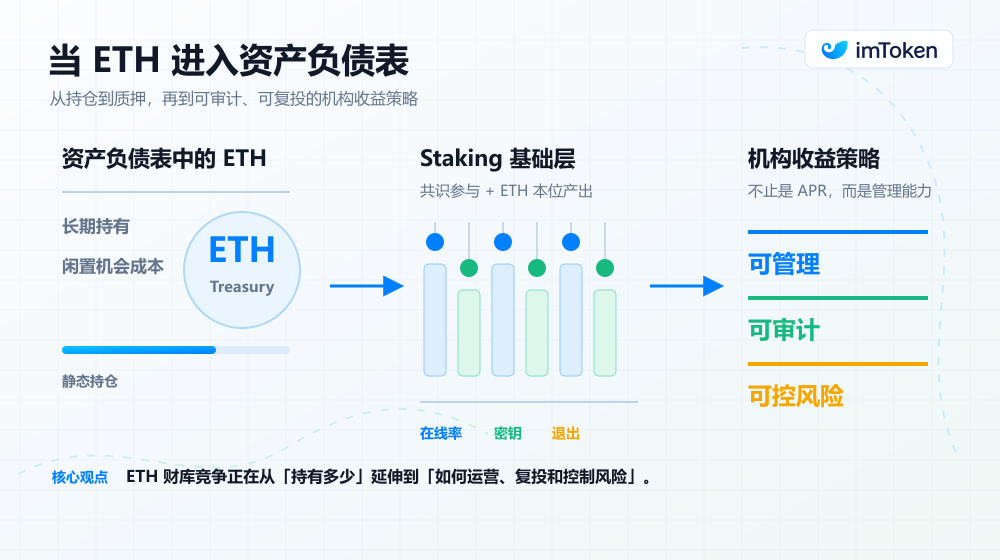
Thus, competition among ETH treasury companies in the future may not solely revolve around who holds more, but also who can manage these ETH at lower costs, higher uptime, and better risk control.
From this perspective, ETH is transitioning from a crypto asset waiting for price appreciation to an asset that requires continuous operation.
3. The Yield Is Not High, Why Is Staking More Important?
As of the writing, the overall staking APR for Ethereum is about 2.64%, and honestly, compared to some DeFi products, this level is not particularly outstanding, and as more ETH continues to participate in staking, this base yield may be further diluted.
However, the institutional demand for Staking cannot be understood solely through yield rates—staking reduces their opportunity cost of long-term holding of ETH.
For short-term investors, an annual yield of 2% to 3% is unlikely to offset the price volatility of ETH itself; but for treasury companies, funds, or large addresses that have already decided to hold ETH long-term, the issue is that since ETH is already on the balance sheet, they must continuously earn more ETH by participating in network security without relinquishing exposure to ETH price (see also “When Wall Street's ETH Starts Earning: Viewing Ethereum's Asset Attributes Through BlackRock's ETHB”).
This is understandable; for an ordinary user holding 100 ETH, a yield of 2.6% may not be significant; but for a treasury company holding millions of ETH, the same yield would result in substantial absolute income, and through long-term reinvestment, gradually influence the number of ETH per share.
This is also one of the significant differences between ETH and BTC in treasury narratives.
Therefore, when ETH enters institutional balance sheets, the treasury departments are not facing a static position but a chain asset that can be continuously deployed, accounted for, and adjusted.
Moreover, as institutional participation increases, native staking rewards may also serve another function: that is, to become the yield benchmark for the entire ETH asset system.
This is easy to understand; for instance, when a DeFi strategy promises 5%, 8%, or even higher yields in the future, institutions need to compare not just "having yields" versus "having no yields," but rather how much more it earns relative to the roughly 2.6% native staking yield and what additional risks it assumes.
Lending, liquidity market making, structured products, and re-staking strategies all need to demonstrate whether their risk-return propositions are reasonable based on this foundational yield; from this perspective, the importance of Staking in the next phase lies not only in how much ETH it brings to holders but also in its role as a baseline measurement for other on-chain strategies.
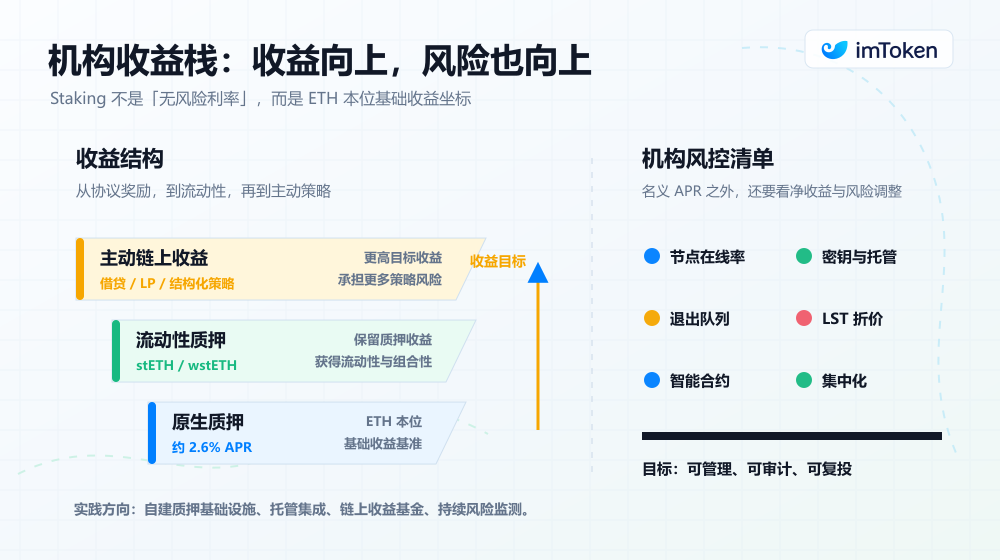
However, it should not simply be viewed as Ethereum's "risk-free rate." Stakers need to bear the risks of ETH price volatility, validator downtime, node failures, and potential penalties; participation through service providers can also increase operational and custody risks; if continuing to enter DeFi, risks will also layer as protocols and strategies increase.
Additionally, higher staking rates do not only have positive impacts; if new funds are primarily concentrated within a few treasury companies, custodians, liquid staking protocols, and node operators, it may exacerbate the centralization of validators, cloud service providers, and jurisdictions.
Therefore, as staking gradually evolves from a network participation mechanism to an institutional asset allocation tool, Ethereum needs to address more than just how to absorb more funds, but also how to maintain a balance between capital efficiency, institutional needs, and decentralization.
In Conclusion
Overall, from the initial requirement of 32 ETH for validator nodes when the Beacon Chain went live, to the reduction of participation barriers by liquid staking protocols, to today's treasury companies, self-built validator networks, and institutional on-chain yield funds, the changes in Staking essentially reflect changes in how the market understands ETH.
It began as a mechanism for participating in network consensus, subsequently became a tool for ordinary users to obtain on-chain yields, and now it is starting to enter company balance sheets, custody systems, and professional yield management frameworks.
For these long-term holders, a yield of 2% to 3% may not be impressive.
However, as long as ETH is not just idly resting in addresses or custody accounts waiting for a price increase but can participate in network security, earn protocol rewards, continue to reinvest, and maintain a certain level of liquidity, it will help accelerate its transformation into a foundational asset for other financial strategies.
This is also the new era proposition for ETH.
免责声明:本文章仅代表作者个人观点,不代表本平台的立场和观点。本文章仅供信息分享,不构成对任何人的任何投资建议。用户与作者之间的任何争议,与本平台无关。如网页中刊载的文章或图片涉及侵权,请提供相关的权利证明和身份证明发送邮件到support@aicoin.com,本平台相关工作人员将会进行核查。


