Original Author: Long Yue
Original Source: Wall Street Insights
This year's emerging market trend is a feast for the few—Citigroup believes the core issue in the second half of the year is: Can this feast spread out?
The MSCI Emerging Markets Index has risen about 20% since the beginning of the year, achieving one of the best starts in history. However, according to the chasing wind trading desk, a report by Citigroup on July 19th stated bluntly in its "Emerging Market Stock Strategy Outlook for the Second Half of 2026" that this round of rally is "extremely concentrated," with South Korea and Taiwan contributing almost all the gains at the index level. The degree of concentration is historically rare. Citigroup's data shows that the return dispersion among major markets in emerging market countries (EM) has reached its highest level in the past 25 years.
Citigroup believes that the rising volatility of AI exposes concentrated risk and that China's light positions and improved macro environment create conditions for a "rally expansion," with a year-end target for the Hang Seng Index of 29,600 points and 5,600 points for the CSI 300.
Concentration of Gains Reaches 25-Year High, "Diffusion" Becomes Core Theme for the Second Half
Analysts from Citigroup point out that a true "diffusion market" requires two conditions to be met simultaneously:
First, evidence of cyclical recovery—macro data improves, and earnings upgrades spread to a wider range of sectors and regions.
Second, a pause in the leadership momentum of technology/AI—leaving room for other sectors to catch up in relative performance.
Currently, both conditions are "partially met."
At the macro level, the bank's economic data change index has increased overall since May, and the economic surprise index (CESI) has continued to be positive, but the degree of improvement is significantly weaker than in developed markets. The conflict in Iran has brought stagflation shocks, lowering growth expectations and raising inflation expectations, particularly impacting energy-importing countries like ASEAN. The bank's commodity strategists maintain a benchmark forecast of an average price of $75 per barrel for Brent crude in Q3, decreasing to $65 per barrel at the beginning of next year; if oil prices fall as expected, it will benefit the stock markets in South Korea, Taiwan, and India.
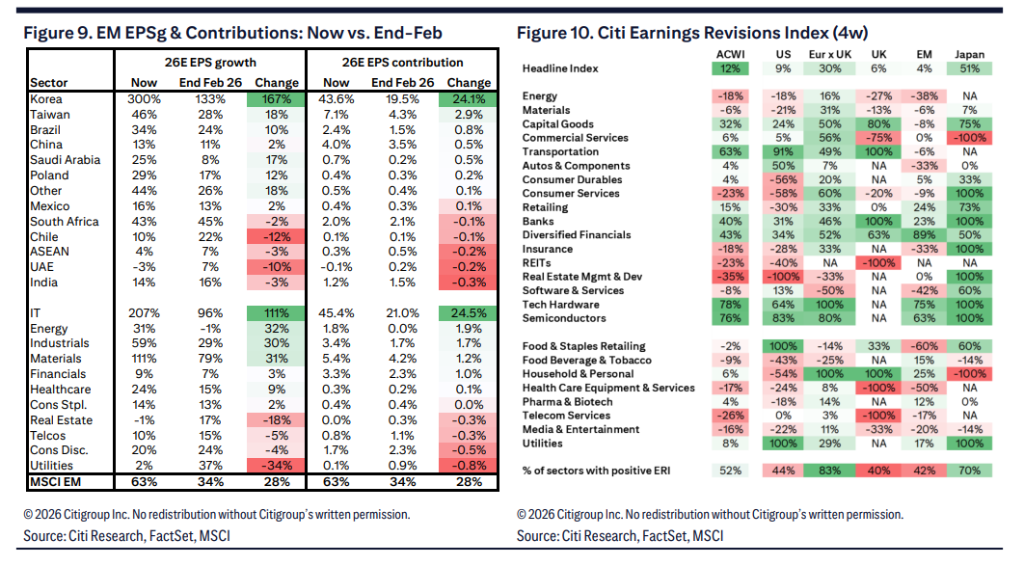
From an earnings perspective, the issues are even more prominent. The expected EPS growth for MSCI Emerging Markets 2026 has been raised by 28 percentage points since the end of February, but about 85% of this comes from the IT sector. Currently, the overall expected EPS growth for emerging markets EM is +63%, with the IT sector contributing about two-thirds. In the emerging markets EM earnings revision index (ERI) tracked by Citigroup, only 42% of sectors have seen net upgrades, and only the technology and financials are clearly improving. In contrast, the earnings upgrades in Japan and Europe have shown a broader diffusion trend.
Tactically Downgrade South Korea, Upgrade China to Overweight
Based on the above judgments, Citigroup made three key adjustments to its allocation in emerging market countries:
South Korea: Overweight → Neutral (Tactical)
The bank has held an overweight position in South Korea since July 2025. However, the South Korean market has recently experienced intense volatility, with KOSPI's implied volatility far exceeding that of comparable global markets.
Analysts point out that there are three pressures behind the volatility: doubts about the sustainability of AI capital expenditures, local resistance to data center construction, and increasing threats to cutting-edge AI laboratories from open-source models. Additionally, the influx of retail investors and the use of leveraged products further amplified the volatility.
Quantitative data from the bank shows that KOSPI long positions have returned from extreme overweight to neutral but have not yet turned into net shorts. Analysts state, "Although South Korea continues to perform exceptionally well in our fundamental models, given the volatility of current trading conditions, we are tactically downgrading to neutral."
Local strategists in South Korea maintain a year-end target price of 10,000 points for KOSPI (approximately 47% upside from the current level), and expect a memory shortage to further intensify in 2027, with memory manufacturing companies' operating profits projected to reach 58.53 trillion won and 76.36 trillion won in 2026 and 2027 respectively, accounting for 65% of total operating profits of KOSPI 200.
China: Neutral → Overweight
Citigroup has maintained a cautious attitude towards the Chinese stock market this year, mainly due to weak relative EPS momentum. However, the logic behind this upgrade is that China is a strong candidate for a "diffusion market"—light positions, declining oil prices, and an improving global growth macro environment are favorable, and valuations remain attractive.
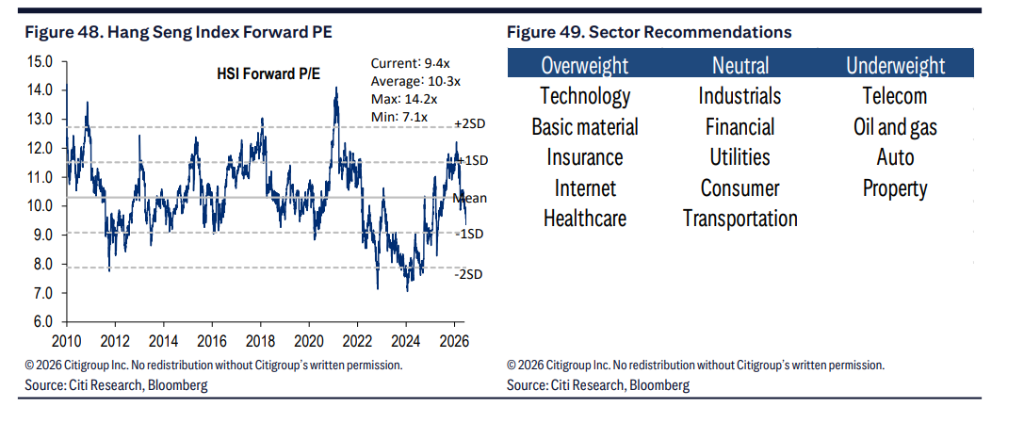
The bank's China strategist Pierre Lau points out that the Hang Seng Index is currently trading at 9.4 times the expected 2026 price-to-earnings ratio and 1.1 times the price-to-book ratio, both below historical averages (10.3 times P/E and 1.2 times P/B). The bank's economists expect a rate cut from the People's Bank of China to be likely, and fiscal policy deployment will accelerate, which could support the market marginally.
Analysts set a year-end target price of 29,600 points for the Hang Seng Index, a mid-2027 target price of 30,500 points; for the CSI 300, target prices are set at 5,600 points and 5,700 points respectively; MSCI China target prices are set at $92 (end of 2026) and $97 (mid-2027), indicating approximately 31% upside from the current level.
Mexico: Underweight → Neutral
Mexico has continued to underperform this year, hampered by unclear prospects for USMCA renegotiations and expectations of policy tightening. However, similar to China, Mexico performs well within Citigroup's "diffusion candidates" framework, and its positions are the lightest among emerging markets EM. The bank sets a year-end target price of 70,000 points for the Mexican IPC Index and a mid-2027 target price of 73,000 points.
AI Theme: Structurally Bullish, but Short-term Volatility is Inevitable
Citigroup makes it clear that it will not fully withdraw from technology/AI exposure because of short-term volatility.
There are three reasons:
First, the free cash flow of Asian memory manufacturers is expected to rise significantly in 2026-27, contrasting sharply with the near-zero free cash flow of U.S. hyper-scale cloud providers, indicating that the profit pool of the global tech sector is still expanding.
Second, Citigroup's local strategists in Korea believe that signals of a memory shortage will be further strengthened in 2027, and the trend toward customized memory and growth in AI tokens will drive the continuity of the upcycle.
Third, the fundamentals of the EM technology sector remain solid: EPS growth in the IT sector far exceeds that of comparable global sectors, earnings upgrades continue, and valuations are attractive relative to peers.
The bank also points out that for investors looking to hedge against AI exposure, Saudi Arabia, India, and Mexico have a low correlation with the Bloomberg AI Index, serving as effective hedging tools.
Target Prices and Overall Allocation Framework
Citigroup maintains a year-end target price of 1,870 points for the MSCI Emerging Markets, about 12% upside from the current level, and introduces a mid-2027 target price of 2,050 points (about 20% upside). The target prices are based on conservative EPS growth assumptions (approximately 40-45%, below market consensus expectations) and slight contractions in valuation multiples.
Among local strategists, the most optimistic views are for South Korea and China, both having target prices implying about 40% upside.
At the global allocation level, the bank currently maintains a neutral stance on EM (relative to the globe), reasoning that EM still faces volatility risks related to AI and macro complexities (geopolitics, Fed, El Niño). To return to an overweight position, a true turning point in EPS for a broader market is needed.
The bank's global bear market checklist (BMC) is currently at its highest level since the financial crisis but has not yet triggered "euphoric" signals. Historical patterns show that near the end of a bull market, market capitalization-weighted indices often outperform equal-weighted indices—indicating that the technology-led momentum may continue until market euphoria ends.
Quantitative Perspective: Emerging Markets EM Are the Cheapest in Valuation, Slowing Capital Inflow
Citigroup's quantitative strategists point out that in the global "World Radar" model, EM's relative valuation is the cheapest among all regions, ranking the highest overall.
However, the capital flow outlook is not optimistic: the inflow of funds into global and U.S. funds continues to exceed that into EM funds, with EM funds (excluding China) experiencing nearly stagnant inflow. Chinese funds have primarily seen redemptions since the beginning of the year but have seen some minor inflow in recent weeks.
South Korea faced net outflows from foreign capital in the second quarter, with cumulative net outflows totaling about $97 billion. The overcrowding in the tech sector has further increased, making it the most crowded sector in Asia, with the information technology sector's crowding score reaching 60%.
免责声明:本文章仅代表作者个人观点,不代表本平台的立场和观点。本文章仅供信息分享,不构成对任何人的任何投资建议。用户与作者之间的任何争议,与本平台无关。如网页中刊载的文章或图片涉及侵权,请提供相关的权利证明和身份证明发送邮件到support@aicoin.com,本平台相关工作人员将会进行核查。


