Original |Odaily Planet Daily(@OdailyChina)
Author|Golem(@web3_golem)
The World Cup has just ended, and Hyperliquid has thrown a "nuclear bomb" into the prediction market track.
On July 20, Hyperliquid announced that HIP-4 will, like HIP-3 in the future, support permissionless deployment. The staking requirement for HIP-4 deployers is also 500,000 HYPE, which will be locked for 6 months. HIP-4 deployers can set up to 50% fee sharing in the already deployed markets. This feature will first be available on the testnet and then go live on the mainnet.
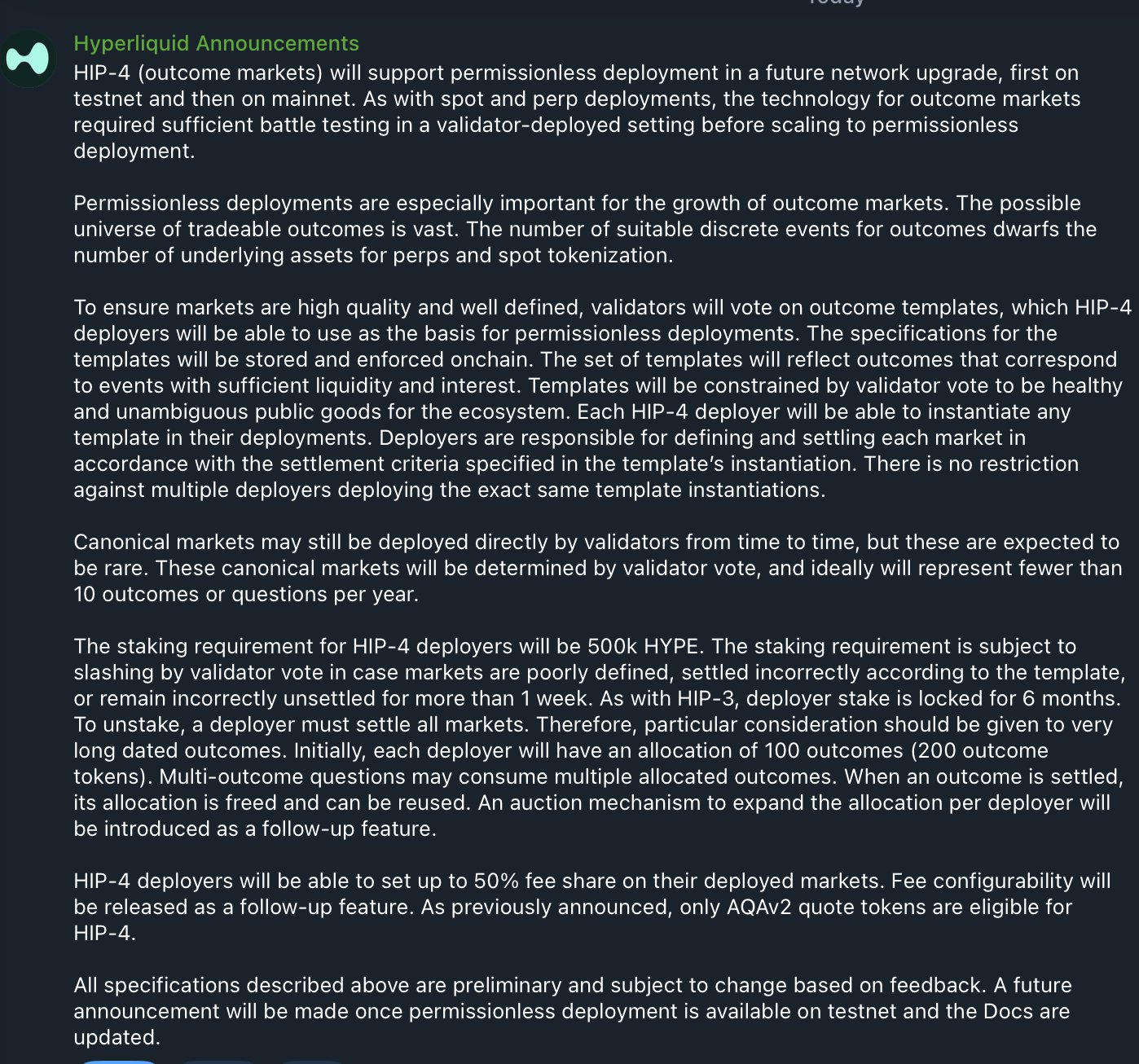
Hyperliquid announces HIP-4 opens permissionless deployment
Although Hyperliquid's announcement this time is just a preliminary notice, the specific opening time for HIP-4 permissionless deployment has not been determined. However, the market has already become excited after the news fermented.
The reason Hyperliquid can now become the world's largest stock token and on-chain commodity perpetual contract trading platform, even ahead of traditional financial markets in pricing for corporate IPOs, is due to the launch of HIP-3 in October 2025, which opened up third-party permissionless creation of perpetual contract markets.
Therefore, investors believe that Hyperliquid can once again rely on the power of "decentralization" to surpass all leaders in the prediction market track.
Who will become the next Trade.xyz?
Hyperliquid launched the HIP-4 market on May 2, 2026, marking its official entry into the prediction market track. Before the launch of the HIP-4 market, the market generally believed it would become the next core narrative point for Hyperliquid, but nearly 3 months since its actual launch, its performance can be described as terrible.
According to Hyperliquid's official data, the HIP-4 market has accumulated a trading volume of only 216 million dollars in the past 3 months, with an average daily trading volume of only 10 million dollars, and a maximum of only 7,000 daily active users. Total fee revenue is merely 442.38 dollars. In comparison, according to DeFiLlama data, Polymarket achieved a trading volume of 4.587 billion dollars in just one month, with fees reaching 50 million dollars.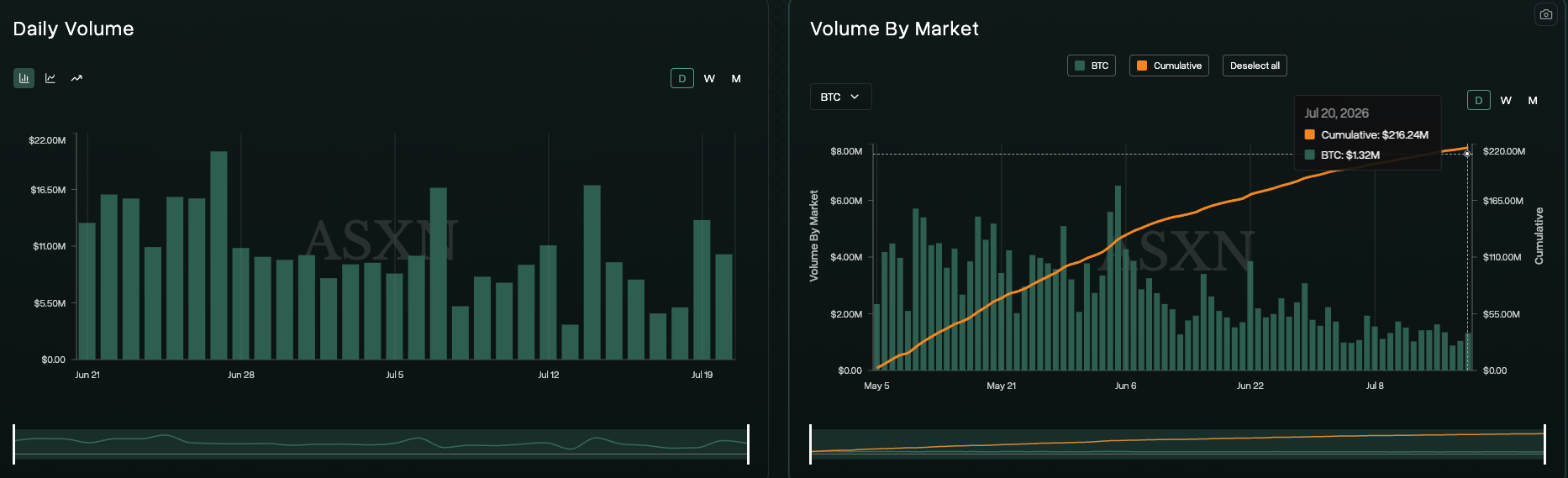
Average daily trading volume and total trading volume of HIP-4
Not only are there few users and trading volumes, but the events for which HIP-4 can be traded are also quite limited. Currently, there are only 6 predictable markets in the entire HIP-4, which pales in comparison to Polymarket in both number and variety.
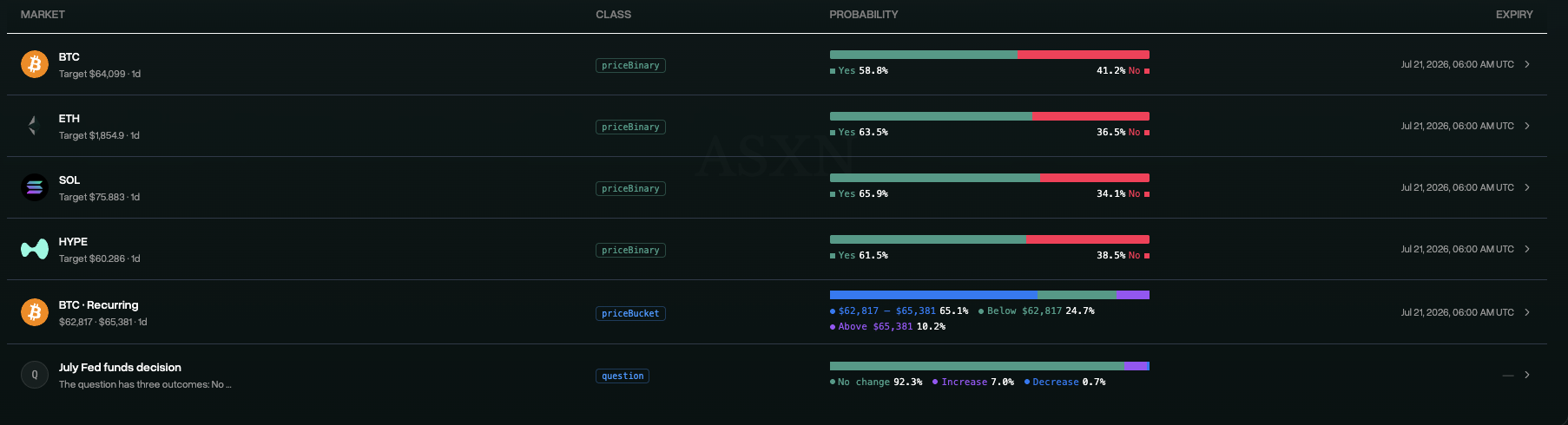
Currently tradable events in HIP-4
With such a significant disparity in scale, Hyperliquid has chosen a path-dependent strategy, following the successful experience of HIP-3. Since they can't build it up themselves, they will hand the stage over to the community to recreate a Trade.xyz in HIP-4.
Hyperliquid's opening of HIP-4 market for permissionless deployment is equivalent to Polymarket allowing users to independently establish prediction market events. Hyperliquid founder Jeff mentioned that permissionless deployment is especially important for the growth of result markets (HIP-4) because the scope of tradable outcomes is extremely broad, with the number of independent events suitable for outcome trading far exceeding the number of underlying assets for derivatives and real asset tokenization.
Moreover, having the community or third parties deploy prediction market events provides greater flexibility. The establishment of existing prediction market contracts is primarily done by teams launching or reviewing community establishments, and the process is not decentralized enough. Team members also cannot cover all areas of interest, especially for hot events happening in the real world, this mode slows down the time from reacting to market hotspots to the final execution and launch.
In the HIP-4 market, as long as enough HYPE tokens are staked, third parties can launch prediction market events according to their own standards without needing to be reviewed by the Hyperliquid team. Hyperliquid has also stipulated that it will not restrict multiple deployers from simultaneously deploying completely identical events, which will encourage healthy competition in the HIP-4 market, with the only way to succeed in competition being to provide users with more comprehensive events and deeper liquidity.
Hyperliquid has always adhered to a win-win strategy in its product philosophy. The HIP-3 market has already nurtured the behemoth Trade.xyz, holding over 90% of the market share in the HIP-3 market, with the trading volume of the first 10 perpetual contract subjects exceeding 10 billion dollars each.
Perhaps many teams are already eagerly waiting, and when Hyperliquid's mainnet opens HIP-4 permissionless deployment, we will also see a lively "battle of the gods".
Can Hyperliquid disrupt the prediction market landscape?
But can Hyperliquid really "eat all over the world with one trick"?
First of all, Hyperliquid is no longer what it used to be; the HYPE price has stabilized above 60 dollars, and the requirement for deployers in the HIP-4 market to stake 500,000 HYPE (approximately 30 million dollars) has effectively kept small entrepreneurial teams at bay. Today's crypto projects might not even manage to reach 30 million dollars in a round of financing, and those capable of raising 30 million might also prefer to develop their own prediction market platforms.
Therefore, the high staking threshold for HIP-4 deployers may lead to a sharp decrease in third-party competitors, ultimately resulting in only "powerful" prediction market projects attracting traffic, with the number of tradable independent events also limited, seriously hindering the innovative momentum of the entire HIP-4.
Secondly, Hyperliquid's timing for launching HIP-4 permissionless deployment missed even the last train. The year 2026 is regarded as an opportunity year for the development of the prediction market track mainly because of the dense sports events in recent years, especially with the four-year World Cup. Various prediction markets have been focusing on the World Cup matches, and on July 20, the total trading volume of the Argentina vs. Spain match event on Polymarket reached 83.75 million dollars.
However, Hyperliquid completely missed this important time window of the World Cup, which undoubtedly represents a huge strategic oversight. Even the success of the HIP-3 market involved a combination of favorable timing, location, and people. For instance, the international oil price fluctuations caused by the US-Iran conflict in February were crucial catalysts for the development of the HIP-3 market. The first day of the war happened to fall on a weekend; with traditional markets closed, traders needing to adjust positions and hedge had to find new tradable markets, and Hyperliquid's HIP-3 market became the preferred choice.
When Hyperliquid launched HIP-3, it did not emphasize its role in creating stock tokens and commodity tokenization, but ultimately resulted in the success of Trade.xyz and Hyperliquid's current leading position in the tokenized trading market. If Hyperliquid hadn't seized the opportunity of the US-Iran conflict, perhaps today there would be no place for Hyperliquid in the tokenized trading market.
Likewise, having missed the World Cup opportunity, how confident can Hyperliquid be in disrupting the prediction market giants now?
免责声明:本文章仅代表作者个人观点,不代表本平台的立场和观点。本文章仅供信息分享,不构成对任何人的任何投资建议。用户与作者之间的任何争议,与本平台无关。如网页中刊载的文章或图片涉及侵权,请提供相关的权利证明和身份证明发送邮件到support@aicoin.com,本平台相关工作人员将会进行核查。


