Since April last year, Alpaca has completed three rounds of financing, totaling over $300 million.
Written by: DeepSeek
Edited by: Luffy, Foresight News
On July 16, Alpaca announced the completion of a $135 million financing, led by Peak XV (formerly Sequoia India / Southeast Asia). Just six months ago, Alpaca entered the unicorn ranks with a $150 million Series D financing, reaching a valuation of $1.15 billion.
This company is not a brokerage that directly targets retail investors, nor does it issue its own crypto assets. However, when you open Binance, Gate.io, or Bitget, and buy stocks of Apple or Tesla with USDT, it is Alpaca that handles the clearing, custody, and dividend distribution behind the scenes. According to Alpaca's data disclosed at the end of last year, it occupies about 94% of the market share for tokenized U.S. stocks and ETFs.
From a Failed AI Startup to a Fintech Unicorn
To understand Alpaca's current market position, we must go back to its starting point. Alpaca's story began in 2015, founded by two Japanese-American founders, Yoshi Yokokawa (CEO) and Hitoshi Harada (CPO/CTO), with headquarters in the United States. According to the official website (https://alpaca.markets/about-us), Yoshi's career started in the securitization team at Lehman Brothers, after which he worked full-time in day trading and co-founded several software development companies. Hitoshi has a strong technical background, having served as the chief architect of Greenplum, Silicon Valley's first parallel distributed database company (later acquired by EMC).
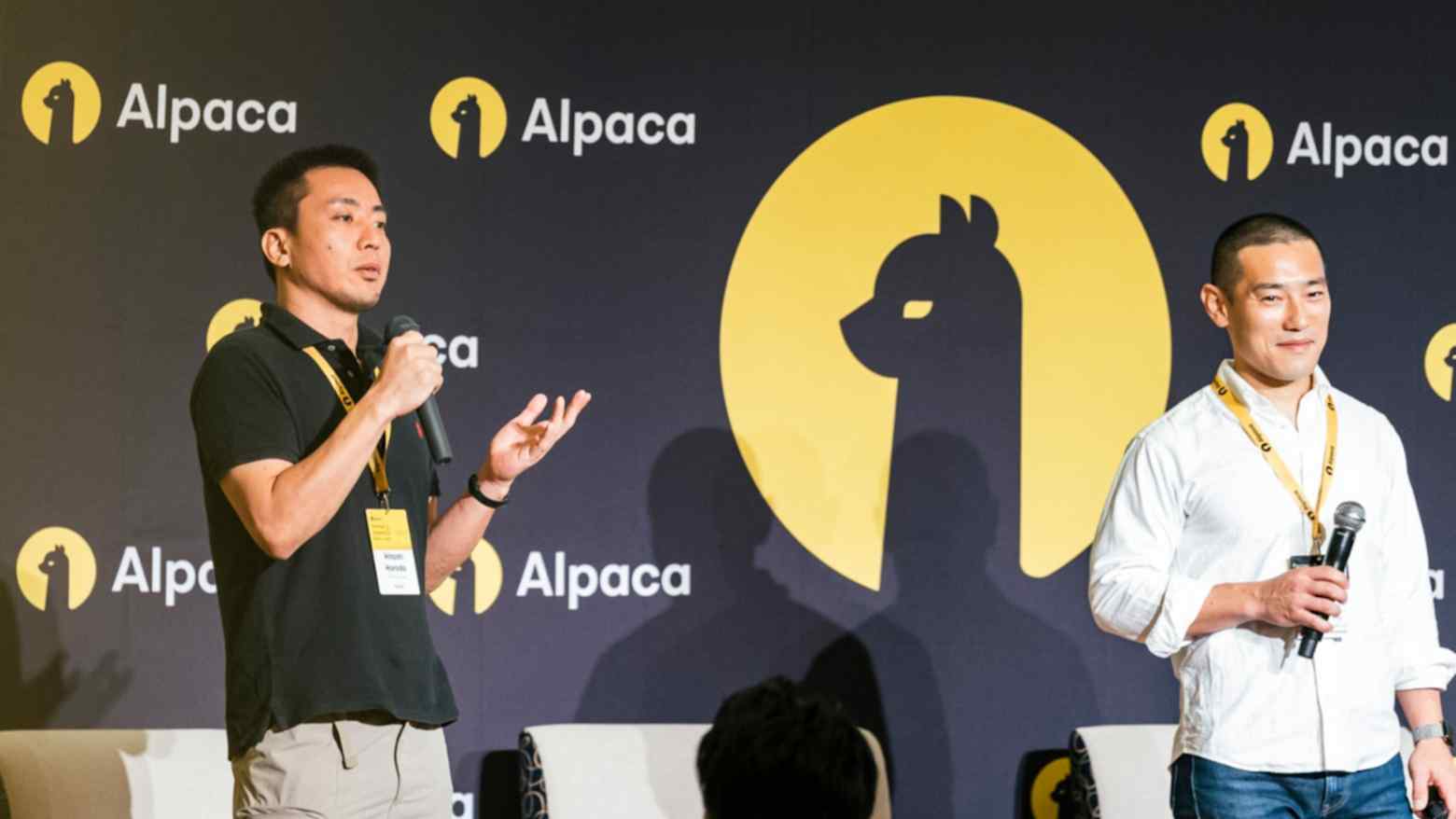
Hitoshi Harada (left) and Yoshi Yokokawa (right)
However, Alpaca's earliest direction was not in security infrastructure. Hitoshi Harada later admitted in a sharing session, "We founded the company simply because we wanted to start a business, which was actually a huge mistake." Alpaca initially started as a database and machine learning company, but eventually lost direction due to deviating from real business pain points. This transformation did not happen overnight, as Alpaca applied to Y Combinator four times and was rejected each time, until it was admitted to the Winter 2019 cohort.
The turning point occurred in the year Robinhood sparked the zero-commission revolution. What Yoshi saw was not Robinhood's success, but the gap behind it—there was Stripe for payment, Plaid for bank data access, but there was no developer-friendly API for securities trading and clearing. If you want to build a trading app, you have to sort out the brokerage license, clearing system, and custody bank by yourself; just these tasks can consume years and tens of millions of dollars. Thus, Alpaca completely transformed: abandoning AI to become "the Stripe of finance." From a machine learning company to a regulated licensed self-clearing broker, while obtaining DTCC membership, Alpaca took several years.
In 2018, Alpaca's subsidiary Alpaca Securities LLC registered as a U.S. brokerage, regulated by the Financial Industry Regulatory Authority (FINRA) and the Securities and Exchange Commission (SEC), and is also a member of the Securities Investor Protection Corporation (SIPC). In 2023, Alpaca Securities LLC received approval from the Depository Trust & Clearing Corporation (DTCC) and will transition to full self-clearing in 2024. By 2025, Alpaca Securities LLC became a member of the Options Clearing Corporation (OCC) and Fixed Income Clearing Corporation (FICC), as well as a member of the Nasdaq stock exchange.
After years of accumulation, Alpaca has become quite substantial. According to the official website, Alpaca serves hundreds of fintech companies and financial institutions globally, supporting over 7 million brokerage accounts across more than 40 countries and regions. Currently, the team has grown to over 250 people, distributed across the United States, Canada, Japan, the United Kingdom, and 25 other countries. CEO Yoshi describes Alpaca's vision as building the "AWS of finance"—providing securities trading functions as infrastructure for global businesses, enabling any company to build its own financial services on Alpaca's platform.
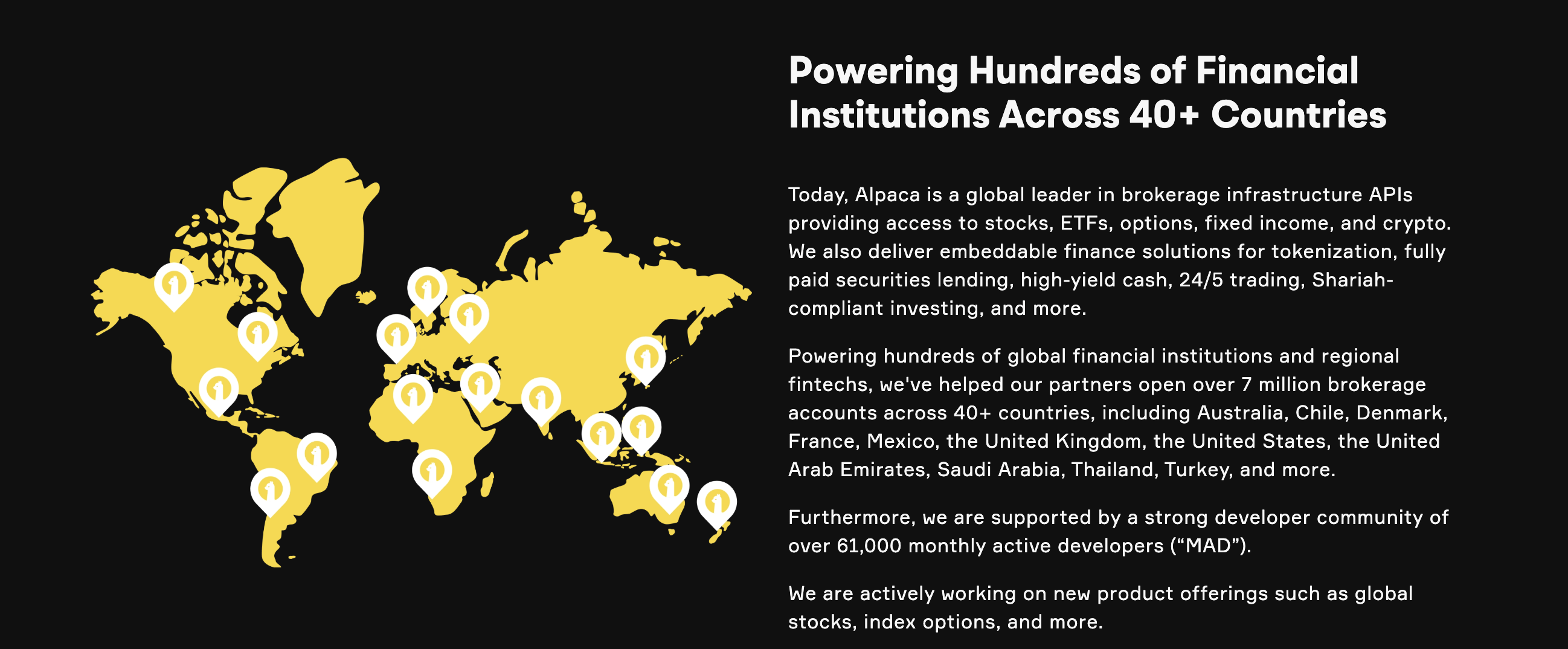
Source: Alpaca Official Website
Tokenized U.S. Stocks: A "Disintermediation" Industry Transformation
Understanding Alpaca's underlying capabilities helps clarify why it plays a key role in the U.S. stock business of cryptocurrency exchanges. The core business relationship between Alpaca and the crypto world focuses on the field of "tokenized U.S. stocks."
From late May to early June 2026, the RWA track saw a concentrated outbreak. Leading exchanges like Bitget, Binance, and Gate launched their own tokenized stock products one after another. Behind this frenzy lies a profound shift in industry logic: exchanges are abandoning traditional intermediary issuers and choosing to connect directly with upstream infrastructure.
Bitget fired the first shot. At the end of May, Bitget launched Reality (rTokens), directly connecting to Alpaca for execution, clearing, and custody. Bitget CEO Gracy explained this choice in a public interview: "Reality is our compliant RWA protocol, and its biggest difference lies in the direct connection to the U.S. licensed broker Alpaca, allowing orders to go straight through to Nasdaq and the New York Stock Exchange." The underlying stocks for Bitget's rTokens are held by Alpaca and isolated in a separate special purpose vehicle from the platform's own assets.
Gate.io quickly followed suit. On June 1, Gate officially launched Gate Stocks, directly connecting to Alpaca, allowing users to trade U.S. stocks and ETFs with USDT, providing direct ownership of real stocks.
Binance's layout is even more in-depth. Also on June 1, Binance listed direct trading for over 7,000 U.S. stocks and ETFs, with Alpaca responsible for execution, clearing, custody, and corporate actions. Then on June 11, Binance launched bStocks, a tokenized securities product issued on the BNB Chain, registered by BTECH Holdings Ltd with the Abu Dhabi Global Market (ADGM). Each bStock token is backed 1:1 by physical stocks held by Alpaca.
Looking back, the biggest winner in this wave of tokenization is indeed Alpaca. In the past, Alpaca indirectly collaborated with exchanges through intermediaries like Ondo and xStocks. Now, leading exchanges are directly connecting to Alpaca, bypassing all intermediary issuers—Alpaca has moved from "behind the scenes" to "in the spotlight."
94% Market Share: Alpaca's Super Moat
This "focus on underlying technology" positioning has allowed Alpaca to establish an almost unshakeable market position in the field of tokenized U.S. stocks. This position can be summed up with one number: 94%. According to Alpaca's data disclosed at the end of last year, Alpaca holds about 94% of the market share in the custody assets related to tokenized U.S. stocks and ETFs, with that percentage nearly reaching 97% in the large and mega-cap stocks sector. The underlying U.S. stock volume supporting these tokenized assets has exceeded $1.5 billion.
The key technology supporting this market position is Alpaca's Instant Tokenization Network (ITN) launched in October 2025. Previously, market makers could not create and redeem tokens physically, only operating with cash, which led to frequent price dislocations of tokens. ITN transformed this process into a single API call: institutions initiate a request, Alpaca immediately deducts an equivalent amount of real stocks from the custody account while minting equivalent tokens on-chain for the other party, completing the process in milliseconds. Essentially, ITN replicates the physical creation and redemption mechanism of ETFs on-chain. ITN has been adopted by partners from around the world, including Backed (xStocks), Dinari, DRW, and Ondo Finance.
Alpaca's moat goes beyond technology. As a U.S. self-clearing broker registered with FINRA, a member of SIPC, and a member of DTCC, Alpaca possesses compliance qualifications that are difficult for crypto-native companies to replicate. The self-clearing model means Alpaca does not need to rely on third-party clearing institutions and can assume core functions such as client bookkeeping, clearing, and custody independently. Technology can catch up, but the barriers to compliance qualifications and clearing networks are high.
Two Huge Financing Rounds in One Year
With market share and compliance barriers in place, capital naturally follows. 2025 is a transformative year for Alpaca. In April, the company completed a $52 million Series C financing, with investors including Derayah Financial, Portage Ventures, and Unbound.
As 2026 arrived, the pace of financing distinctly accelerated. In January, Alpaca announced the completion of $150 million Series D financing, achieving a valuation of $1.15 billion and officially entering the unicorn ranks. This round of financing saw participation from multiple institutions, including the market-making giant Citadel Securities.
Just six months later, on July 16, 2026, Alpaca completed another round of financing—$135 million in equity financing led by Peak XV (formerly Sequoia India / Southeast Asia), with participation from Elefund, BNP Paribas’s Opera Tech Ventures, and Unbound. Coupled with $300 million in debt financing from Kraken's parent company Payward and BMO, the total financing for this round reached $435 million. This means that in the past 15 months, Alpaca has raised over $320 million cumulatively.
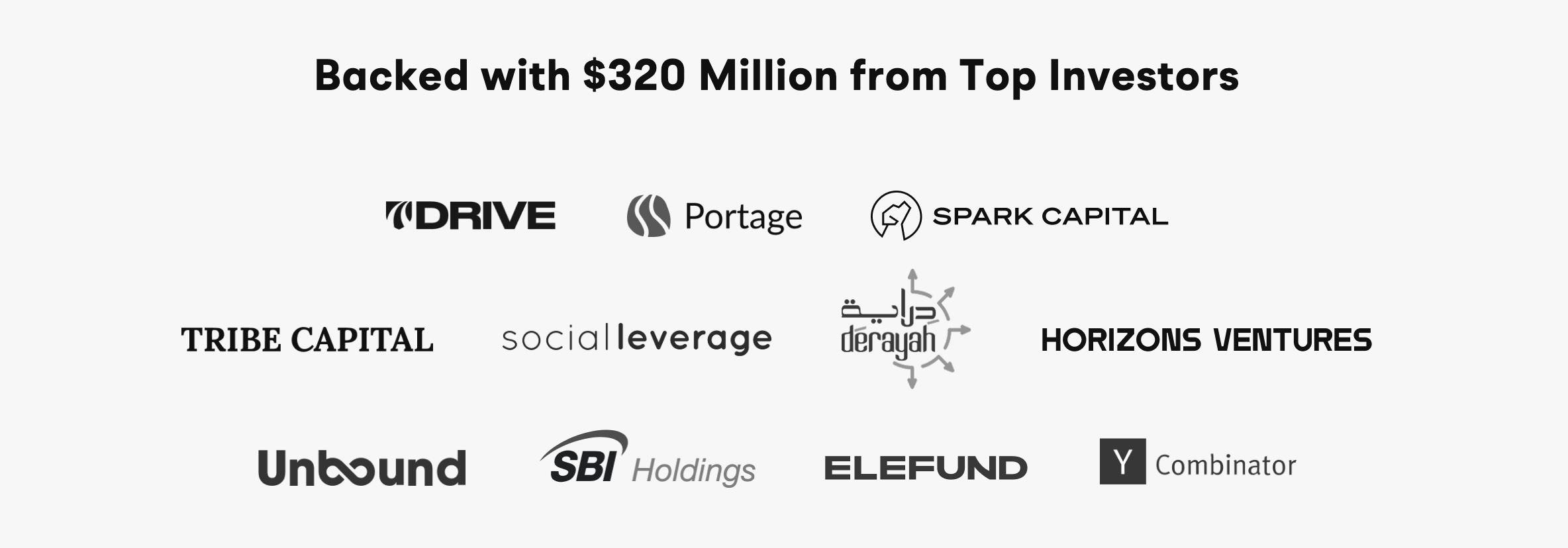
Source: Alpaca Official Website
This funding will be used in two directions. One is to expand the infrastructure for tokenized trading, supporting more exchanges and tokenization platforms to connect; the second is to enter the prime brokerage business, competing directly with Wall Street investment banks like Goldman Sachs and Morgan Stanley. The prime brokerage business involves securities lending, margin financing, trade execution, and custody services, and is essentially a capital-intensive business. Alpaca's $300 million debt financing provides balance sheet support for this part of the business.
AI Agents and the Next Wave of Growth
Tokenized U.S. stocks are currently Alpaca's main battlefield, but the company is already preparing for the next phase. In addition to tokenized U.S. stocks, Alpaca is also betting on another trend: AI agents for autonomous trading. According to company disclosures, as of July 2026, monthly active API users have grown nearly fourfold, partly due to increasing demand driven by AI agents. Alpaca's API-first architecture makes it inherently suitable for AI-driven programmatic trading scenarios. The company describes its platform as "agent-first"—designed to support AI systems that can independently research markets, interact with brokerage services, and execute approved financial workflows via software interfaces.
The growth story sounds smooth, but Alpaca is not resting easy.
In the embedded brokerage track, DriveWealth and Apex Fintech Solutions are its main competitors, with European firms like Upvest and lemon.markets also providing similar services. These competitors currently do not pose a substantial threat to Alpaca in the field of tokenized U.S. stocks, but as the track heats up, competition will only intensify. Greater challenges arise from regulatory and concentration risks. Tokenized assets themselves involve complex legal issues, and Alpaca explicitly warns that such assets are highly speculative and not registered with the SEC. Although Alpaca is regulated as a brokerage, the legal status of tokenized assets remains uncertain across different jurisdictions.
Furthermore, as the industry scales, excessive concentration of infrastructure may also trigger regulatory scrutiny—if Alpaca encounters a technical failure or sudden regulatory policy changes, billions of dollars of tokenized assets issued by Binance, Ondo, and other platforms will simultaneously face a liquidity crisis.
However, from a trend perspective, the tide of RWA tokenization has just begun, as the tokenized stock market grew nearly 3000% in 2025. As crypto platforms continue to ramp up efforts in the on-chain stock track, Alpaca, as a backend infrastructure provider, is likely to continue benefiting from this wave of "stock on-chain." But whether it can maintain its 94% market share under the dual pressures of regulation and competition will be the biggest test for this "invisible broker" in the future.
免责声明:本文章仅代表作者个人观点,不代表本平台的立场和观点。本文章仅供信息分享,不构成对任何人的任何投资建议。用户与作者之间的任何争议,与本平台无关。如网页中刊载的文章或图片涉及侵权,请提供相关的权利证明和身份证明发送邮件到support@aicoin.com,本平台相关工作人员将会进行核查。


