When the R&D cost shifts from "per head" to "Token," the power of judgment in the cryptocurrency industry is re-priced.
Written by: angelilu, Foresight News
Xue Yue, the head of AI research at CertiK, starts his day each morning by checking whether the tasks assigned to the AI the previous night have been completed. He can manage up to 5-6 AI agents working for him at the same time throughout the day.
Will, the head of AI business at Bitget, approved an AI bill exceeding $600,000 for the company last month, and a major focus of his work is to encourage the more than 2,000 employees to utilize AI for efficiency gains.
These two segments reflect an initiative being vigorously promoted across the entire cryptocurrency industry: exploring the use of AI to accomplish tasks that previously needed to be done by humans.
Economist Karl Polanyi described how the Industrial Revolution reorganized society into a market society in "The Great Transformation" over eighty years ago. This time, the "transformation" that AI is bringing to the cryptocurrency industry is an optimization and reallocation of workflows within individuals, teams, and entire companies, ultimately reshaping into a new work model where humans and AI systems collaborate deeply. The most direct evidence of this transformation is not in grand narratives but in the changing workdays of every practitioner.
We interviewed several cryptocurrency practitioners in different positions—Will, the head of AI business at Bitget; Xue Yue, the head of AI research at CertiK; and Guang Guang, a developer at Foresight News. In their workdays, we can see four specific dimensions of this "transformation"—money, efficiency, human sentiment, and decision-making.
From $60 to $10 million monthly bills
Over the past two years, the phrase "investment of AI in the cryptocurrency industry" has transformed from a slogan into a measurable expenditure.
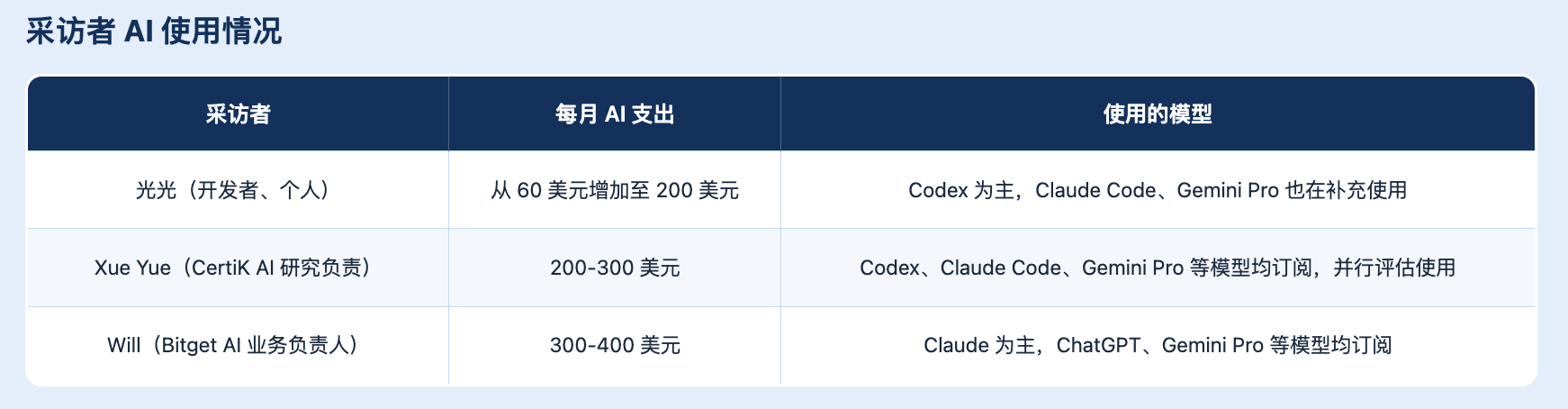
On the personal side, the AI bill of a frontline developer at Foresight News went through an upgrade—initially, he subscribed to the basic versions of three models: Codex, Claude Code, and Google Gemini Pro, spending about $60 per month; after comprehensive experience, he narrowed his subscription down to just the more advanced Codex, with a monthly bill of about $200.
Xue Yue spends $200-300 each month on model subscriptions; Will spends $300-400 monthly on personal subscriptions.
The current bills of the three individuals fall within the range of $200-400—while the spending gap between frontline developers and managers isn't significantly large, the structure differs: developers tend to concentrate their budget on one high-end tool, while managers maintain multiple subscriptions simultaneously for evaluation, testing, and comparison.
On the company side, the scale, structure, and intensity of investment jump across several orders of magnitude.
CertiK (a security company with about 200 employees) spends between $60,000 and $100,000 monthly on AI. Part of this spending comes from the company's consumption of LLM API (used for external services like AI Auditor); another part comes from on-demand subscription fees for employees using tools like Codex and Claude Code—this layered supply and on-demand flexibility constitute a "market-type" model.
Bitget (a cryptocurrency exchange with over 2,000 employees) spent over $600,000 last month on large models, personally approved by AI business lead Will, with an average spend of $500 per person in the R&D team and between $200 and $1,000 for non-R&D segments—concentrated procurement and unified supply form a "managed-type" model.
Internal employees at OKX reported that the company has also uniformly equipped employees with enterprise versions of Claude and ChatGPT, though the overall expenditure has not been disclosed.
Rob Witoff, head of the Coinbase platform, recently stated in an interview that currently 95% to 100% of the code at the company is written or assisted by large language models (LLMs), and almost all employees use AI daily—this ratio was only 40% in February of this year, more than doubling in less than half a year. Overall expenditure has also not been disclosed.
Binance's bill comes from founder Zhao Changpeng's statement in May this year on PBD Podcast: he heard that Binance spends approximately $10 million monthly on AI-related expenses (mainly AI Tokens and computing costs)—he also admitted that this is an internal number not verified by him.
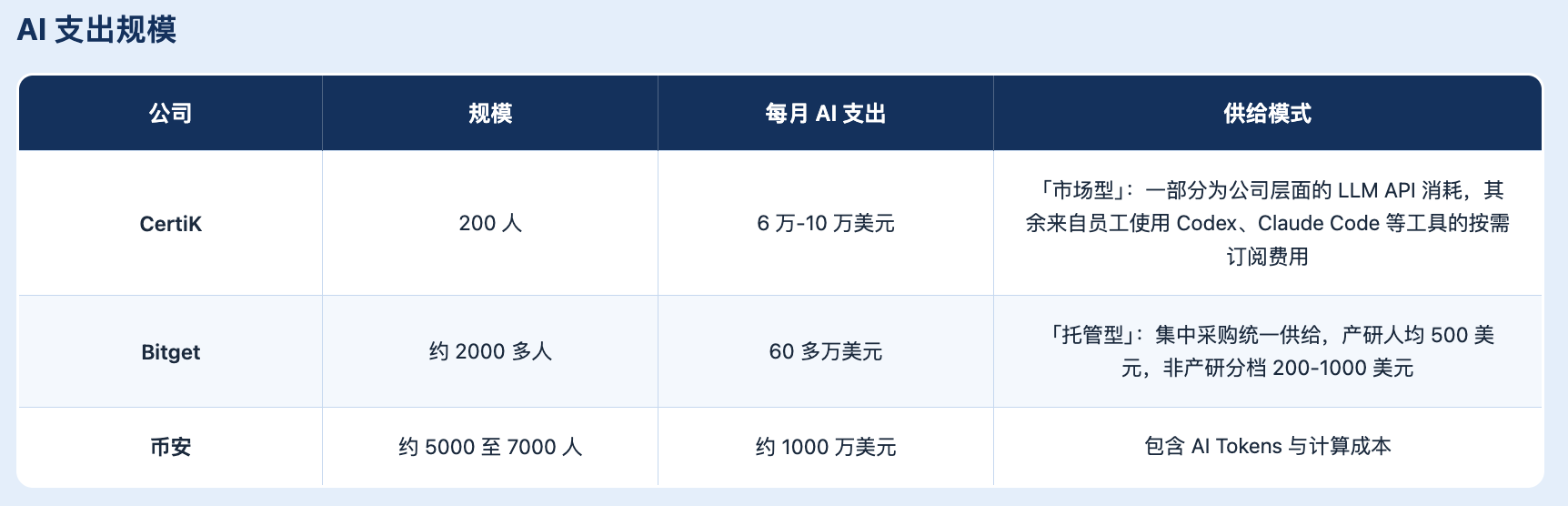
From individual $200 expenses to Binance's $10 million, this shows a staggering increase of 160,000 times. Two years ago, these numbers didn't exist at all. Today, they appear monthly in the bills of every individual and every company like utilities.
The greater the investment position, the more compressed and concentrated the power of judgment becomes.
From one month to three to five days
With money spent, efficiency must also be observable. The most direct manifestation is the processing cycle of individual tasks, which is being dramatically shortened.
Internally at Bitget, this is specifically embodied in a system called BG Agent—developed by Will and his team, which went live on May 18, 2026. In less than two months, over 800 people in the company are using it. Its core positioning is simple: to hand over workflows, which previously required repeated manual stitching by operations, product, and marketing colleagues, entirely to agents for processing.
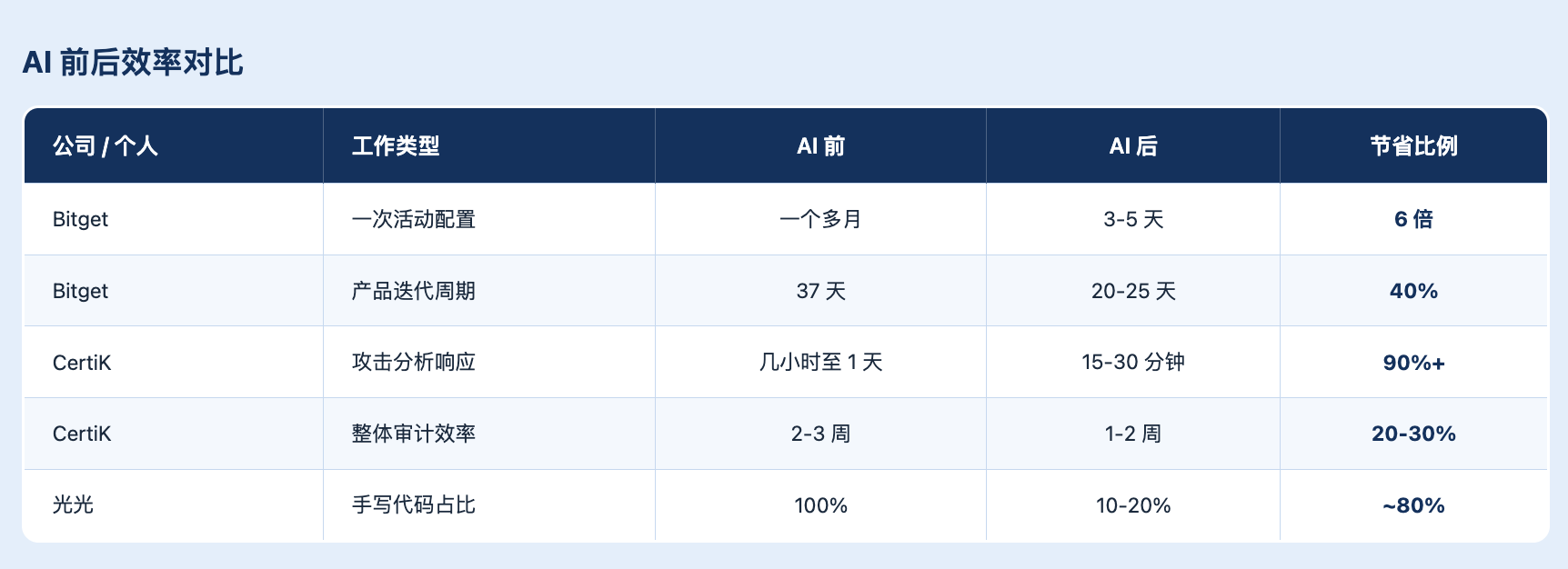
The product iteration cycle at Bitget has been reduced from an average of 37 days last year to 20-25 days, with a goal of under 10 days. The operational team's activity configuration cycle has been even more aggressive—reduced from over a month to 3-5 days, making it six times faster.
"Previously, a single activity—from idea conception to actual launch—would take over a month. This included competitor research, event ideation, configuration, material translation (into 23 languages), material design, launching, and data analysis—each step was labor-intensive and needed manual integration," Will described.
After the launch of BG Agent, this entire set was compressed. Research was done using research agents generating tables with a few commands, configurations were generated automatically for approval, translations were shortened from 7 days to 1 day or even 5 minutes, and data analysis was reduced from 2 weeks to 2 days.
On the product level, the release rhythm of AI-related products at various exchanges is also very tight, only in the first half of 2026: At the end of March, Binance launched AI Pro beta, integrating agentic trading onto the main site; in April, they added 13 Agent Skills; in mid-May, Bitget announced that its AI trading ecosystem surpassed 1 million users and an accumulated trading volume of $1.2 billion; on June 17, Bitget's AI strategy product Playbook officially launched; and at the beginning of July, OKX pushed the competition in a new direction—launching a marketplace where AI agents can hire each other and settle autonomously, with CertiK among the first 50 service providers. The intervals for product releases among top exchanges are now measured in weeks.
In the crypto security sector, the shape of the story is different but the direction remains consistent.
On CertiK's threat monitoring line, AI has reduced the response time for attack analysis from a day or several hours to under 15-30 minutes—a reduction of over 90%. Today, over 90% of the attack events at CertiK undergo preliminary analysis via AI.
However, another set of numbers he provided is even more noteworthy—he informed us that CertiK's overall work efficiency has increased on average by about 20-30%. This number may sound lower than expected, but Xue Yue provided a detailed explanation: "Audits demand a high level of accuracy. For contracts with 3,000 to 5,000 lines of code, our auditors used to spend 1-2 weeks genuinely looking for vulnerabilities, plus 3-4 days to understand the code and 1-2 days to write reports. After AI came in, most of the report writing portion is handed over to AI, and the time needed for code comprehension has also been greatly shortened. But for the actual 'finding vulnerabilities' segment—humans still have to be responsible for cross-checking and ensuring quality."
Overall efficiency improvement of 20-30% and a 90% gain in threat analysis efficiency—this contrast is the most accurate reflection of AI's implementation in the crypto security sector: AI cannot replace humans in high-density judgment areas; however, it has taken over all work in areas with high physical density.
Back to the developer side. Developer Guang Guang's proportion of handwritten code has decreased from 90% to 10-20%—the remainder is entirely delegated to AI. This is not an isolated case; according to IDC statistics, 91% of developers in the US have used AI programming tools, and China has reached 30%.
The arrival of "menial tasks being taken over by AI" in the constantly running cryptocurrency industry is akin to equipping a production line with a turbo engine, not only providing non-stop operation but also exponentially increasing output.
“Will I be optimized away?”
In this arms race, it seems no one chooses to completely forego AI, as the cost of not using it is marginalization. But this has not always been the case.
Xue Yue, the head of AI research at CertiK, said: “In 2024 and 2025, many people in the industry were strongly opposed to AI—they refused to let AI participate in any Web3 security work. But by this year, these individuals have almost all embraced AI, even more aggressively than we did.”
Inside the company—opposition has never truly vanished. They have simply transformed their resistance from open and intense to underground and silent.
Bitget has adopted a relatively radical attitude towards implementing AI, and a saying circulates among them: "In the future, there will be two types of people: those who use AI and those who do not. And those who use AI will eliminate those who do not." They have been vigorously promoting AI coding since August 2025, and by March 2026 even non-R&D teams will fully embrace AI.
Initially, the proliferation of AI tools was not smooth sailing. Because what Bitget aims to do is establish a comprehensive AI efficiency system—BG Agent—while ensuring user data security. As Will describes, many people were initially reluctant to use this in-house system because of the need for retraining. They would say there are so many external AI tools that can accomplish tasks, why insist on using theirs? Ultimately, it boils down to resisting the change in existing work habits.
Some also repeatedly claimed they could not learn, continued working inefficiently and were hesitant to proactively explore how to use these tools. Will had to demonstrate again.
Will wryly remarked: “What we can offer is the method to catch fish, but we can’t deliver fish daily to your doorstep.”
This is the overt resistance. Once everyone truly experiences the system's efficiency improvement, they enter another state—acceptance mixed with anxiety.
After a comprehensive sharing session, a colleague expressed his thoughts, indicating that AI makes him very anxious—“What will I do next? Do I still have value in the company? Will I be optimized away?” Because once AI strengthens, they'll feel replaced.
Whether it can fully "replace" may not yet have an answer. However, from the perspective of job recruitment, job directions are indeed undergoing a transformation, where the thresholds for positions like translation and customer service have been lowered by AI, decreasing the number of those roles, but at the same time, some new positions are also emerging.
A report shows that out of the more than 380 roles Binance is globally recruiting in 2026, 20% are directed towards AI technologies and products, with 28 training courses across 8 categories in AI offered internally—expanding against the backdrop of contraction in the entire tech industry. The total number of positions has not decreased, but the content of these positions is changing: newly added roles include AI trainers and prompt engineers, while thresholds have been lowered for translators and customer service roles.
CertiK's experience is roughly similar, as Xue Yue indicates that the company has not carried out large-scale layoffs due to the development of AI; on the contrary, since the rollout of the coding agent last year, many ordinary individuals who previously did not have the capability to participate in audits have now entered the realm of finding vulnerabilities and bug bounty hunting. The submission volume on major audit bounty platforms has increased from dozens to hundreds and thousands, but behind these submissions, it still requires researchers to manually filter for reasonableness, which is very mentally consuming. Xue Yue believes that instead of considering whether one will be replaced by AI, it is better to think about how to improve accuracy amidst the noise brought by AI.
That line must be held in one’s own hands
After understanding the efficiency, impact, and people's reactions brought by AI, the final question arises: which decisions can be entrusted to AI, and which must be made by humans?
Developer Guang Guang is also a seasoned meme player, and in his view, the areas where AI is truly useless in the cryptocurrency industry are in trading—“In meme trading, AI has no advantage; what matters is information source and speed. News from WeChat groups is faster than Twitter; by the time someone on Twitter calls out a signal, it’s basically at the buy-in phase.”
He created a tool to monitor dog coins: allowing AI to automatically monitor his followed Twitter accounts and filter tweets related to project progress or cryptocurrency based on prompt keywords. He no longer needs to scroll through the entire timeline but only views the parts filtered by AI. Guang Guang said that with the aid of AI, information collection has become easier.
"The risks of dog coins are too great— it's not guaranteed that simply staring at a computer for 24 hours will yield profit, and it’s even harder when relying on AI."
Therefore, Guang Guang drew a line between himself and AI in trading: AI can watch for me, but don’t act for me.
The same logic has been established as product rules at Bitget.
When asked how to draw the boundaries between human and "AI automatic trading," Will used a metaphor—“Humans are always anxious about the money put in. You can’t start by letting AI automatically trade with $100,000; what if you lose? Therefore, humans must hold that line, like flying a kite—when the line is in your hand, there is confidence; when the line is not in your hand, the kite flies off to who knows where, and cannot return, and you lose all confidence.”
Bitget's AI trading product, Playbook, launched this year, reflects this logic concretely. Initially, it limited each user to only use a sub-account of $2,000 for AI automatic trading—tightening the line.
However, Will noticed a change: after users personally tried AI trading, they began to proactively request to extend the line a bit. Some users wanted to increase the limit to over $10,000.
The boundary is not fixed. After using it, people will reassess where it should be drawn.
Beyond trading, the boundaries at the decision-making level are more stringent.
Within Bitget, the final decisions are still made by employees, not AI. "AI's decision-making advantage is not yet evident. AI will provide suggestions, but final decisions are still made by humans."
Xue Yue pointed out, "What is most scarce is judgment. Discovering problems is more challenging than solving them. When AI gives you a solution, how do you assess whether that result is accurate and free from illusions—these two tasks are the most difficult."
He provided an example, "The hardest part is not validating vulnerabilities, but how to notice that there might be a vulnerability in that area. It’s like doing math problems; the hardest part isn't calculating the answer but noticing that 'there's a solution here'." In other words—before making a decision, you first need to know "there’s a decision to make." This step, AI is still incapable of performing.
Four completely different work scenarios—developers writing code, exchanges launching products, security companies conducting audits, and investors making investments—yet each role, whether by active choice or due to objective necessity, leaves the same task for themselves: decision-making.
This is the “Theseus's ship” that this round of AI penetration leaves for all cryptocurrency companies—when all the parts of a ship are replaced, is it still the same ship? The answer lies in the retained "decision-making."
This may be the meaning of the AI transformation in the cryptocurrency industry—AI has taken "doing" out of everyone’s hands, and decision-making has become the most scarce, valuable, and challenging task in this industry. Everyone must make decisions about "what to do."
“Don’t face the current AI; face the future AI. What it can do today doesn’t matter; what matters is that it’s getting stronger every day.” Xue Yue concluded the interview with this statement.
But precisely because of this, that line must be held in one's own hands.
免责声明:本文章仅代表作者个人观点,不代表本平台的立场和观点。本文章仅供信息分享,不构成对任何人的任何投资建议。用户与作者之间的任何争议,与本平台无关。如网页中刊载的文章或图片涉及侵权,请提供相关的权利证明和身份证明发送邮件到support@aicoin.com,本平台相关工作人员将会进行核查。


