EF layoffs, the establishment of Ethlabs/EI in succession, Ethereum is consciously decentralizing protocol development, R&D transformation, and institutional adoption to different organizations.
Written by: imToken
In the past two weeks, there has been an unprecedented transformation at the organizational level of Ethereum.
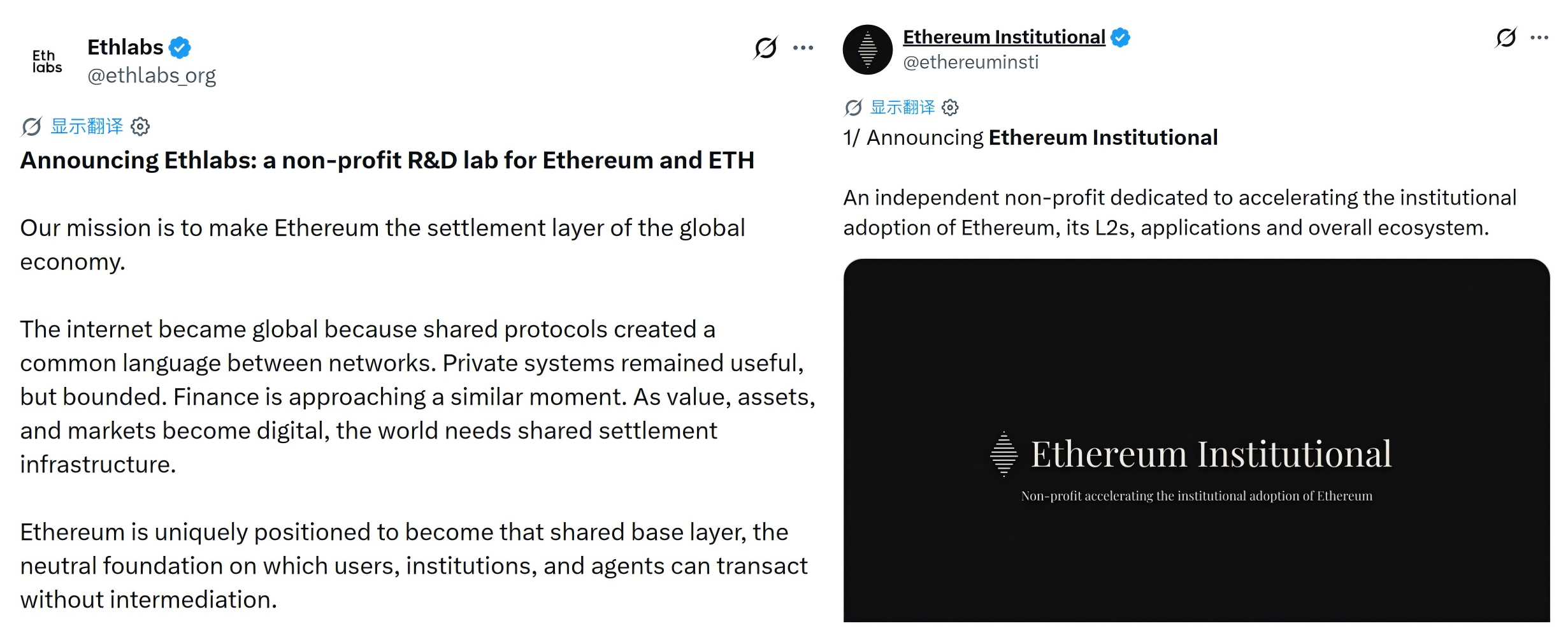
- On June 22, 2026, five former core researchers of the Ethereum Foundation announced the establishment of Ethlabs, an independently operating non-profit research and development laboratory;
- The next day, EF announced a new organizational structure, confirming the termination of cooperation with 54 employees — about 20% of the total number of the foundation;
- On July 1, another independent non-profit organization, Ethereum Institutional, was officially launched, taking over the institutional cooperation work previously managed by the EF market expansion team;
Viewed separately, these events can easily be summarized into a familiar pessimistic narrative: the foundation is facing financial crisis, core talents are leaving, and the ecosystem is in turmoil.
Similar narratives indeed abound in the market.
However, if we place these events on the same timeline, what we can see is a more complete picture, which is Ethereum is deliberately reducing its dependence on a single foundation, gradually decentralizing various functions that were previously concentrated within EF into multiple independent ecological nodes with different roles.
Ethereum seems to finally be attempting to answer an age-old question: as a decentralized network gradually becomes a global infrastructure, what should the organization driving its development look like?
1. Why does EF want to "actively become smaller"?
Realistically speaking, interpreting this series of changes in the context of traditional business is indeed likely to lead the vast majority of users to misunderstand; after all, in the narrative of traditional tech companies, layoffs almost always signify income pressure, business contraction, or strategic failure.
But the Ethereum Foundation is not an ordinary company.
It does not have shareholders in the traditional sense, does not aim for market share and quarterly profits, and does not "actually own" the Ethereum network. In a way, EF is essentially more like a protocol guardian, whose main responsibilities are to support core protocol R&D, fund public goods, coordinate ecological resources, and uphold those principles that should not be easily compromised during Ethereum's development.
This also creates an inherent tension for EF.
On one hand, Ethereum needs long-term investment in protocol R&D, organizational upgrades, and public goods construction; on the other hand, if R&D, funding, talent, and decision-making increasingly concentrate within the foundation, then EF itself would become the biggest source of centralization risk for Ethereum.
Therefore, EF has long adhered to a philosophy of "doing subtraction." According to EF's explanation of this concept, a healthy Ethereum ecosystem should not rely on an ever-expanding foundation but should be maintained by numerous independent organizations and contributors together. Hence, the foundation's success should ultimately manifest as its relative influence gradually declining rather than infinitely growing.
This thinking is not a temporary impulse. In the fiscal policy announced in 2025, EF had already clearly stated its intention to gradually shrink its scope of responsibilities, planning to reduce annual operating expenses over the next five years, ultimately moving towards a more long-term and sustainable foundation model.
Months ago, we also mentioned that since 2025, EF has indeed gone through a rather tumultuous period, at which time EF was at the center of a public relations storm, with rising criticism from the community, and some even called for the introduction of a so-called "wartime CEO" to push for change. Ultimately, a series of internal struggles surfaced publicly, forcing EF to undergo the highest-level power restructuring since its establishment:
- At the beginning of the year, Executive Director Aya Miyaguchi was promoted to President, and Vitalik Buterin committed to restructuring the leadership;
- Hsiao-Wei Wang and Tomasz K. Stańczak were then appointed as Co-Executive Directors;
- A new marketing narrative organization, Etherealize, led by former researcher Danny Ryan, was established;
- EF further restructured its board to clarify its values guided by cypherpunk ideals;
- By mid-year, the foundation also restructured its R&D department, integrating teams and making personnel adjustments to ensure that the core protocol priorities were focused;
It proved that this set of combined efforts significantly strengthened Ethereum's execution capability — on May 7, 2025, the Pectra upgrade was officially activated; less than seven months later, on December 3, Fusaka successfully launched on the mainnet. In the subsequent annual summary, EF referred to 2025 as one of the most productive years for the Ethereum protocol layer, as the two major upgrades made the often-discussed topic of "accelerating hard fork pace" seem closer to reality (See further reading: Ethereum 2026: Interpreting EF's latest protocol roadmap, officially stepping into the era of "engineering upgrades"?).
Therefore, from this perspective, the layoffs in June 2026 appeared as the first time this long-term strategy was presented to the outside world in the most direct manner.
After the adjustment, EF's work was divided into five main clusters, namely protocol layer, access layer, user layer, community layer, and institutional layer, plus operations, management, and related support teams. EF's explanation for cutting about 20% of its staff was to concentrate the organization and resources on "the work that only EF can and must perform."
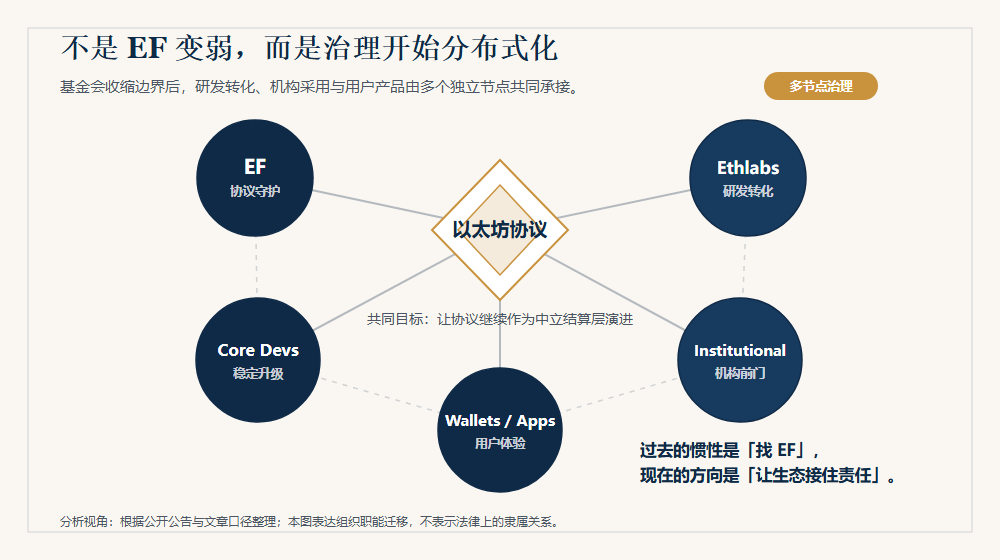
This is also an organization actively shrinking its boundaries, which raises the question of who will take on some of these tasks?
2. How to view Ethlabs and Ethereum Institutional?
If we must draw a metaphor, my understanding is that this change superficially resembles the "Three Kingdoms" — the talent, R&D, and institutional functions that were originally concentrated within EF are starting to decentralize into different organizations.
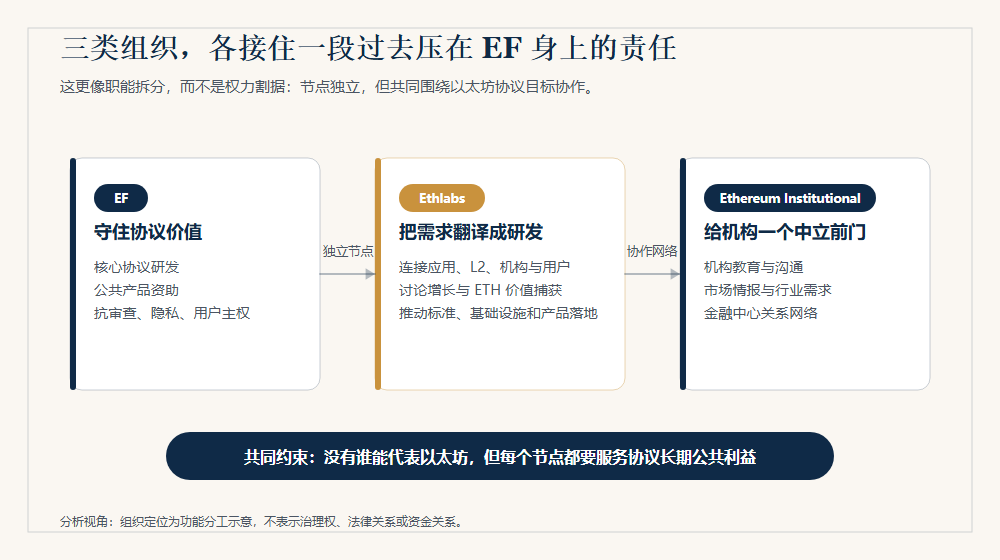
However, in terms of actual relationships, it is closer to a functional split rather than a power divide. That is, EF, Ethlabs, and Ethereum Institutional do not have a mother-son or superior-subordinate relationship in the traditional corporate system; instead, they resemble three differently positioned and interconnected nodes within the Ethereum governance network.
First, there is Ethlabs.
Although it was announced the day before EF revealed its layoff plan, five former Ethereum Foundation researchers founded it — the founding members include Ansgar Dietrichs, Barnabé Monnot, Caspar Schwarz-Schilling, Josh Rudolf, and Julian Ma, who are indeed heavyweight figures previously involved in research areas such as Ethereum finality, scalability, data availability, virtual machines, and protocol economics.
But Ethlabs distinctly defines itself as an independent non-profit research and development laboratory serving Ethereum and ETH, with a mission encapsulated in one sentence: "to make Ethereum the settlement layer of the global economy."
In Ethlabs' narrative, Ethereum should not merely be a blockchain for issuing tokens and running applications but should become a neutral settlement infrastructure jointly used by digital assets, stablecoins, on-chain markets, institutions, and AI Agents.
This mission establishes a crucial distinction between Ethlabs and EF:
- EF's core task is to ensure that Ethereum does not sacrifice censorship resistance, privacy, and user sovereignty for short-term adoption and commercial interests. Its official organizational description even clearly states that the protocol team's responsibility is not to make Ethereum easier to market, nor to transform it into a financial rail controlled by intermediary institutions.
- In contrast, Ethlabs is different; it can more explicitly discuss growth, the value capture of ETH, institutional demand, and real-world adoption;
In other words, it positions itself between two worlds. On one side are wallets, applications, Layer 2, infrastructure teams, institutions, and real users; on the other side are Ethereum's core protocol, researchers, and core developers, actively transforming the real needs of the former into protocol R&D, shared standards, infrastructure, and deployable products.
This also helps us better understand the positioning of Ethereum Institutional. If Ethlabs undertakes the "research-driven growth transformation" after EF hands off responsibilities, then Ethereum Institutional takes on the "commercial and compliance promotion" that EF originally solely handled.
In simple terms, this non-profit organization directly takes over the institutional cooperation work previously managed by the EF market expansion team for over a year, positioning itself as the "neutral front door" for traditional institutions to enter the Ethereum ecosystem, aiming to answer a long-unanswered question for Ethereum: when a bank or asset management firm wants to deploy products on Ethereum, who should they contact?
This question has become increasingly urgent over the past few years.
It is well-known that ecosystems like Solana have a clearer foundation, business development team, and institutional cooperation window, continuing to make inroads into global financial institutions thanks to high salaries and aggressive sales teams. In contrast, Ethereum, due to its emphasis on decentralization and trusted neutrality, has long lacked a unified external interface.
This presents a deep-seated paradox, as neutrality is an advantage in both technology and governance; however, in practical business environments, neutrality also means "no clear person in charge." When an institution like BlackRock wants to deploy on Ethereum, it hopes to see a team that can maintain contact, rather than a foundation with an absolutely neutral, lofty stance that is unwilling to pander to Wall Street and sovereign wealth funds like a traditional company.
Ethereum Institutional aims to resolve this paradox. No one can represent Ethereum, but institutions still need a party they can continuously communicate with.
Therefore, being incubated by Bitmine, Sharplink, and Joe Lubin, and led by seasoned professionals like former Blackstone Group veteran Joseph Chalom, undeniably provides a distinct advantage to directly engage with banks, asset management firms, custodians, market infrastructure providers, fintech companies, and sovereign institutions.
According to its released information, Ethereum Institutional primarily covers five types of work, mainly helping everyone understand Ethereum, articulate needs, and translate those needs into truly actionable on-chain projects:
- Institutional education and communication: helping traditional financial institutions understand Ethereum's technical architecture, governance model, and ecological status;
- Institutional market intelligence: tracking and analyzing trends, barriers, and best practices for institutional adoption of Ethereum;
- Promotion of ETH and the Ethereum ecosystem: articulating Ethereum's value proposition to the traditional financial world;
- Research on industry needs and standards: converting institutional practical needs into standard recommendations and product requirements;
- Institutional events and relationship networks: continuously building relationships in financial centers like New York, London, Hong Kong, and Singapore;
As a result, a clearer division of labor system within Ethereum begins to emerge: EF is responsible for protocol value and public interest, Ethlabs is responsible for the transformation between R&D and growth, Ethereum Institutional is responsible for institutional adoption, while wallets, applications, and infrastructure teams are responsible for the final products and user experiences.
This also means that Ethereum governance is shifting from the relatively vague "EF coordinates everything" to a more modular structure.
3. From "EF drives Ethereum" to "the ecosystem jointly safeguards Ethereum"
In the past, although Ethereum's governance structure was highly open, many key responsibilities naturally converged onto EF, and it can even be summarized as the relatively vague "EF coordinates everything."
When protocol R&D encountered problems, people would look to EF; when the market narrative lagged, people would criticize EF; when ETH performed poorly, institutional adoption was slow, or user experience had not improved for a long time, the outside world often attributed the blame to EF.
This is, in itself, a contradiction. Ethereum aspires to be a decentralized network that does not rely on any single organization, but the entire ecosystem has long been accustomed to seeing EF as the ultimate responsible party.
Now, a more modular structure is forming, with each key function having a corresponding independent organization to take on the role. They are no longer in a superior-subordinate relationship, but interlinked through shared protocol goals and ecological interests.
Of course, this does not mean that Ethereum has found a perfect new governance model; on the contrary, the real test is just beginning.
When different functions are decentralized into independent organizations, Ethereum needs to face higher coordination costs and must prevent different teams from acting independently, duplicating research, allowing funders to influence technical directions, and institutional adoption gradually overshadowing the interests of ordinary users.
But from another perspective, this uncertainty itself is also a cost that must be paid for decentralization. A truly decentralized protocol should not forever depend on an ever-expanding foundation, nor should it lose its capability to continue developing just because a few core members leave.
The key to judging whether this transformation is successful is not how many people EF has left, but:
- whether the core protocol can continue to upgrade steadily;
- whether research talents can remain within the Ethereum ecosystem after leaving EF;
- whether independent organizations can maintain collaboration and mutual checks and balances;
- whether institutional adoption can expand without sacrificing openness and user sovereignty;
- whether wallets and applications can turn underlying advancements into products that ordinary users can actually use;
If these goals can be achieved, the decline in EF's influence may actually prove that Ethereum is becoming more mature.
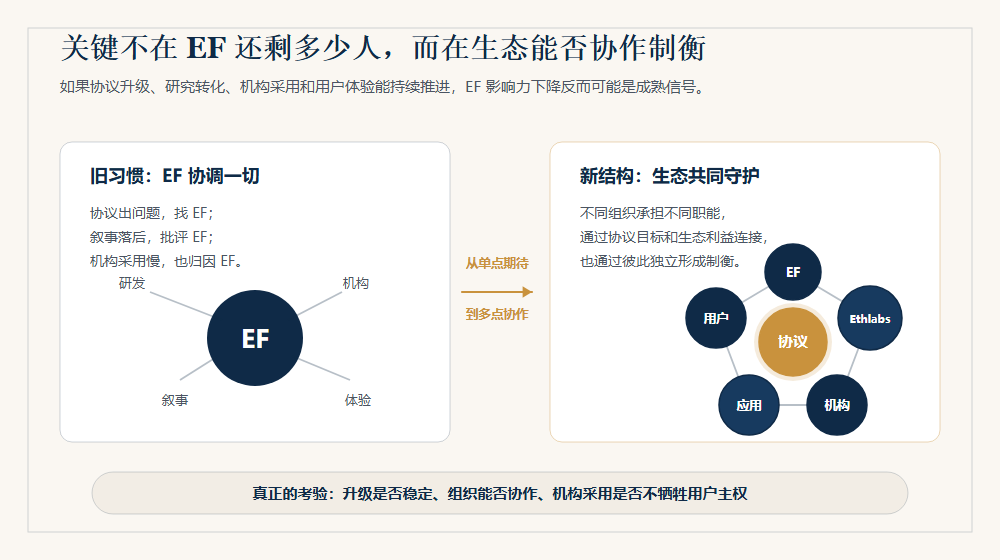
At that time, Ethereum will no longer be a seedling that needs constant support from the foundation but will become an ecosystem jointly maintained by the foundation, research institutions, developers, wallets, applications, enterprises, and users.
Just as Ethereum's decentralized network architecture, Ethereum's governance structure has, in 2026, finally become distributed.
We also firmly believe that this is not the end of a crisis but a new starting point for a more resilient and vibrant Ethereum ecosystem.
免责声明:本文章仅代表作者个人观点,不代表本平台的立场和观点。本文章仅供信息分享,不构成对任何人的任何投资建议。用户与作者之间的任何争议,与本平台无关。如网页中刊载的文章或图片涉及侵权,请提供相关的权利证明和身份证明发送邮件到support@aicoin.com,本平台相关工作人员将会进行核查。


