The original text comes from:WSJ
Translation | Odaily Planet Daily (@OdailyChina)
Translator | Wenser (@wenser2010)
Editor's Note: The controversy surrounding OpenAI and Sam Altman has never ceased. Some view him as a leader in AGI, considering him the core soul leading tech elites to challenge and explore the forefront of AI, dubbing him the "Father of AI"; others see him as a schemer, often citing the transformation of OpenAI from a nonprofit to a commercial company, his factionalism within the OpenAI board, and the removal of dissent. However, in terms of personal wealth, Altman is not as notable as global billionaire Elon Musk, yet in his own way, aided by his position as OpenAI CEO, he has carefully built a personal "wealth closed loop," making him a "modern alchemist of AI wealth."
This issue, Odaily Planet Daily will unveil "Sam Altman's personal alchemy mystery" in conjunction with a recent investigation by The Wall Street Journal. Below is the main content, with some portions edited, Enjoy~
The "Personal Wealth Network" Built by Altman: A Private Equity Wealth Group Centered Around OpenAI
Most of Sam Altman's personal wealth is spread across a vast network of tech companies, including high-tech firms like fusion company Helion and even a startup focused on building new cities along the Mediterranean coast.
It is evident that many of these companies have already established various business partnerships with OpenAI, forming a complex network of investment interests. As OpenAI prepares for an IPO and undergoes close scrutiny and review, last month, the U.S. House Oversight Committee initiated an investigation into Altman's potential conflicts of interest, with several state attorneys general calling for the U.S. SEC to intervene and review.
Notably, he does not directly hold shares in OpenAI (with a latest valuation of $852 billion), which indicates a rare phenomenon—his personal interests are not directly tied to the company he leads. Given this background, The Wall Street Journal has outlined dozens of his investments and analyzed the impact of certain transactions on his personal wealth.
Altman's "Investment List": About 400 Investment Projects, At Least 10 Companies with Cooperation or Potential Contacts with OpenAI
Three years ago (around 2023), during an external event, Altman stated that he was involved in investments in approximately 400 active startups in the market. Based on public data and investigative reports, The Wall Street Journal selected over 80 of these investment projects, many of which trace back to his time leading the venture capital firm Y Combinator.
These investments are mostly concentrated in fields closely related to the AI wave, including software, biotechnology, and energy.
Among his personally invested companies, at least 10 have formed business partnerships with OpenAI or had recent discussions regarding such collaborations.
After Altman's personal investment, OpenAI established research collaborations with at least two biotechnology companies.
According to evidence submitted during the trial of Musk versus OpenAI last month, the relevant shares in one of the companies Altman holds—anti-aging startup Retro Biosciences—were valued at $258 million as of December of last year.
Additionally, the chip manufacturer Cerebras, known previously as the "next Nvidia," was invested in by Altman nearly 10 years ago. The key factor driving its IPO was the recent chip procurement agreement OpenAI reached with it. After Cerebras' IPO, the shares Altman held increased in value by more than six times compared to last December.
Typically, the CEO of a public company is advised by the board not to hold substantial shares in external companies. The reason is that this may create entangled interests, prompting them to engage in transactions favorable to their own shareholdings, or expose them to risks of being accused of "self-dealing transactions."
However, OpenAI board chairman Bret Taylor stated that Altman has always maintained high transparency in disclosing his involvement in other business matters, and OpenAI also prudently manages potential conflicts of interest.
Altman's "Energy Layout" Achievement: Made $4.1 Billion from Nuclear Fusion Startup Helion
When mentioning the largest investment project Altman has participated in, the nuclear fusion startup Helion is certainly among them.
He initially started investing in the company while serving as president of Y Combinator. The company claims to be close to achieving commercial power generation, but it never publicly shares its research results, making independent verification of its external statements difficult.
On the other hand, OpenAI's collaboration with Helion, which Altman has vigorously promoted, has also sparked significant internal controversy.
Below is a timeline of Altman's over 10-year "entanglement of interests" with Helion—
In 2015, Altman invested in Helion and became its board chairman. The same year, he co-founded OpenAI.
In 2021, while leading OpenAI, Altman made an additional investment in Helion. That year, he invested $375 million, marking the largest single investment he has ever made in a startup.
In 2024, OpenAI signed a non-binding agreement with Helion to purchase power resources in the future. During the trial between OpenAI and Musk, former OpenAI board member Shivon Zilis (note: mother of Musk's four children) testified that this deal was "unexpected," as nuclear fusion remains a "speculative technology" (Odaily Planet Daily: as if they were about to write "such projects are scams" across their forehead).
In 2025, Japanese investment firm SoftBank invested in OpenAI, and Altman subsequently lobbied SoftBank to invest in Helion, which they complied with. Months later, The Wall Street Journal reported that Altman urged OpenAI to invest about $500 million in Helion, which made some OpenAI employees feel suspicious and uneasy. Ultimately, OpenAI rejected the investment proposal.
In 2026, OpenAI signed a revised agreement with Helion in March; that same month, Altman resigned as Helion's board chairman, citing future cooperation with OpenAI. OpenAI stated, "The board determined this agreement was in the 'best interest' of the company," without pointing out any issues.
In 2026, in June, Helion announced a new funding round at a valuation of $15.5 billion, with OpenAI strategic investor Thrive Capital as the investor. Insiders revealed that Altman's stake in Helion consequently doubled in value, worth at least $4.1 billion.
Lastly, the company behind World Coin, which developed the iris scanning company Tools for Humanity, co-founded by OpenAI CEO Altman and others and previously valued at $2.5 billion, has recently returned to the spotlight due to internal investigation scandals.
According to Business Insider, amidst collapsing cryptocurrency prices, global regulatory crackdowns, and business contraction layoffs, the company initiated two investigations led by external law firms, targeting improper use of funds by executives and alleged violations in the Thai market.
Previously, OpenAI faced criticism for the trillion-dollar contracts it secured with major cloud providers and chip manufacturers, including a $500 billion partnership with chip giant Nvidia, a $300 billion agreement with AMD, a $300 billion cooperation with cloud provider Oracle, and a transaction exceeding $22 billion with data center group CoreWeave.
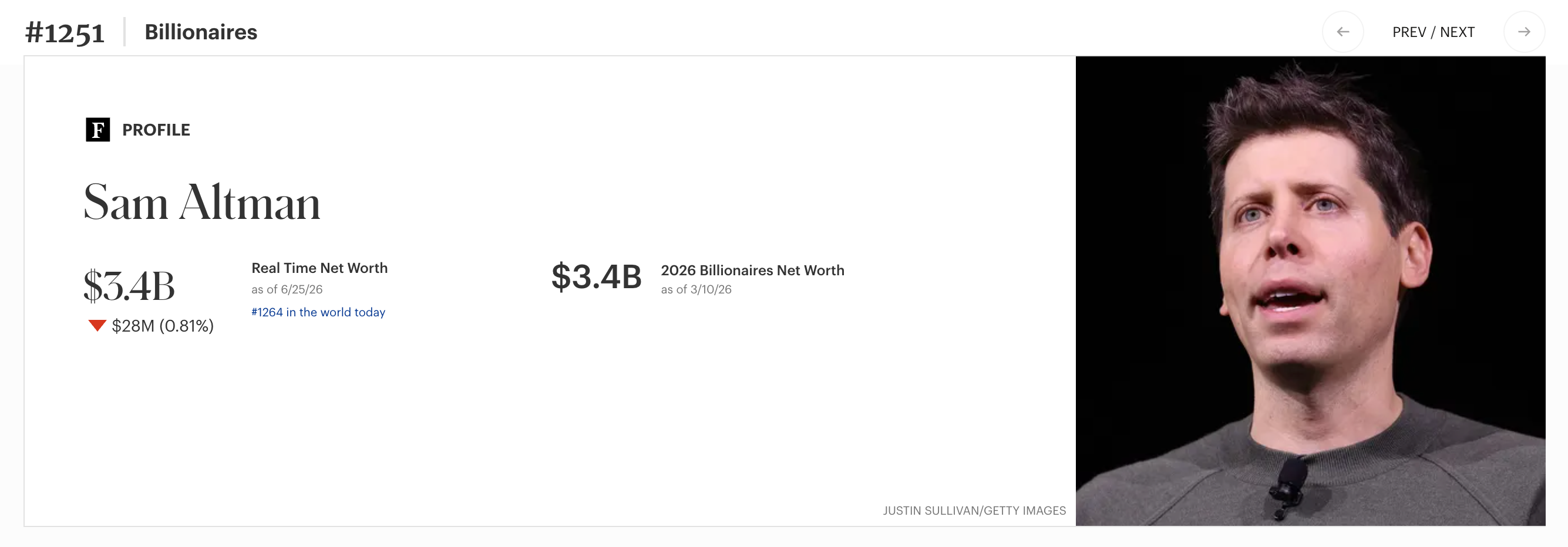
According toForbes Billionaires List Data, Sam Altman currently ranks 1251st on the global billionaires list, with a personal net worth of approximately $3.4 billion. Additionally, he has investments in well-known tech companies like Stripe and Reddit. As of April 2024, Altman was ranked only 2692nd on this list, and in the two years since, his personal net worth ranking has risen by over 1400 places; note that this list encompasses the wealth ranking of over 8 billion people worldwide.
免责声明:本文章仅代表作者个人观点,不代表本平台的立场和观点。本文章仅供信息分享,不构成对任何人的任何投资建议。用户与作者之间的任何争议,与本平台无关。如网页中刊载的文章或图片涉及侵权,请提供相关的权利证明和身份证明发送邮件到support@aicoin.com,本平台相关工作人员将会进行核查。


