The proportion of compliance positions has risen to 10.4%, with CEX and stablecoins becoming the absolute mainstay of recruitment.
Written by: @Fromadistance11 & @ryanyoon_eth
Translated by: AididiaoJP, Foresight News
Although the overall hiring scale in the cryptocurrency industry is still shrinking, compliance and legal positions have seen significant growth against the trend. Demand for engineering roles remains resilient, with centralized exchanges (CEX) and the stablecoin sector becoming the main drivers of recruitment. This report, based on real job data, clearly outlines the industry's trajectory from the speculative era to institutionalization and compliance.
Key Points
The cryptocurrency recruitment market has not yet recovered to its peak in 2022. According to Coincub data, the number of new cryptocurrency positions in 2025 will reach 66,494, reflecting a year-on-year rebound of 47%, but still far below the 2022 peak.
In 2026, the contraction further intensified, with major recruitment platforms seeing a year-on-year decline of approximately 80% in January in new positions.
As of the first half of 2026, among the 2,932 active positions tracked by Tiger Research, engineering roles accounted for the highest share at 34.1%; compliance/legal roles ranked second with a share of 10.4%. Active positions are highly concentrated in regulatory compliance and technical development fields.
By sector, CEX accounted for 30.8%, while stablecoins and payments accounted for 13.4%, together nearing half of all positions. The gaming and NFT sectors comprised only 2.4%.
The past market, driven by token sales, had demand concentrated in community operations and token sales roles. As the market shifts towards institutional participation, the importance of product operation management and regulatory compliance capabilities has significantly increased.
Recruitment Peaks in 2021-2022 and Current Market Status
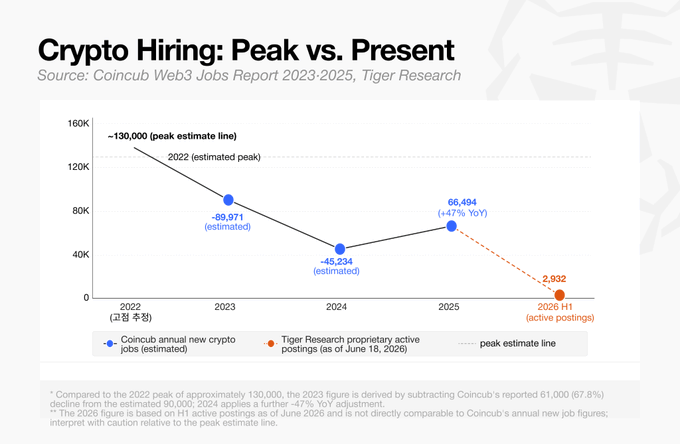
The cryptocurrency industry's most booming recruitment period was from the end of 2021 to the first half of 2022. At that time, Bitcoin and Ethereum both reached historic highs, NFT trading volume skyrocketed, and the total locked value in DeFi reached hundreds of billions of dollars at one point.
Major centralized exchanges were frantically expanding their global businesses. At that time, Coinbase had over 250 open positions, Kraken over 300, and Binance over 600. DeFi protocols and the NFT market were simultaneously recruiting engineers and marketing talents in large numbers, while the GameFi boom also brought traditional gaming studios into the recruiting army. At the time, the focus was more on rapid expansion rather than immediate proof of profitability.
From the second half of 2022 onward, the number of new positions saw a sharp decline. Between 2022 and 2023, cryptocurrency-related positions in most regions of North America and Europe decreased by about 40%. The collapse of FTX in November 2022 further exacerbated this slowdown, and the market has not been able to recover to peak levels since then.
To accurately grasp the current state of cryptocurrency recruitment and read market directions from the data, Tiger Research compiled a proprietary dataset. As of June 2026, a total of 2,932 active positions have been tracked. The data sources include web3.career, cryptocurrencyjobs.co, major company career pages (Greenhouse, Ashby, Lever, etc.), and manual collection from local South Korean platforms Wanted and Jobkorea. DAO contributors, freelancers, and contract positions are not included in the statistics.
Major Cryptocurrency Companies Continue Layoffs in First Half of 2026
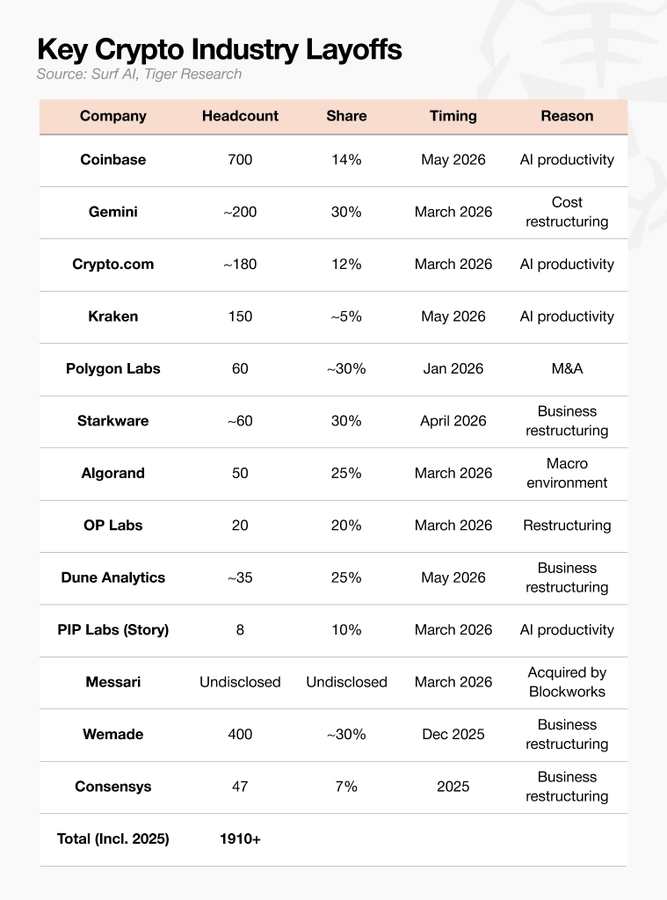
Restructuring had already begun before the first half of 2026. Wemade and Consensys had already conducted layoffs in the second half of 2025, and in 2026, this trend continued to Coinbase, Gemini, Crypto.com, Kraken, and other major exchanges.
March was the month with the most concentrated layoff announcements in the first half of 2026, with six companies including Gemini, Crypto.com, Algorand, OP Labs, PIP Labs, and MessariCrypto disclosing layoffs in the same month. In the first quarter, multiple companies chose to reset their strategic direction at this time due to geopolitical tensions in places like Iran and overall market weakness.
The reasons provided by companies vary: Algorand mentioned the macroenvironment and falling token prices; Crypto.com and Gemini emphasized AI integration; Coinbase announced it would transform into an "AI native company."
Some companies, after multiple rounds of layoffs, were ultimately acquired at prices far below previous valuations. Messari underwent three rounds of layoffs starting in 2023 and was acquired by Blockworks in June 2026 for approximately $10 million. At its peak, its valuation was as high as $300 million, a trajectory that encapsulates the harsh reality of the current market.
Recruitment is Concentrating in Specific Regions
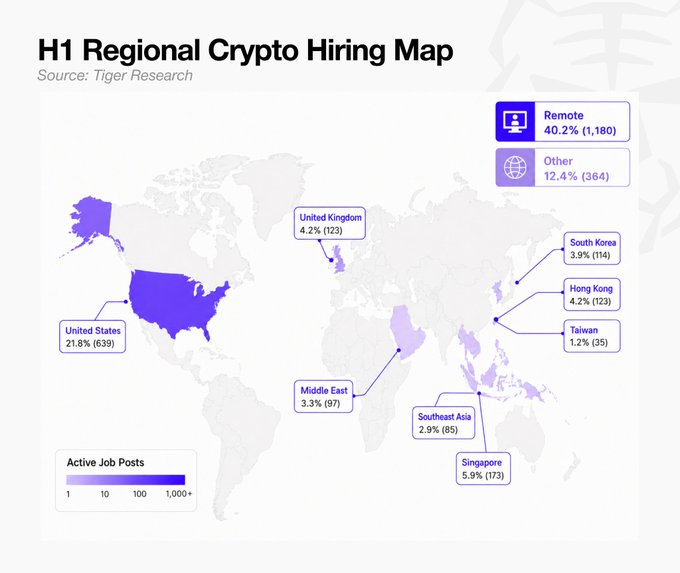
The cryptocurrency industry still has a high percentage of remote work. In the active positions of the first half of 2026, remote positions accounted for the largest share, reaching 40.2% (1,180 positions).
Excluding remote positions, office recruitment is mainly concentrated in areas with mature regulatory frameworks or lower uncertainty: the United States accounted for 21.8%, Singapore 5.9%, and Hong Kong 4.2%.
Once branded as "borderless," the cryptocurrency industry now increasingly requires local operations and proactive regulatory engagement, with the recruitment structure gradually concentrating in these mature regulatory hubs.
Compliance Roles are Rapidly Rising
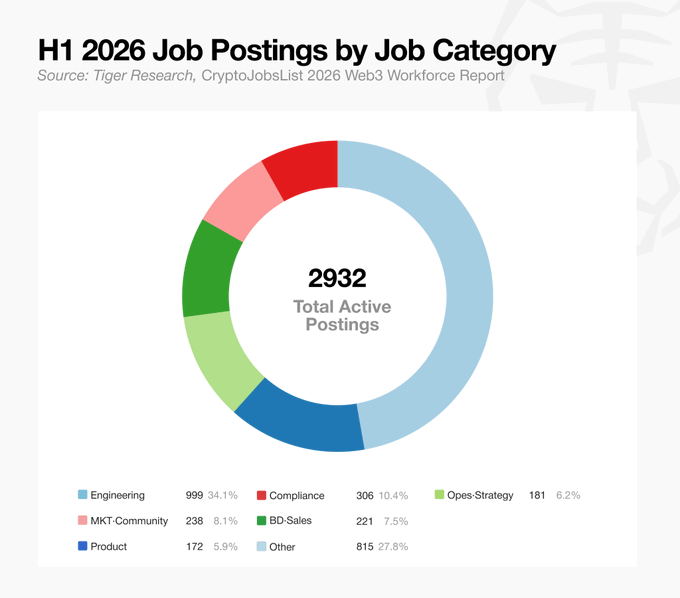
Engineering positions still ranked first in the first half of 2026, accounting for 34.1% (999 positions), indicating that even in an overall shrinking market environment, demand for technical development remains robust.
Of particular note is that compliance and legal roles have established themselves firmly in second place. In Tiger Research's 2023 Global Cryptocurrency Job Report, this category was not yet independently tracked, and within just three years, it has accounted for one-tenth of all active positions.
This trend is especially evident in the exchange sector. Among 904 exchange positions, there are 275 in engineering (30.4%), 145 in compliance and legal (16.0%), and only 61 in business development/sales (6.7%). The number of compliance positions is 2.4 times that of business development/sales, indicating that exchanges are investing more resources in regulatory defenses rather than business expansion.
The growth in compliance recruitment is partly due to the comprehensive implementation of the EU MiCA framework—effective December 30, 2024, the CASP license becomes a mandatory requirement. European exchanges and asset management companies have simultaneously expanded their compliance teams significantly.
A similar situation has arisen in South Korea. After the implementation of the "Virtual Asset User Protection Law" in July 2024, the domestic demand for compliance talent has evidently increased. This also explains why the proportion of compliance positions in South Korea reached 18.4%, nearly twice the global average (10.4%).
A survey by CryptoJobsList showed that content creation and community management are the functions most hoped to be automated. These two types of work often involve repetitive tasks and emotional labor, with relatively low technical complexity, making them areas where AI agents may be replaced first. Currently, the recruitment demand for these positions is decreasing, and practitioners themselves believe they are most suitable for automation.
CEX Dominance Solidifies, Stablecoin Sector Rises Strongly
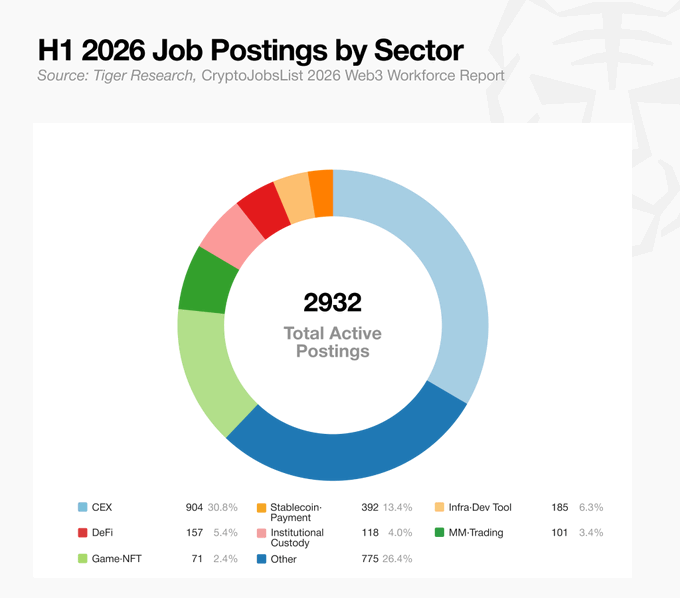
The CEX sector comprises 904 positions, accounting for 30.8%, close to a third of all positions. The main contributions come from leading exchanges such as OKX (267), Bybit (138), and Binance (135).
The stablecoin and payment sector ranks second, with 392 positions (13.4%). However, Tether alone accounts for 224 (57.1%), and Ripple contributes 104 (26.5%), making up 83.6% of this sector. This indicates that current data reflects the concentrated hiring of a few large companies, rather than an overall sector explosion. The situation may change in the second half of the year—as U.S. legislation concerning stablecoins progresses, the recruitment environment in this sector is expected to undergo a substantial change.
The market-making and trading sector has reached 101 positions (3.4%), sufficient to stand alone. Major players include B2C2, GSR, Keyrock, and Wintermute. This category was not listed independently in the 2023 report; its emergence reflects the consolidation of institutional liquidity provision and asset management in cryptocurrency infrastructure.
The gaming and NFT sector only has 71 positions left (2.4%). This sector once led recruitment during the GameFi boom in 2022-2023, now its share has fallen below that of the market-making sector.
Current recruitment is no longer driven by cyclical bulls and bears but revolves around sectors emphasizing structural stability: exchanges, payments, and regulatory infrastructure.
Cryptocurrency Recruitment Market After AI Adoption
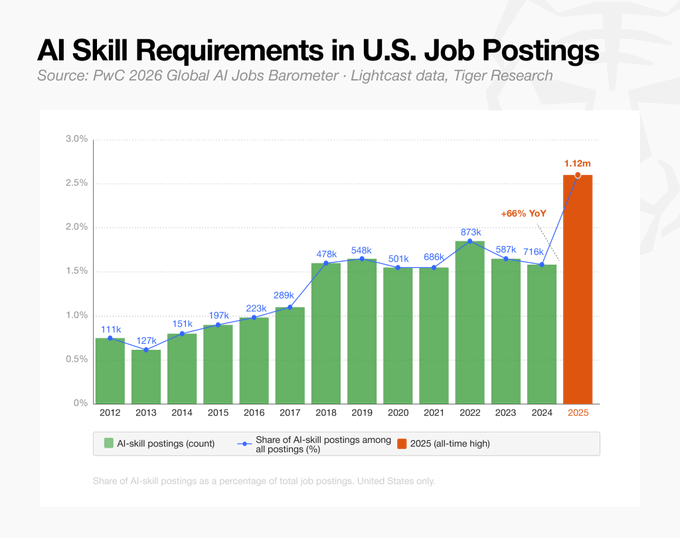
In the same period, the AI industry, however, has shown a completely opposite growth trend. PwC's 2026 Global AI Job Weather Report analyzed more than 1 billion job postings across six continents and found that in 2025, approximately 1.12 million jobs in the U.S. will require AI-related skills, a year-on-year increase of 66%, accounting for 2.8% of all jobs.
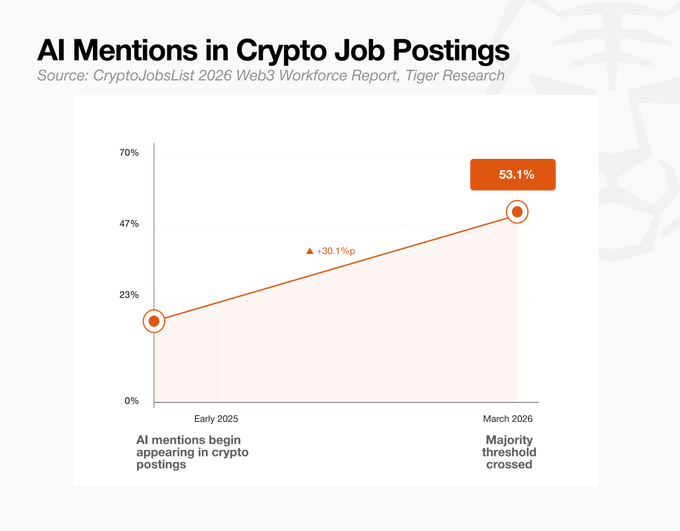
The cryptocurrency industry is also following a similar path. The proportion of cryptocurrency positions mentioning AI skills rapidly rose from 23% at the beginning of 2025 to 53.1% by March 2026.
Overall, AI is creating new jobs across various industries, while the cryptocurrency market achieves higher productivity through leaner teams.
The contraction of the cryptocurrency recruitment market and the selective elevation of standards
The global cryptocurrency recruitment market not only shrinks in scale but also undergoes fundamental changes in the nature of recruitment work.
The focus has shifted from marketing to regulatory compliance and infrastructure operations. The promotion of tokens and expansion of community roles that were common in past bull markets have significantly decreased; meanwhile, the demand for positions directly dealing with operating systems, exchange operations, stablecoin infrastructure, and on-chain risk management remains stable or even grows.
Communication with frontline practitioners confirms this shift. Project teams no longer emphasize seeking "degen" (decentralization enthusiasts) type talent. After an early education phase, the recruitment standards adopted by the blockchain industry today are as rigorous and demanding as those in traditional finance and fintech.
These changes indicate that the cryptocurrency industry has moved out of the speculative stage and is gradually integrating into the institutional mainstream. The market no longer needs those who build beautiful narratives, but rather needs professionals who can truly construct and validate reliable infrastructure.
Data source (Tiger Research proprietary dataset, as of June 18, 2026): web3.career, cryptocurrencyjobs.co, major company recruitment systems (Greenhouse, Ashby, Lever, Polymer), manual tracking from local South Korean platforms, manual LinkedIn samples, etc. External references include authoritative reports from Coincub, CryptoJobsList, PwC, LinkedIn, and others.
免责声明:本文章仅代表作者个人观点,不代表本平台的立场和观点。本文章仅供信息分享,不构成对任何人的任何投资建议。用户与作者之间的任何争议,与本平台无关。如网页中刊载的文章或图片涉及侵权,请提供相关的权利证明和身份证明发送邮件到support@aicoin.com,本平台相关工作人员将会进行核查。


