The group that created the strongest AI is becoming one of the first to be overwhelmed by it.
Written by: Astronaut Ape
Edited by: Jingyu
“On smooth days, I can't help but think that anything I do is meaningless; everything has been automated, better and faster than anything I could ever do in the future. But when everything collapses, I don’t know where things went wrong; at that moment, I realize I no longer know what I’m doing.”
This statement didn’t come from a laid-off programmer, nor from a customer service representative replaced by AI, but from an employee at Anthropic—one of the world's leading AI companies, the creator of Claude, an organization sprinting towards an IPO at a valuation of $965 billion.
They built AI, and then AI began to make them question the meaning of their work.
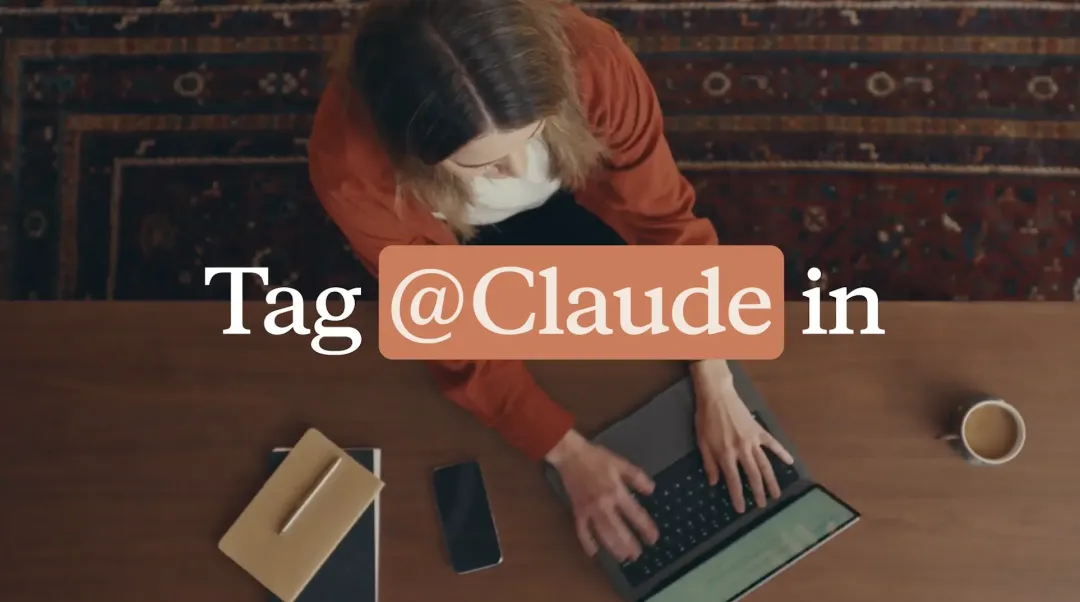
Anthropic released the AI employee Claude Tag | Source: Anthropic
On May 23 local time, Anthropic launched a new feature—Claude Tag, an “AI employee” that exists within the collaboration software Slack. In “environment mode,” Claude continuously monitors channel conversations, and when it determines an intervention is needed, it actively speaks up—summarizing a discussion, reminding of a missed detail, or retrieving the information you need from elsewhere within the company.
Needless to say, you already know that many office software options have actually defaulted to having “AI employees” to help employees “passively” feel the charm of AI collaboration.
However, beneath a seemingly “efficient” surface, everyone working alongside AI experiences “loneliness and frustration.”
Why is that?
01 Lonely Engineers
On June 21, Fiona Fung, the engineering lead of the Anthropic Claude Code and Cowork teams, spoke on Lenny's Podcast, and her comments were subsequently shared by multiple tech media outlets.
She mentioned that after extensively using Claude Code, the team discovered an unexpected issue—engineers began to feel lonely. Everyone was collaborating with their own AI agents, leading to a decrease in direct communication among team members.
This is not just a vague sentiment. Fung's team specifically implemented interventions—organizing pair programming lunches, hackathons, and scheduling “co-creation time” to attempt to restore that sense of collaboration between people. In other words, an AI company had to strategically design activities to counteract the erosion of team social structures caused by its own products.
To understand the source of this loneliness, one must look at a set of numbers.
On June 4, the Anthropic Institute released an internal research report titled “When AI Builds Itself.” The report disclosed previously unpublished data—by May 2026, over 80% of the merged code in the Anthropic codebase was written by Claude. Before the launch of Claude Code in early 2025, this figure was in single digits. Meanwhile, each engineer was merging code at a rate eight times greater than in 2024.
The report also included a comment from another employee: they hadn’t personally written any code for about five months.
Boris Cherny, the creator of Claude Code, was even more straightforward—he hadn’t hand-written a line of code in eight months and on some days managed thousands or even tens of thousands of AI agents. He
was no longer a coder but a dispatcher of AI agents.
In an internal survey at Anthropic, the median estimate from 130 researchers was that their output using AI was approximately four times what it was previously. The company proudly pointed out that Claude fixed over 800 API errors in April 2026 alone; if assigned to humans, this work would take four years.
But the report's wording also acknowledged a fact—“there remains a significant performance gap” between Claude and humans on the most open and judgment-requiring tasks. In a study test named “Next Step Judgment,” the latest model, Mythos Preview, selected the next step option with a 64% probability of being better than the actual choices made by human researchers. In November 2025, this number was 51%.
These numbers together paint a picture: human employees are still needed, but you become increasingly uncertain as to why.
AI has not replaced you. It’s that AI is performing so well that you start to doubt your own reason for “being here.” Your code was written by AI, your judgments are approximated by AI's judgment, your role has shifted from “creator” to “approver,” and you are not even sure whether what you are approving is beyond your understanding.
The latter part of that anonymous employee’s comment accurately describes this state: “On the day when everything collapses, I didn’t know what went wrong; at that moment, I realized that I no longer knew what I was doing.”
This is not the fear of unemployment; it is something deeper—a fundamental loss of self-worth and value.
What makes this even more unsettling is that these individuals are not fringe employees; they are engineers and researchers at Anthropic, at the forefront of AI capabilities.
If they have already developed such feelings, then how will ordinary knowledge workers, who lack their technical skills, feel when AI enters regular businesses in the form of Claude Tag, digital employees, and permanent agents in Slack?
02 Meta AI’s “Gulag”
If Anthropic's issue is “AI is too useful causing people to lose a sense of existence,” then Meta's problem is its mirror:
People being downgraded to fuel for AI.
In March 2026, Meta established a new department called Applied AI, specifically tasked with improving the company’s generative AI models. About 6,500 engineers and product managers were transferred to this department—but for many, this was not a promotion or reassignment but a forced conscription. An internal memo from the department head clearly stated that the transfer was not optional.
Those transferred began to refer to themselves as “draftees.”
They found themselves assigned to work on data labeling and RLHF (reinforcement learning from human feedback)—the foundational tasks for training AI models, repetitive, trivial, and vastly different from their previous software engineering roles. According to estimates from The Pragmatic Engineer, about one out of every five to six Meta engineers is now working full-time on data labeling.
Some employees described to WIRED that this work was “soul-crushing.” Some directly compared it to a “gulag.”
WIRED and Business Insider's reports painted a rather bleak picture—vague employee roles, unclear career development paths, and chaotic management hierarchies (with some managers having 50 direct reports), all happening just after Meta laid off about 8,000 employees (10% of the global workforce) in May 2026.
Ironically, that quarter, Meta’s net profit soared to $26.8 billion.
CTO Andrew Bosworth admitted in an internal employee meeting in early June that morale was “probably the worst, or close to the worst I have seen in 20 years at this company,” comparable to the Cambridge Analytica scandal. Later, in an internal memo, he wrote: “We have done a terrible job explaining the vision. We have shaken your trust that your expertise would be valued, your careers would progress, and you could have a real impact.”
Chief Product Officer Chris Cox used a more vivid metaphor—“running a marathon in a hailstorm.”
Bosworth promised to limit the number of direct reports for managers to around 20, reduce organizational changes during restructuring, and increase budget for travel, team building, and snacks. Some analysts noted this detail—using improved snacks to respond to an existential crisis suggests a certain disconnect.
When comparing Meta's case with Anthropic's, a complete picture emerges—
In Anthropic, humans and AI are in a parallel relationship. As AI becomes stronger, humans feel increasingly redundant.
In Meta, humans and AI are in a feeding relationship. Humans are downgraded to parts on the AI training assembly line.
Two paths, seemingly opposite, but ending in the same destination—the sense of human value is shattered.
Furthermore, Meta's situation reveals a harsher fact. In the age of AI, it’s not just “being replaced by AI” that harms people; “serving AI” does as well. You haven’t lost your job; you even got an “AI-related position”—but the essence of this job turns you from an engineer into a labeler, from a creator into a feeder. Your skills, your judgment, your engineering intuition accumulated over a decade, are hardly used in this new role.
Later, Zuckerberg also acknowledged in a memo that the changes “caused distress” and promised no more company-wide layoffs in 2026. But the damage has been done. Reports indicate that some Meta employees even secretly hoped to be laid off—because the severance package includes 16 weeks of pay and 18 months health insurance, which is more attractive than staying in a position they find dreadful.
When an employee begins to look forward to being fired rather than to staying, something in the system has already broken.
03 The Counseling Room
Pulling back from Anthropic and Meta reveals that this is not just an internal issue for two companies, but a systemic phenomenon spreading across the entire tech industry.
Psychotherapists in San Francisco were among the first to feel the change.
In April 2026, a report from SF Standard interviewed several therapists in the Silicon Valley area. They stated that the demand for therapy among tech industry workers is significantly increasing, and this time the existential despair is deeper than ever before.
Psychotherapist Candice Thompson said something I found memorable—previously, if someone walked into the therapy room saying, “It’s the end of the world,” that was clearly a statement needing clinical intervention. But now, the fears described by clients are realities that therapists also have to take seriously.
Another therapist observed that many patients’ anxiety does not arise from the direct threat of “being replaced,” but is instead borne out of a more complex rift—they are concerned that the technology they are building may harm humanity, while simultaneously feeling uneasy about whether their company is providing enough attention and restraint.
One therapist summarized, “There is a lot of pressure about where this boat is headed.”
But most people did not resign. They choose to stay within the system, trying to exert influence from the inside. This in itself is a fatigued posture.
Macro data corroborate these clinical observations.
The Gallup 2026 Global Workplace Report shows that global employee engagement has dropped to 20%, the lowest level since 2020, marking a second consecutive year of decline. In the U.S., only about 30% of full-time and part-time employees report being engaged at work, a ten-year low. More notably, managerial engagement has decreased by 9 percentage points since 2022, from 31% to 22%. Gallup estimates that low engagement costs the global economy approximately $10 trillion annually in lost productivity.
A report from ADP Research released in March 2026 covering 36 countries and over 39,000 workers was even more straightforward—only 22% of workers globally strongly agree that their jobs won't be replaced. Among frontline workers, this figure is just 18%.
Meanwhile, the wave of layoffs in the tech industry continues. Since the beginning of 2026, nearly 120,000 tech workers have been laid off, almost matching the total for all of 2025. Meta attributed its 8,000 layoffs to AI; this is not an isolated case.
At the same time, a joint survey conducted in June 2026 found that 90% of U.S. job seekers are concerned about AI’s expansion in the workplace—42% worried about over-reliance on technology, 36% were anxious about a reduction in entry-level jobs, and another 36% feared they would lose their problem-solving abilities if machines performed too much cognitive work.
On the managerial side, 81% of hiring managers believe AI will improve efficiency, and 79% believe it will free up employees’ time.
This disconnect itself is a problem—management sees efficiency curves, while employees perceive threat signals.
The same technology is interpreted as entirely opposite in different floors of the same company.
04 The Ghosts of Lordstown
At this point, a question naturally arises—Is this really something new?
The history of humans working with machines is far older than AI. In manufacturing, workers have labored alongside robotic arms, assembly lines, and industrial robots for over half a century. Did they experience similar psychological shocks?
The answer is yes, and very severe.
In 1966, General Motors built the most advanced automobile factory in the U.S. in Lordstown, Ohio, introducing robotic welding equipment and the fastest production line at the time. By the early 1970s, management laid off 300 workers and increased the speed of the assembly line from 60 vehicles per hour to 101 vehicles— the fastest in the world. Workers were asked to complete assembly actions within 60 seconds, with both arms hanging in the same position while handling ten-pound springs, where mistakes could fracture fingers or crush wrists.
The workers' response was total resistance—slowdowns, skyrocketing absenteeism, substance abuse on the job, and widespread sabotage. Some workers threw parts into car bodies, letting new vehicles leave the assembly line without completing assembly.
A lengthy strike erupted in March 1972.
The media coined a term “Lordstown Syndrome” to describe the widespread dissatisfaction of American workers with work quality and meaning. It was not just about wages or working hours, but a more fundamental question: when the rhythm of machines dictates every movement of your body, are you still a complete person?
Later quantitative studies confirmed the depth of this harm. A study by the University of Pittsburgh found that injuries among American workers who worked alongside industrial robots did indeed decrease—by 1.2 cases per 100 workers. However, the death rates related to drugs or alcohol significantly increased, by 37.8 cases per 100,000 people, and suicides and mental health issues also rose.
An interesting comparison is with Germany.
The same study found that German workers did not experience significant changes in mental health after exposure to industrial robots. Researchers speculated that this was related to Germany’s stronger labor protections and social safety nets. In other words, machines themselves do not necessarily harm people, but in an unsupportive system, machines amplify that sense of insecurity.
In 1974, former metal worker and sociologist Harry Braverman provided a theoretical framework for these phenomena in his book “Labor and Monopoly Capital.” His central thesis is that the essential tendency of capitalist management is to separate the “conception” from execution—management monopolizes the power of planning and design, leaving workers with only the mechanical aspects of execution. This separation deprives workers of knowledge and judgment regarding the labor process, downgrading work to “almost animal labor.”
Braverman termed this “deskilling.”
Half a century later, from industrial robots to AI, what has changed and what has not?
What has not changed is that core question—humans lose their sense of meaning in their relationship with machines. Lordstown workers felt they had become extensions of the assembly line, Anthropic engineers see themselves as AI approvers, and Meta's “draftees” feel they have become feeders for AI. Stripping away the technological shell, the underlying psychological harm is strikingly similar.
But what has changed is more unsettling than what hasn’t:
The injured demographic has changed. The victims of Lordstown were blue-collar workers—at the time, their pain was often recognized but attributed to “low education levels” or “inability to adapt to technological advancements.” Today, the injured are Silicon Valley’s top knowledge workers—researchers at Anthropic, senior engineers at Meta, people with six-figure salaries. If even they are experiencing existential crises, how long can the narrative that “learning new skills will allow adaptation” hold up?
The nature of the harm has changed. The Lordstown workers had their bodies controlled by the rhythm of machines—Braverman said the “separation of conception and execution,” where management removed the “thinking” part and left only the “doing” for workers. Today, AI is taking away even the “doing” part, leaving humans with only “approving” and “supervising.” This is not deskilling; this is de-existing.
The potential for resistance has changed. Lordstown workers could strike, work slowly, throw parts into car bodies, and organize unions. They knew who the enemy was—management and the assembly line that made it hard to breathe. But how can an Anthropic engineer resist? Their “enemy” is the very thing they created. Claude is not a manager they can fight against, but a mirror reflecting the fact that they are becoming less and less needed.
You cannot throw parts at a mirror.
Anthropic released Claude Tag this week—an AI colleague that can permanently reside in your Slack channel, have its own name, possess memory, and actively participate in discussions.
This means that the symptoms that have already appeared within Anthropic—loneliness, confusion, doubt about one’s own value—are about to enter every company that deploys AI digital employees in some form.
This is not just a question of how good a product is. It’s a question of how to define “your meaning of being here” when your colleagues are never tired, always online, and becoming better at your job than you are.
Lordstown workers took half a century to find this answer. In the end, that factory closed.
The questions left behind will last longer than the existence of the factory.
免责声明:本文章仅代表作者个人观点,不代表本平台的立场和观点。本文章仅供信息分享,不构成对任何人的任何投资建议。用户与作者之间的任何争议,与本平台无关。如网页中刊载的文章或图片涉及侵权,请提供相关的权利证明和身份证明发送邮件到support@aicoin.com,本平台相关工作人员将会进行核查。


