Original author: Ye Zhen
Original source: Wall Street Watch
A severe sell-off in the Korean stock market is evolving into a storm sweeping through the global semiconductor sector. This crash is not solely due to deteriorating fundamentals, but rather the result of excessive technical extension, slight adjustments in industry expectations, and a series of policy rumors triggering a panic sentiment that compounded one another.
On Tuesday, as a global hub for memory chips, the Korea Composite Stock Price Index (KOSPI) plunged 10% in a single day, triggering a circuit breaker mechanism. Major index stocks Samsung Electronics and SK Hynix both fell over 12%, together contributing more than 70% of the index's decline. Panic sentiment quickly spread to global markets, directly affecting the U.S. semiconductor industry chain, causing Micron Technology to drop 13% in a single day and Western Digital a substantial 8.5%.
The immediate trigger for this sell-off frenzy was the resonance of a series of negative news.
Reports in the Korean media regarding SK Hynix possibly slowing down the expansion of advanced artificial intelligence memory chip production severely undermined market expectations for AI hardware demand. At the same time, domestic discussions in South Korea regarding taxation on unrealized stock profits, as well as regulatory warnings about overheating in leveraged ETFs, completely shattered the market's fragile confidence.
Analysts point out that this extreme volatility is more driven by mechanical sell-offs from algorithmic trading, forced liquidations of retail leverage, and institutional rebalancing, rather than an instant deterioration in fundamentals. Under multiple pressures, global investors are closely focused on the upcoming financial report from Micron Technology to evaluate the true prosperity and valuation support of the AI industry chain.
Ghost Story One: Slowdown in HBM Expansion and Nvidia's Order Cuts
The direct cause of the fundamental concerns is the marginal changes in the high-end memory chip supply chain strategy.
Wall Street Watch previously mentioned that SK Hynix is considering slowing the ramp-up pace of sixth-generation high bandwidth memory (HBM4) production, delaying the conversion of some production lines, and reallocating resources towards general-purpose DRAM.
The logic behind this strategic adjustment lies in the reversal of product profit margins.
Currently, the profit margin of general-purpose DRAM is 15% higher than that of HBM, and Daishin Securities expects the operating profit margin of general-purpose DRAM to peak at 90% within the year. Additionally, media reports cite insider information that Nvidia's production forecast for the next-generation "Rubin" chip is being revised downward, raising market speculation that the tension in HBM supply and expectations for surging AI demand may weaken.
Such concerns also find verification at the macro industry chain level.
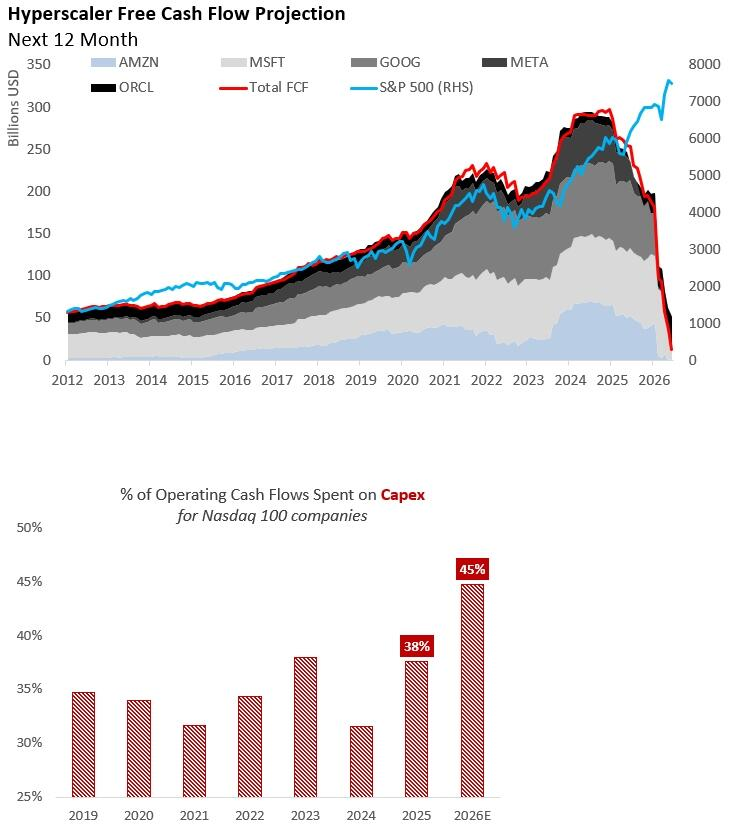
As hyper-scale data center operators face soaring capital expenditures and turning cash flow expectations negative, the market begins to question whether these tech giants, seen as the "source of funds," will cut hardware procurement budgets, thereby constraining revenue for the entire supply chain of storage, chips, networks, and servers.
Ghost Story Two: Policy and Tax "Black Swan," Panic Over Taxation on Unrealized Gains
At the moment of divergence in industry fundamentals, a discussion document on tax reform triggered significant panic in South Korea.
According to the Korean News Agency, a group of multi-party National Assembly members held a tax reform forum, advocating for the transition to a "comprehensive income tax" system, i.e., exploring the inclusion of "unrealized gains" (the book value increase) of assets like stocks and real estate into the tax system.
Although this proposal includes progressive paths like deferred taxation, it is essentially a heavy negative for the already overvalued Korean stock market. Experts warn that taxing only when assets are realized would create a "freeze effect," but the expectation of taxing unrealized gains has directly prompted investors to rush to sell before the policy is implemented.
Furthermore, South Korea's exclusion from the MSCI developed markets (DM) watch list, coupled with the Korean president’s comments last week regarding concerns over the "wealth effect" brought about by stock market fluctuations, further exacerbated the uncertainty from the policy front.
Ghost Story Three: Leveraged ETFs and the Negative Gamma Effect Backfire
From a quantitative and technical perspective, this crash is a classic structural collapse.
According to ZeroHedge, Nomura's quantitative strategist Charlie McElligott noted that massive capital inflows into single stocks and storage-themed leveraged ETFs have produced a huge "real and synthetic" negative gamma effect.
This market structure has led to pro-cyclical and mechanical fund flows—i.e., the more the market falls, the heavier the selling pressure. Charlie McElligott pointed out that during the sell-off, zero-day-to-expiration (0-DTE) options traders were actively shorting at highs, completely dismantling the buying attempts of those trying to bottom fish. Additionally, the position adjustments by options traders during the prior rising process further exacerbated the systemic downward spiral.
This effect means that as the market declines, market makers and ETF management firms must mechanically sell more stocks to maintain risk exposure balance. Chris Cha, head of high-touch trading at Goldman Sachs Korea, revealed in a report that the scale of leveraged ETFs in South Korea has reached $9.1 billion, while offshore leveraged ETFs tracking SK Hynix and Samsung total $21 billion.
The change in attitude of Korean financial regulators further worsens the technical landscape. The head of the Financial Supervisory Service (FSS) publicly expressed regret over the failure to prevent the listing of single stock leveraged ETFs linked to Samsung and SK Hynix and warned that its side effects are worsening. Discussions on tightening margin loans and limiting ETF issuances by regulators have directly shaken the technical buying that supported the recent uptrend.
Ghost Story Four: Liquidity Drought, Retail Liquidations and Pension Fund Reversals
The crash reveals the extreme singularity of the buying structure in the Korean stock market.
Alexander Redman, chief equity strategist at CLSA Singapore, pointed out that the market's surge is almost entirely driven by retail investors, raising alarming levels of underlying泡沫化. This month, the balance of retail financing in South Korea surged to a record 38.5 trillion won (about $25 billion). Seoul fund manager Kim Namho stated that massive margin debts triggered forced liquidations in the afternoon, accelerating the market's free fall.
Meanwhile, traditional stabilizers turned into the main force of selling.
Goldman Sachs’ report indicated that due to the prior surge in the stock market, the National Pension Service (NPS) of South Korea exceeded its domestic equity position target of 28.8%. To rebalance its assets, NPS recorded the largest net sale ($1.5 billion) since April 2021 in June.
When pension funds shift from passive support to mechanical supply, combined with foreign capital exiting, the market's marginal liquidity instantaneously dries up.
External Macro Pressures: Cooling Rate Cut Expectations and Financial Report Preview Tests
As the domestic fundamentals and technical dimensions in South Korea resonate downward, the variables in the global macro environment have also exacerbated the market's vulnerability.
The unexpected reignition of Federal Reserve rate hike expectations poses systematic pressure on overvalued tech stocks. Bank of America analyst Aditya Bhave predicts the Federal Reserve will hike rates again in September, October, and December this year, cumulatively raising by 75 basis points to combat sticky service sector inflation and wage growth.
In the wake of extreme market turbulence, investors' attention is now focused on the forthcoming financial report from Micron Technology. Goldman Sachs notes that market expectations prior to Micron's report have been pushed to extremely high levels, providing a motive for capital to take early profits. Pepperstone Group strategist Dilin Wu stated that Micron's earnings report will be a true test of whether the investment boom in AI hardware is sustainable.
As CLSA strategist Alexander Redman stated, the extent of this volatility is closely related to the degree of retail-driven and bubble-like conditions in the market. Although the upward cycle of memory chips and the logic of AI demand have not been falsified in the medium term, under the impact of forced deleveraging and multiple rumors, global chip stocks are undergoing a painful reset of expectations and valuation digestion.
免责声明:本文章仅代表作者个人观点,不代表本平台的立场和观点。本文章仅供信息分享,不构成对任何人的任何投资建议。用户与作者之间的任何争议,与本平台无关。如网页中刊载的文章或图片涉及侵权,请提供相关的权利证明和身份证明发送邮件到support@aicoin.com,本平台相关工作人员将会进行核查。


