This article is only a personal market view and does not constitute investment advice. If you act on it, you bear your own profit and loss.
First, let's review the views on the height of the rebound mentioned in the article on June 14, which were basically not far off. When the article was published, the signing of the US-Iran memorandum had not been confirmed, but we already judged that this signing was a high probability event, and with the good news materializing, there would be a final short-term surge.

If you missed the article and the high short-selling opportunity, don’t feel too regretful. There are still short-selling opportunities on the right side. Currently, BTC has broken below the nearly one-month rising trend line and has seen a pullback, which is a good entry opportunity with relatively small stop-loss. But the current price is not suitable for heavy short-selling.
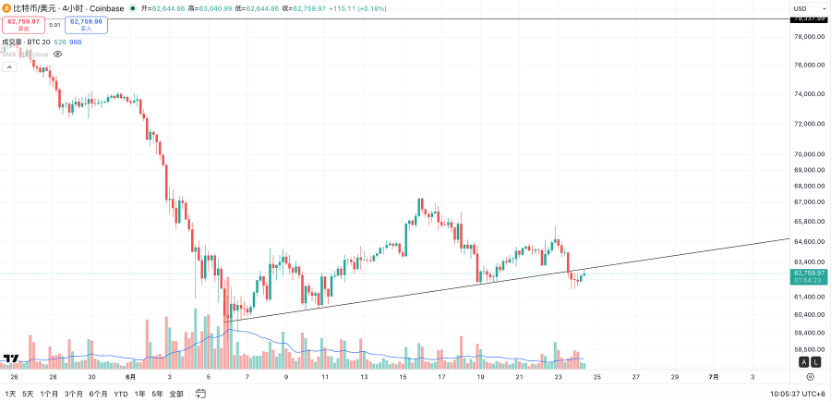
Next, we need to observe what was mentioned in the June 14 article, whether it is possible to retest around $60,000 is a second bottoming. For specific judgment, please refer back to the article; I won't dwell on it here.
On the 23rd, there was a global sell-off; US stocks, A-shares, the South Korean stock market, and the cryptocurrency market were all affected. The reason is that the market began to price in at least one interest rate hike in September, with the probability significantly rising to 75%, which is a short-term one-time risk release and value reassessment. The current market risk is mainly dominated by the expectation of interest rate hikes in the US. If subsequent data supports a second or even a third interest rate hike within the year, the market will react sharply. Therefore, we need to pay attention to data that might affect interest rate expectations. The PCE on June 25, non-farm payrolls on July 2, and CPI on July 14 are all important data and key time points. Closely monitor the trends before and after these time points; if BTC is at a critical position and the data is unfavorable, then the possibility of a new round of market decline will be very high.
Returning to the main content of this article: highlighting a possible black swan—MSTR's potential bullish turn to bearish.
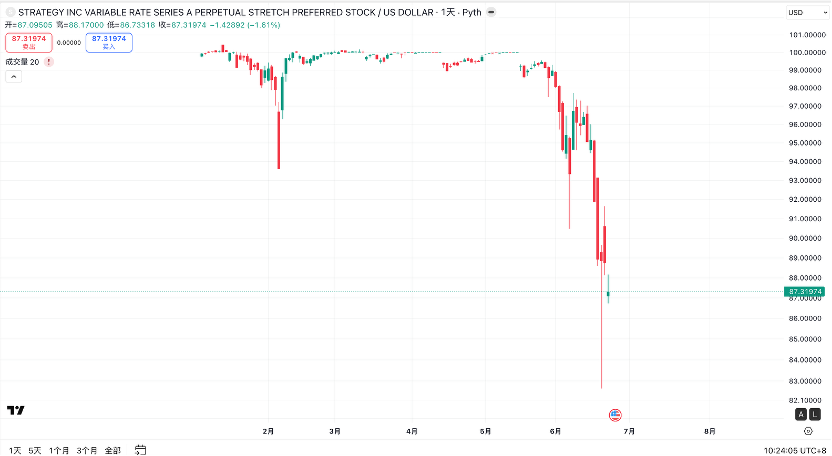
The chart below shows the performance of MicroStrategy's preferred stock STRC. As of the latest closing, its price is $87.3, which has deviated from its original design intention—a par value of $100.
So the questions arise:
1. What is STRC and its mechanism?
2. Why has STRC experienced this decoupling trend? What are the implications?
Let me give a simple conclusion first: the significant discount of STRC indicates that MicroStrategy's financing flywheel has failed, BTC will lose a stable buyer. In extreme cases, this former buyer may even become a seller.
1. What is STRC and its mechanism?
The design goal of STRC is to trade around a par value of $100. The Strategy official said its dividend yield adjusts monthly to keep STRC close to $100 (the anchor price) and to reduce price volatility. For MicroStrategy, it uses about 11.5% financing costs to finance purchasing coins. For STRC holders, it is equivalent to holding a stock with a basically stable par value (which can be sold in the secondary market) and then receiving a fixed annual benefit of about 11.5%. The company does not need to repay the principal, only to pay interest regularly.
However, STRC is not a stablecoin, nor is it a bond with mandatory redemption. It is a perpetual preferred stock, and while the dividends are cumulative and variable rates, whether dividends are paid depends on the board of directors and available funds; MicroStrategy also has the discretion to adjust the dividend rate. That means, theoretically, whether to pay dividends is uncertain, and this $100 par value is not a hard peg but a soft peg maintained by "yield attractiveness + market confidence + company financing ability."
In extreme cases, if MicroStrategy's cash resources are insufficient, it can announce a suspension of dividend payments. So where do the cash resources for buying coins come from? There are four ways: issuing common stock, issuing preferred stock, issuing bonds (which do not account for much, not analyzed separately), and selling coins.
When MSTR's common stock is at a high premium and the market is willing to buy MSTR, then it will issue more common stock;
When STRC approaches 100, and the market is willing to buy high-yield preferred stock, then more STRC will be issued;
The worst-case scenario is that the long-term price of BTC declines, leading to a sharp drop in the price of MSTR's common stock while the premium decreases or disappears, which will cause STRC to also fall. Both forms of financing would become undesirable, the financing flywheel would begin to fail, and if MSTR's cash reserves are still insufficient, then the only option left would be to sell coins.
The price of STRC is also correlated with the price of MSTR's common stock. When MSTR has a premium or a higher premium, financing through common stock is lower in cost and easier, and MSTR's dollar reserves can be easily replenished, making the payment of cash dividends on STRC credible, thus stabilizing the price of STRC. Conversely, when the premium of MSTR weakens significantly, it will also affect the market's concerns regarding STRC's dividend payment capacity, thereby reducing the price of STRC.
Why is it harder to finance through common stock when MSTR's premium decreases?
A simple arithmetic problem: if both need to finance $1 billion, and if the stock price is $200, then only 5 million shares need to be issued; if the stock price is $100, then 10 million shares have to be issued.
The lower the stock price, the more shares need to be issued, which severely dilutes the per-share BTC, per-share NAV, and per-share equity of existing shareholders.
More critically, the MSTR model originally relied on: issuing common stock at a premium above BTC NAV, then buying BTC, thus increasing the per-share BTC.
But if MSTR’s premium falls or even flips to a discount, continuing to issue common stock may become: selling undervalued common stock for cash to buy BTC, which would instead dilute the per-share BTC or per-share net asset value.
This is why when MSTR’s stock price is weak, issuing common stock At-The-Market is not just "dilution," but rather the financing flywheel reverses.
The complete causal chain is:
BTC drop → MSTR common stock drop / premium shrink
→ Common stock ATM financing efficiency decreases → Difficulty in replenishing dollar cash reserves increases → STRC holders worry about cash distribution stability
→ Demand for higher yield → STRC price drops → STRC ATM financing capacity decreases → The company relies more on common stock financing or selling BTC, and the market further questions MSTR's flywheel → BTC reserves turn from "eternal buying asset" to "potential liquidity source."
This forms a negative cycle. The key to breaking this negative cycle is: financing ability, whether MSTR can continue to roll over financing without permanently damaging per-share BTC, significantly increasing cash costs, or continuously selling BTC.
3. Why has STRC experienced this decoupling trend? What are the implications?
From the chart, it can be seen that STRC's decoupling began on May 27 and intensified starting June 1.
On May 26, Strategy disclosed the completion of a $1.5 billion convertible bond buyback due in 2029, reducing dollar cash reserves to $871 million. This made the market see that cash reserves were being consumed, and the capital structure's cash coverage was declining.
On June 1, the company disclosed the sale of 32 BTC from May 26 to May 31, netting $2.5 million, and stated that the proceeds were expected to be used for preferred stock distributions. This indicates that MSTR's entire narrative has changed, and for the first time, BTC reserves were explicitly stated to be used for servicing preferred stock distributions.
Looking at the two aspects together, we can draw a conclusion: STRC's price weakened due to the company's decreasing dollar cash reserves, leading to expectations of financing pressure and later rising concerns about dividend payments, hence the weakening (at this point it was still mild); after the disclosure of selling BTC for preferred stock distributions on June 1, the market confirmed this concern.
At the same time, with the substantial drop in BTC prices this year, the premium on MSTR's common stock has also significantly decreased.
The premium on MSTR's common stock = market value of common stock / (market value of BTC + cash - debt - preferred stock). The current premium for common stock is approximately 1.18 times (as of June 18). In the first quarter of 2026, MSTR financed $5.292 billion through common stock, with an average issuance price of $158, which corresponds to a premium on common stock of about 50%, or 1.5 times.
Therefore, the decline in MSTR's common stock premium with the significant drop in BTC prices is an undeniable fact.
In the past week, MSTR financed another $335.5 million through common stock but only purchased $34.9 million worth of BTC, significantly increasing cash reserves. This led to the current financing not increasing the per-share BTC content of common stock but rather decreasing it. This would have a negative impact on the next common stock financing (as potential investors buying in would experience dilution, lowering their willingness to buy).
In summary, MSTR currently faces a dilemma; maintaining more cash is not conducive to subsequent common stock financing, while holding less cash would call into question its ability to pay preferred stock dividends (although there is still $1.4 billion in cash reserves on the balance sheet, the market will not wait until the cash runs out to start worrying about MSTR's financial sustainability. From recent trends, a drop of around $800 million has already been dangerous enough), while the STRC price's failure to return to around $100 already indicates the market's stance.
Of course, the worst situation has not yet arrived. If BTC prices continue to fall, further exacerbating MSTR's common stock financing difficulties, then MSTR will have to face the dilemma of selling coins. If the market begins to trade and MSTR, once a permanent bull, becomes a potential bear, it would be a nightmare for BTC.
MSTR's previous coin-selling behavior has already altered its permanent bullish narrative, but it has not yet reached the worst situation, so it is still just a potential black swan event.
Follow me to earn maximal trend profits with minimal operations.

免责声明:本文章仅代表作者个人观点,不代表本平台的立场和观点。本文章仅供信息分享,不构成对任何人的任何投资建议。用户与作者之间的任何争议,与本平台无关。如网页中刊载的文章或图片涉及侵权,请提供相关的权利证明和身份证明发送邮件到support@aicoin.com,本平台相关工作人员将会进行核查。