Interpreting the major upgrade of consensus execution separation, paving the way for the first phase of Nightshade 3.0 evolution.
Written by: Anton Astafiev, CTO of Near One;
Mally Anderso, NEAR columnist
Translated by: Saoirse, Foresight News
The NEAR core development team Near One recently announced two major upgrades to the NEAR protocol, both of which will officially launch later this month: one is dynamic re-sharding to enhance network scalability; the other is the launch of the first quantum signature solution, providing post-quantum security for all NEAR accounts. This article will detail the next core plan in the NEAR technology roadmap—SPICE, short for "Separation of Consensus and Execution." SPICE is currently still in the development stage and is the most important upgrade before the implementation of Nightshade 3.0, which is an iterative version of NEAR's sharding technology.
(For a detailed understanding of the sharding technology iteration from 2019 to the present, you can read the previously publisheddynamic re-sharding thematic article; If you want to fully understand the overall evolution direction of the NEAR protocol, you can refer to Bowen Wang's keynote speech on Nightshade 3.0 at the2026 NEARCON conference.)
Once SPICE is officially launched, the block generation speed of NEAR will increase to three times faster than before, achieving a block time of 200 milliseconds. As of May 2025, NEAR's current performance is a 600 millisecond block time and a 1.2 second transaction finality. The core logic behind this performance leap is the decoupling of the consensus process from transaction execution: the consensus layer can run at full speed without waiting for transactions to be executed to generate blocks. It is worth mentioning that, constrained by the speed of light and the basic time cost of consensus nodes sending and receiving information, 200 milliseconds is already the theoretically fastest block generation speed achievable at the physical level.
The separation of consensus and execution will bring three core improvements: faster block generation speed, lower transaction latency, and support for longer operating cycles and more complex transaction logic.
How SPICE Accelerates the Protocol
The separation of consensus and execution is a fundamental and far-reaching upgrade to the NEAR protocol, and it is the largest technical transformation since the introduction of the stateless verification mechanism in 2024, representing a massive project for the Near One team. The concept of SPICE was first proposed at the NEAR industry summit at the end of 2024; now with all pre-upgrades deployed including Gas keys (version 2.12 has been launched), sharded smart contracts, and dynamic re-sharding, the development process of SPICE has also accelerated significantly.
Although implementing this layered architecture is extremely challenging, its underlying logic is clear and understandable: the core value of blockchain is to provide an immutable, irreversible transaction sequencing guarantee. Traditional solutions rely on Byzantine Fault Tolerance (BFT) consensus mechanisms to achieve this, where each block synchronously packages ordered transactions and updates account balances, which directly slows down block generation efficiency. SPICE separates the processes of transaction ordering and state execution into two independent workflows: all validating nodes only need to reach consensus on the transaction list and block hash, ensuring that the transaction order is not altered. This process does not require complex calculations while maintaining blockchain determinism. Nodes can complete block generation by merely verifying transaction signatures, and during block consensus confirmation, account state calculations can be performed in parallel. The execution process is no longer bound to block ordering and does not need to synchronously update the state root in each round of consensus blocks.
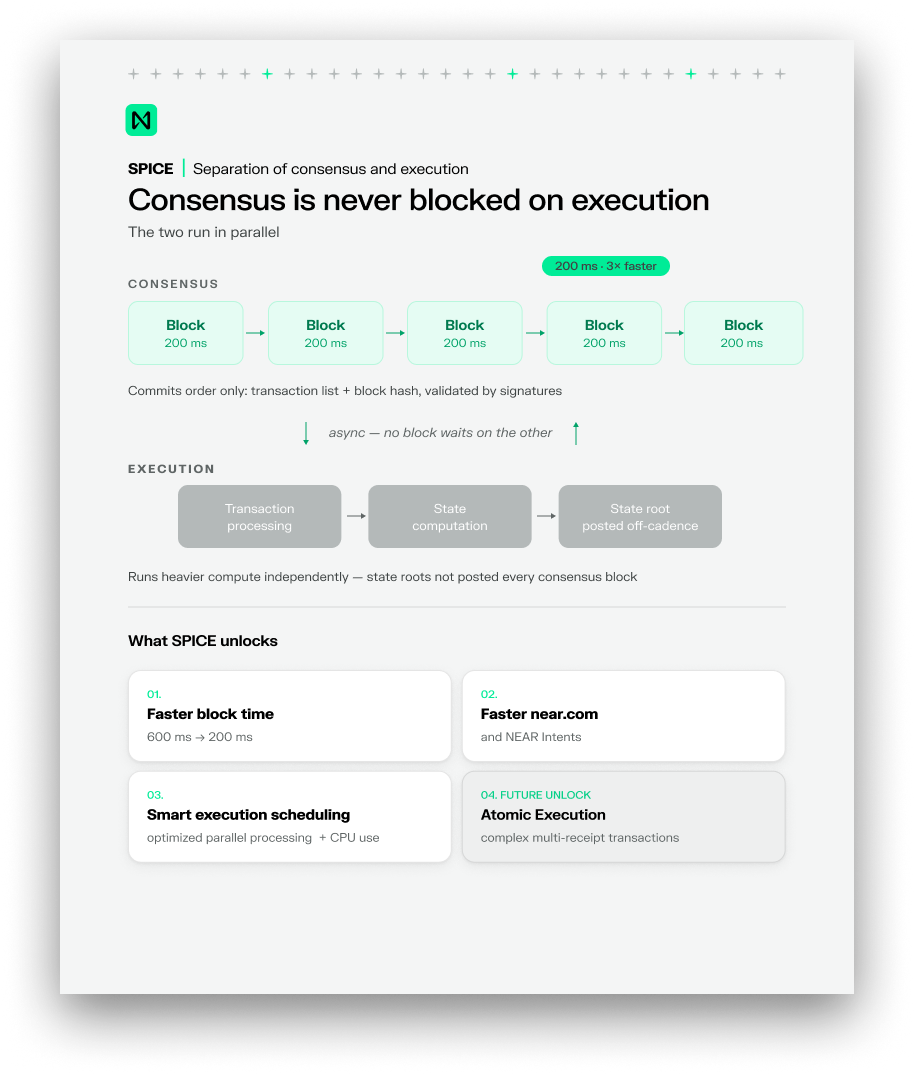
Diagram of the SPICE layered architecture
SPICE not only compresses the block time from 600 milliseconds to 200 milliseconds—tripling the speed—but also allows for more interactive operations within the same timeframe, significantly accelerating the processing speed of complex transactions, and even supporting stepwise execution of lengthy transactions across multiple blocks. NEAR itself has already adopted an optimistic block mechanism, and SPICE will greatly shorten the maximum waiting time for users. Under the current mechanism, if a transaction requires supplementary external data, users must wait for an entire block to be generated before initiating the next operation; with SPICE, users can complete three consecutive interactive operations within the previous block's waiting period.
SPICE will also greatly enhance the user experience with near.com and NEAR Intents. Alex Shevchenko, CEO of Defuse Labs, commented: "The NEAR block speed improvement means transaction endpoint confirmation is faster, and the user experience will become incredibly smooth, truly achieving 'instant completion.' Whether it's ultra-fast sub-second transactions, transfers, or privacy payments, it can be realized. The traditional payment giant Visa's transaction confirmation standard is 3 seconds, while NEAR only needs 0.4 seconds, faster than entering your payment password or getting your phone close to the cash register."
This extreme speed is also a necessity for the agent economy: the interaction rate of automated agents far exceeds that of human users with traditional financial systems. Relying on this block generation mechanism that approaches physical limits, NEAR can unleash the full operational potential of agents, realizing seamless flow between fiat and crypto assets; while supporting multiple agents to initiate logically complex, longer-duration transactions in parallel.
The Technical Path to Nightshade 3.0
The separation of consensus and execution is the primary key step for the implementation of Nightshade 3.0. Among all sharded public chains, NEAR is the first project to implement this architecture; although Monad also achieves separation of consensus and execution, it is based on a non-sharded EVM public chain. In addition to speeding up, SPICE further enhances network scalability through deep parallelism. Currently, NEAR executes transactions by dividing shards based on account IDs, and once a specific shard is under heavy load, all user transactions within that shard experience delays. SPICE lays the foundation for future cross-shard synchronous transactions. At the same time, it utilizes the "bubble fill" mechanism to fully utilize bandwidth resources: the execution queue does not need to wait for network communication, and block generation does not have to wait for transaction execution to complete. These two processes operate in parallel without gaps, significantly improving network resource utilization.
Faster blocks combined with already deployed sharded smart contracts can also concurrently strengthen network security. NEAR's sharded smart contracts essentially represent lightweight independent accounts, individually divided by user and business scenarios; together with shorter and simpler blocks, the network's business load can be evenly distributed across shards, achieving dynamic adaptive scalability in the network. This not only optimizes scalability performance but also reaps significant benefits in security. Currently, AI tools greatly lower the threshold for hacker attacks and exploitations; the structurally simple blocks and lightweight contracts are easier to protect; as NEAR gradually implements formal verification of contracts and zero-knowledge proofs, smaller blocks can significantly reduce verification computational consumption and costs.
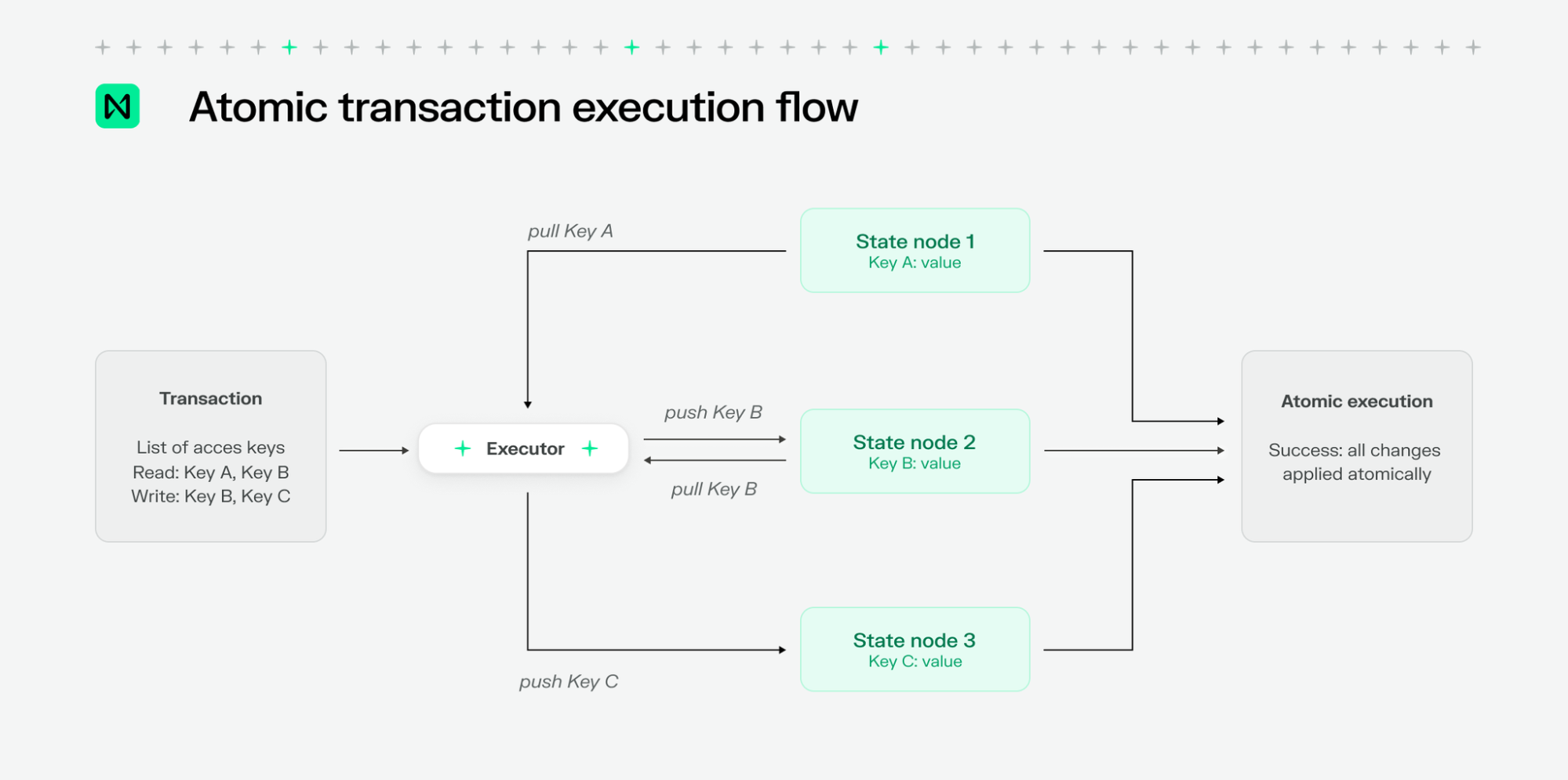
Cross-shard atomic transaction execution flow
SPICE also paves the way for the subsequent major upgrades of Nightshade 3.0. In the future, another iterative update based on SPICE will enable cross-shard atomic transactions—transactions that cannot be split or reversed, executed in full across shards. This is also the core goal long pursued in the field of sharding technology and is a significant demand from developers, especially those in the NEAR Intents ecosystem. Atomic execution can simplify complex transaction logic and avoid the development difficulties posed by the existing asynchronous cross-shard mechanisms; this type of asynchronous logic has long been a major cause of smart contract vulnerabilities and functionality delays, whereas the SPICE architecture can alleviate this issue at the foundational level. The core realization idea is to rely on the decoupling of consensus and execution, migrating transaction computations to specialized execution nodes that can read all shard states involved in a transaction. Combined with NEAR's mature stateless verification system, only a single execution node needs to generate an execution proof, and the remaining nodes in the network can complete the verification. This design does not elevate the hardware thresholds for ordinary validating nodes, while continuously unleashing the performance limits of the execution layer.
The Near One team is fully promoting SPICE development, planning to launch it within the next few months. (Everyone can continue to follow nearone.org for detailed technical updates, and you can also check the latest protocol updates on the NEAR X official account.)
免责声明:本文章仅代表作者个人观点,不代表本平台的立场和观点。本文章仅供信息分享,不构成对任何人的任何投资建议。用户与作者之间的任何争议,与本平台无关。如网页中刊载的文章或图片涉及侵权,请提供相关的权利证明和身份证明发送邮件到support@aicoin.com,本平台相关工作人员将会进行核查。


