Original | Odaily Planet Daily (@OdailyChina)
Author | Golem (@web 3_golem)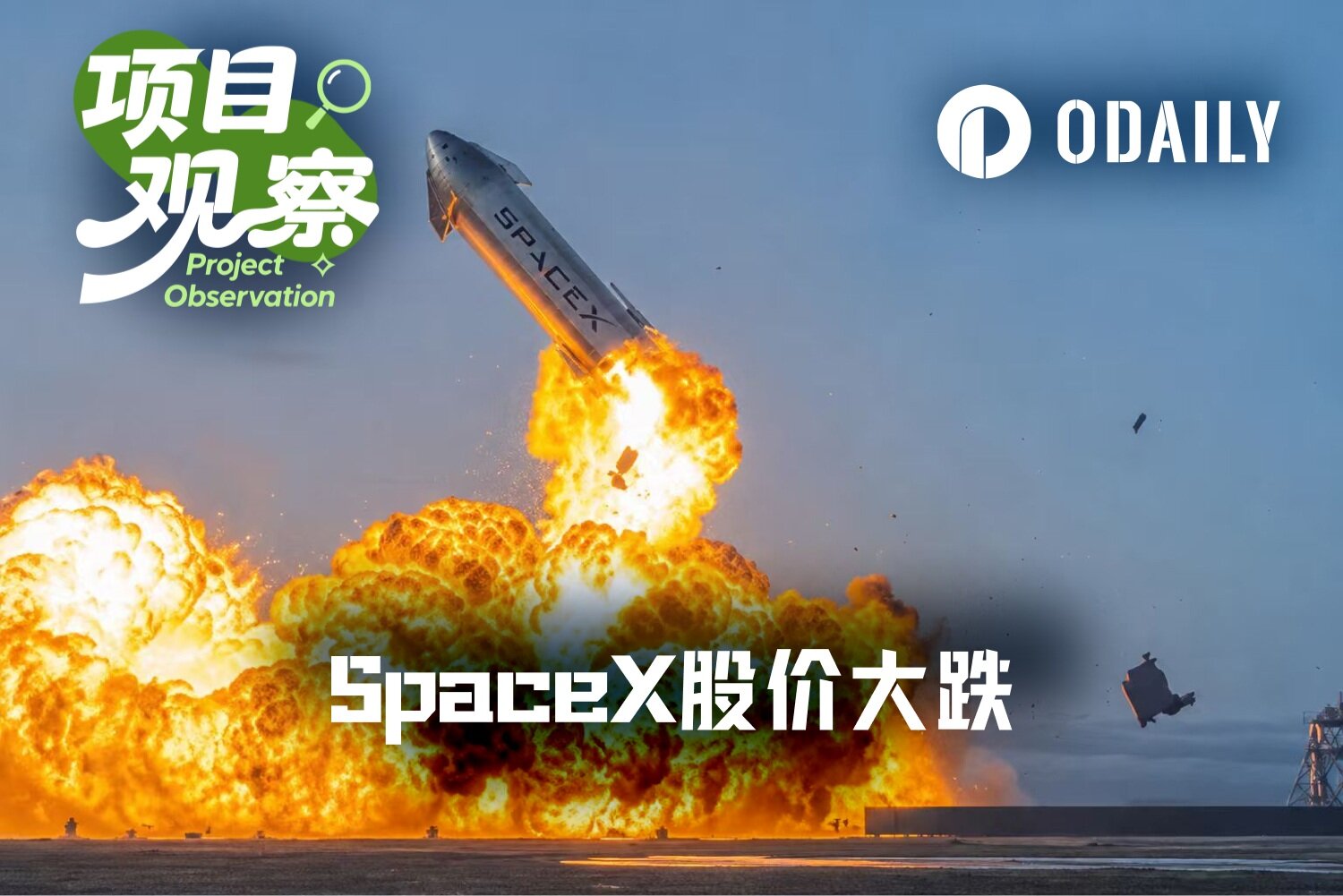
On the evening of June 18, SpaceX's Starship No. 36 exploded during its 10th static fire test, creating a massive fireball; fortunately, there were no personnel injuries. This was the most serious ground accident for SpaceX in recent times, damaging the entire testing facility, and Western media referred to it as a "catastrophic failure."
The "aftershock" of this explosion quickly spread to the capital markets. Since June 18, SpaceX has seen its stock decline for three consecutive trading days, plummeting over 16.43% on June 22 alone, with a single-day market value evaporating by approximately $400 billion, setting the record for the second-largest single-day market value loss in the history of global companies.
Worse yet, SPCX has fallen below its IPO closing price ($160.95), with after-hours trading data from Hyperliquid showing that SPCX briefly dropped below its listing opening price ($150). If U.S. stocks open below $150 on June 23, it would mean that all investors who bought and held SPCX in the secondary market would be trapped.
Is this continuous decline due to a loss of investor confidence in SpaceX or a short-term market sentiment adjustment? What will happen to SpaceX's stock price in the future? Odaily Planet Daily will provide a brief analysis in this article.
$20 billion bond financing may just be the fuse
On June 22, the direct trigger for SPCX falling over 16% was SpaceX's announcement to initiate its first senior unsecured bond issuance. Although the 8-K document submitted to the U.S. SEC by SpaceX did not disclose the specific issuance scale, Bloomberg reported last week that SpaceX is planning a bond issuance of at least $20 billion. SpaceX confirmed that this fundraising is intended to repay bridge loans, cover related expenses, and for general corporate purposes, with this bridge loan originating from SpaceX's acquisition of Musk's own company, xAI, in February of this year.
However, conducting bond financing less than two weeks after going public is not good news for investors. The additional interest expenses resulting from issuing bonds are a minor issue; it signifies that SpaceX currently requires additional financing, which brings enormous negative implications.
SpaceX had already raised $85.7 billion in its IPO, and it has also disclosed that it possesses approximately $100.8 billion in cash and cash equivalents. This has become the latest point of attack for bears: a company that just went public and has over $100 billion in cash is now looking to borrow money from the market, indicating that SpaceX's free cash flow has yet to be established, while the burn rate of the Starship and capital expenditures for AI infrastructure have far exceeded market estimates.
The rating agency CFRA Research, which had continuously rated SpaceX as a sell, also questioned the necessity of SpaceX's massive financing, commenting, "With Elon Musk, you never know what he is thinking."
Notable tech hedge fund manager Dan Niles also stated on the X platform that SpaceX's bond issuance and the computing power agreement with Reflection AI may remind investors of another massive AI competitor that requires substantial financing, having previously expressed concerns about its overvaluation.
Weighed down by the decline of global AI concept stocks
The announcement of bond financing may only be the trigger for SpaceX's decline, as its stock price pressure is also affected by the adjustment of global AI concept stocks.
On June 23, not only did U.S. AI concept stocks decline sharply at market close, but AI sectors in other global markets were also retreating. On June 23, the South Korea Composite Index (KOSPI) became the worst-performing major index in Asia, dropping over 9%. The South Korean stock market hit a circuit breaker in the morning and continued to decline in the afternoon, with SK Hynix and Samsung Electronics both falling over 12%. Meanwhile, the Hong Kong stocks' AI giants also plummeted, with MINIMAX dropping 15% and Zhikong falling over 9%. The four major A-shares indexes also collectively declined in the morning session.
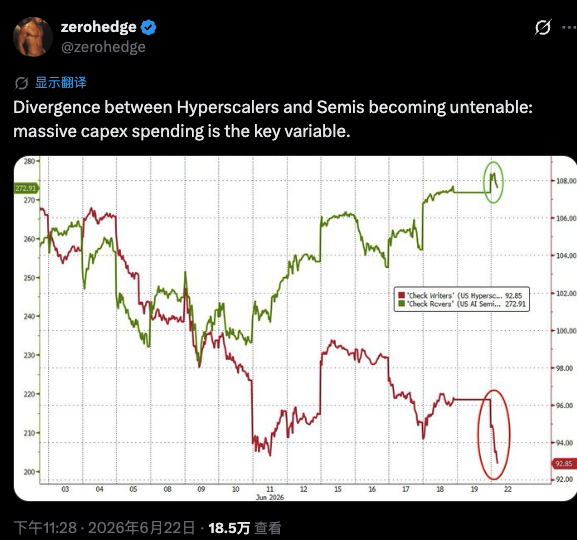
The global decline of AI concept stocks is primarily because investors are beginning to worry about excessive investment in AI infrastructure and the long commercial return cycle, questioning whether the capital expenditures will ultimately yield corresponding returns. SpaceX is viewed as one of the representative companies of this logic, as its investment scale significantly exceeds the speed of commercial returns, naturally resulting in a substantial blow to its stock price.
U.S. financial media zerohedge stated on June 22 on the X platform that the divergence between super-scale cloud vendors and semiconductors is intensifying, and massive capital expenditures have become critical.
Retail buying dries up, equity unlocking brings early bad news
Since its IPO, SpaceX has been the most sought-after stock among retail investors in the U.S. stock market. As initially less than 5% of the floated shares were available, SPCX's price was essentially driven up by retail investors. According to Vanda Track statistics, retail investors net purchased $405 million of SPCX in the first five trading days, which far exceeded the total amount they invested in all other stocks of the seven U.S. giants combined (NVDA, MSFT, AMZN, META, GOOGL, and GOOG), which was only $278 million during the same period.
However, retail buying cannot serve as a long-term support for SPCX's stock price; on the contrary, the more aggressively retail investors bought previously, the quicker they will dissipate their momentum once true buyers finish buying and the sentiment cools.
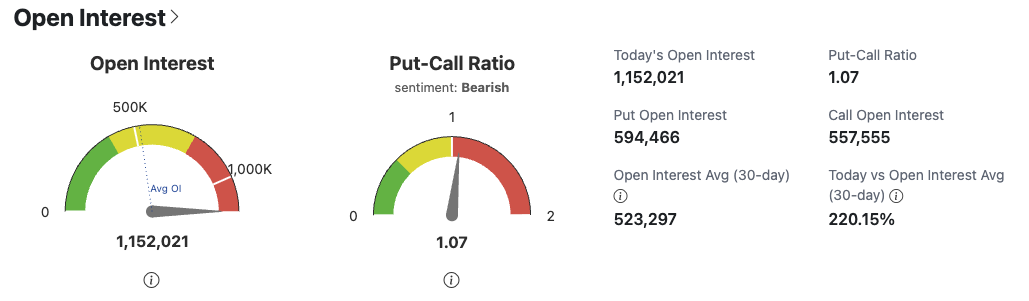
Options trading for SpaceX began on June 16, initially dominated by bullish sentiment. However, according to OptionCharts data, the current put/call ratio for SPCX is 1.07, indicating a leaning towards neutral to bearish sentiment among investors. While it's not yet a consensus bearish view, it at least shows that retail investors have begun to lose their nerve.
This sharp decline in SPCX has occurred with only 5% of the float available for trading. When the equity unlocking date arrives, how will SPCX sustain itself? To some extent, the current drop in SPCX stocks is also a premature reaction to the impending equity unlocking, as investors may be waiting to re-enter their positions after the first round of equity unlocks.
According to regulations, 20% of SpaceX's shares will be unlocked after the Q2 earnings report is released in mid-August. If the stock price is up by 30% from the IPO issuance price at that time and meets that standard for 5 of the 10 trading days, an additional 10% can be unlocked.
22V Research strategist Jeff Jacobson noted that insiders might sell 44% of SpaceX's shares before early September, significantly increasing the current float by about 900%.
SpaceX's next positive node is anticipated to be its inclusion in the Nasdaq 100 index in July, but due to the stock price's continuous three-day decline, investor panic has already outweighed the expectations for this potential good news.
Bull and bear arguments
Unlike the first week after going public, the market currently leans towards bearish views on SpaceX, with the main bull and bear perspectives summarized as follows.
Short selling tools complete the correction; valuation has reflected future growth
On June 18, after SpaceX announced a $60 billion equity acquisition of Cursor, the well-known independent investment research firm Morningstar not only did not raise its expectations for SpaceX's AI business but further lowered its fair value from $63 to $62. They believe that the current stock price is entirely narrative-driven, lacking substantial quarterly financial support.
Gary Black, co-founder of Future Fund, previously pointed out that before SPCX options trading opened, SpaceX's trading logic had completely detached from fundamentals, stating, "Its trading performance resembles a meme stock rather than a company driven by fundamentals." Therefore, the current plummet is an inevitable correction following the completion of short selling tools.
On June 22, U.S. investment bank KeyBanc Capital Markets (KBCM) assigned a neutral rating to SPCX, and although no target price was provided, its analysts stated that SpaceX's current valuation fully reflects future growth, suggesting that the stock price could be halved. While there may be long-term growth drivers, much of the good news has already been "priced in."
Cathie Wood as a steadfast bull for SPCX
Witnessing the dusk are the faithful followers: ARK Invest, led by Cathie Wood, is not only a bull for Bitcoin but is now also one of the staunchest bulls for SpaceX. On the day of SpaceX's IPO, ARK Invest heavily purchased about 3.3 million shares, with a total value exceeding $500 million. On June 22, on the day SPCX dropped significantly, ARK bought approximately 210,000 shares of SPCX (valued at about $38.9 million) through multiple ETFs (including ARKK, ARKQ, etc.).
Previously, in 2024, ARK's model estimated that SpaceX's enterprise value would reach $2.5 trillion by 2030, and it could be as high as $3.1 trillion in optimistic scenarios; at that time, ARK was referencing a company yet to be listed with an estimated valuation of about $180 billion to $350 billion. Now that SpaceX has successfully gone public and its market value has approached ARK's model estimate from that year, ARK is still choosing to increase its position, perhaps reflecting a long-term optimism for SpaceX's reusable rockets, Starlink, and the space economy's disruptive innovations.
免责声明:本文章仅代表作者个人观点,不代表本平台的立场和观点。本文章仅供信息分享,不构成对任何人的任何投资建议。用户与作者之间的任何争议,与本平台无关。如网页中刊载的文章或图片涉及侵权,请提供相关的权利证明和身份证明发送邮件到support@aicoin.com,本平台相关工作人员将会进行核查。


