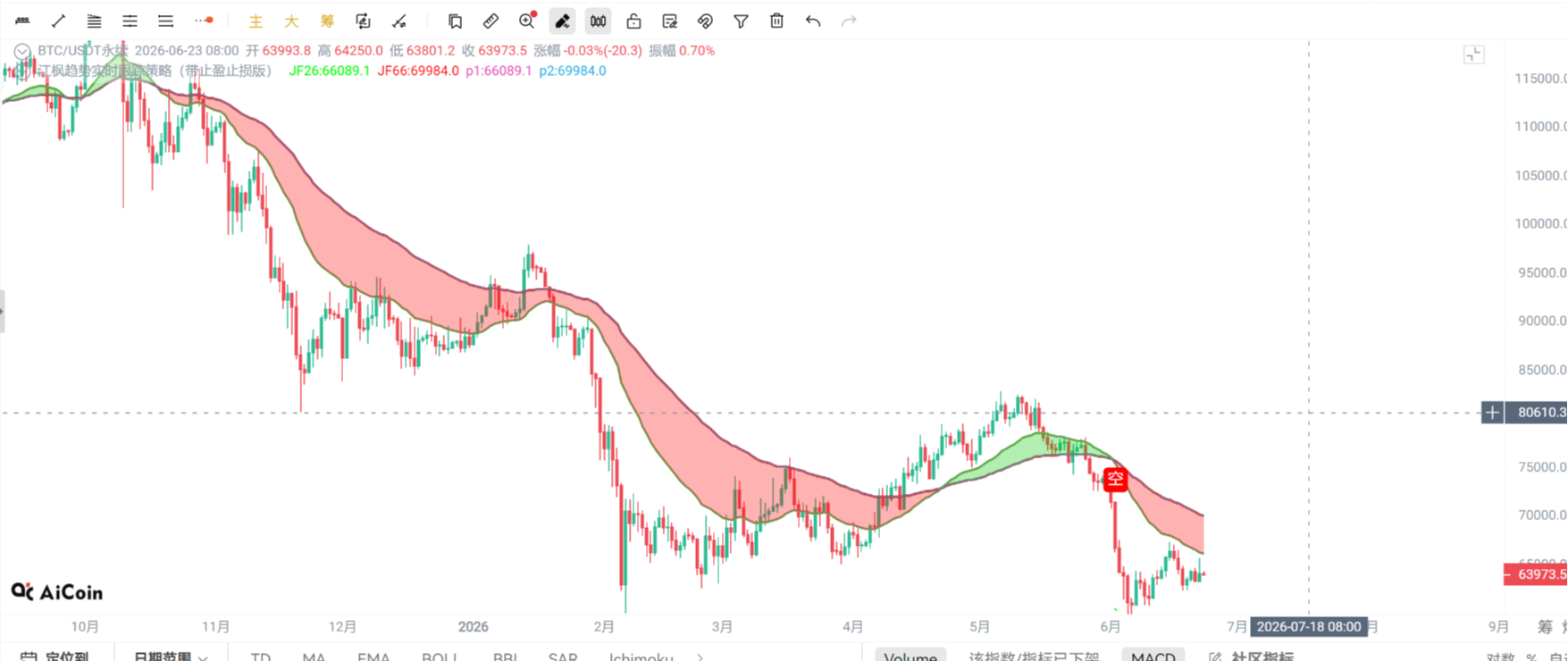
In June 2026, Bitcoin stepped on a new low of about $59,000 and subsequently closed above $63,000 for three consecutive weeks, giving a typical technical bottom signal on the chart. However, beneath this "bottom," the capital structure is much more torn apart than the price itself. The open interest in the futures market fell about 19.5% from the June peak, and the funding rate was compressed from about 0.1% to about 0.02%. Coupled with a decline in BVIX to 41.47 and EVIX to 55.36, this indicates that the accumulated leverage and emotional volatility from earlier are being forcefully cleared out, with the market shifting from "betting on the direction" to "calculating chips." At the same time, the on-chain and holding levels present a completely different picture: Strategy and Bitmine collectively show about $18 billion in unrealized losses on the books, while highly leveraged long positions are still betting on a steeper rebound with 40x leverage, and a group of long-term funds are choosing to continue adding to positions above $63,000, treating this rebound as a window for mid-to-long term chip repositioning — gigantic unrealized losses, aggressive leverage, and patient buying are interwoven within the same price range, forming the core contradiction of this round's bottom game.
Three Consecutive Weekly Gains and Leverage Clearance
The price first gave a signal. In mid-June 2026, Bitcoin briefly dipped to about $59,000, and then closed above $63,000 for three consecutive weeks, technically nailing a phase "bottom anchor" in that area. More importantly, this "three consecutive gains" was not pushed out under high leverage stacking, but steadied in the process of actively and passively clearing leverage — during the same period, open interest in Bitcoin futures fell about 19.5% from the June peak, and the funding rate decreased from about 0.1% to about 0.02%. The price held steady sideways while positions became lighter, indicating that this rebound was no longer driven by high-multiple contract short-term speculation, but rather quietly taken on by spot and low-leverage funds, clearing out the crowded positions of the previous round.
The volatility environment is providing a bottom for this "light leverage bottom turnover." BVIX reported 41.47 and EVIX reported 55.36, showing a significant drop from previous peaks. The USD/JPY is consolidating around 161.577, gold is about $4,193.38 per ounce, and silver is about $64.903 per ounce, similarly lacking violent pull. Overall cross-asset is in a low volatility range of "valued but lack of drama." Against this backdrop, when carry and trend funds reassess Bitcoin and Ethereum positions, they face lower position costs, milder volatility premiums, and a cleaner leverage structure. This combination of "stable prices, light leverage, and low volatility" is, in itself, the starting point for a new round of risk appetite repricing.
Heavy Pressure of $18 Billion Unrealized Loss
While surface volatility was compressed, beneath the surface lies the immense unrealized losses left by the previous round of institutional entry. Calculating within the time window from June 19 to June 23, 2026, Strategy's Bitcoin position had an unrealized loss of approximately $9 billion, and Bitmine also about $9 billion, totaling nearly $18 billion in losses, becoming the heaviest "historical chip" in this phase's bottom narrative. This means that the institutions that heavily positioned in the previous higher price range did not truly exit during this round's dip to about $59,000 and subsequent rebound to above $63,000, but are instead entirely "sealed" in a state of unrealized loss. The new funds negotiating around the $63,000 line are effectively coexisting with this batch of deeply trapped chips.
Such a scale of unrealized loss is not an abstract number to the market but a concrete shadow of supply. Traders know that in the face of $18 billion in losses, any liquidity demand from either rebalancing, regulatory pressure, or operational stress could theoretically translate into a substantial sell-off that could crush short-term buying interest. This notion of "potentially being smashed at any moment" raises risk premiums and suppresses the willingness to chase higher prices, making every attempt at breaking above $63,000 seem hesitant and cautious. However, to date, there has not been any public indication of systematic reductions from Strategy and Bitmine. They have chosen to continue holding under significant unrealized losses, somewhat turning their book losses into a form of path dependency: the greater the sunk costs, the harder it becomes to casually take losses and exit within the current range, and the easier it is to be interpreted by the outside as "long-term faith." For the market, this constitutes a contradictory bottom structure — one side is the potential for activation of selling pressure at any time, while the other side is the long-term chips bound by unrealized losses. The outcome of the tug-of-war between the two will directly determine whether this round's platform around $63,000 is a transition zone for slowly digesting old wounds or the true starting point for the next round of risk appetite recovery.
Saylor and Institutions Continue to Increase Positions
While the market is magnifying and examining the unrealized losses, Saylor chooses to lock in the narrative of "the more you lose, the more you buy" with action. In June 2026, he again spent about $35 million to buy 520 BTC, raising the Bitcoin reserves under the Strategy system to 847,363 BTC (according to a single source). Continuing to increase holding costs against a backdrop of around $18 billion in unrealized losses is no longer just simple "value investment," but a commitment publicly made to the entire market: the duration of this batch of chips has been artificially extended, and the elasticity of short-term price fluctuations against its selling pressure is nearly zero. For other institutions, this behavior of "advertising with the balance sheet" serves as both a signal and a pressure — whoever concedes first must surrender chips and voice to Saylor's long-term chips.
Saylor is not an isolated case. Strive increased its holdings of 759 BTC at an average price of about $65,850, raising its total holdings to 19,864 BTC (according to a single source), choosing to continue adding positions on the stable platform above $63,000 instead of using the rebound to reduce exposure and lower risks, which indicates that some funds among traditional institutions are still willing to view the current range as a "allocation band" rather than a "reduction band." Even more aggressive is the directional rewriting at the corporate level: Nakamoto shut down its medical clinic business on June 19, 2026, announcing a complete transformation into a Bitcoin operating company, with the relevant administrative wrap-up expected to be completed in the third quarter of 2026 (according to a single source). This is no longer just adding a line of BTC to the balance sheet, but directly replacing the main business with high Beta exposure to a single asset, tying the company's future cash flow to Bitcoin prices. Meanwhile, Intercontinental Exchange and OKX established a joint venture OKXICE, which has not yet disclosed specific business scope, equity structure, and launch time, but represents further integration of traditional financial infrastructure and cryptocurrency trading platforms (according to a single source), providing institutional support for Bitcoin spot and derivatives in the medium to long term, as well as laying a deeper foundation of liquidity and compliance framework for cross-commodity and cross-term trading structures around BTC and ETH.
40x Leverage Long Bets
At a time when surface volatility and funding rates are compressed, an extremely aggressive hand suddenly reached out in the market: on-chain monitoring shows that a giant whale directly opened a long position of 1,100 BTC with about 40x leverage, with a nominal size of approximately $70.54 million, and the liquidation price pinned near $61,724.22. This position entered when the futures funding rate fell from about 0.1% to about 0.02%, significantly lowering the holding cost. The whale can leverage a larger directional exposure with less actual margin, betting with extremely high odds that "the bottom has been seen at around $59,000 and the stabilization above $63,000 will continue."
The problem is that this extreme leveraged bet is not an isolated personal story, but directly rewrites the current micro price structure. Above this long position's liquidation price, the Bitcoin range of $61,000 to $62,000 has been artificially created into a "leverage-sensitive zone": as long as the price retraces closer to $61,724, it will begin to test the pressure limit of this 40x long, and once it triggers systemic reduction or liquidation, not only will this 1,100 BTC be forcibly sold, but it may also trigger a chain liquidation of other following positions against the backdrop of a total open interest having already fallen about 19.5% from the June peak. In other words, against the backdrop of overall leverage level contraction, a single ultra-large high-leverage long greatly amplifies its impact on short-term prices, providing a temporary "chip lock support" above $63,000, while also turning the vicinity of $61,000 into the most concentrated liquidity and risk resonance point in the current Bitcoin bottom capital game.
Trading Routes After Bottom Games
Technically, the range of $59,000 to $63,000 has been repeatedly confirmed as a phase anchor point: three weekly closes above $63,000, combined with an unbroken structural low not falling below $59,000, form the "bottom coordinate system" shared by all participants; beneath the surface lies the approximately $18 billion in unrealized losses of Strategy and Bitmine passively locked in, along with the long-term buying from Michael Saylor and Strive that continues to increase, and that 40x leveraged long that ignites the $61,000 to $62,000 range into a leverage minefield at a liquidation price of $61,724.22, together constituting the current multi-party game at the bottom. On the macro side, the USD/JPY is at 161.577, gold is about $4,193.38 per ounce, and silver is about $64.903 per ounce, consolidating at high levels, while BVIX at 41.47 and EVIX at 55.36 dropped from previous highs, indicating cross-asset has some risk premium but lacks systematic panic, giving Bitcoin time to digest chips and reshape its position structure within this narrow range. For Bitcoin and Ethereum traders, the key points to watch are whether the weekly support above $63,000 holds, whether the leverage liquidation band between $61,000 and $62,000 gets breached, and whether BVIX/EVIX rebounds or continues to decline, which will directly depict whether risk appetite is recovering or contracting again; what to look for next is whether Strategy and Bitmine will be forced to reduce positions, whether Saylor and Strive will continue to pick up at lower levels, and when and in what form the joint venture OKXICE between ICE and OKX will land — these structural variables will ultimately determine whether this bottom rises slowly through time or chooses to break downward again amidst liquidity resonance.
Join our community, let's discuss and grow stronger together!
AiCoin exclusive Hyperliquid benefits: https://app.hyperliquid.xyz/join/AICOIN88
AiCoin exclusive Aster benefits: https://www.asterdex.com/zh-CN/referral/9C50e2
On-chain Telegram community: https://t.me/AiCoinWhaleData
On-chain community: https://www.aicoin.com/link/chat?cid=N6OVMor5g
AiCoin on-chain Twitter: https://x.com/aicoinwhaledata
免责声明:本文章仅代表作者个人观点,不代表本平台的立场和观点。本文章仅供信息分享,不构成对任何人的任何投资建议。用户与作者之间的任何争议,与本平台无关。如网页中刊载的文章或图片涉及侵权,请提供相关的权利证明和身份证明发送邮件到support@aicoin.com,本平台相关工作人员将会进行核查。