Author: qinbafrank
What key points to watch ahead of Micron's earnings report?
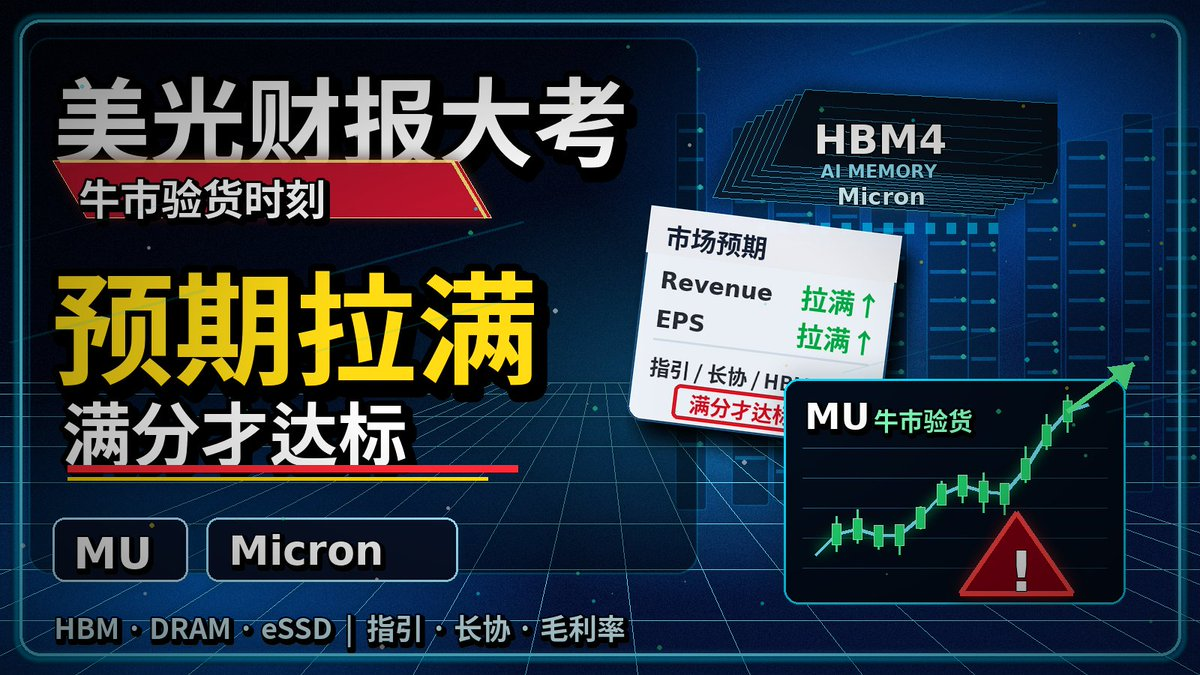
This week's most important event in the AI industry is likely Micron's earnings report. Everyone will be concerned about how Micron's stock will perform after the earnings report and how it will influence the market. From a personal perspective, this earnings report is not about simply confirming "strong or weak," but rather how long it can remain strong. Here are several points worth discussing:
1. This quarter's performance must not only exceed company guidance but also reach the upper limits of the market's most optimistic expectations;
In the last earnings call, Micron's guidance for this quarter was $33.5 billion, but the market currently generally expects revenue to have risen to about $34.8-$35.5 billion, with EPS in the range of $19.8-$20.7. Simply exceeding company guidance is far from enough; it must also exceed market expectations.
The strongest beat would significantly surpass market expectations, with a gross margin of 83%, and management clearly breaking down the sources of revenue:
1) How much comes from ASP (average selling price)
Last quarter, Micron stated that DRAM prices rose 60% sequentially, and NAND prices rose 70%, which indicates the contribution from ASP increases. ASP increases are usually the strongest part of the cycle (price increases due to supply-demand tightness), but they are also the easiest to reverse;
2) How much comes from bit shipments
Actual storage capacity sold (measured in "bits"), the core is to let the market know what portion of growth is from unit price increases and what portion is from shipment volume increases;
3) How much comes from product mix
Changes in the proportion of high-margin products versus low-margin products in total sales. Even if the total bit shipment volume does not change, as long as more products are sold to high-price, high-margin markets (such as HBM, DDR5 high-end, enterprise-grade SSDs), overall revenue and gross margin will rise;
4) How much comes from cost decreases
Even if prices and sales volumes remain unchanged, if costs decrease, gross margins will automatically increase. This is one of the most "solid" sources of profit because it results from the company's own efforts and is not easily replicable by competitors.
2. Not only look at current quarter results but also guidance for the next quarter
The current quarter is history; visibility for the next quarter and 2027 truly determines whether the sell-side model will continue to be upgraded. Goldman Sachs currently has an extremely aggressive FYQ4 model (approximately $48.8 billion in revenue, 86.1% gross margin, EPS $29.95), while market consensus expects about $40.4 billion in revenue and around $23.68 EPS.
If the guidance for the next quarter can reach $4.5-$4.9 billion in revenue and an EPS range of $25-$30, the high-end sell-side model can continue to be supported, and the trend for target price upgrades is likely to continue.
If it only reaches $4.0-$4.2 billion and around EPS $23-$24, the numbers are still strong, but they may only "cash out" rather than catalyze further.
If it falls below high-end expectations and management avoids discussing supply-demand in 2027, short-term adjustment pressure will significantly increase.
3. “SCA/LTA Long-term Agreement Mechanism”: This is the core of valuation enhancement
In the past two months, the market has started to view memory stocks more as growth stocks rather than cyclical stocks, with the core being long-term agreements. The biggest problem with memory stocks in the past was not being unable to make money but rather that the market did not believe high profits could be sustained. Previously, we discussed the long-term agreement terms disclosed in SanDisk's Q1 earnings report. Micron also announced reaching several SCA strategic customer agreements. If SCA can bind future supply, customer commitments, pricing mechanisms, and capex returns together, Micron's valuation multiples may shift from "cyclical peak discount" to "AI infrastructure assets with little discount."
Last quarter, Micron confirmed several points:
- First, SCA is different from traditional LTA, which usually tends toward a one-year term;
- Second, SCA is a multi-year agreement;
- Third, it includes specific commitments from customers;
- Fourth, the goal is to improve business visibility and stability;
- Fifth, the company has signed its first five-year SCA.
But the company also clearly stated that, for confidentiality reasons, it will not disclose details such as prices, cancellation terms, and downside protection.
Therefore, during this earnings call, it is important to listen to whether management has advanced compared to the last quarter. The key is not to "repeat robust terms" but to provide the following information:
1) Coverage: Does SCA cover HBM, DDR5, LP DRAM, NAND/eSSD, or only certain AI data center products?
2) Commitment strength: Is it take-or-pay, capacity reservation, pre-payment, minimum purchase quantity, or soft forecasts?
3) Pricing mechanism: Are there price floors, formula pricing, cost+returns, ROIC-linked pricing?
4) Termination costs: If demand slows in 2027-2028, do customers need to compensate for canceled/postponed orders?
5) Capex binding: Is Micron's new capacity expansion contingent on customer commitments rather than proactively leveraging high prices for expansion?
If management can only repeat "we have multi-year agreements with robust terms," but cannot convince the market that declining gross margins are protected, then the benefit of SCA to valuation multiples will be discounted. If management can convince investors that part of the 2027 profits has been contracted, that would clearly support a higher target price.
4. “HBM4/HBM4E Roadmap”
Micron has officially announced that HBM4 36GB 12H has entered mass production, targeting NVIDIA Vera Rubin, with bandwidth exceeding 2.8TB/s and energy efficiency improved by more than 20% compared to HBM3E; it has also sent samples of HBM4 48GB 16H to customers, with single-stack capacity 33% higher than that of 36GB 12H. The company also stated in the last earnings call that HBM4E development is progressing, with mass production expected in 2027, using 1-gamma DRAM.
However, here's a counterintuitive point: Currently, Micron's gross margins might not be driven by HBM but rather by non-HBM DRAM/DDR5. TrendForce noted that Micron's management stated last quarter that "non-HBM margins are currently higher than HBM," meaning that the current gross margin of over 81% is largely due to extreme shortages in traditional DRAM rather than HBM itself independently raising gross margins.
So when discussing HBM during the earnings call, do not only listen to "shipments," "certifications," "roadmaps," but also listen for:
Whether HBM4 yield matures faster than HBM3E;
Whether HBM4/HBM4E can maintain or increase the company's market share in HBM;
Whether HBM4E's collaboration with custom base die/TSMC brings stronger customer binding;
Whether overall gross margins continue to rise, stabilize, or are diluted by advanced packaging costs after the HBM mix rises;
Whether Micron is a core supplier or a third supplier filling gaps among NVIDIA Vera Rubin, Rubin Ultra, and other XPU customers.
Competition cannot be overlooked either. Samsung has already begun sending samples of HBM4E to customers, and SK Hynix has also sent samples of 12-layer HBM4E to major customers, with speeds up to 16Gbps/pin and energy efficiency improvements exceeding 20%. This does not necessarily bode poorly for Micron but means that HBM4E is not a one-sided story; platform certification and share stability are very important.
5. “NAND/eSSD Data Center Business”
This segment is actually likely undervalued by the market and is an important part that distinguishes Micron from the "pure HBM story." Last quarter, management stated very clearly: AI inference, vector databases, and KV cache offload are driving NAND bit demand in data centers; data center SSD market share has increased for the fourth consecutive calendar year; FY2Q26 data center NAND revenue increased more than doubled sequentially, hitting a significant new high, and is expected to continue growing next quarter. Meanwhile, Micron has already begun mass production of PCIe Gen6 data center SSDs, Micron 9650 for AI training and inference, supporting up to 28GB/s sequential read and 5.5 million random read IOPS.
The significance of this segment has three layers:
- First, it positions Micron not just as an HBM supplier but as a supplier of AI memory + storage combinations.
- Second, it enhances the quality of the NAND cycle, as data center SSDs are biased toward a higher value pool than consumer NAND.
- Third, it explains why NAND prices can also be strong, rather than simply stating "when DRAM rises, NAND follows."
The earnings call will need to focus on:
- Whether data center NAND revenue has significantly increased again sequentially; 122TB/245TB high-capacity SSD adoption rates;
- Customer validation and ramp-up pace for PCIe Gen6 SSDs;
- Profitability of QLC at the data center capacity layer;
- And whether NAND supply is also entering a long-term balanced tight situation.
Currently, "AI memory" is not solely an HBM narrative; if the earnings call only discusses HBM, the story is incomplete. If it can clearly articulate the joint growth of AI servers, traditional server refreshes, and agentic AI leading to CPU memory, LPDRAM, and eSSD growth, the valuation logic will be more solid.
Additional points of concern
1) Capex discipline should be viewed together with SCA
Last quarter, the stock price was pressured after hours, one important reason being that strong performance was significantly offset by the increase in capex. At that time, Micron raised FY2026 capital expenditure to over $25 billion and is expected to continue increasing in 2027, raising market concerns that this means normalization of future supply and the re-emergence of cyclicality.
During the earnings call, questions to ask include:
How much of the new capex is for shell/cleanroom, how much is for equipment?
When will this capacity form an effective bit supply?
Is it related to HBM, DRAM, NAND, or general expansion?
Are there customer SCAs or prepayment supports?
What is the target ROIC?
If demand in 2027 is lower than expected, can capex be delayed?
If capex is described as "long-term investments based on customer commitments," this is a positive for valuation; if it is like traditional cyclical peak expansions, it would be a source of valuation discounts.
2) Gross margin is not simply better the higher it goes; after 80%, "sustainability" must be considered
The company’s guidance for gross margin in FYQ3 is around 81%, already well above Micron's historical norm. Last quarter, management also reminded that at this level of gross margin, further price increases will have diminishing marginal improvements on gross margin.
Therefore, the market will not only reward "another 2 points increase in gross margin" but will also ask:
Can the gross margin be maintained above 70% for 2027? MarketWatch also mentioned that investors are concerned about whether long-term gross margins can exceed 70%, which would be seen as a strong positive signal.
The key is not whether Q3 gross margin is 82% or 83%, but whether management is willing to suggest that even with price declines, SCA, mix, cost curve, and supply-demand structure can maintain gross margin at historically high levels.
3) Strong demand does not mean there is no "demand destruction"
Rapid price increases may lead PC, mobile, and consumer electronics customers to reduce configurations or delay purchases. Last quarter, management already acknowledged that in price-sensitive markets, high prices may affect part of the demand, but overall demand remains strong; meanwhile, it has also stated that the company can only meet 50% to two-thirds of customer demand in the medium term.
This time, we need to see:
Are PCs/mobile beginning to lower memory configurations? Are OEMs delaying purchases? Are automotive/industrial customers accepting price hikes? Are customers pulling orders forward? If significant demand destruction occurs, the market will worry that 2027 is the peak.
Currently, MU is around $1,134, with a market value close to $1.3 trillion, and the market has already priced in a large portion of optimistic expectations before the earnings report. It is easy for a slightly less than optimistic guidance or insufficiently detailed explanations about certain segments to lead to fluctuations. However, from a medium to long-term perspective, it is still crucial to dig deep into the underlying business logic to understand what drives growth? Where does the performance come from? How sustainable and certain is future performance growth? This is the most critical aspect
免责声明:本文章仅代表作者个人观点,不代表本平台的立场和观点。本文章仅供信息分享,不构成对任何人的任何投资建议。用户与作者之间的任何争议,与本平台无关。如网页中刊载的文章或图片涉及侵权,请提供相关的权利证明和身份证明发送邮件到support@aicoin.com,本平台相关工作人员将会进行核查。


