Original | Odaily Planet Daily (@OdailyChina)
Author|Azuma (@azuma_eth)

Last week, Odaily Planet Daily published an article titled 《The first stock of the prediction market concept has appeared!》, which mainly mentioned that Robinhood is intercepting orders that once relied on Kalshi for execution through its self-built prediction market Rothera, thereby reducing revenue sharing with Kalshi and controlling profits within its self-built system.
Although it was anticipated that Rothera does not have the cold start issue that is generally prevalent among competitors, the data performance of the platform in the past week has significantly exceeded our previous expectations. After all, it is hard to imagine that a platform that has just been launched for half a month can directly parachute into the third place in the highly competitive prediction market, with only Kalshi and Polymarket as leaders ahead.
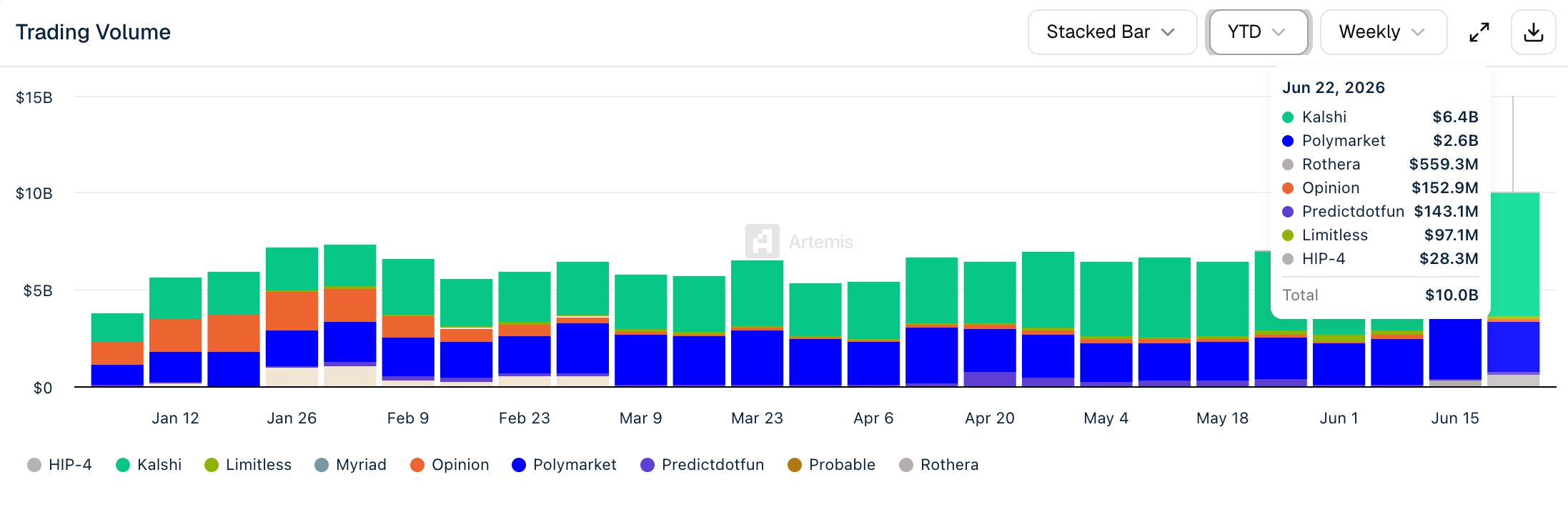
Artemis data shows that in the week ending June 8, Rothera, as a new platform, had a weekly trading volume of only $21.9 million, which is still in obvious contrast to second-tier platforms like Opinion, Predict, and Limitless; but in the week ending June 15, Rothera's weekly trading volume directly climbed to third in the industry, reaching $276 million; in the latest week ending June 22, Rothera's weekly trading volume increased to $559 million, nearly reaching one-fifth of Polymarket.
Atypical Growth Case (Skip if you have read the previous article)
One point that needs to be clarified is that the rise of Rothera essentially does not stem from the creation of incremental users (though it cannot be ruled out that some users entered due to the World Cup), but rather a migration of existing orders, rather than the creation of incremental users.
Over the past year, Robinhood has been one of the most important distribution channels for Kalshi. Relying on tens of millions of retail users and a mature entry for trading stocks, options, and cryptocurrencies, Robinhood has delivered a large volume of orders to Kalshi. Piper Sandler analysts once estimated that the trading volume completed through the Robinhood channel accounted for about 25%-35% of Kalshi's total trading volume.
The problem is that although these orders come from Robinhood users, they do not belong to Robinhood itself. Under the previous cooperation model, Robinhood was more like a front-end traffic entry, while Kalshi was the true provider of the infrastructure responsible for matching, clearing, and settling. All revenue generated from each transaction needs to be distributed between the two parties.
Rothera is the weapon Robinhood uses to break this revenue-sharing model. Since the beginning of this month, Robinhood has started to transfer some World Cup-related event contracts to be executed internally on Rothera, which means that a large number of orders that would have flowed to Kalshi now stay within Robinhood's own system.
Therefore, in a sense, the surge in Rothera's trading volume is less about the threat from other prediction markets like Polymarket, Predict, or Limitless, and more about directly "drawing blood" from Kalshi.
Robinhood's Value Capture
The rapid growth of Rothera's trading volume has directly reinforced Robinhood's ability to capture the value of prediction market-related orders on the platform.
Long-term tracking of Robinhood by the investment research media Hood House, combined with public data statistics, shows that as of June 20, Robinhood's prediction market business had a daily total of 34,700 contracts traded, corresponding to a daily revenue of about $4.9 million.
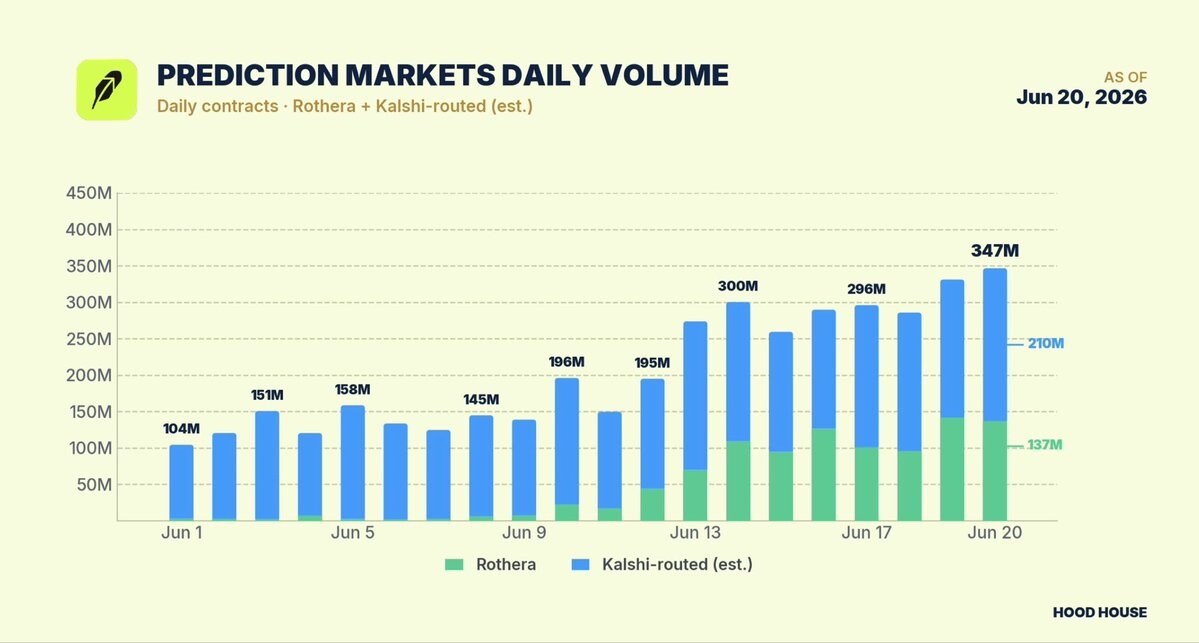
Hood House then disclosed its statistical logic:
- The daily trading volume of Rothera (mainly carrying World Cup-related markets) has reached 137 million contracts, corresponding to a trading amount of about $47 million;
- In comparison, Kalshi's total trading volume that day was about 1.5 billion contracts, corresponding to a trading amount of about $416 million; if excluding World Cup-related markets, Kalshi's trading volume was about 1 billion contracts, corresponding to a trading amount of about $260 million;
- Considering that the current trading volume contributed by Robinhood users still accounts for about 20% of Kalshi's non-World Cup market trading volume (conservative estimate), this means that for Kalshi's non-World Cup-related event contracts, about 210 million contracts and $52 million in trading volume were completed through Robinhood.
Hood House further aggressively estimates that if this growth rate continues, Robinhood's prediction market business has the opportunity to achieve a revenue scale of $1 billion this year. This figure even exceeds the historical peak of Robinhood's cryptocurrency-related revenue, which was about $900 million achieved in 2025.
Kalshi's Response Strategy: Finding New Channels
In the face of Rothera's rapid rise, Kalshi has clearly recognized the problem.
For Kalshi, Robinhood has been both a partner and one of the most important sources of traffic; however, as Robinhood begins to migrate more and more orders to its own platform, the two parties have become direct competitors.
A recent report by The Information may reveal Kalshi's response strategy. Insiders disclosed that Kalshi has begun contacting multiple investment banks to have early, informal discussions regarding a potential IPO in the future. More importantly, Kalshi has made a clear request in its communications with these investment banks — if they wish to obtain underwriting qualifications for a future IPO, these institutions need to prioritize completing technical integration with Kalshi to allow their underlying institutional clients to directly participate in event contract trading on the Kalshi platform.
In other words, Kalshi is taking advantage of the opportunity provided by the IPO to seek new distribution channels, integrating prediction markets into the customer networks of banks, securities firms, and other financial institutions. This might also indicate a subtle shift in the competitive landscape of the prediction market industry. In the past, the market focused on who could provide more contracts, who could design better products; now, as prediction markets gradually move towards the mainstream financial system, the focus of competition is shifting to another dimension — who can master user entry, who can more effectively control value.
The rise of Rothera has proven the significance of distribution capability, parachuting into third place in the race seems effortless, whether it can challenge Kalshi and Polymarket in the future does not seem to be a difficult problem.
免责声明:本文章仅代表作者个人观点,不代表本平台的立场和观点。本文章仅供信息分享,不构成对任何人的任何投资建议。用户与作者之间的任何争议,与本平台无关。如网页中刊载的文章或图片涉及侵权,请提供相关的权利证明和身份证明发送邮件到support@aicoin.com,本平台相关工作人员将会进行核查。


