Written by: Lacie Zhang, Researcher at Bitget Wallet
In November 2021, a group of strangers pooled over 40 million dollars in just a few days to buy a first edition of the U.S. Constitution from 1787. This organization, called ConstitutionDAO, ultimately lost to a hedge fund billionaire at the Sotheby’s auction. They arrived with the money but failed to take the item home. It was many people's first time witnessing that blockchain could aggregate dispersed retail funds around the world in a very short period to focus on a rare asset.
Four and a half years later, a similar scene played out in a different setting, telling another story.
On June 12, 2026, SpaceX (stock code: SPCX) landed on NASDAQ with an opening price of 150 dollars, about 11% higher than the initial offer price of 135 dollars, becoming the strongest IPO in history.
For the vast majority of users, U.S. stock IPOs are almost an invisible barrier. Without qualified investor status, traditional brokerage accounts, or long-term relationships with underwriters, blockchain has dissolved this threshold. Multiple crypto platforms attempted to bring this originally closed-off rare asset to the chain in a tokenized manner. Bitget Wallet even collaborated with the tokenized stock platform xStocks to open tokenized subscriptions for SPCX IPOs, setting individual quotas between 10–5,000 dollars, lowering the participation threshold to near zero.
The results were not ideal. Due to xStocks' upstream underwriting channels failing to secure the corresponding quotas, the underlying shares for the tokenized subscriptions were not delivered as expected, and this attempt ended in refunds.
However, this result is precisely the best entry point for understanding the real situation of on-chain Pre-IPO.
1. The Ultimate Challenge of Tokenized IPOs: Centralized Distribution of Off-Chain Assets
所谓代币化打新,本质上是对传统券商 IPO 额度的代币化分发。而造成这次行业集体受阻的核心症结,在于传统 IPO 配售体系与链上分发能力之间的结构性错配。
Tokenized channels can place the subscription entry on-chain: anyone, anywhere, without needing an account, can participate using stablecoins. But what tokenization cannot change is that the decision-making power of distribution still lies in the hands of the traditional financial syndicate.
Taking SpaceX as an example, the co-managing underwriters included top investment banks like Goldman Sachs, Morgan Stanley, Bank of America Securities, Citigroup, and JPMorgan Chase, responsible for organizing the book-building, aggregating demand, and ultimately deciding on quota distribution.
This distribution logic follows the priority of institutions, relationships, and long-term clients, with underwriters favoring institutional clients who place large orders and can maintain stable holdings. This tendency becomes more pronounced for hot IPOs with scarce supplies. SpaceX was oversubscribed by about 4 times, with BlackRock alone placing an order of about 5 billion dollars, leaving very limited quotas for crypto-native channels.
The result is that although blockchain has a powerful global distribution capability, it faces a set of game rules that completely do not belong to it at the most critical juncture.
The path to breaking this deadlock is not complicated, but it requires time: first, to gradually allow crypto-friendly institutions to enter the traditional underwriting network, obtaining institutional seats in the primary market through licenses, capital strength, and long-term accumulation; second, to promote the native issuance of assets on-chain from the source, fundamentally bypassing the existing IPO quota system. Until these two paths are successfully navigated, tokenized IPOs will face a ceiling on the supply side.
2. An Imperfect but Important On-Chain Stress Test
Despite disappointing settlement results, this collective industry attempt was not without gain. It left real signals in two dimensions: first, on-chain permissionless distribution can fully accommodate the real demand of retail investors for rare assets; second, on-chain distribution infrastructure is relatively mature, beginning to show potential for reshaping the traditional IPO participation process.
Demand Aspect. Over 800 million dollars in subscription funds gathered in a short time from ordinary users around the world, targeting an asset that is almost completely closed off to them through traditional channels. Assets like SpaceX face geographic restrictions, accredited investor thresholds, and brokerage account requirements, keeping the majority out. On-chain provides a new entry: users do not need traditional brokerage accounts, do not need complex account setup processes, just a wallet and stablecoins. This demand itself will not disappear due to one failed delivery.
Notably, on-chain participation also provides flexibility that traditional channels do not offer after allocation. Traditional IPOs usually come with “anti-flipping” constraints, where winners may face penalties such as commission recovery and being blacklisted if they short-sell; tokenized assets typically do not have mandatory lock-ups, allowing for free trading once acquired. For retail investors long troubled by “can I enter the market,” being able to freely enter and exit after “entering the market” is itself a real and scarce value.
Execution Aspect. This incident also provided a real stress test for on-chain infrastructure. Taking Bitget Wallet as an example: with the help of its self-developed DEX aggregator and multi-chain gas payment, subscriptions were extended to USDC/USDT on five chains—users could participate using stablecoins from any mainstream chain without needing to swap across chains or being stuck due to a lack of native gas tokens, providing solid technical support for over 13 million dollars in on-chain subscriptions in less than half an hour.
Once the confirmation of delivery failure was received, full refunds (including principal, fees, and exchange differences) were completed within about 4 hours without any user action. More importantly, each refund, each reconciliation, and each status change were real transactions on-chain that are publicly verifiable. Compared to traditional brokers relying on internal ledgers and manual coordination for refunds, the transparency and execution efficiency advantages of on-chain infrastructure were genuinely reflected in this stress test.
3. Two Participation Methods in Pre-IPO: Tokenized IPO or Perp?
Since tokenized IPOs currently cannot change the asset supply method in the primary market, we may need to lower expectations for a considerable period. They are unlikely to truly achieve permissionless and unlimited supply; a more realistic form may be a “stablecoinization” transformation of the traditional IPO participation process. When subscription scales exceed actual quotas, oversubscription, lottery selection, pro-rata distribution, and even full refunds will become the norm.
In contrast, another type of participation method appears to be more noteworthy: Pre-IPO perpetual contracts (Perp).
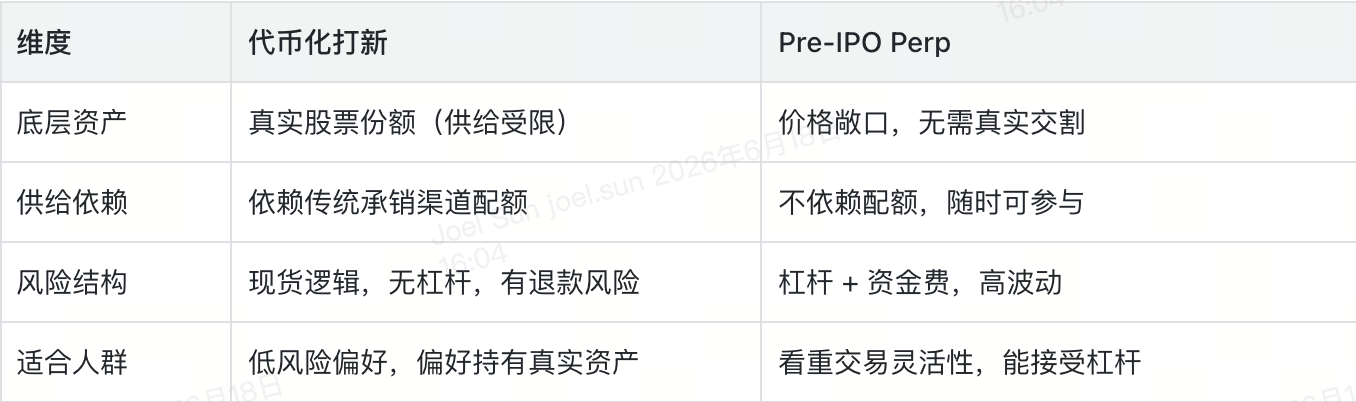
The two types of tools cater to different preferences. Tokenized IPOs are closer to spot logic: they are backed by real underlying assets and suitable for users with low risk tolerance who do not want to bear the wear and tear of leverage and funding costs, but the trade-off is limited supply and potential for oversubscription lotteries or even full refunds. Pre-IPO Perp, on the other hand, does not require waiting for quotas, does not rely on underwriter allocations, and does not require real stock delivery; instead, it directly trades around the price expectations of unlisted assets, demonstrating higher flexibility, but requires acceptance of leverage and high volatility risks.
What is even more noteworthy is that Pre-IPO Perp has already shown certain price discovery capabilities. The SPCX perpetual contract has been traded 24/7 on venues like Hyperliquid since May 18, weeks ahead of its official listing on June 12. Approaching the listing, the volume-weighted average price across locations was about 155 dollars, about 15% higher than the 135 dollar issue price; the first transaction price upon official listing was 150 dollars, indicating that the on-chain market had largely converged to the true price prior to opening. Another reference point is Cerebras, where the Pre-IPO Perp pricing on Hyperliquid at the time of listing was only about 1.3% different from the opening price of 350 dollars.
It is evident that on-chain can not only form price consensus around unlisted assets but can also partially reflect market expectations for formal listing prices in advance. This capability itself has surpassed the simple scope of “participating in IPOs.”
4. Conclusion
Back to that auction house in 2021. ConstitutionDAO lost to a bidding war, while the tokenized IPO of SpaceX lost to trust and qualifications, with on-chain channels even failing to enter the room that determined quota distribution.
The reason for failure shifted from “the bid was not high enough” to “there was no qualification to enter,” indicating that the issue has moved from the execution level to the structural level. The maturity of on-chain infrastructure does not automatically lead to the opening of the off-chain supply side. These are two different matters, and their progress is not synchronized.
However, if we broaden our perspective, this asynchrony is not unheard of. Every shift in financial infrastructure, from the emergence of clearinghouses to electronic trading replacing manual bidding, has gone through a long coexistence stage of old and new systems, marked by repeated frictions. The traditional financial system will not immediately open the doors of allocation after a failed IPO, just as Sotheby’s would not change auction rules because of ConstitutionDAO’s emergence. But friction leaves traces: it changes user perceptions, alters platform capabilities, and gradually shifts institutional views on crypto channels.
The most notable aspect of this event may not be the result itself but what it inadvertently accomplished: all users who participated in this IPO have already gotten used to using stablecoins in their wallets to touch an asset that previously belonged only to institutions. Once this perception is formed, it is difficult to reverse. When the day comes for changes in the supply side access structure, the demand side will already be prepared, and the infrastructure will also be ready.
The value of this review may lie in this: it turns a vague failure into a clear issue; and only clear issues have the potential to be resolved.
免责声明:本文章仅代表作者个人观点,不代表本平台的立场和观点。本文章仅供信息分享,不构成对任何人的任何投资建议。用户与作者之间的任何争议,与本平台无关。如网页中刊载的文章或图片涉及侵权,请提供相关的权利证明和身份证明发送邮件到support@aicoin.com,本平台相关工作人员将会进行核查。


