When cryptocurrency exchanges turn the entry to US stocks into a button, what users should really care about is whether there are real assets behind the button, who is responsible for delivery, and who to contact when exiting.
Written by: Liu Honglin
On June 12, SpaceX listed on Nasdaq with an issuance price of $135, raising about $75 billion, which the market dubbed as the largest IPO in history. According to the normal script, this should have been a celebration for Musk, Wall Street, underwriters, and tech stock investors.
However, while some celebrate, others worry. The most concerning for this event appears to be friends in the cryptocurrency circle.
In the days leading up to the IPO, many cryptocurrency exchanges and platforms began promoting "on-chain participation in the SpaceX IPO" and "using stablecoins to subscribe to tokenized SpaceX shares." Users could use their USDT or USDC to register for SpaceX's stock. But on the day of the IPO, it turned out to be a series of apologies for lack of stock...
According to The Wall Street Journal, tokenized platforms like xStocks had previously received over $1 billion in demand related to SpaceX, but major exchanges claimed they had not received a SpaceX allocation from partners and could only refund pre-order users.
This situation is very abstract, yet quite real.
Users believed they were participating on-chain, but in reality, they might have just placed their money into a centralized entry, waiting for another centralized partner to acquire the stock, with the availability of stock left to chance. The so-called on-chain US stocks, RWA, tokenized US stocks suddenly shifted from a grand financial innovation narrative to a simple question: did you actually buy stocks, or did you purchase a symbol?
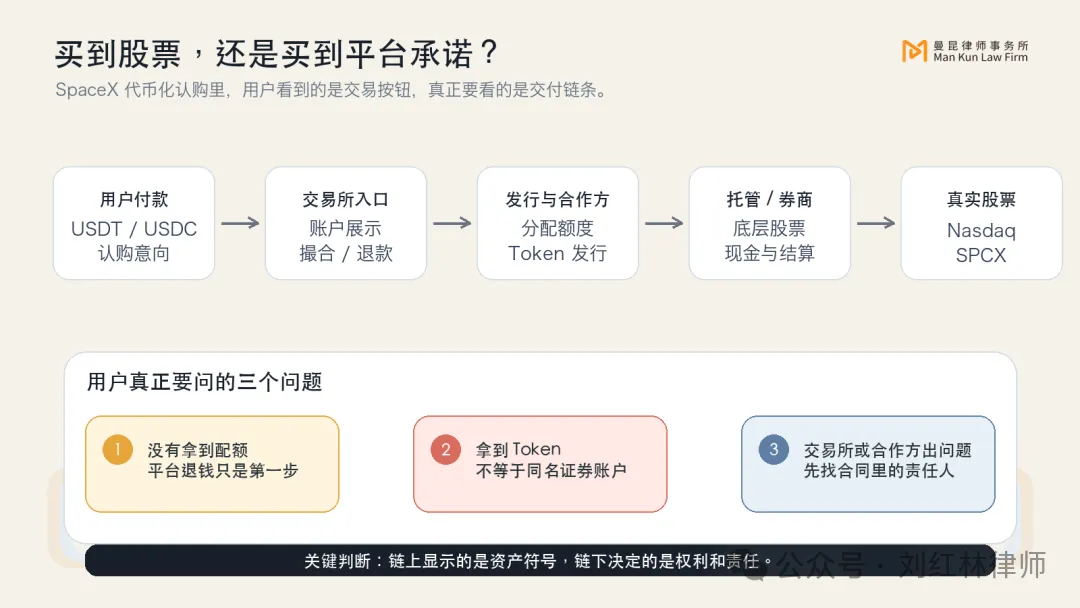
The Asset and Responsibility Chain of On-Chain US Stocks
Are You Buying Real Stocks?
Many people's first reaction is to say that since the platform refunded the money, isn't that good? At least they didn't run away or distribute worthless tokens.
Refunding money is certainly better than not. A more reliable platform, when it hasn't received an allocation, would at the very least cancel orders, refund funds, and explain the reasons. But the real concern is not whether there was a refund this time, but why a product marketed as "on-chain participation in the world's largest IPO" would encounter a situation where "the underlying assets were not obtained" at such a critical delivery point.
In traditional IPOs, users submit subscription requests through brokers like Robinhood, Fidelity, Schwab, or SoFi, and there is no guarantee of being allocated shares. It's perfectly normal not to get stock; hot IPOs typically get divided repeatedly among institutions, underwriters, major clients, and retail channels. But if you do get allocated, you receive a stock of Nasdaq: SPCX, and the registration, clearing, custody, customer asset protection, and subsequent dispute handling are at least still within the traditional securities system.
On-chain entry does not work this way.
Taking the public documents of xStocks as an example, it describes its products as "representations of tokenized stocks or ETFs," claiming each xStock is backed 1:1 by corresponding underlying assets. It sounds much like stocks, but Kraken’s risk disclosure puts it more directly: xStocks holders do not own the underlying stocks or company shares, have no voting rights, distribution rights, nor legal claims to the company’s assets during liquidation; users gain economic exposure to the underlying stock's performance rather than direct shareholder status. xStocks’ official legal explanation also categorizes it as a debt instrument of tracking certificates rather than direct equity.
Many users compare such products to brokerage accounts like Futu, Tiger, and Interactive Brokers: Aren't I buying US stocks in the app, separated by brokers, custodians, and clearing houses? Why should I be particularly cautious about on-chain US stocks?
This analogy holds to some extent. The modern securities market does not involve you taking paper stocks home; there are certainly brokers, clearing, custody, registration, market making, and regulation behind it. Ordinary people only see digits in the app.
But the difference is that the "digit" behind the traditional brokerage system has relatively mature account registration, customer asset segregation, underlying custody, and regulatory relief pathways. For example, if you buy US stocks through a licensed broker, the underlying might connect to institutions like Interactive Brokers, where the relationship between asset registration, securities custody, and customer identity is comparatively clear. Broker insolvency is, of course, troublesome, but you can at least pursue it through securities accounts, customer information, custody records, and regulatory procedures.
The trouble with on-chain tokenized US stocks is that it often packages 'the rights in a securities account' as 'the asset sense in a wallet.' Users think that by bringing assets into their wallets, they have real ownership. However, in many structures, the token held in the wallet does not represent stocks registered in your name but rather a financial instrument created by an issuer and backed by certain underlying assets that can be transferred in secondary markets.
You control that token, but it does not mean you directly control the underlying stocks.
If the platform runs smoothly, with sufficient underlying assets, market makers quoting normally, and redemption mechanisms available, this difference is not obvious in everyday trading. Users see prices following SpaceX, Tesla, Nvidia, and naturally treat it as "on-chain stocks."
But once issues arise, the difference becomes apparent.
What if the cooperation between exchanges and issuers is severed? What if there is a dispute between the issuer and the custodian? What if the underlying broker cannot deliver? What if liquidity in the secondary market dries up? What if regulators require cessation of services in certain regions? If you hold stocks in a traditional securities account, the problems, although complex, have relatively clear pathways; but if you hold tokens under an offshore structure, many times you first need to clarify who you are a creditor to, based on which document you claim rights, and in which legal jurisdiction you seek protection.
This is where on-chain US stocks are most easily overlooked: they make trading seem simpler, but complicate the rights relationships.
What you are buying is not a stock directly registered in your name, but a trust chain supported by exchanges, issuers, custodians, brokers, and redemption arrangements. The on-chain token is just the last visible segment; it is the entire set of centralized arrangements offline that ultimately determines whether you can get your money back.
It's Not the Technology That's Amateurish
The crypto world has always loved to talk about "decentralization," but on-chain US stocks pull everyone back into centralized trust.
In the past, we joked that the biggest paradox in the crypto world is that many people trade so-called decentralized assets on centralized exchanges. Now, tokenized US stocks have taken it a step further: people use centralized exchanges, with centralized stablecoins, to subscribe to stocks issued by centralized issuers, held by centralized custodians, and where centralized platforms are responsible for matching and refunds in "on-chain US stocks."
This is not a victory for decentralized finance. It's merely a stress test of the risk pressures shared by traditional finance, crypto exchanges, offshore issuance structures, and on-chain narratives.
Tokenized US stocks are also a certain trend, especially as non-US users, crypto-native users, and the demand for 24-hour trading grows stronger. Stocks, bonds, funds, government bonds, receivables, and private fund shares could all possibly use on-chain methods in the future to enhance circulation efficiency, reduce cross-border operational costs, and improve settlement experiences.
The problem is that a trend does not mean every product is reliable, and putting assets on-chain does not mean rights go on-chain. Truly mature tokenized securities should address the underlying assets, investor identity, rights registration, redemption arrangements, information disclosure, suitability, anti-money laundering, and dispute resolution. Currently, many exchanges take out the easiest parts to propagate: names of large companies, stock codes, stablecoin subscriptions, 24-hour trading, low thresholds for participation. As for the unsexy work that comes afterward, users often only remember it when issues arise.
So, it is not the technology that is amateurish.
For ordinary users, the advice from lawyer Honglin is: if you are not familiar with how equity tokenization works, don’t easily try to jump into something popular.
First, you need to clearly understand what you are actually buying: is it an internal certificate recorded by the exchange, a token issued by the issuer, a type of tracking certificate, or stocks registered in your name in a securities account? Some platforms are merely matching entry points, some are responsible for custody, others are only secondary markets, and some have issuers, brokers, custodial banks, market makers, and redemption agents behind them.
Secondly, you need to clarify investment exit paths. Whether you can sell does not only depend on whether you want to sell but also on whether the platform continues to offer trading, whether there is liquidity in the secondary market, whether the issuer supports redemption, and whether your identity meets KYC and regional restrictions. For such products, this means that not all wallet holders can directly redeem with the issuer.
Lastly, be cautiously aware of promotion of "equity tokenization" and "on-chain US IPO subscription" aimed at users in mainland China. In the context of mainland China, promoting overseas securities, derivatives, or high-risk financial products to the unspecified public carries strong compliance sensitivity. While offshore platforms may claim they do not offer services in certain regions, communities and agents work hard to acquire customers in the Chinese market, leading the risks to likely fall on users who are the last to understand the rules.
If you must pay attention to such products, try to only focus on leading platforms that have undergone longer scrutiny, have relatively complete information disclosure, and have more mature risk control and compliance systems. Do not rush into a small exchange you’ve never heard of just because of a few topics, a couple of yield pictures, low fees, or an invitation code from a community. You may think you have bought stocks of Musk, Nvidia, or Tesla, but in the end, what you could end up with is just a symbol carrying a stock name.
The Wind Continues to Blow
In this SpaceX debacle, the most noteworthy aspect is not whether a certain platform received stock or whether some users missed out on profits.
This event resembles a stress test: when cryptocurrency exchanges turn the entry to US stocks into a button, what users should really care about is whether there are real assets behind the button, who is responsible for delivery, and who to contact when exiting.
In the coming years, tokenized US stocks are likely to continue to develop. Nasdaq, Kraken, Robinhood, Coinbase, Backed, various wallets, and exchanges will continue to explore; on-chain US stocks could become an important market infrastructure in the future.
But at this stage, ordinary users should not rush to treat it like the US stocks in a Futu or Interactive Brokers account. First, confirm whether what you have is an actual stock or merely a string of symbols in an exchange account.
免责声明:本文章仅代表作者个人观点,不代表本平台的立场和观点。本文章仅供信息分享,不构成对任何人的任何投资建议。用户与作者之间的任何争议,与本平台无关。如网页中刊载的文章或图片涉及侵权,请提供相关的权利证明和身份证明发送邮件到support@aicoin.com,本平台相关工作人员将会进行核查。


