Since mid-April this year, the token $CARDS of the TCG card market/drawing platform Collector Cards on Solana has surged over 5 times at its peak. Currently, the circulating market value of $CARDS is approximately 60 million dollars, with an FDV of about 468 million dollars.
In a year where the cryptocurrency market lacks narrative and is sluggish, such market performance is undoubtedly eye-catching. Let's first analyze why Collector Cards has been able to reverse the trend and show strong performance, and then take a look at the current on-chain TCG card field.
Reasons for Collector Cards' Increase: It's Really Profiting
What might surprise people is that Collector Cards is currently almost the second most profitable dApp on Solana, right behind pump.fun.
According to data from defillama, whether in the past 7 days or the past 30 days, Collector Cards’ revenue has consistently ranked 2nd among Solana dApps. In the past 7 days, the revenue of Collector Cards was 3.86 million dollars, while in the past 30 days, it was 9.48 million dollars.

This revenue data surpasses many well-known Solana dApps such as Axiom, Phantom Wallet, Jupiter, and Meteora.
Moreover, this revenue data is impressive even when compared to the entire cryptocurrency sector. In the past 7 days, the revenue of Collector Cards ranked 7th among crypto projects, and in the past 30 days, it ranked 10th. If we exclude stablecoin projects like Tether and Circle, as well as Polymarket, Collector Cards is almost second only to Hyperliquid and pump.fun as a native "money printer" in cryptocurrency.
The revenue sources for Collector Cards are quite simple: part comes from card draws, while another part comes from the transaction fees of the card trading market. These two revenue streams are very uneven; for instance, in May, the total transaction volume of card draw packs was approximately 194.7 million dollars, while the total transaction volume in the card trading market was only about 205,000 dollars.
Although the sales of card draw packs have been very strong, it is essentially a "gambling-style gacha". Many players, after opening card packs and finding the cards they obtained are worthless, will immediately sell them back to the platform at a discount price. The repurchase price varies between different card packs; generally speaking, cheaper packs, such as those costing 25 or 50 dollars to draw once, are repurchased at 85% of the price, while packs costing 2500 dollars for a draw can be repurchased at 93% of the price.
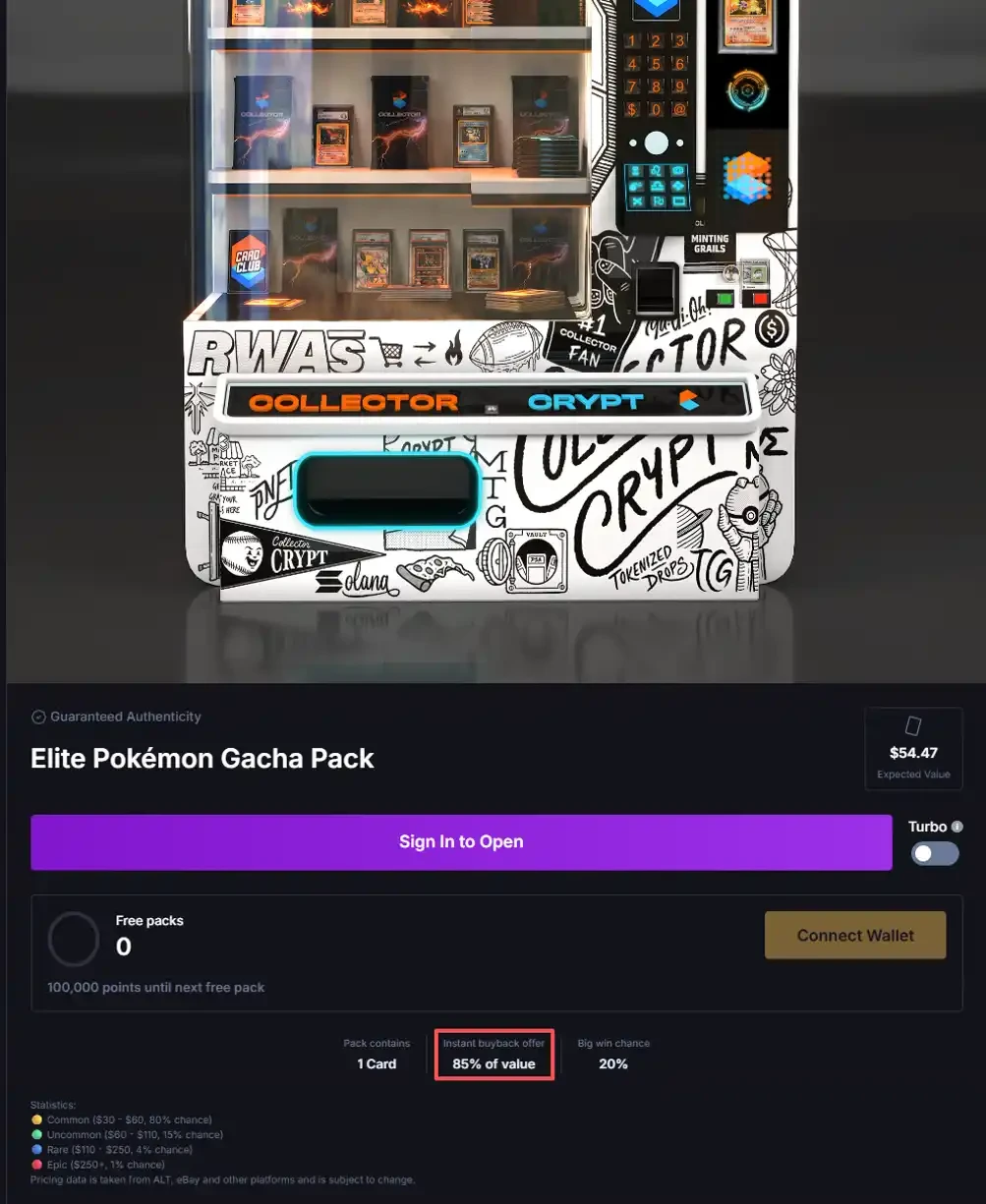
Although the total transaction volume for card draws is substantial, many players sell their ordinary, worthless cards back to the platform right away, resulting in the profits being what we've shown at the beginning of this section.
Some might wonder, is there really such a large number of people playing these soft gambling card draws on-chain?
Let’s not jump to conclusions and look at the data. So far, the number of unique users who have participated in card draws on Collector Cards is 23,733, with an average spend of 26,843.71 dollars per wallet on card draws. The total drawing instances exceed 4.87 million, with an average of over 205 draws per unique user.
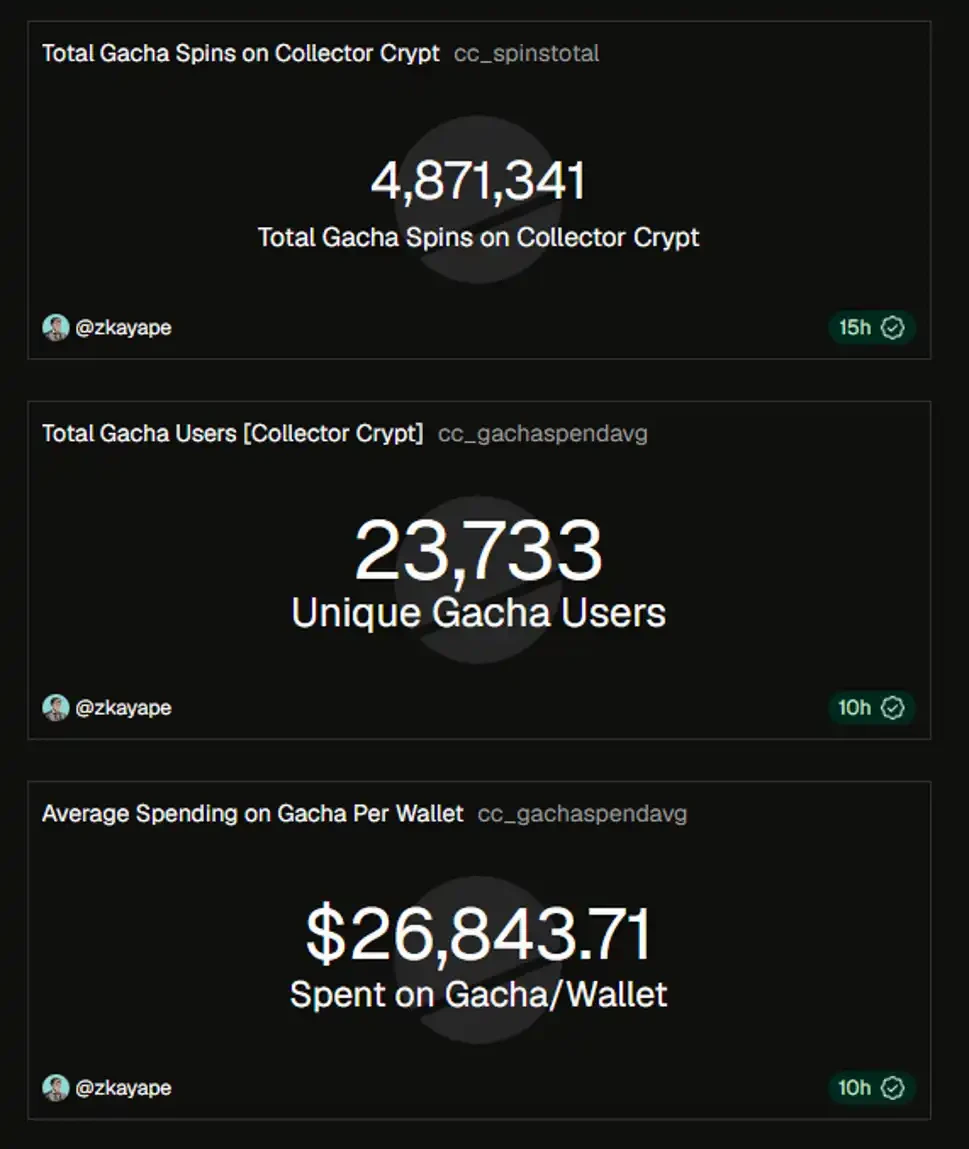
Nearly 60% of users spent over 250 dollars on card draws, and there were even 109 users who drew more than 1 million dollars.

This data is impressive, but it is also important to consider that the points accumulated from participating in card draws are a core indicator of how much $CARDS airdrop can be obtained each quarter. Furthermore, the official has clearly stated that the points for each new quarter are more important than the total accumulated points:
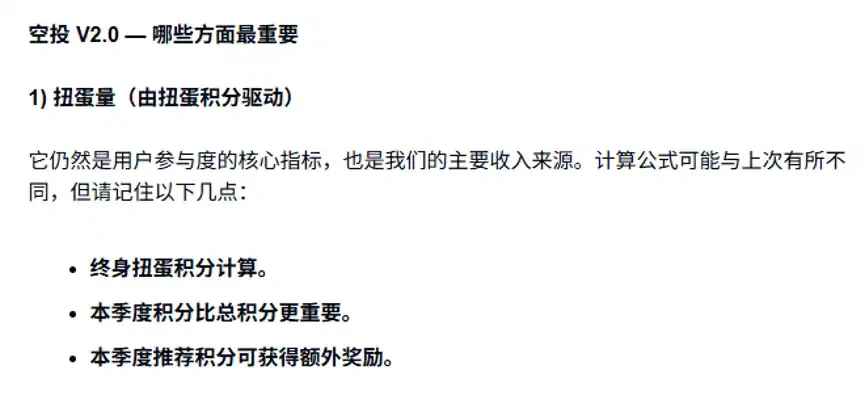
So far, the quarterly airdrop of $CARDS has been completed three times, with a total of 0.75% of the tokens distributed to players on the platform each time. This is similar to when NFTs were popular, and many were trading at a loss just to acquire Blur points.
Thus, Collector Cards is indeed profitable, but this data has certainly been amplified due to the potential airdrop gains. Of course, the amplification mentioned here is not derogatory or indicative of a long-term bearish outlook, but rather an affirmation of its successful flywheel.
With this successful token incentive, Collector Cards has successfully pushed the former king of the same track, Courtyard on Polygon, off its throne. Its market share in card draws has stabilized above 50%, reaching as high as 83.6% in the most recent week:
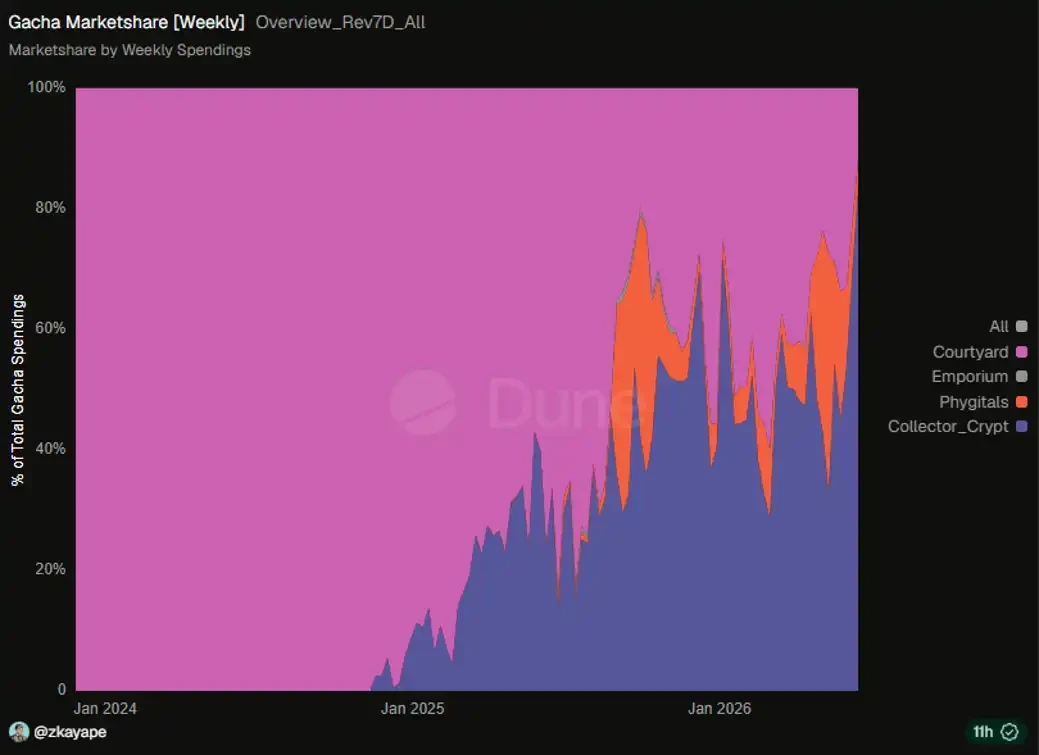
From the revenue data perspective, Courtyard had a revenue of 1.14 million dollars in the past 7 days and 6.99 million dollars in the past 30 days. Given that Courtyard has not issued tokens nor provides token incentives, its revenue data can actually prove that there is real demand for on-chain card draws, and the competitive advantages amplified by tokens, if paced well with a long enough timeline, will also help with long-term user retention.
Returning to the discussion about the strong performance of $CARDS price. Besides being genuinely profitable, it is currently the only investment option with tokens in the same track. The total transaction volume of Collector Cards has already exceeded 1 billion dollars, while other projects in the same track, like Courtyard, have a total transaction volume exceeding 1.1 billion dollars, Phygitals exceeding 336 million dollars, and Beeize on Base has also surpassed 100 million dollars within four months.
The market for Pokémon cards is indeed huge enough to support the scale of these on-chain drawing platforms. Over the past year, according to pokeca-soken data, the market price of single Pokémon cards has been continuously rising.
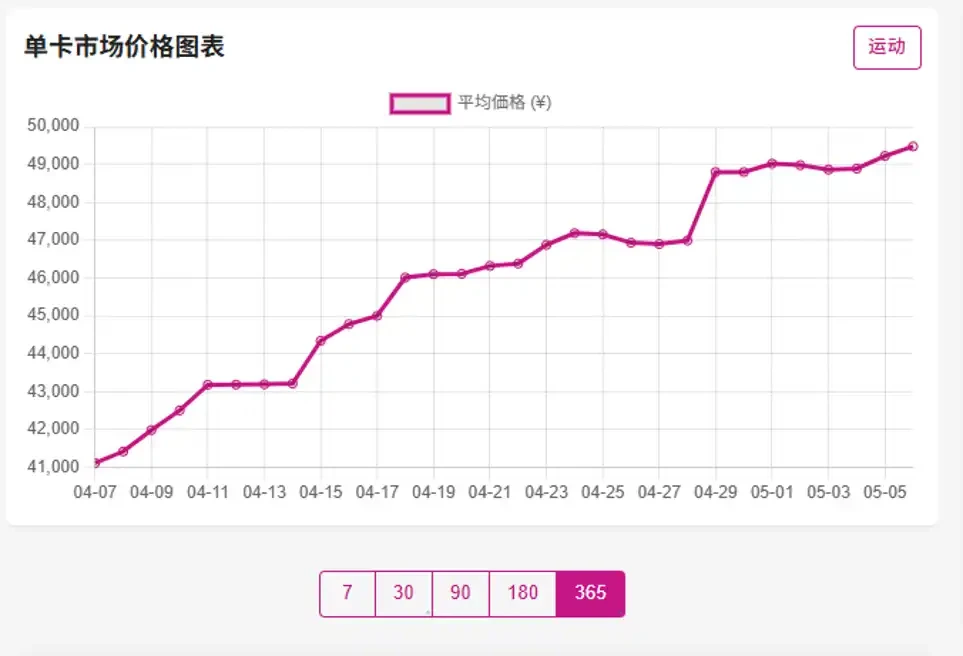
As of March 2025, the cumulative production of Pokémon cards has exceeded 75 billion, being sold in over 90 countries worldwide. Its sales for the fiscal year 2024-2025 reach as high as 410.9 billion yen, a year-on-year increase of 38.1%. Its digital product Pokémon TCG Pocket even surpassed 1.3 billion dollars in revenue in its first year of launch.
Especially after the launch of the physical card game "Pokémon Trading Card Game Pocket Version" in the fall of 2024, demand for physical cards surged, resulting in large-scale shortages and scalping phenomena. The Pokémon Company is currently building a new printing factory covering 1.27 million square feet, expected to be operational by the end of 2028.
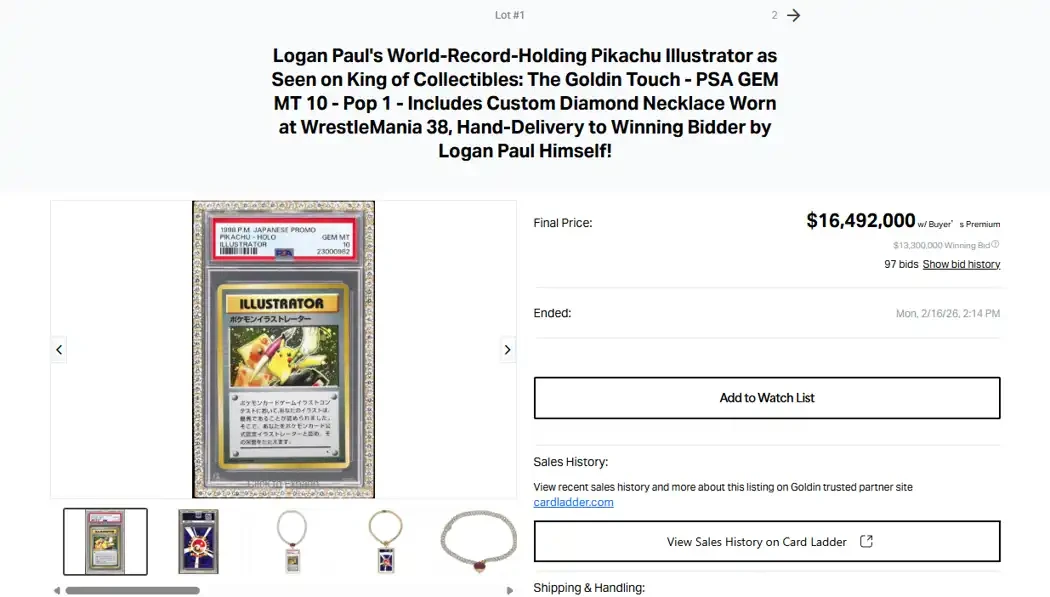
In February 2026, famous YouTuber and WWE star Logan Paul auctioned the only PSA GEM MT 10 perfect condition version of a Pokémon card, which he privately purchased for about 5.275 million dollars in 2021, at Goldin Auctions, resulting in a final price of approximately 16.5 million dollars.
With on-chain card draws, there is no need to physically buy card packs. Players can immediately sell back ordinary cards they don't want to the platform, and if they draw cards they desire, they can claim the physical cards from those platforms, which is indeed very convenient for many loyal Pokémon card players. Simply understanding the development momentum of these platforms from a "gambling" perspective overlooks the massive young market size and demand of Pokémon cards themselves.
Additionally, the repurchase of $CARDS is already underway. However, the project team stated they need to wait for the CLARITY Act to be implemented before they can provide further details.
Other Types of TCG Card Projects
Analyzing $CARDS allows us to see that drawing cards is currently the most profitable business in the on-chain TCG card market. However, this gameplay is not everything; there are other directions as well.
Card Fragmentation
This direction differs from the previous NFT fragmentation that mainly focused on on-chain DeFi or speculation. Essentially, rare and expensive cards are indeed difficult to collect and invest in, and there is a long-term, practical market demand and price support. However, this also means that the demand in this area is not as large as that for card draws; it targets a more hardcore player base and investors who want to invest in rare cards for excess returns rather than take chances with luck.
Recently, notable projects in this type include Grail on Base and $SV151, launched by Sunrise and Meteora on Solana. The token price of the Cristiano Ronaldo card on Grail has risen nearly 100 times since May 5, while the price of the Mbappé card token has surged nearly 300 times since the same date.
On the other hand, $SV151 has chosen to tokenize the limited edition SV151 card set featuring the initial 151 Pokémon. Its market cap once exceeded 3 million dollars.
However, the biggest problem with this type of project is that the narrative has very limited imagination. The market cap of its tokens is closely tied to the actual value of card storage, making it difficult to convince on-chain players to speculate for corresponding high market cap premiums. Both fragmented card tokens on Grail and $SV151 have faced a situation where after initial speculation, they quickly dropped back to a price range linked to the actual card prices. Taking $SV151 as an example, they have currently announced the purchase of related card assets worth about 185,000 dollars, but the current market cap of the token is around 600,000 dollars, which itself is already several times the premium logically.
Lottery-style Card Drawing
If we interpret card drawing as a form of gambling, then this type of token adds a layer on top of that gambling.
The most typical project of this type is $GACHA, where transaction fees are all used for card draws. Each hour, one lucky holder is drawn to receive all the cards drawn within that time period, or users can deposit US dollars with credit cards, and the deposited money is all used for drawing cards. Then, according to the proportion of US dollars contributed by different players, one player is selected to win the entire prize pool.
Meme Collection Vault
This type of project is mainly divided into two kinds.
One example is $PIKA, which specializes in creating Pikachu-themed card packs on various on-chain drawing platforms and has accumulated related Pikachu cards and collectibles worth 85,000 dollars, giving a bit of a "Pikachu culture fund" feeling.
The other is $KABUTO, which saw a surge of speculation last year. It originated from a collector who frantically purchased the first edition of Kabuto (the Pokémon "Fossil Helmet") cards, resulting in this meme coin, with all creation fees used to buy more Kabuto cards.
Perpetual Contracts for Cards
This direction has lost the confidence of on-chain players due to a rug pull incident involving Trove earlier this year, but there are still some small projects being developed, such as $POKE on Solana.
In summary, besides card draws, there has been almost no progress in the direction of on-chain TCG cards. However, if the profitability of on-chain TCG is recognized as the main narrative in the future, these directions might still see new opportunities emerge.
免责声明:本文章仅代表作者个人观点,不代表本平台的立场和观点。本文章仅供信息分享,不构成对任何人的任何投资建议。用户与作者之间的任何争议,与本平台无关。如网页中刊载的文章或图片涉及侵权,请提供相关的权利证明和身份证明发送邮件到support@aicoin.com,本平台相关工作人员将会进行核查。


