Many companies, aside from Strategy and BitMine, have already transformed.
Written by: Eric, Foresight News
How long has it been since you heard news about Metaplanet?
In the first quarter of 2026, this largest Bitcoin treasury company in Japan and even Asia adjusted its capital strategy, choosing not to dilute equity when mNAV is less than 1 (i.e., when the company's market value is less than the value of its held cryptocurrencies), and shifted to strategies including collateralized Bitcoin financing and share buybacks to maintain its stock price to some extent.
Although the first quarter financial report showed that Metaplanet still purchased 5,075 Bitcoins, since the beginning of the second quarter, apart from the nearly week-old announcement of acquiring the licensed Japanese securities company Siiibo Securities to promote bond products based on Bitcoin as an underlying asset and explore securities tokenization.
Even Strategy, which has repeatedly assured that it would never sell Bitcoin, has attempted to sell a small amount of Bitcoin to supplement cash and assess its impact on the market. The once "never sell" vow has been transformed into "guarantee total increase." When the top two companies in Bitcoin reserves, DAT companies, have already found themselves in a predicament, it is not hard to imagine the current difficulties faced by other companies.
In fact, apart from a few companies including Strategy, Metaplanet, and BitMine that are still holding on, most former DAT companies have begun to seek alternative paths.
Two Paths to Survival
Under the unexpected bear market, many DAT companies have directly chosen to "give up."
ETHZilla is a typical example. This company, supported by Peter Thiel, held over 90,000 ETH at its peak in 2025, but by the end of that year, it had sold a total of $115 million in ETH twice to pay off debts, and this year directly abandoned the DAT model in favor of RWA tokenization and other businesses.
Bitcoin DAT companies such as Prenetics Global and Sequans Communications have also chosen to abandon the DAT model to return to their core businesses. Many follow-the-trend altcoin DAT companies have even closer to zero stock prices, and their tokens are difficult to liquidate, so they simply gave up. Data shows that in July 2025 alone, DAT companies purchased a total of about $20 billion worth of cryptocurrency, while the total purchases in the first quarter of this year were only about $3.7 billion.
Faced with the stagnation of the flywheel, aside from exiting, the mid-tier treasury companies have started a collective strategic shift, which can be broadly summarized into three directions. They all point to a core proposition: DAT must change from passive balance sheet managers to active ecosystem participants to truly possess commercial value.
The first direction is to reposition themselves as institutional-level cryptocurrency asset management platforms and yield funds, with SharpLink Gaming as a representative of this path. This company has invested nearly 100% of its ETH holdings into staking from day one, and all staking rewards belong to shareholders without any deductions. This stands in stark contrast to spot ETH ETFs, which, although granted staking permission by the SEC, can actually only use about 50% of their holdings for staking to meet daily liquidity requirements. On this basis, SharpLink launched a $125 million “Galaxy Sharplink On-chain Yield Fund” in early 2026 in collaboration with the established Wall Street crypto investment bank Galaxy Digital, investing about $100 million of staked ETH into DeFi liquidity protocols in search of excess returns. This company is transforming from a pure cryptocurrency holding company into a management platform providing on-chain yield allocation channels for institutional clients.
GameSquare's exploration, holding about 15,000 ETH, is even more aggressive. This publicly traded company, which owns gaming assets like FaZe Clan, partnered with crypto asset management firm Dialectic to introduce its self-developed Medici platform. This platform uses machine learning models and automated algorithms to dynamically allocate funds among 72 to 250 different DeFi protocols, aiming for an annual return of 8% to 14%, far exceeding Ethereum's standard staking benchmark of 3% to 4%.
The second direction is to transform into blockchain infrastructure operators, which is particularly evident in the Solana ecosystem. DeFi Development is the company that has gone furthest in this regard. It not only purchased a large amount of SOL but also acquired a validator company and launched its own liquid staking token dfdvSOL. dfdvSOL has been integrated into several core Solana DeFi protocols such as Kamino, Orca, Drift, and Jupiter Lend, used as collateral for lending and liquidity pool assets. DeFi Development generates revenue from every staking operation and protocol integration, creating a self-reinforcing network effect cycle.
SOL Strategies constructed a complete business line from digital asset holdings to infrastructure operations through the acquisition of three validator companies. It manages delegated staking of over 3.4 million SOL, far exceeding its own treasury size, and is transitioning from serving its own balance sheet to providing staking infrastructure for institutional clients across the ecosystem.
Forward Industries is in a similar position. In addition to launching the liquid staking token fwdSOL, Forward Industries has partnered with Galaxy Digital and Jump Crypto to launch the propAMM project BisonFi. After its launch, BisonFi quickly became the highest trading volume DEX on Solana, with the once-dominant HumidiFi squeezed down to less than 4% market share.
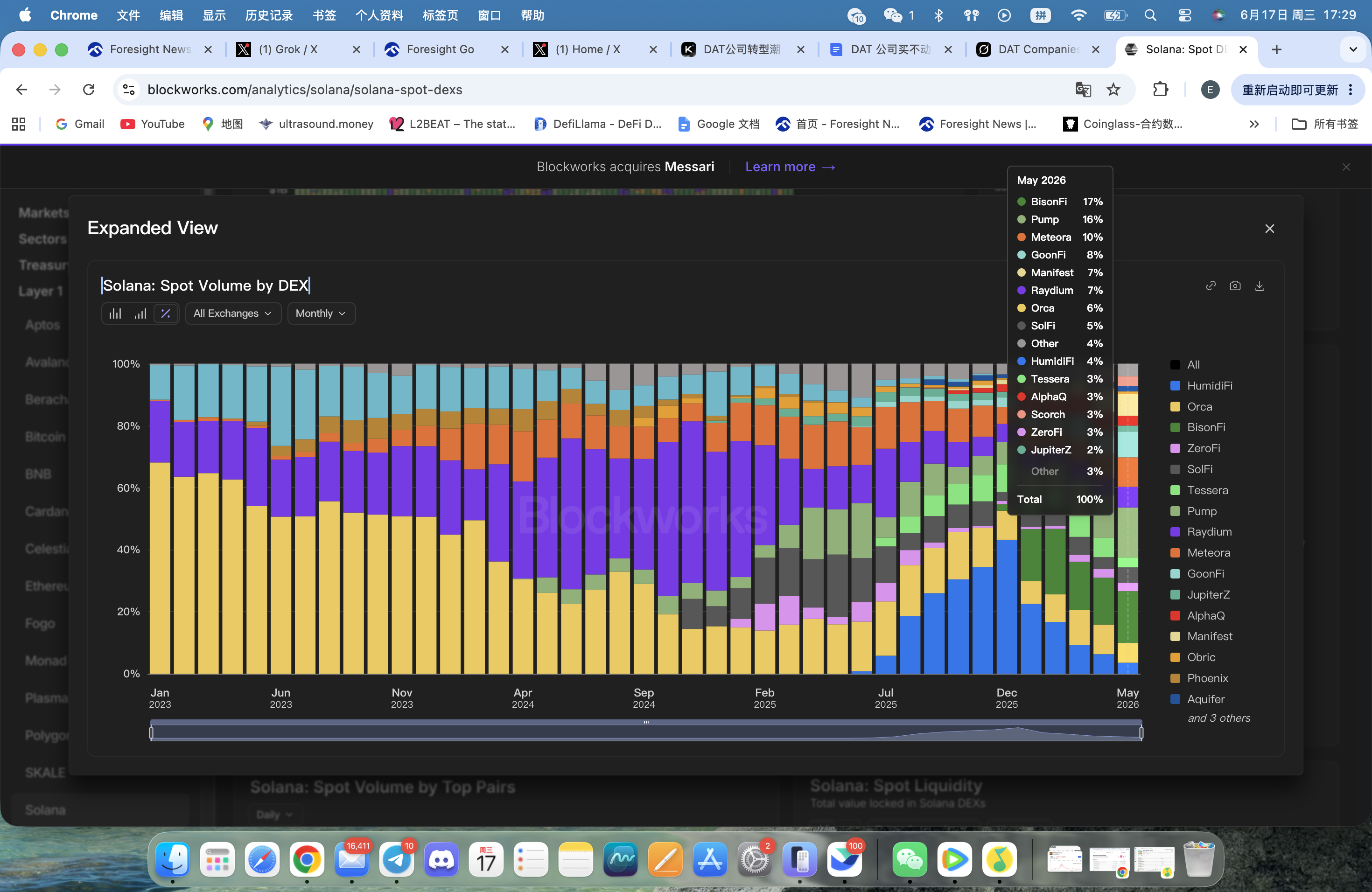
These two routes essentially correspond to the capital market's different attitudes toward Ethereum and Solana. ETH is still recognized as a "higher value asset" compared to SOL, where ETH treasury companies can build themselves as a “fund managing ETH,” providing institutional exposure to yield-generating assets; on the other hand, Solana's crypto-native attributes are more pronounced, requiring SOL treasury companies to demonstrate their profitability within the ecosystem to reveal their value in a manner similar to how conventional public companies "look at financial reports."
Can the Transformation Succeed?
The collective transformation of DAT companies reflects the profound cognitive upgrade that the entire crypto industry is undergoing. The treasury model initially created by Strategy is essentially a financial engineering approach that utilizes the convenience of public market financing and investor sentiment for capital arbitrage. When participants expand from a few pioneers to hundreds of companies and from Bitcoin to various altcoins, scarcity is diluted, and thus premiums naturally disappear. The launch of cryptocurrency ETFs further accelerated this process, as investors can purchase ETH ETFs with staking rewards directly through traditional brokerage accounts at prices close to net asset value, fundamentally shaking the logic of premium holdings in DAT stocks.
Successful transformation cases provide the answer of operational capability. Whether it is SharpLink's 100% staking strategy and institutional-level yield fund, DeFi Development's dfdvSOL ecosystem and validator network, or GameSquare's machine learning-driven yield platform, they are all attempting to build difficult-to-replicate operational barriers around crypto assets. These barriers might arise from technological advantages, network effects, institutional collaborations, or deep participation in the on-chain financial ecosystem.
However, these transformations are not without risks. GameSquare's pursuit of an 8% to 14% DeFi yield rate is based on smart contract risks and protocol risks, and any significant DeFi protocol exploit or extreme market event could lead to severe losses. DeFi Development's business model highly depends on the healthy development of the Solana network; once the ecosystem experiences a downturn, its entire business will be impacted.
For the Web3 market, the impact of this transformation is profound and complex. Those DAT companies that have successfully evolved into infrastructure operators and asset management platforms are building bridges between traditional finance and the blockchain ecosystem, promoting the maturity and standardization of institutional-grade services. However, the transition from frenzy to calm in the DAT model also sends an important message to the market: in the crypto realm, a purely capital game is not for just anyone; rather, those who truly participate in network building, create actual cash flow, and provide user value are more resilient to cycles.
The DAT movement is transitioning from a capital frenzy to a phase of rational reconstruction. This may not be bad news. An industry can only see who is swimming naked and who is building an ark after the bubble bursts. The collective turn of treasury companies is not only a passive response to survival pressure but also a necessary growing pain for an emerging industry maturing.
免责声明:本文章仅代表作者个人观点,不代表本平台的立场和观点。本文章仅供信息分享,不构成对任何人的任何投资建议。用户与作者之间的任何争议,与本平台无关。如网页中刊载的文章或图片涉及侵权,请提供相关的权利证明和身份证明发送邮件到support@aicoin.com,本平台相关工作人员将会进行核查。


