CoinW Research Institute
Recently, Strategy (originally MicroStrategy, commonly referred to as "MicroStrategy" in the market) sold coins, triggering a renewed discussion in the market about the BTC treasury company model. Between May 26 and May 31, Strategy sold approximately 32 BTC at an average price of about $77,135, totaling around $2.5 million. Subsequently, the company disclosed that it bought back 1,550 BTC at an average price of about $65,332, amounting to about $101.3 million. After the purchase, Strategy's holdings increased to approximately 845,256 BTC, accounting for about 4% of the total BTC supply.
Looking solely at the changes in holdings, Strategy remains a net buyer of BTC. However, the real source of market emotion in this controversy goes beyond the 32 BTC themselves. For the first time, the market sees more clearly that the BTC on Strategy's balance sheet can serve purposes beyond the "long-term holding" narrative—it may also be strategically utilized in financing, taxation, cash flow, and capital structure management.
More importantly, on June 12, Strategy founder Michael Saylor responded at BTC Prague that he had never stated that the company could not sell Bitcoin, emphasizing instead that investors should not sell their own Bitcoin. Saylor also mentioned that anyone who has listened to the company's earnings calls or reviewed disclosure documents over the past five years should know that Strategy can certainly sell BTC when necessary. This response effectively redraws the boundaries of the "never sell coins" narrative: Strategy's long-term bullishness on BTC does not mean that the BTC on the company's balance sheet cannot be utilized.
1. The sale of 32 BTC is small in scale but significant in signal
Strategy sold approximately 32 BTC at an average price of about $77,135, totaling around $2.5 million. Based on a pre-sale holding of approximately 843,706 BTC, this sale accounted for about 0.0038% of the total holdings, or about 3.8 ten-thousandths. This proportion is very small and would hardly change the company's BTC reserve scale. Subsequently, Strategy continued to buy 1,550 BTC at an average price of about $65,332, totaling around $101.3 million. After the purchase, the company's holdings increased to approximately 845,256 BTC, about 4% of the total BTC supply. From a net holding perspective, Strategy is still increasing its BTC position.
Therefore, the impact of the 32 BTC does not lie in the supply side, but in the expectation side. The market previously understood Strategy as an institutional buyer that "only buys and never sells," and the MSTR premium was built upon this linear narrative. Now the option to sell coins has been publicly showcased, and the market needs to understand Strategy's BTC reserve characteristics anew: it remains a core asset while also being a deployable resource on the balance sheet.
2. Selling coins is just a surface signal; the key is whether the amount of BTC per share has increased
Meanwhile, Strategy CEO Phong Le stated in a June 11 CNBC interview that the company's sale of 32 BTC was primarily to desensitize the market and test internal coin sale processes, while the tax losses generated from the sale could be used to offset related taxes. Phong Le also emphasized that selling coins is not because the company lacks other means to pay dividends; Strategy can still address dividend issues through other financing channels. However, as long as it benefits common shareholders, the company may choose to sell BTC.
This statement explains why the company chose to sell 32 BTC, but it does not completely alleviate market concerns. The reason is that the focus of the market debate has shifted from "why sell 32 BTC" to whether Strategy is turning its BTC reserves from a unidirectional accumulating asset into a tool for financing, taxation, and capital structure. Once BTC can be sold "for the benefit of common shareholders," the market will naturally question: who defines this judgment, when is it triggered, and will it shift from small-scale testing to more routine balance sheet actions.
This is also why the market has not been entirely convinced by the "process testing" explanation. The sale of 32 BTC itself is small, but the concurrent financing and coin purchase arrangements may have a larger impact on common shareholders. What ultimately determines MSTR's long-term attractiveness is whether the BTC content per share continues to increase. If the company is selling a small amount of BTC for testing while issuing stock to raise cash in an inefficient financing environment, then investors should focus more on whether "the BTC corresponding to each share of common stock behind it has increased."
From actual data, this issue can be understood as follows. Before this purchase, Strategy held approximately 843,706 BTC; after the purchase of 1,550 BTC, the company's total BTC holdings increased by about 0.184%. This means that from the perspective of BTC reserves, the company is indeed still increasing its position. But common shareholders need to take an additional step: while the company is buying BTC, it has also issued about 1.41 million shares of common stock. According to CompaniesMarketCap data, Strategy's circulating number of common shares is approximately 333,913,000. If we deduct the newly issued approximately 1.41 million shares, the common shares before issuance were approximately 332,503,000. Therefore, the newly added 1.41 million shares increase the total common stock number by about 0.42% compared to before issuance.
This is quite intuitive: the BTC holdings increased by only about 0.184%, but the number of common shares increased by about 0.42%. The increase in the number of shares is outpacing the increase in BTC holdings, so while the total BTC has grown, the proportion of BTC behind each share of MSTR has not increased but instead slightly decreased. Simply put, the market cannot only look at "selling 32 BTC and then buying 1,550 BTC." At the corporate level, the company is still net buying BTC, but from the perspective of common shareholders, it is essential to see whether the new BTC has outpaced the new stock issuance. Based on this data, the speed of buying BTC has not kept pace with the speed of issuing shares, thus marginally diluting the BTC content per share.
3. Dividend pressure constitutes the background for the flywheel reversal
Phong Le has clarified that this coin sale is not intended to pay dividends. However, for investors, the pressure of dividends must still be included in the analytical framework. In recent years, Strategy has funded BTC purchases through common stock, convertible bonds, and various preferred shares. Preferred shares provide the company with a source of ongoing funds to continue buying BTC while also creating a continuous distribution obligation. Dividends are not the direct reason for the sale of 32 BTC, but they will affect how the company allocates cash, how it chooses financing tools, and whether it sells a small amount of BTC in specific situations.
Strategy's Stretch variable rate preferred shares (STRC) employ a monthly dividend payment structure. The initial annualized dividend rate for STRC was 9%, but it has since been raised to 11.5% due to market prices falling below the regulatory threshold. If the monthly trading average continues to be below the specified level, the dividend rate may be further increased.
If the STRC dividend rate rises from 11.5% to 11.75%, Strategy's annual financing costs will increase by approximately $26 million. By the end of June, Strategy has about $235 million in dividend and interest payment pressures. These figures indicate that Strategy's BTC treasury model is entering a more complex phase. The company not only needs to prove that it can continue buying BTC but also needs to demonstrate its ability to continuously manage the relationships between preferred stock dividends, debt interest, cash reserves, and financing costs.
This aspect is directly related to the flywheel reversal. Preferred stock dividends and debt interest do not disappear automatically; they will continuously consume the company's cash flow. To keep the financing structure operating smoothly, Strategy needs to maintain a cash buffer and choose lower-cost options among different financing tools. The result is that not all financing rounds will necessarily be used to buy BTC; some funds may be reserved as cash reserves or to meet future obligations. For common shareholders, this will decrease the efficiency of financing to buy BTC and may also affect whether the BTC content per share can continue to rise.
The frequency of dividend payments will also affect subsequent pressures. Strategy has changed the STRC dividend frequency from monthly to bi-monthly to enhance its attractiveness to income-focused investors. This revision was approved by shareholders on June 8, 2026, and will take effect on June 30, 2026. The higher the frequency of dividends, the friendlier preferred shares are to income-type funding, but the company's cash flow management requirements also become more stringent. If Strategy wants to rely on preferred stock financing for the long term to continue buying BTC, it must convince the market that these distributions can be paid steadily.
4. The real risk variables for MSTR
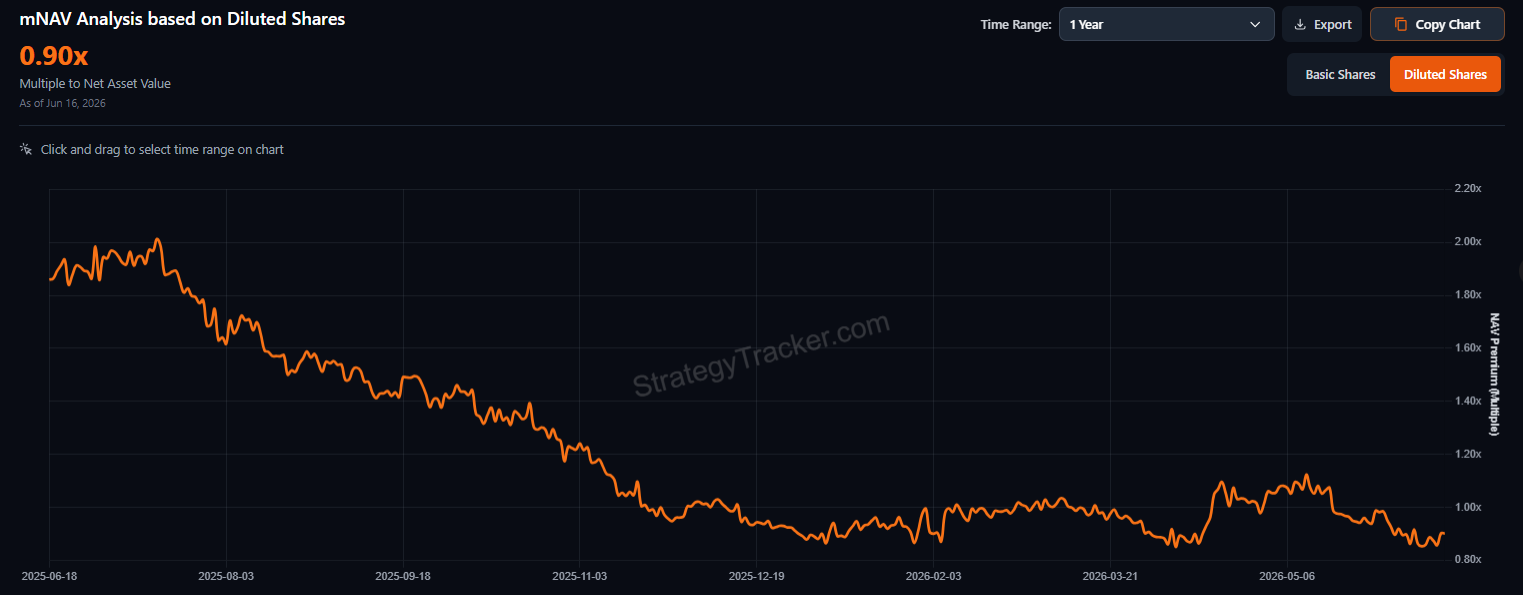
At the same time, determining whether Strategy will continue to sell coins cannot solely depend on whether the company remains bullish on BTC. A more effective observation framework is to see if MSTR's financing cycle can continue to operate. In recent years, Strategy's model has generally been: MSTR maintains a premium relative to the net asset value of BTC, the company continues to buy BTC through common stock, preferred stock, or debt financing, and the growth of holdings further reinforces MSTR's narrative as a BTC proxy asset. As long as this cycle operates smoothly, continuing to finance for coin purchases will typically take priority over selling BTC.
Diving deeper, the core that MSTR truly needs to be cautious about has shifted from "selling BTC" itself to whether the positive flywheel has begun to reverse. The premise for establishing a positive flywheel is that the company can issue stock at a price higher than the net asset value of BTC. At this point, the company sells a small amount of high-priced stock to obtain more BTC, thereby increasing the BTC content per share, and the dilution pressure on common shareholders is relatively light. The negative flywheel occurs during stages of discounted or inefficient financing: the company issues stock to raise money, but the amount of BTC bought back is insufficient to offset the dilution from the new shares; the BTC content per share drops, weakening MSTR's core attractiveness.
This is the point that the market easily overlooks. The sale of 32 BTC has only about a 0.0038% impact on total holdings. The real impact on the BTC content per share stems from the concurrent issuance of common stock and the use of funds. Strategy issued about 1.41 million shares of common stock, raising approximately $181 million, of which about $101.3 million was used to buy 1,550 BTC, and the remaining funds primarily went into cash reserves. By roughly calculating the use of funds, about 56% of the financing was converted into BTC, while about 44% formed a cash buffer. This indicates that the company is still buying BTC, but not all financing funds have entered the BTC reserves. For common shareholders, if the dilution from the newly issued shares has already occurred, and only part of the raised funds has been used to buy BTC, then the BTC content per share will be under greater pressure. This is also a core signal of the decreased efficiency of MSTR's flywheel: in the past, the market focused on whether the company could continue to buy BTC; now it needs to see how much of every dollar raised translates into increments of BTC behind each common shareholder.
This cycle hinges on three key pivot points. The first is the premium on common stock. The second key point is the price of preferred stock and financing costs. If preferred stocks like STRC continue to trade below par, an increase in the dividend rate will elevate financing costs, decreasing the efficiency of continuing to rely on preferred stock for BTC purchases. The third is the BTC price itself. If a drop in BTC weakens market confidence, Strategy will face dual pressures of reduced financing ability and ongoing existing obligations for dividends and interest.
Source: https://saylortracker.com
Therefore, the risk of continued coin sales typically does not rise linearly; it is more like the result of multiple variables deteriorating simultaneously: shrinking MSTR premium, increasing preferred stock financing costs, and weakening BTC prices. If only one variable appears, Strategy may still mitigate pressure through other financing tools or cash reserves; but if multiple variables occur simultaneously, selling a small amount of BTC will transition from "process testing" to a more routine balance sheet management tool.
5. Summary
The controversy over MicroStrategy's coin sale will indeed be interpreted by the market as a bearish sentiment on BTC in the short term, but the 32 BTC themselves are not the core issue. The deeper change lies in the underlying contradictions of BTC treasury companies beginning to manifest: BTC can become a reserve asset but does not automatically generate cash flow; Strategy can buy BTC through common stock, preferred stock, and debt financing, but these financing tools will gradually accumulate as obligations for dividends, interest, and market trust costs. Early on, the market focused solely on how much BTC the company purchased. In the next phase, investors need to pay closer attention to how the company maintains balance between financing costs, preferred stock obligations, and BTC content per share.
The act of MicroStrategy selling coins does not necessarily indicate a loosening of BTC belief; what truly deserves vigilance is whether the MSTR flywheel starts to reverse. If the MSTR premium remains, preferred stock financing runs smoothly, and BTC prices hold support, selling a small amount of coins may resemble financial engineering; if MSTR premium shrinks, STRC financing costs rise, and BTC prices come under pressure simultaneously, BTC reserves may shift from being an "underlying asset for continued purchases" to a "source of liquidity for maintaining capital structure." For MSTR investors, the focus needs to shift from how much BTC the company has purchased to whether the BTC content corresponding to each share is still increasing.
免责声明:本文章仅代表作者个人观点,不代表本平台的立场和观点。本文章仅供信息分享,不构成对任何人的任何投资建议。用户与作者之间的任何争议,与本平台无关。如网页中刊载的文章或图片涉及侵权,请提供相关的权利证明和身份证明发送邮件到support@aicoin.com,本平台相关工作人员将会进行核查。