Original authors: @MrRyanChi, founder of @insidersdotbot.
Preface
It has been a long time since my last article. During this time, I have been researching various new strategies while polishing our trading terminal, insiders.bot, countless times. The World Cup is definitely a moment to “find out whether it's a mule or a horse by taking it out for a walk.” It serves as a test for our product, to see if it can be applied universally, allowing everyone the opportunity to achieve successful trades through the World Cup.
Therefore, this article will reconstruct the historical strategies that have been effective for trading during the World Cup, the strategies that have inspired our current version of the product.
What excites me most about the new version of insiders.bot is not just its speed in placing orders, but that it pulls together many scattered elements: smart money signals, order books, TP/SL, second-level following, filterable data, and an AI Agent that can directly answer questions in natural language.
The World Cup is the perfect scenario to explain this. It is broad enough for everyone to have emotions; it is also low-scoring enough that a small variable can change the entire trajectory. A forward's absence, a red card, a 0.08 xG deflection, or a third-place group team’s goal difference can shift championship probabilities, qualification probabilities, and market prices simultaneously.
So, back to strategy - this article does not aim to tell you “who will win the championship.” To be honest, nobody can predict that accurately.
What I want to dissect instead is another matter: when the World Cup becomes a price in the prediction market, how do we break down emotions into variables, compress those variables into probabilities, and then present those probabilities before the prices for judgment?
To summarize in one sentence: scientifically predicting the World Cup is not about predicting a single future but laying out all possible futures on the table, pricing them, and then executing with discipline.
This article will take you through the evolution and changes in strategies over the past century, teaching you the essence of each type of strategy.
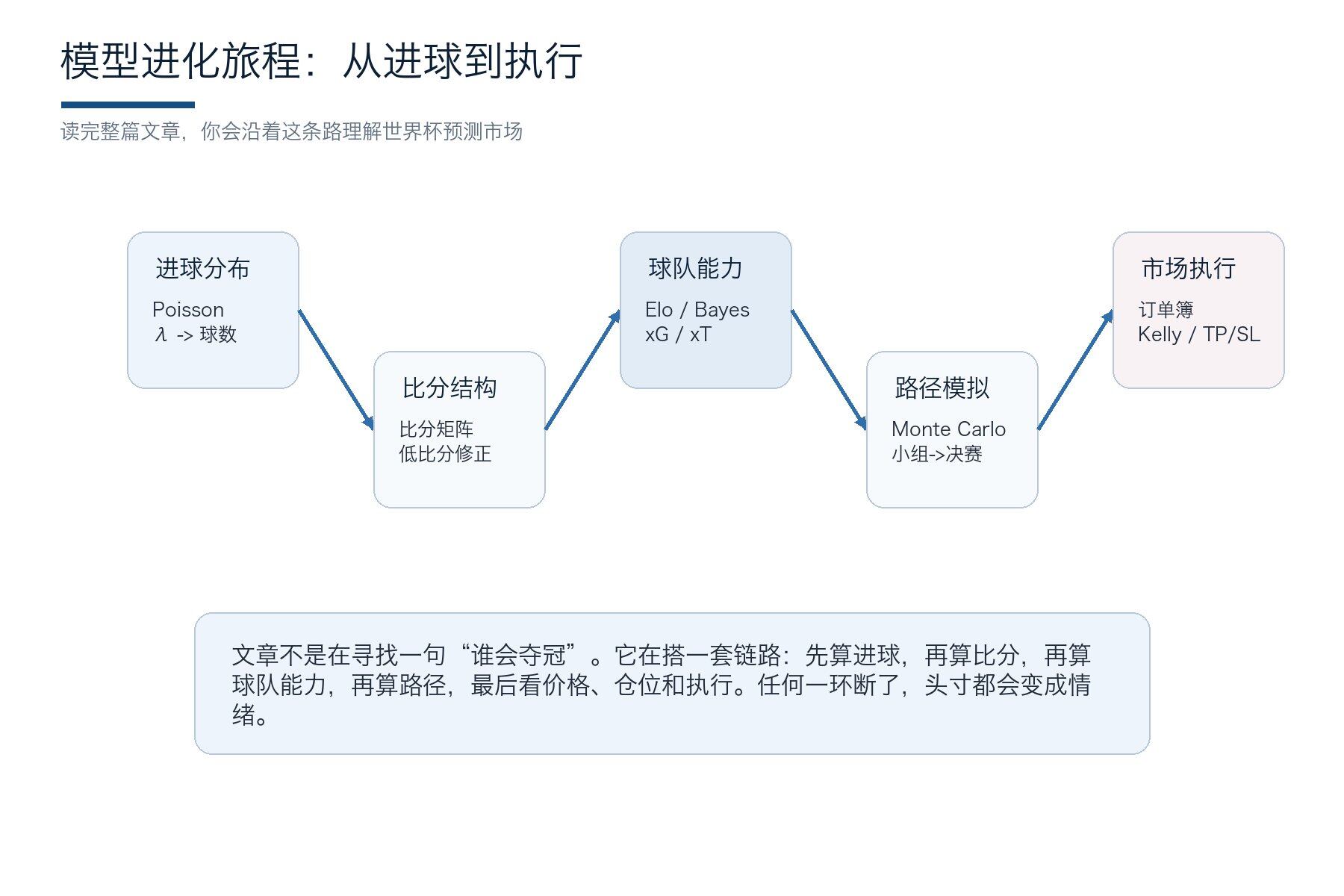
Initially, people simply asked: how many goals can a team score on average? Thus, Poisson came into play, transforming “feelings of strength and weakness” into goal distribution.
Soon, everyone realized that simply looking at averages was not enough; there was structure between scores, so score matrices, Dixon-Coles, Bivariate Poisson, and Skellam continued to dissect soccer further.
Later, the question shifted from “how many will be scored in this match” to “how strong is this team.”
Next, Elo, Bradley-Terry, ordered logit provided us with a stable framework for long-term strength; Bayesian hierarchical showed us that with few samples from national teams, we couldn’t let a single big win or upset carry too much weight; xG, xT, VAEP reopened the processes behind scores, allowing us to see opportunity quality, possession advancement, and action value.
Finally, models must step into the market. Machine learning and ensemble methods are responsible for blending numerous pieces of information together, while Monte Carlo simulates the group stage, knockout rounds, and half-pathways repeatedly, while the order book tells you whether the theoretical price can genuinely transact, and Kelly and TP/SL determine whether you can last until the finals. As you read on, you will find this article is not asking “who will win,” but rather: where do probabilities come from, why do prices move, and how should trades be executed and reviewed.
With this roadmap, each subsequent section will no longer be an isolated concept. We do not start with formulas but first return the World Cup from emotions back to the pricing system of the prediction market. Only by first understanding what contract prices represent will discussions on goals, pathways, and positions not devolve into mere technical self-indulgence.
1. First, Treat the World Cup as a Probability Asset
Let’s change the perspective: the World Cup certainly has emotions, national narratives, and superstar farewells, but the prediction market cares about one thing: whether the probability of a future event is accurately expressed by the current price.
1.1 Why 2026 is Special: Expansion of Tournament Format Changes the Championship Market to Path Asset
The 2026 World Cup expands from 32 teams to 48 teams, with 12 groups of four, and the top two from each group along with 8 of the best third-placed teams advancing to the round of 32, with the champion needing to play 8 matches. In FIFA's official tournament explanation, these numbers merely look like organizational arrangements; from a trading perspective, they mean an expansion of the state space, increased path dependence, and more frequent market re-evaluations (FIFA World Cup 2026).
In past World Cups, many strong teams could confidently advance through the knockout phase by securing first in their group.
In 2026, the mechanism for third-place teams to advance will make the final round of group matches resemble a complex payoff table.
- A team may not need to win but only needs to lose by a small margin;
- A team may already have qualified but still needs to compete for their half-bracket;
- A team may appear third, but due to the results of other groups, their actual qualification probability is rapidly changing.
This is crucial for prediction markets. The championship contract is not a single match win rate but a pathway probability. The championship probability can be roughly written as the probability of advancing from the group stage multiplied by the probabilities of advancing in each round. Playing one more match means more chances for red cards, penalties, injuries, weather, referee decisions, and tactical mismatches. The advantages of strong teams accumulate, as do their risks.
Thus, the correct trading target for the 2026 World Cup is not just “who the champion is,” but the pathway itself: group advancement, strength in half-brackets, third-place qualification, avoiding strong opponents, penalty risks in knockout rounds, and travel fatigue. The market will assign a total price before the matches and will continuously revalue the pathways during the games.
Therefore, what traders need to do is to know which pathway's price is severely undervalued before the revaluation happens.
............
......
免责声明:本文章仅代表作者个人观点,不代表本平台的立场和观点。本文章仅供信息分享,不构成对任何人的任何投资建议。用户与作者之间的任何争议,与本平台无关。如网页中刊载的文章或图片涉及侵权,请提供相关的权利证明和身份证明发送邮件到support@aicoin.com,本平台相关工作人员将会进行核查。


