Key Takeaways:
- Semianalysis found ChatGPT Pro’s $200 tier may deliver $14,000 in AI value.
- Anthropic’s Fable 5 moves to usage credits after June 22, 2026.
- Bittensor, io.net, Akash, and many others could see demand as AI labs meter heavy usage.
The June 2026 report tested consumer tiers from Anthropic and OpenAI by running long-horizon coding and agentic tasks until weekly limits were exhausted.
The finding was blunt: $200 subscriptions can behave less like ordinary software plans and more like heavily subsidized compute contracts.
ChatGPT Pro 20x, priced at $200 per month, delivered up to about $14,000 in estimated API-equivalent token value under heavy use, according to the report. Claude Max 20x, also priced at $200, reached up to about $8,000 in estimated API-equivalent value.
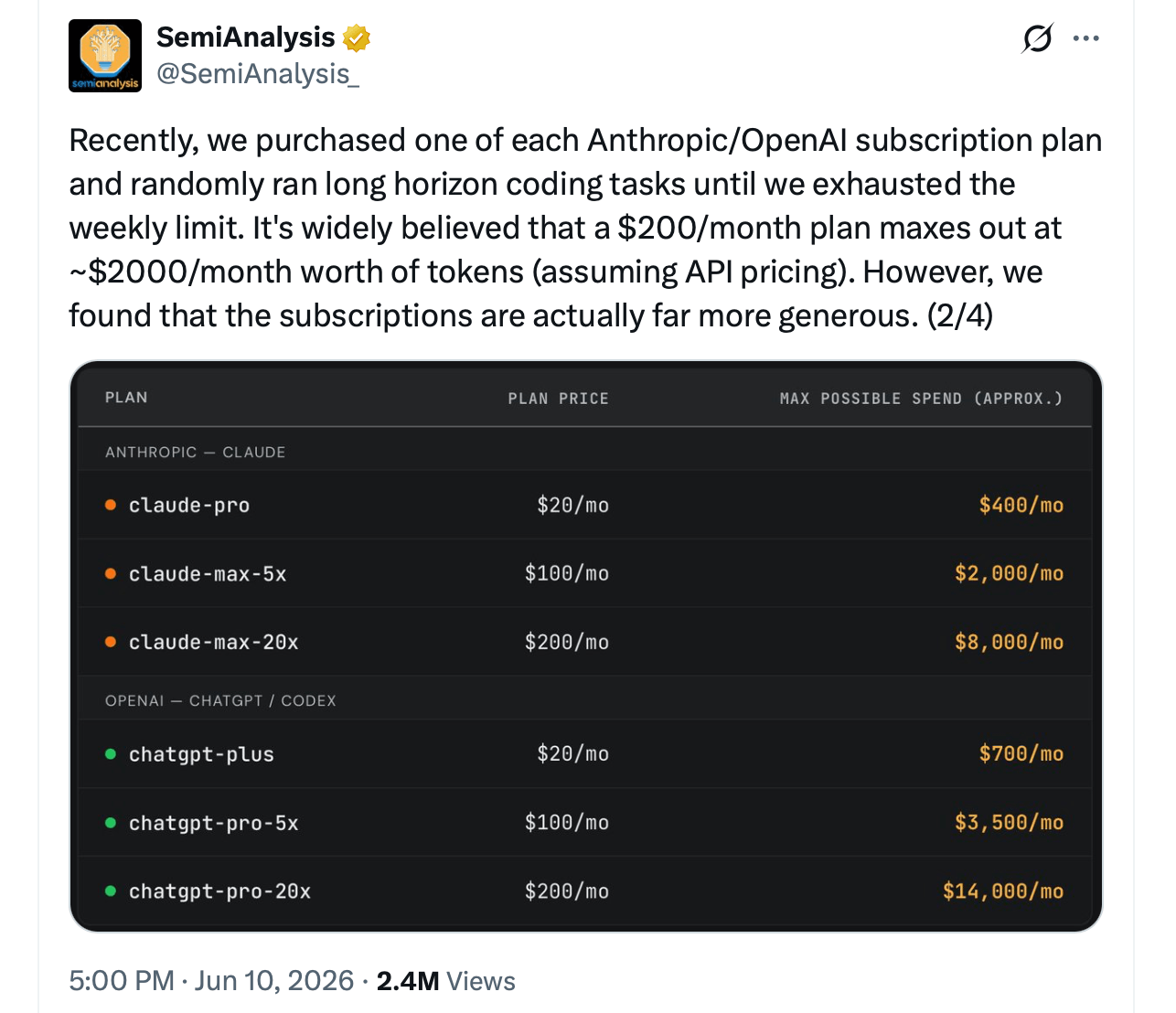
Image source: X
Lower tiers followed the same pattern. Claude Pro at $20 was estimated to be worth near $400 in value, while ChatGPT Plus at $20 was estimated to be worth around $700. The math is especially relevant for crypto developers using AI to review code, debug smart contracts, build trading infrastructure, and run tool-using agents.
Semianalysis stressed that these figures reflect the maximum quota value, not average subscriber behavior. Most customers do not exhaust weekly limits with large codebases, multi-turn debugging loops, and agentic workflows. Power users do, and that is where the economics become difficult.
Assuming 75% API gross margins, Semianalysis found that subscription economics can turn negative at modest utilization. At full use, the report estimated margins near negative 900% for Claude Max 20x and negative 1,650% for OpenAI’s top tier.
That creates a strategic problem for AI labs. Cutting limits too openly risks angering the very developers who have built daily workflows around these products. Semianalysis argues the more likely path is subtler: keep subscriptions attractive, but reserve the newest and most expensive models for API, usage-credit, and enterprise channels.
Anthropic’s Claude Fable 5 rollout fits that pattern. The Mythos-class model is included at no extra cost in Pro, Max, Team, and seat-based Enterprise subscriptions only through June 22, 2026. After that, Fable 5 moves to usage credits unless capacity allows it to return to standard plans.
That shift matters because Fable 5 is priced at $10 per million input tokens and $50 per million output tokens, double the listed pricing for Opus 4.8. Leaving a model with that price profile open inside flat-rate plans would make the subsidy even harder to defend.

On a recent podcast, Laura Shin discusses the subject with Infinex founder Kain Warwick. He argues that consumer AI plans heavily subsidize usage by around 100x, with subsidies for Anthropic’s new Claude Fable 5 model ending June 22 as it shifts to API-only paid access.
For crypto teams, the message is direct: today’s AI subscription arbitrage may be valuable, but it is not guaranteed to last. The next phase likely favors hybrid usage, with subscriptions for daily interactive work and metered systems for production-grade agent workloads.
That is where decentralized AI, often called DeAI, AI x crypto, or AI-focused decentralized physical infrastructure networks, could become more than a speculative theme. These projects aim to turn compute, inference, model access, and autonomous agents into market-priced networks rather than closed systems controlled by a few labs.
The project io.net aggregates GPU capacity from data centers, miners, and independent hardware providers for AI and machine learning workloads. Its pitch is simple: let users source compute through a decentralized network, while agentic systems can provision GPU resources as needed.
Another DeAI project, Render Network, has expanded from decentralized rendering into broader GPU-based AI workloads. Akash Network offers an open cloud for CPU, GPU, and storage demand. Additionally, Nosana, built on Solana, focuses on scalable AI model inference.
Bittensor takes a different path. Its subnet system rewards miners that deliver useful AI outputs, while validators score quality. In that model, intelligence becomes a competitive market, not just a centralized product sold through a subscription or API dashboard.
Ridges AI, Bittensor Subnet 62, is one of the clearest examples tied to the Semianalysis thesis. It focuses on autonomous software engineering agents that can ingest repositories, fix issues, write code, test changes, and submit pull requests.
That makes it a direct analog to the heavy coding workloads that drove Semianalysis’s highest subscription values. Instead of relying entirely on OpenAI or Anthropic, crypto developers could route some work to decentralized inference and agent networks when cost, access, or flexibility becomes more important than using the latest proprietary model.
Virtuals Protocol extends the theme into tokenized AI agents, while the Artificial Superintelligence Alliance connects Fetch.ai, SingularityNET and related elements around autonomous agent services and decentralized AI coordination. Internet Computer and NEAR also sit near this conversation through onchain AI execution and agent-friendly infrastructure.
The caveat is important. Many decentralized AI systems still lean on open-source models, and not every workload will match the newest frontier systems from OpenAI or Anthropic. Latency, verification, regulatory questions, and quality control remain active challenges. Amid the DeAI efforts happening today, only a small few may succeed, and a myriad will ultimately fail.
Even so, the direction is clear. If centralized AI firms push premium models behind meters, crypto-native compute and agent networks gain a sharper commercial story. They do not need to beat every frontier model on every task. They need to offer builders cheaper, open, and flexible options where centralized pricing becomes painful.
For investors and developers, the Semianalysis report reframes DeAI as a practical infrastructure question. The issue is not just whether AI tokens are fashionable. The question is whether decentralized networks can capture demand from users who have outgrown subsidized consumer plans.
The current bargain is powerful for heavy users, especially coders. But if the most advanced models keep moving toward usage credits and API pricing, crypto’s AI sector has a timely opening: sell compute and intelligence as an open market before the subsidy disappears.
免责声明:本文章仅代表作者个人观点,不代表本平台的立场和观点。本文章仅供信息分享,不构成对任何人的任何投资建议。用户与作者之间的任何争议,与本平台无关。如网页中刊载的文章或图片涉及侵权,请提供相关的权利证明和身份证明发送邮件到support@aicoin.com,本平台相关工作人员将会进行核查。


