Original Title: "Trust Me, Bro" Is Not A Middle East Policy: Trump Just Bombed Iran Again Over A Helicopter That May Have Flown Into A Drone
Original Author: Dean Blundell
Translation: Peggy, BlockBeats
Editor's Note: This article focuses on the airstrike launched by the U.S. military against targets near the Strait of Hormuz in Iran on the morning of June 10, Beijing time. Dean Blundell critically examines the inconsistency of Trump’s administration regarding Iran policy with a strong tone of sarcasm: an American AH-64 "Apache" helicopter crashed near the Strait of Hormuz, two pilots were rescued, and the reasons for the incident remain controversial; initially, Trump described the incident as "no big deal," but later labeled it as Iran "shooting down" the U.S. helicopter on Truth Social, justifying strikes on Iran's coastal air defense, radar, and ground control facilities.
The real criticism of the article is not just the military response, but also the repeated creation of a smokescreen by the Trump administration claiming that "an agreement is about to be reached." On one hand, they assert that negotiations are in the "final stage," and the agreement can be signed "within two to three days," while on the other hand, they escalate military actions and publicly humiliate Iran, making the so-called diplomatic negotiations more like a political performance serving the news cycle. Meanwhile, the U.S. military's so-called "proportional response" further provokes Iran to retaliate against U.S. bases in the region, and normalcy in the Strait of Hormuz remains elusive, with oil prices and market pressures still present. The author reminds readers that when "very close" repeatedly replaces genuine progress, the most rational response may not be to believe, but to record it and assume the reality is likely quite the opposite.
Here is the original text:
Let’s begin with the timeline, as this timeline itself is at the core of the entire scam.
On Monday night, an American AH-64 "Apache" armed helicopter crashed off the coast of Oman in the Strait of Hormuz. Both pilots survived and were unharmed—they were rescued by a drone boat within two hours. It must be acknowledged that it is indeed a rather cool piece of military equipment, and the only part of the entire story that truly worked properly.
But one part that Trump will not include in those all-caps social media posts: a U.S. official told the Associated Press that the "Apache" crashed after colliding with an Iranian drone, and it is currently unclear whether this collision was intentional. Trump himself told The Wall Street Journal that the whole incident was "no big deal" and that "the pilots are fine."
So, please remember this: no big deal. The pilots are fine. The cause is still under investigation. It may just be an accident.
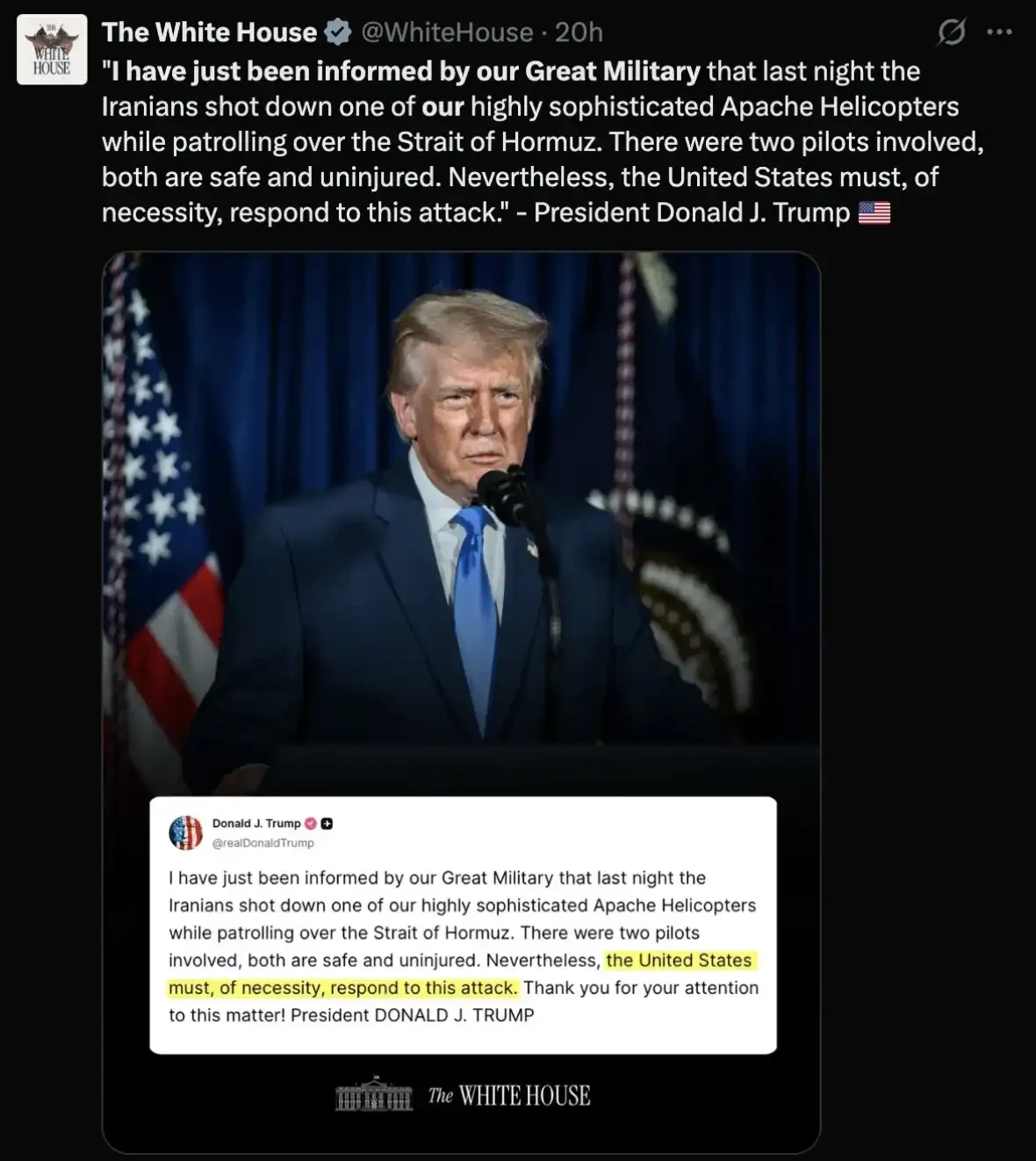
On Tuesday morning, the same person, with a different tone. He ran back to Truth Social to write: "I just received word from our great military that last night, Iranians shot down our highly advanced Apache helicopter while patrolling over the Strait of Hormuz... America must respond to this attack. Thank you all for your attention to this matter!"
From "no big deal" to "a response is necessary," only one news cycle passed. This person overturned his statement in less than 24 hours, and we seemed still expected to nod along as if it were some form of statecraft.
From late Tuesday night to early Wednesday morning, the U.S. Central Command began striking Iranian coastal areas. The operation lasted from 10:00 PM Greenwich Mean Time on Tuesday until nearly 1:00 AM on Wednesday, targeting about 20 locations, including air defense systems, ground control stations, and monitoring radar stations, covering Geshm Island, Goruk, Abbas Port, Jask, Sirik, and Minab, extending along the Strait of Hormuz and deep into the strait. The Pentagon described it as a "defensive strike," a "proportional response" to "Iran’s unprovoked aggression."
According to Iranian state television, the so-called "proportional response" resulted in: two reservoirs near Sirik being struck, leading to the interruption of drinking water supply for about 20,000 people in the Bamani area. The next time you hear the term "surgical strike," please remember this scene.
On the same night, Iran retaliated. The Iranian Revolutionary Guard claimed they carried out 21 strikes against U.S. targets in the region—drones attacked the U.S. Fifth Fleet in Bahrain, and the Ali Saleem base in Kuwait, while long-range missiles targeted the Azraq Air Base in Jordan; they claimed to have destroyed an F-35 hangar there. Jordan stated that five missiles were shot down. Iranian Foreign Minister Zarif spoke in a tone of deterrence that Trump thinks he possesses: "If you want security, get out of our region." Iranian Parliament Speaker Ghalibaf said: "We prefer to use diplomatic language, but in other languages, we are more fluent."
On Wednesday morning. Then—right here—the crucial key moment occurred. Trump returned to Truth Social, and this "master deal-maker" completely removed the mask:
"The Iranian military is in complete disarray. Most of their forces, such as the navy and air force, no longer exist—they have been utterly defeated. Iran only talks, it does not act. The Middle Eastern bully is dead!!! They have taken too long negotiating an agreement that would have been extremely beneficial to them, and now they must pay the price!!!"
"They have taken too long to negotiate."
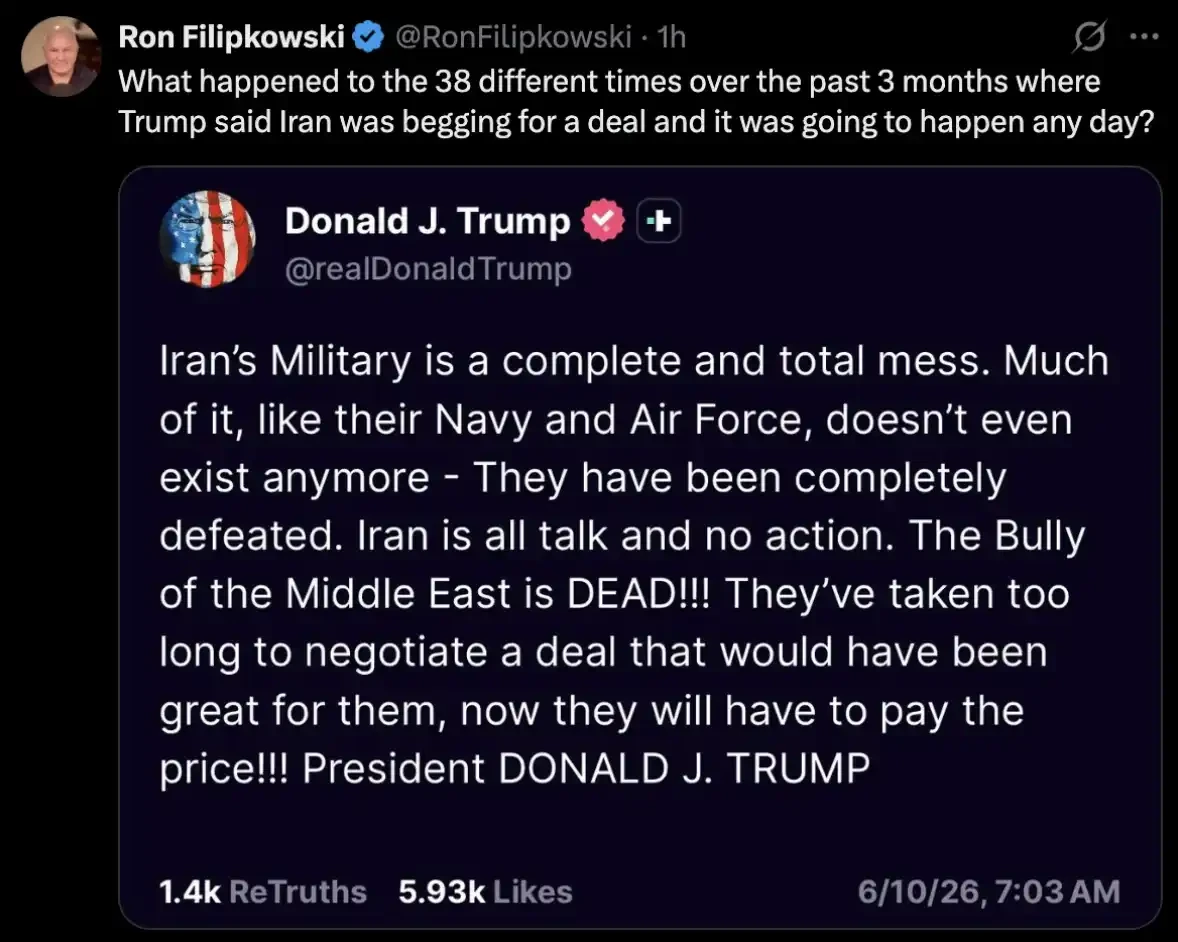
Too long. The person making this statement was the same one who less than 24 hours earlier claimed the agreement was in the "final stage" and could be signed "within two to three days." He was also the one who, after leaving the NBA Finals the night before, said both sides were in the final stage of a "very, very good agreement," and that once signed, the Strait of Hormuz would "immediately" reopen.
"Two or three days" Industry Complex
There is one thing I want you to seriously think about. Throughout this entire war, Trump has been telling us: an agreement is coming soon. By Sunday, this war had surpassed 100 days. By my counts—yes, I’ve recorded them all, because someone has to do it—since this conflict erupted in late February, Trump has promised a shiny, imminent agreement over thirty times.
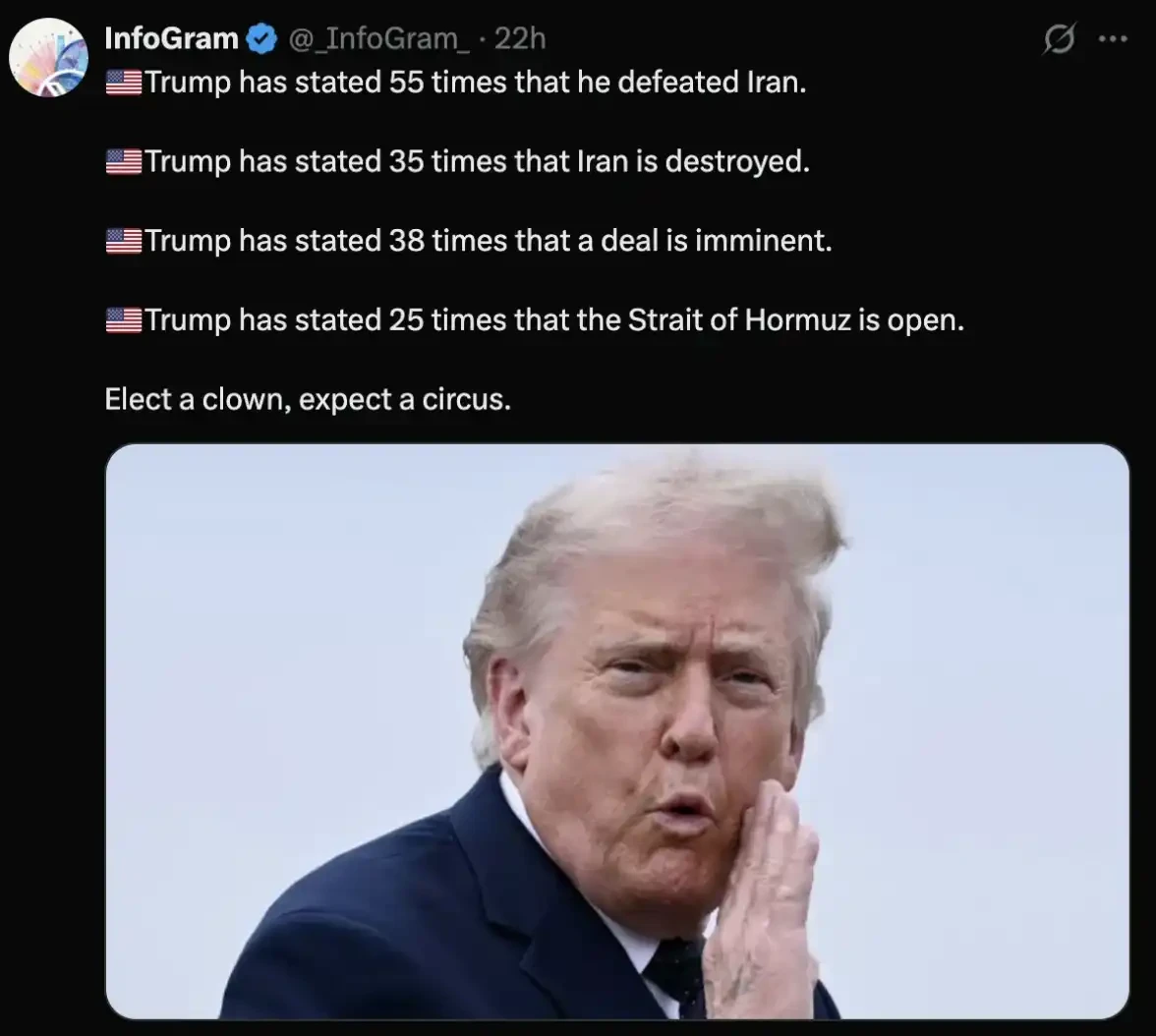
Just pulling a few out from the "receipt drawer":
March 23: Announced that there had been "very good and productive dialogues" between both sides, and postponed the previously threatened strikes on power plants by five days. What was Iran's response? They directly denied any talks had occurred. Oil prices initially dropped, then rebounded after Tehran debunked his claims.
Late March: Threatened that if Iran did not open the strait, he would "destroy" Iran's power plants within 48 hours. They did not open. He did not act.
April: Announced "a 10-day pause on the destruction of energy facilities." A ceasefire was announced. Then negotiations occurred in Pakistan, primarily mediated by Islamabad, ultimately ending with no results.
This week: "Final stage." "Two or three days." "Will reopen immediately upon signing."
Wednesday: "They have taken too long. Must pay the price."
This is not negotiation. This is a slot machine that only spits out media exposure. Every time you pull the lever, three cherries pop up on the screen: an agreement is nearly done, the other side is weak, trust me.
And every time, JD Vance stands nearby endorsing him—on Sunday, he told CBS that the government was "very close" to an agreement. Very close. The two most abused words in this government are probably only narrowly outpaced by "perfect call."
Let’s Remove the Mask
If you really controlled the negotiations, you wouldn't need to blow up reservoirs to prove you are winning. If you really controlled the negotiations, the other side wouldn't fire 21 missiles at your three bases on the same night. If you really controlled the negotiations, your diplomatic posture wouldn’t shift like a mood ring from "a very, very good agreement" to "the Middle Eastern bully is dead" within 18 hours—and this shift seems based solely on his mood about cable news coverage.
The blockade he has been bragging about—by his own words, the "most successful blockade in naval history"—has not stopped Iran from launching attacks throughout the region, has not reopened the Strait of Hormuz, nor has it facilitated any agreements. A shopkeeper in Tehran even told CBS this week that his shelves remain full. But of course, that can still be called "the most successful." He even really wrote "Praise be to God"—I have many questions about that, but that’s another topic.
The real leak lies here: the strait remains closed. The specific goal that this war is supposedly all about—reopening the passage through which one-fifth of global oil supply flows—has not been achieved even after more than 100 days. During this time, there have been dozens of "agreements about to be reached," a naval blockade, and now a new round of strikes. Oil prices have risen nearly 2%. The market has fallen. And the person at the center of it all is still posting in all caps, announcing that a "bully" is dead.
This is not a bargaining chip. This is a person who has been recklessly off course since around March but has insisted for three months that he intended to drift the car into the guardrail.
The Bottom Line
Both pilots are safe, which is certainly a good thing and the only clean result in this whole situation. But tonight, 20,000 people in southern Iran lack drinking water, three U.S. allies suffered missile attacks, and an F-35 hangar in Jordan may have turned into smoking ruins, while the one who should be responsible for this has handled the entire affair like a promotional speech for a pro wrestling match.
Every "two or three days" is either a lie or a delusion. And at this point, the distinction between the two no longer matters. You cannot say on Tuesday that the agreement is in the "final stage," and then on Wednesday say "They have taken too long," and still expect anyone with a normal memory to continue believing your judgment on Thursday's situation.
So, the next time you hear "We are very close," whether this phrase is said by Trump, Vance, or any of them, please do the only somewhat rational thing.
Count it up. Write it down. Then assume the opposite of the facts is true.
Because "Trust me, bro" had long ceased to be a foreign policy by the twelfth promise of agreement. Now, we have surpassed thirty times.
This is clearly worth remembering.
免责声明:本文章仅代表作者个人观点,不代表本平台的立场和观点。本文章仅供信息分享,不构成对任何人的任何投资建议。用户与作者之间的任何争议,与本平台无关。如网页中刊载的文章或图片涉及侵权,请提供相关的权利证明和身份证明发送邮件到support@aicoin.com,本平台相关工作人员将会进行核查。


