
Author: Nancy, PANews
As players in the crypto circle share SpaceX subscription sheets and celebrate the excitement of this super IPO feast on social media, Trade.xyz on Hyperliquid has come under public scrutiny due to its pricing rules for the SPCX perpetual contract, becoming the focus of market controversy.
After the SPCX pricing controversy, Trade.xyz faces a trust test
On June 10, Trade.xyz issued a statement officially responding to the recent pricing controversy surrounding the SPCX perpetual contract.
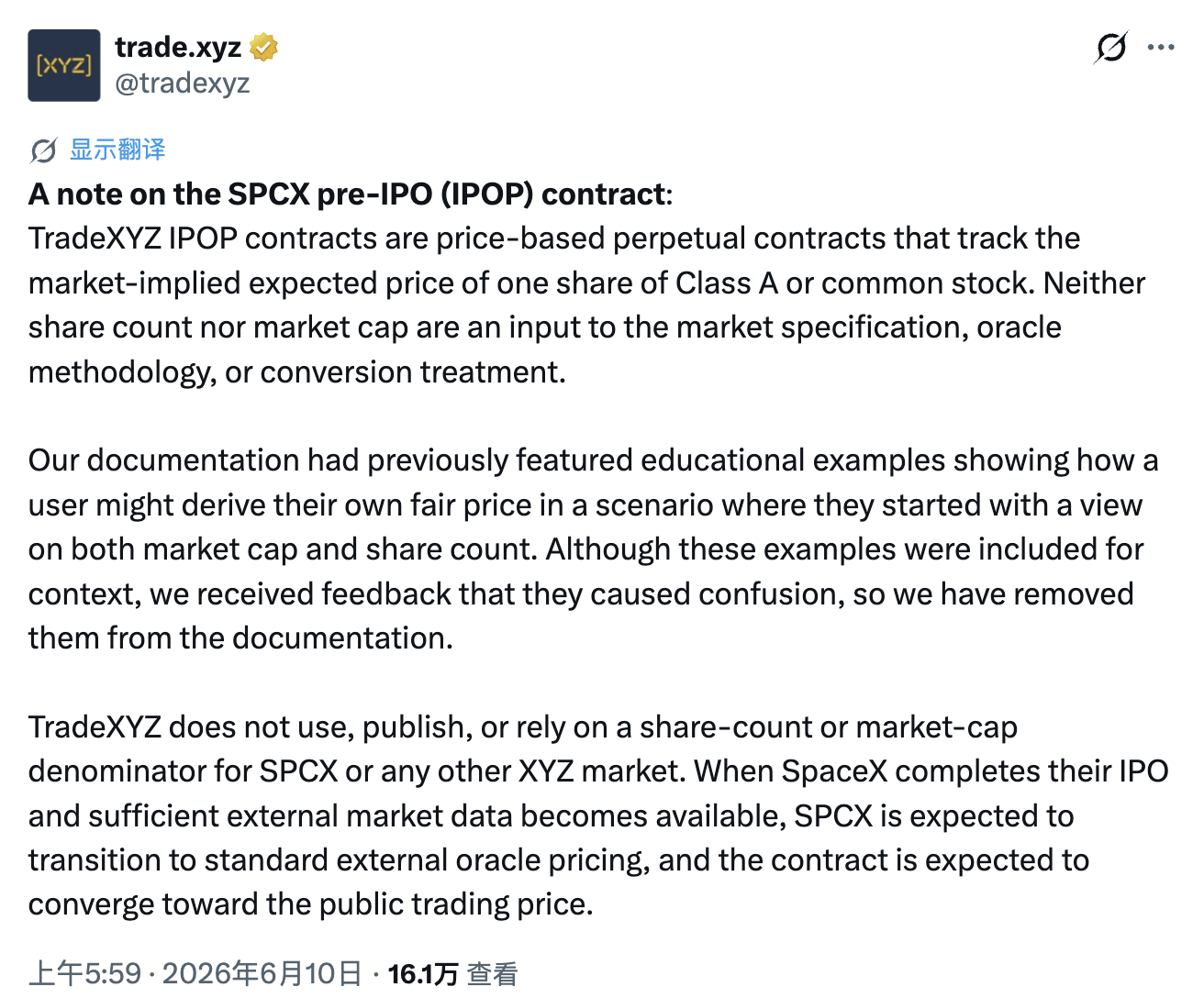
According to the statement, Trade.xyz's IPOP contracts are a type of price-based perpetual contract, with the core goal of tracking the market's expectations for the price of Class A common stock shares, rather than reflecting the overall valuation of the company. Therefore, information regarding the company's total equity and market capitalization is not part of the contract rules, oracle pricing logic, or future contract conversion mechanisms. In other words, the SPCX price on Trade.xyz is more akin to an indicator reflecting market sentiment and trading expectations, rather than a theoretical share price calculated based on the company's fundamentals.
Trade.xyz also mentioned that its early product documentation included some instructional examples demonstrating how users could derive a reasonable per-share price based on their own judgments of the company's valuation and total equity. Although these contents were meant to aid in understanding the product mechanism, some users mistakenly believed that the platform itself would set prices based on market capitalization or equity data. As a result, the relevant examples have now been removed from the official documentation.
The statement emphasized, Trade.xyz will not use, disclose, or rely on the number of shares or market capitalization as the pricing benchmark for SPCX or any other XYZ market.
The catalyst for this controversy was the recent SpaceX prospectus disclosure. The document revealed that SpaceX's actual total equity is 13.08 billion shares, approximately 10% higher than the 11.87 billion shares long used by the market. This means that, assuming the company's overall valuation remains unchanged, the theoretical share price for SpaceX needs to be adjusted downwards by about 10%.
After the news was released, several centralized exchanges (CEX) chose to suspend trading of related contracts and resumed trading after re-pricing based on the new equity data. In contrast, Trade.xyz insisted that its product logic does not rely on equity data and therefore did not adjust its pricing framework. The two pricing systems also triggered a wave of cross-platform arbitrage, quickly pushing Trade.xyz into the public spotlight.
Regarding how to address this disparity in the future, Trade.xyz stated that once SpaceX officially completes its IPO and sufficient external trading data is formed in the public market, SPCX will switch to a standard external oracle pricing mechanism, at which point the contract price is expected to gradually converge with the actual trading price of SpaceX shares in the public market.
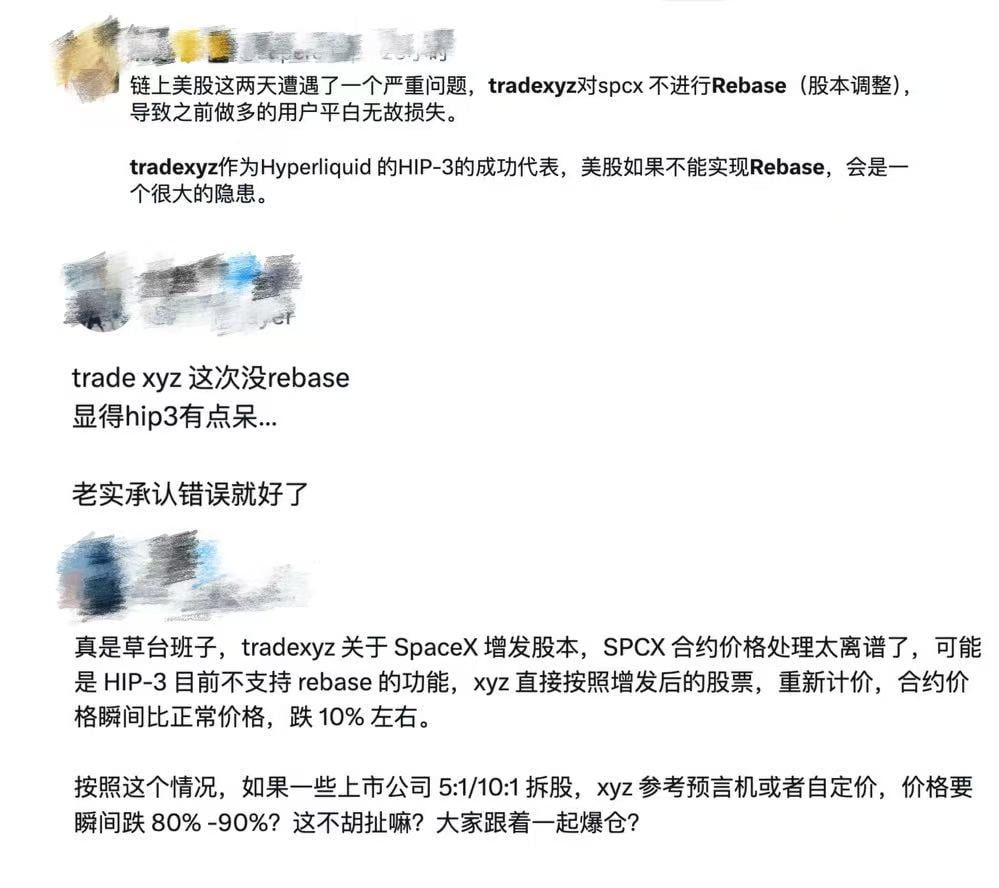
Feedback from some community members
However, this clarification further stirred up market controversy. Many users believe that at the initial launch of the product, Hyperliquid did not adequately or clearly disclose the contract rules, and that descriptions in the UI and official documentation long contained ambiguities that could lead to misunderstandings. It was only as the IPO approached and the controversy erupted that the platform hastily issued a clarification announcement and revised the document content; such retrospective corrections are hard to find convincing.
Greater dissatisfaction comes from the real financial losses of users. Because the HIP-3 mechanism itself lacks the Rebase capability of traditional exchanges, when the market re-prices according to SpaceX's latest equity, the SPCX contract price can only passively adjust downwards. As a result, the value of long positions shrank by about 10% in a short period, and many users using high leverage were forced to liquidate or even completely liquidate, while these losses directly turned into profits for short sellers and arbitrageurs.
To these users, the platform not only failed to express sufficient concern for the affected users, but also did not propose any compensation or mitigation plans, instead responding with "this is how the product mechanism works," which seemed very indifferent and lacking in responsibility.
In a sense, this discussion surrounding the SPCX pricing rights also provides a reference case for the design and rule disclosures of more on-chain Pre-IPO assets in the future.
Rebase dilemma remains unsolved, on-chain Pre-IPO faces a major test
For Perp DEXs, lacking the Rebase capability means that any Pre-IPO asset may face issues such as stock splits, new share issues, or dividends, which are common in traditional stock markets, leading to sudden revaluation of contract prices, large-scale liquidations, unfair losses, and a weakened user trust in the platform.
To understand the importance of Rebase, one must first understand what Rebase is, and why it has become a key component in the design of Pre-IPO perpetual contracts.
In simple terms, Rebase is a value-neutral adjustment mechanism. The platform adjusts contract prices and user holdings in proportion, ensuring that the overall value of traders' positions remains roughly unchanged before and after the adjustment. This mechanism is necessary because, at the Pre-IPO stage, a company's actual total equity is usually not publicly disclosed, and exchanges can only set initial prices and multipliers based on market estimates of equity. When a company officially submits S-1/S-1A documents and discloses its true equity, if the actual figure differs from the estimate, Rebase is needed to calibrate the contract parameters. Otherwise, contract prices will gradually deviate from the true per-share value, leading to cross-platform arbitrage opportunities and causing unilateral holders to passively bear losses.
However, compared to CEXs, achieving Rebase is much more challenging for Perp DEXs.
Specifically, CEXs can rely on centralized databases and professional risk control teams to quickly halt trading in the event of corporate actions (such as share issues or splits), uniformly adjust all user positions, and then resume market trading. This entire process is completed by the exchange's backend, allowing users' nominal position values to remain smooth and continuous. Nevertheless, even for large CEXs with mature trading systems and professional technical teams, such Rebase operations involving synchronized adjustments of the entire market's positions remain a complex undertaking.
Furthermore, the matching, clearing, and position statuses of Perp DEXs all run on smart contracts, which cannot modify data directly as CEXs do. To achieve a similar Rebase effect, it often requires additional design monitoring logic, special hooks, or upgraded contract mechanisms, which not only increase Gas costs and system complexity but also expand potential attack surfaces, bringing new security risks.
In addition, Rebase may further amplify the liquidity fragmentation problems that already exist in decentralized markets. The same Pre-IPO asset may exist on multiple DEXs, each with limited market depth, and liquidity providers (LPs) might reduce their willingness to invest due to the additional uncertainties brought by Rebase, ultimately leading to reduced liquidity, increased slippage, and further deterioration of the trading experience.
Of course, Rebase is not entirely unachievable under decentralized architectures. Some community users pointed out, for example, Aster has already completed similar asset Rebase adjustments, indicating that the real challenge lies not in DEXs being inherently incapable of supporting it, but in whether the platform is willing to design additional mechanisms and bear the corresponding development and operational costs.
In contrast, Trade.xyz, in addition to adhering to a more market-oriented pricing philosophy, relies on the HIP-3 architecture that allows developers to independently deploy their own Perp markets. While this model inherits Hyperliquid's high-performance order book system, each market has completely independent contract specifications, oracle definitions, and parameter settings, lacking platform-level unified Rebase native support, thus making batch adjustments of all positions challenging. However, some community members also revealed that Trade.xyz is researching corresponding solutions for potential special events such as stock splits that may occur in the future.
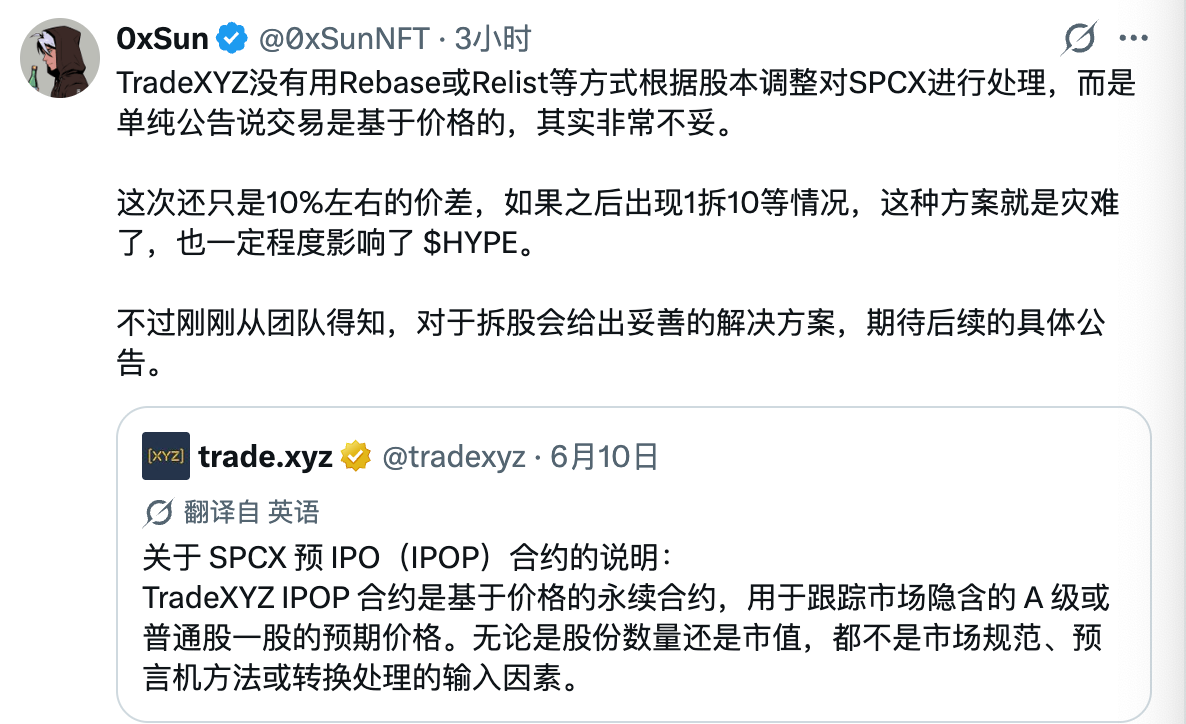
From a longer-term perspective, the issues exposed by the SPCX pricing not only reflect a product design flaw but also highlight the real challenges that current Perp DEXs must confront in exploring RWA assets. As more and more Pre-IPO assets are mapped on-chain, the ability of on-chain Pre-IPO perpetual contracts to establish a sufficiently reliable price discovery mechanism and withstand the tests of actual company actions and information disclosures, or to evolve into a funding game detached from fundamentals, remains to be seen by time and market validation.
免责声明:本文章仅代表作者个人观点,不代表本平台的立场和观点。本文章仅供信息分享,不构成对任何人的任何投资建议。用户与作者之间的任何争议,与本平台无关。如网页中刊载的文章或图片涉及侵权,请提供相关的权利证明和身份证明发送邮件到support@aicoin.com,本平台相关工作人员将会进行核查。


