Article Author: Prathik Desai
Article Translator: Block unicorn
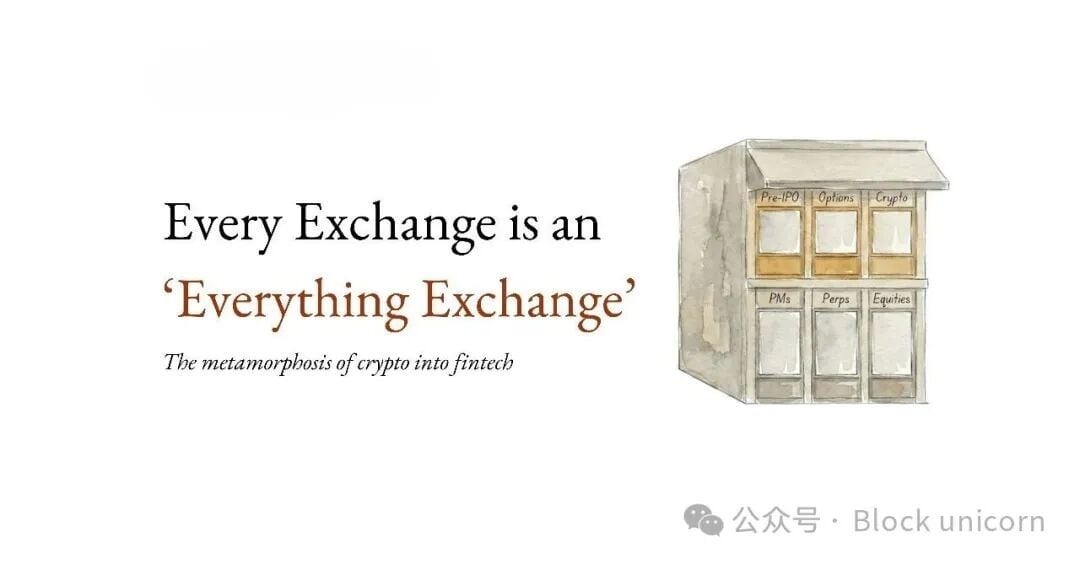
Markets constantly evolve, which is their inherent nature. They eventually surpass the initially designed products. The Chicago Mercantile Exchange (CME) was established in 1898 primarily for trading butter and eggs and later evolved into the world’s largest derivatives market. Amazon also initially sold paperback books by building warehouses and payment systems. Today, that same system no longer cares what it sells. Books may now be just a negligible part of Amazon's revenue.
This model still applies today. You initially build infrastructure for something, then discover it can be used for many other things, and you continuously expand the business to accommodate everything the infrastructure can support.
Cryptocurrency exchanges are experiencing this moment.
The infrastructure they built for token trading is also applicable to trading crude oil, silver, stock indices, pre-IPO stocks, or event contracts. Over the past seven months, non-crypto perpetual contracts accounted for 99% of total trading volume, in a permissionless trading market that didn't even exist two years ago.
This market model is ubiquitous. Every exchange is competing to transform into a multi-asset broker, with blockchain technology providing the most economical way to achieve this.
The Cheapest Path
Perpetual futures contracts or prediction market contracts do not care whether the underlying asset is Bitcoin or crude oil. All you need is a wallet funded with stablecoins to buy a futures contract for a certain meme coin or wager on Apple's quarterly earnings report. The trading platform itself does not concern itself with the underlying asset, just as the internet and logistics networks do not care what products are being traded on the Amazon marketplace.
But why would traders abandon existing trading venues to trade silver and stocks on an exchange that has only been established for a few years? The reason is the same as why people choose online trading: convenience and cost savings.
Amazon eliminated intermediaries, allowing remote sellers to ship directly to buyers. This enabled sellers to defeat competitors by offering subsidized prices. At the same time, buyers can easily browse vast amounts of products at home (or anywhere), add items to their carts, and complete payments.
While the cost advantages offered by blockchain were initially built for cryptocurrency trading, they also apply to stock settlement, commodity clearance, and cross-border stock trading.
The uninterrupted real-time market on the blockchain also allows global traders to price events anytime. In recent months, we have repeatedly witnessed their impacts on non-crypto assets.
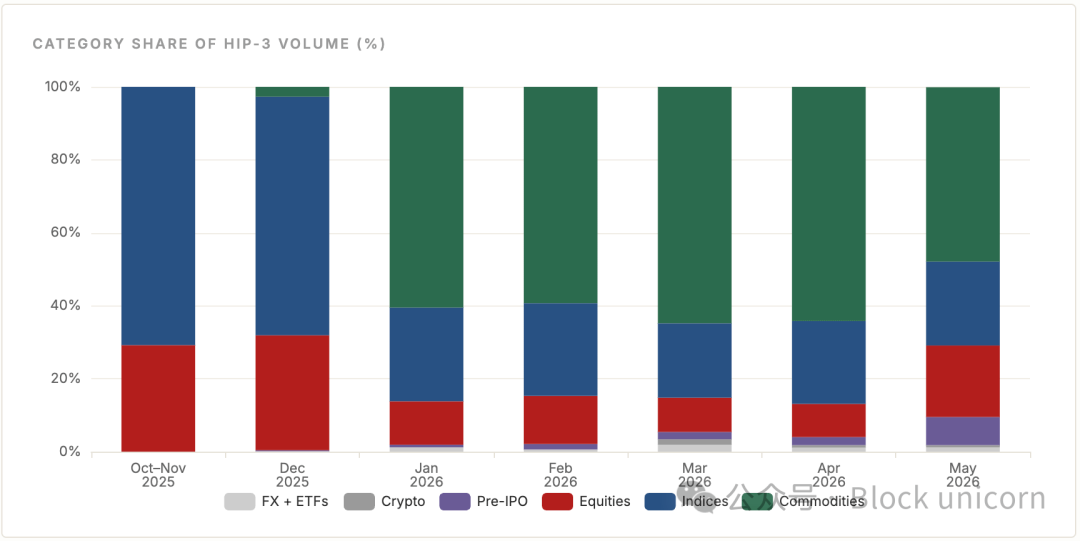
Since October 2025, Hyperliquid's permissionless market (HIP-3) has processed about $270 billion in trades across seven developer-deployed trading venues. Of this, 99% of the trades came from commodities, stocks, forex, indices, and pre-IPO contracts. Cryptocurrency trading volume has consistently been below 1%. Moreover, the portfolio is diversifying continuously every month.
On the last weekend of February this year, the conflict between the U.S. and Iran escalated, and the world's largest commodity exchange, the Chicago Mercantile Exchange (CME), was closed. However, Hyperliquid's WTI crude oil perpetual contracts remained open. In just three weekends, the platform's trading volume surged from $25 million to over $550 million. According to a recent report from TD Securities, before the CME reopened on Monday, Hyperliquid had already absorbed about 80% of the subsequent WTI crude price fluctuations.
Earlier this year, during the rise in precious metal prices, the daily trading volume of silver perpetual contracts even approached $1 billion. Even when traditional markets are closed, blockchain-based trading platforms continue to operate.
This phenomenon is not exclusive to criminals; the same phenomenon exists in stock trading.
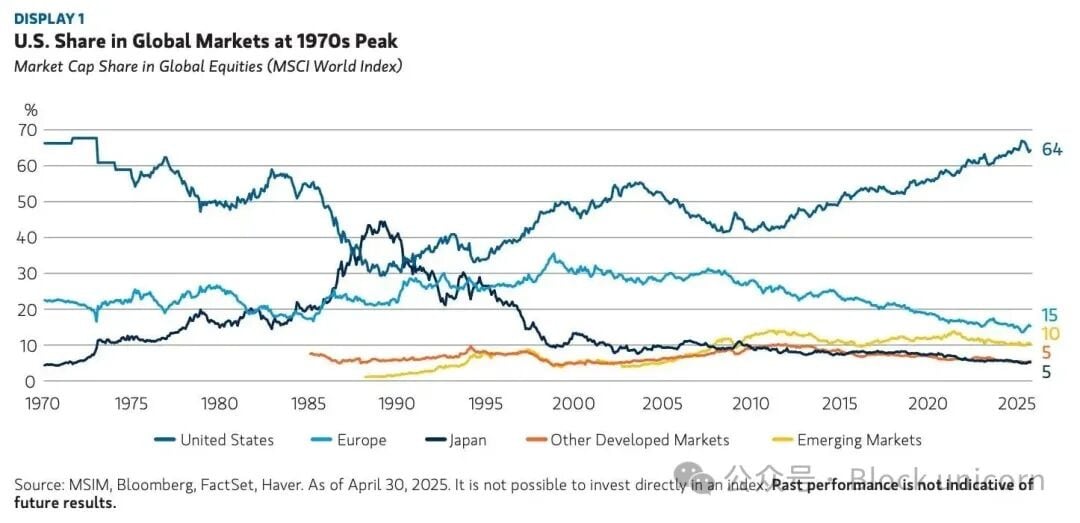
U.S. stocks account for over 60% of global stock market value. For most investors worldwide, purchasing U.S. stocks requires intermediaries, currency exchange, and meeting minimum account balance requirements, with account types also restricted.
Everyone wants a piece of the action and to participate in the growth story of the world's largest economy. This explains why nearly all cryptocurrency exchanges want to allow traders to buy and sell U.S. stocks or derivatives based on U.S. stocks.
On June 1, Binance announced a zero-commission trading service for 7,000 U.S.-listed stocks for its 300 million registered users, offering fractional shares starting at $5. The majority of users are located outside the U.S. and can now invest in U.S. stocks through their stablecoin wallets.
Kraken's xStocks has demonstrated how tokenization can affect investors' access to public stocks. The platform has tokenized over 100 public stocks, with a trading volume of $25 billion and 80,000 on-chain holders.
Blockchain can also unlock the pre-IPO price discovery mechanism for traditional markets. SpaceX is preparing for the largest IPO in history, expected to raise about $75 billion. On June 1, Anthropic secretly submitted its IPO application. OpenAI might follow closely behind. Before these companies go public, the price discovery mechanism is not transparent and only eligible investors can participate.
In the book "Pricing Private Assets", I explain how the market prices assets that behave like public companies.
Companies like OpenAI and Anthropic possess brand recognition, scalable revenue, and hundreds of millions of users. They have everything of a public company, except for public shareholders. Their marketing strategies ensure that everyone has their opinion about them. In fact, the success rate of SpaceX is unprecedented, and almost everyone has an opinion about it, yet hardly anyone can really evaluate its value.
Blockchain provides various tools for the market to price these private companies.
For example, many platforms originally designed as cryptocurrency exchanges now offer pre-IPO perpetual contracts, prediction market contracts, and tokenized IPO access for companies that are not yet public.
Several market makers provide perpetual contracts for companies like SpaceX, Cerebra, and Anthropic on the Hyperliquid platform. Over the past six months, the trading volume of these contracts has increased by about 300 times, skyrocketing from $16 million to $4.7 billion. In May, these pre-IPO stock perpetual contracts accounted for 7.7% of the total trading volume of HIP-3, whereas in December 2025, that percentage was just 0.2%.
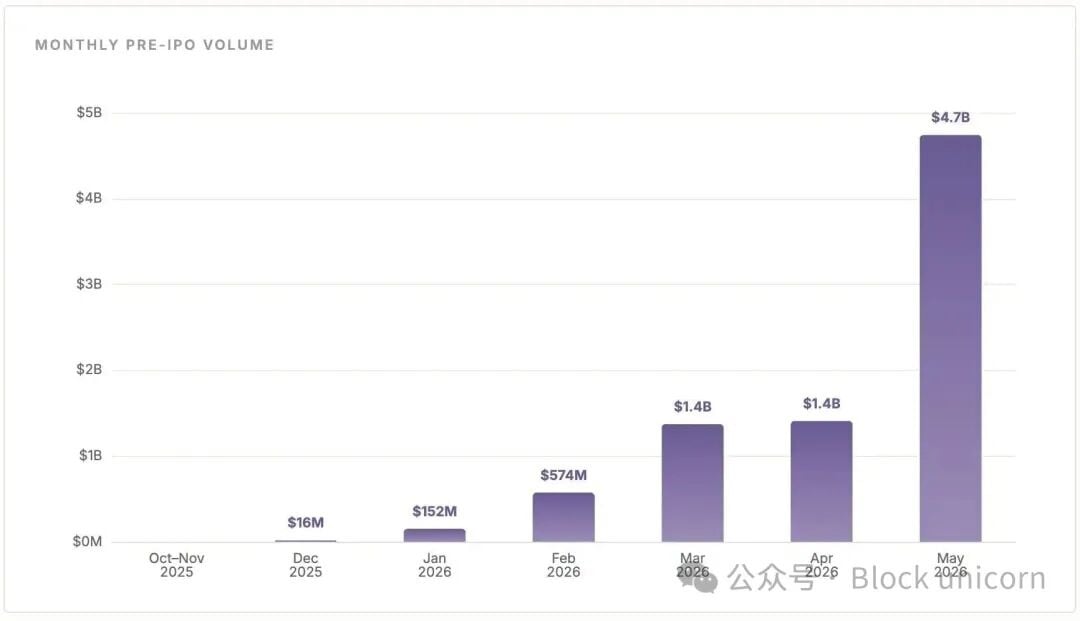
These trading venues are not only always open and cheaper but also offer sufficient liquidity that traders can trust.
During the escalation of the situation in Iran, Hyperliquid's WTI crude futures contracts averaged several hundred million dollars in daily trading volume with very small spreads. From January to April 2026, the open interest of WTI crude futures contracts surged from $1.8 million to $560 million.
Traditional exchanges can also utilize user deposits to provide users with cross-margin trading and deep liquidity. Binance enabled users to participate in pre-IPO stock trading through integration with PreStocks; while Payward (the parent company of Kraken) allows users to invest in tokenized IPOs.
Less than 24 hours ago, Coinbase joined Kraken and Binance in launching malicious contracts for pre-IPO stocks, with the first stock being SpaceX.
Building a Full-Stack FinTech
The bidirectional integration of traditional finance and cryptocurrency is creating a full-stack fintech platform for many companies. On one hand, cryptocurrency-native platforms are expanding traditional asset categories; on the other hand, traditional exchanges are rapidly adopting blockchain infrastructure.
In the cryptocurrency field, Kraken has spent over $2.7 billion on acquisitions over the past 12 months, transforming into a multi-asset broker. In March 2025, the company acquired injaTrader for $1.5 billion, which is the largest deal to acquire a futures commission merchant registered with the U.S. Commodity Futures Trading Commission (CFTC) to date.
The company then acquired Backed Finance, enabling it to gain autonomous control over the issuance, trading, and settlement of xStocks. By early 2026, its product range grew from 60 tokenized stocks to 100. Subsequently, the company made five acquisitions in payment, clearing, and automated trading infrastructure.
The company then launched Krak, a payment application supporting over 300 assets across 160 countries, helping users spend, send, and earn profits using cryptocurrencies.
Coinbase has also launched a similar product suite.
In the product launch event in December 2025, Coinbase introduced commission-free stock trading covering all 50 states in the U.S. and launched a prediction market through Kalshi.
In August 2025, Coinbase acquired Deribit for $2.9 billion, gaining control of the world's largest cryptocurrency options market. Now, Coinbase is positioning USDC and its Layer-2 chain Base as a settlement platform for various transactions ranging from agency payments to stock trading.
These platforms have entered the financial sector through cryptocurrencies and now possess distribution networks developed over decades by traditional financial giants. Binance has 300 million registered users, and Kraken serves 15 million customers across 190 countries. Such a massive user base is their greatest competitive advantage in expanding multi-asset brokerage services.
When Binance launched 7,000 U.S. stocks, it did not need to build demand from scratch. The buying channels for these stocks and pre-IPO stocks are open to users who have already recharged stablecoins multiple times and completed identity verification. For an existing cryptocurrency broker, the marginal cost of adding stock trading is far lower than the cost traditional brokers incur to acquire a new customer.
Traditional companies are also actively adapting themselves to remain competitive.
On the same day that Binance launched U.S. stock trading, the Chicago Mercantile Exchange Group, the world's largest derivatives exchange, announced that all of its cryptocurrency futures and options would be traded 24/7.
DTCC, which manages $114 trillion in assets, will pilot tokenized securities this July and fully roll them out in October. This pilot includes Russell 1000 index constituents, major index ETFs, and U.S. Treasuries. More than 50 companies, including BlackRock, JPMorgan, and Circle, are participating in the project.
The New York Stock Exchange has partnered with Securitize to build a 24/7 tokenized stock trading platform. Nasdaq received approval from the U.S. Securities and Exchange Commission in March to trade tokenized stocks in its existing trading system.
This is an interesting fusion phenomenon. The Chicago Mercantile Exchange (CME) and other traditional financial institutions are implementing 24/7 operations because cryptocurrencies have proven that the markets need not shut down. Cryptocurrency exchanges are also beginning to offer traditional assets—oil, silver, indices—because users have shown that any platform capable of providing adequate liquidity and lower-cost information pricing will attract their demand.
Blockchain is becoming a bridge between the two.
The Evolution of Cryptocurrency as FinTech
Like any other technology, the outlook for the application of cryptocurrency among internet forums is either this or that. They believe cryptocurrencies will either build a brand new, independent financial system or collapse due to their own development. But in reality, the development of cryptocurrencies is occurring in between both extremes. The development trajectory of the internet was similar.
When people were still debating the internet, or seeing it as the dawn of a new world, the internet was gradually commodifying and eventually became ubiquitous, with almost the entire world relying on it to function. Today, people no longer debate the utility of the internet; it has become the common foundation supporting various emerging technologies.
This is exactly the change I believe is happening in the cryptocurrency field. The technologies related to cryptocurrency may not have realized the expectations of the early cypherpunks. I doubt most of them even care; at least I don’t.
While the internal market is busy discussing Bitcoin cycles and downtrends, an external market running parallel is steadily expanding across multiple layers of the financial system. Payment infrastructure, agency commerce, integrated price discovery platforms, and now multi-asset brokerage businesses are thriving regardless of whether the price of Bitcoin is $60,000 or $100,000.
Charlie Booth from Hepworth Iron Capital provided an excellent explanation of the endogenous-exogenous market evolution in a guest commentary published last week in Token Dispatch.
What interests me most is that a technology originally intended for trading tokens is now being used to allow retail investors to access $5 worth of Apple stock on a Saturday, settled with stablecoins, with fees under 1 cent, all built on the infrastructure initially constructed for meme coins.
Such possibilities only emerge when the new infrastructure far exceeds the old infrastructure it replaces. We all know old habits die hard. And the world is discovering that blockchain is the panacea for improving financial operations. In some cases, blockchain operates by smoothing out the traditional financial systems; in others, it functions by completely replacing old and outdated systems. Changing for the sake of change is not wise.
For any industry operated by humans, resisting transformative changes that can improve how current systems function is tantamount to suicide. This is because humans have an innate desire to improve inefficient systems. Anything that can enhance system efficiency will be adopted, regardless of how novel or radical it may seem. The development of blockchain technology is situated in a domain with substantial room for improvement, capable of effectively reducing such inefficiencies. Traditional institutions and markets, such as Nasdaq, the New York Stock Exchange, and the Chicago Mercantile Exchange, are all adopting blockchain technology, which clearly demonstrates that blockchain is playing an increasingly important role in the future of finance.
Now every exchange is a broker (or will soon become one). Not all exchanges anticipated this, but this is exactly what they aspire to be. What will happen next? When every platform offers stocks, derivatives, prediction markets, and cryptocurrencies on the same application, who will be the ultimate winner? The key lies in how they integrate these assets into their platforms and enable users to perform some of the most basic actions in finance: spending, transferring, receiving, and making money.
That's all for today. See you in the next article.
免责声明:本文章仅代表作者个人观点,不代表本平台的立场和观点。本文章仅供信息分享,不构成对任何人的任何投资建议。用户与作者之间的任何争议,与本平台无关。如网页中刊载的文章或图片涉及侵权,请提供相关的权利证明和身份证明发送邮件到support@aicoin.com,本平台相关工作人员将会进行核查。


