Inventory of the ten most common, popular, and often misunderstood licensing paths for cryptocurrency payment projects.
Written by: Shao Jiadian
In the past two years, whenever the topics of cryptocurrency payments, stablecoin collections, U cards, and PayFi come up, the conversation inevitably circles back to the same question: "Which license should we obtain first?"
This question is very practical. Without a suitable regulatory identity, banks hesitate to engage, payment channels are reluctant to open, merchants are cautious about signing, and investors find it hard to trust that a project can sustain in the long run. However, if the initial query is framed as "Which license is the cheapest, quickest, and easiest to obtain," the focus can easily go off track.
Cryptocurrency payment is not a business that can be resolved by merely obtaining a single certificate. It involves fiat currency transactions, stablecoin circulation, merchant settlements, asset exchanges, wallet custodianship, anti-money laundering, on-chain transaction monitoring, contract liabilities, and fund freezing. A license merely places a segment of the business within a regulatory framework; what truly determines whether a project can operate is whether its business actions and regulatory identity align.
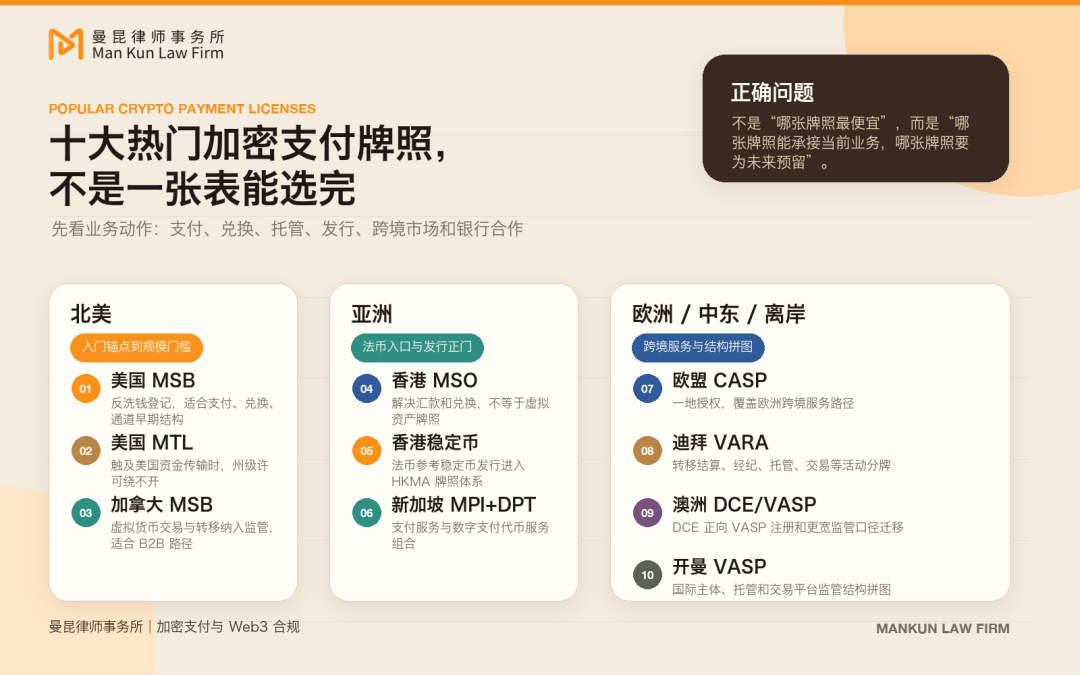
Map of the ten popular cryptocurrency payment licenses
Therefore, this article does not aim to provide a "global license compendium." We will only inventory the ten most common, popular, and easily misunderstood licensing paths for cryptocurrency payment projects.
Don’t Just Focus on License Names
When selecting a license for cryptocurrency payments, the biggest mistake is to frame the question as "Which license is cheaper?" This type of question appears to be about controlling costs, but in reality, it may be a way of avoiding the core business itself.
A platform for stablecoin merchant collections, a project developing U cards, a company providing fiat currency funding channels, and an institution preparing to issue stablecoins each face different regulatory issues. Although they all fall under the umbrella of cryptocurrency payments, regulators observe completely different activities: who collects payments, who exchanges assets, who custodies funds, who settles, who commits to users for transfers, and who bears responsibility in the event of transaction failures, money laundering, frozen accounts, and refunds.
A more accurate approach is to break the project down into six questions.
First, where are the customers? The regulation of cryptocurrency payments does not follow the server's location or solely the place of registration; it often follows the location of customers, merchants, sources of funds, marketing targets, and the places where services are implemented. A project registered in an offshore location but primarily serving clients in the US, EU, Hong Kong, Singapore, or the Middle East cannot rely entirely on the offshore entity to explain all compliance needs.
Second, does the platform actually handle money? Simply providing software interfaces is different from collecting payments for customers, safeguarding balances, and controlling funding pathways. Once a platform begins to transmit, control, possess, or allocate others' funds, regulators will shift their perspective from "technical services" to "payment, fund transmission, custody, or virtual asset services."
Third, is it dealing with fiat, stablecoins, or the conversion between the two? If it only deals with fiat remittances, it may be prioritized under traditional payment or money service frameworks; if it involves stablecoin trading, on-chain transfers, wallet custodianship, transaction matching, or virtual asset exchanges, it will fall under virtual asset regulatory scopes; and if it needs to bridge both sides, the licensing structure is rarely encapsulated by just one certificate.
Fourth, has the project generated user balances or merchant funds awaiting settlement? Many disputes about cryptocurrency payments do not occur at the moment of payment but rather in intermediary states like "money reaching the platform first, then given to merchants days later," "user deposits forming account balances," or "platform exchanging currencies before releasing funds." The longer these intermediary states persist, the more control the platform exercises, and the heavier compliance and civil liabilities become.
Fifth, who performs KYC, AML, and KYT? KYC stands for Know Your Customer, AML is anti-money laundering, and KYT can be understood as on-chain transaction monitoring. A cryptocurrency payment project cannot claim to have risk control simply by incorporating an on-chain monitoring tool. Regulators and banks are more concerned about: Who identifies customers, who screens merchants, who assesses high-risk addresses, who maintains records, who has the authority to freeze accounts, and who reports suspicious transactions.
Sixth, is the project currently in its starting phase or scaling phase? The startup phase requires compliance anchor points to legally trial the business, while the scaling phase requires collaboration with multiple entities, jurisdictions, licenses, and banking channels. An early-stage project can first confirm its business boundaries, but it cannot use “early-stage” as a long-term justification for neglecting licenses and risk control.
Once these six questions are clearly answered, choosing a license becomes meaningful. Otherwise, whether US MSB, Hong Kong MSO, Singapore MPI+DPT, EU CASP, or Dubai VARA all sound appealing, but each may only cover part of the business.
Ten Popular Licenses
US MSB: The most common compliance anchor point for cryptocurrency payment projects.
MSB stands for Money Services Business, which is the currency services business registration under the money laundering regulatory framework of the US FinCEN. It is not a traditional financial license in the usual sense, but it is very common in cryptocurrency payment projects, because FinCEN provided guidance as early as 2019 on how the interchangeable virtual currency business model applies to MSB regulations.
For stablecoin receiving and payment, fiat and cryptocurrency exchanges, cross-border payment APIs, U card underlying channels, and OTC liquidity interfaces, US MSB often serves as the entry ticket for early compliance discussions. Its value lies in integrating the project into an anti-money laundering regulatory context and establishing foundational frameworks for client identification, transaction records, suspicious transaction reports, compliance officers, internal systems, etc.
However, its boundaries must be clearly defined. MSB does not equate to universal acceptance across the US, does not mean it can freely cater to US retail investors, does not represent a stablecoin issuance license, nor does it guarantee that a bank account can be opened. It addresses some federal anti-money laundering identity issues, but it does not automatically solve state-level money transmission permits, securities law, commodity law, consumer protection, and bank access issues. Many projects treat MSB as a form of endorsement on their official website, which may mislead merchants and investors.
US State-Level MTL: When you actually start handling US client money.
MTL stands for Money Transmitter License, which is the state-level money transmission license in the US. Many projects initially only discuss MSB but later discover that the real hurdle is not the federal registration but rather the money transmission requirement under state law.
The difference between the two can be stated plainly: MSB primarily considers whether you have anti-money laundering obligations, while MTL focuses more on whether you are qualified to transmit, control, or possess funds on behalf of others. Whenever a platform directly provides fiat payment services, account balances, integrated fiat-stablecoin exchanges to US users, or if funds enter the platform before being transferred out by the platform, it cannot treat state-level MTL as a future consideration.
The challenges of MTL extend beyond just the application process. It often involves evaluations state by state, capital requirements, net worth, permitted investments, audit reports, compliance systems, consumer complaint handling, and ongoing reporting. For entrepreneurial teams, the most practical option is not necessarily to apply for all states at once, but to first determine if their business indeed triggers money transmission, and then decide whether to self-build the license, collaborate with a licensed partner, or initially limit American customers and funding paths.
Canada MSB: Not a substitute for US MSB, but a heavier B2B path.
Canada's FINTRAC clearly includes dealing in virtual currencies, or virtual currency trading or transfer services, within the MSB/FMSB regulatory scope. This is suitable for B2B stablecoin payments, cross-border settlements, virtual currency exchanges, enterprise payments, and projects with long-term compliance operations.
The value of Canada MSB does not lie in being "cheap and easy to obtain," but in a relatively clear regulatory interpretation that banks and partners find easier to comprehend. For projects serving corporate clients, the Canadian path is sometimes easier to explain to banks than simply obtaining an offshore VASP: Who the clients are, what types of transactions occur, and who bears the anti-money laundering obligations.
However, it is not a lightweight registration. FINTRAC has also made it clear that registration does not mean regulatory endorsement or commercial recognition; it merely states that the business has fulfilled its registration obligations. The project will still face customer identification, large transaction records, suspicious transaction reports, compliance plans, risk assessments, agent management, and ongoing oversight. Obtaining the registration but not operating with genuine compliance may expose issues concerning bank account openings, channel partnerships, and financing due diligence.
Hong Kong MSO: The fiat currency gateway has value, but don’t treat it as a virtual asset license.
The Hong Kong MSO is Money Service Operator, primarily corresponding to money changing services and remittance services. For cryptocurrency payment projects, its value lies in the fiat currency gateway: If a project involves local or cross-border remittances, currency exchanges, or merchant fiat settlements in Hong Kong, MSO may be an important piece of the puzzle.
However, MSO addresses traditional money service issues, not a virtual asset trading platform license, nor a stablecoin issuance license, much less a custodial license. If a project uses MSO to engage in stablecoin trading, matching, on-chain custody, virtual asset settlements, or promotes itself as "we already have a Hong Kong payment license, therefore we can do all cryptocurrency payment services," it will need to reassess whether it touches upon the regulatory framework of the Hong Kong Securities and Futures Commission, the Hong Kong Monetary Authority, or subsequent regulations on virtual asset OTC, custody, etc.
The key for the Hong Kong path is not to frame MSO as a universal entry point but to clearly delineate the interfaces between "fiat currency exchange/remittance" and "virtual asset services." Which elements are accomplished by the MSO entity and which are carried out by licensed virtual asset platforms, stablecoin issuers, custodians, or technical service providers; contract terms, fund flows, and promotional rhetoric must all align.
Hong Kong Stablecoin Issuer License: The true gateway to issuance.
The stablecoin issuer system in Hong Kong is no longer just a concept. The regulatory system under Hong Kong's "Stablecoins Ordinance" will be implemented starting August 1, 2025, with fiat-backed stablecoin issuance becoming a regulated activity. On April 10, 2026, the Hong Kong Monetary Authority's register showed that Anchorpoint Financial Limited and Hongkong and Shanghai Banking Corporation Limited became the first batch of licensed stablecoin issuers.
The popularity of this license is not because every cryptocurrency payment project should apply for it, but because it has pushed the matter of "issuing stablecoins" into formal regulatory discussions. Issuing stablecoins and utilizing stablecoins for receiving payments are not the same; onboarding stablecoins for merchants and committing to issue, redeem, and maintain a peg is also not identical.
For most cryptocurrency payment teams, the real question is not whether they can issue stablecoins, but whether the stablecoins they are integrating are compliant, whether the circulation channels are regulated, what merchants and users receive, who bears the redemption responsibilities, and whether the platform has mixed up "collecting U," "exchanging U," "selling U," and "issuing U." The Hong Kong stablecoin license will heighten industry expectations about reserve assets, redemption arrangements, governance, risk control, and disclosure while compelling payment projects to clarify the source of stablecoins.
Singapore MPI+DPT: A high-value combination for cryptocurrency payments in the Asia-Pacific region.
Singapore's Payment Services Act places payment services under a unified regulatory framework. The most common for cryptocurrency payment projects is MPI, or Major Payment Institution, combined with Digital Payment Token Service, which is digital payment token service. The Monetary Authority of Singapore (MAS) has publicly listed several major payment institutions authorized to offer DPT services.
The advantage of this path is that payment, merchant acquiring, cross-border transfers, and digital payment token services can be combined under the same regulatory logic. For teams genuinely aiming to establish a central role in the Asia-Pacific region, corporate payment, merchant collections, and stablecoin settlements, the market recognition and communication value of the Singapore license are very high.
However, its challenges are also apparent. Singapore does not merely offer a project a flashy façade; instead, it examines actual management, compliance teams, customer asset protection, technological risk control, anti-money laundering, outsourcing management, directors, and local substance. A project that only seeks to use a Singapore entity to mark its global operations, while customers, teams, systems, funds, and risk controls are not in Singapore, will face difficulties in future regulatory communications. MPI+DPT is more suitable for teams truly willing to invest in tangible presence and compliance capabilities in Singapore.
EU CASP: If you want to serve Europe, MiCA is the unavoidable gateway.
CASP refers to Crypto-Asset Service Provider, which is the provider of crypto-asset services under the EU MiCA framework. The value of MiCA lies in its unification. According to the ESMA rule page, unauthorized bodies may not provide crypto-asset services within the EU; authorized CASPs can carry out services across EU member states through cross-border service mechanisms.
For Asian cryptocurrency payment projects, the appeal of EU CASP lies in the "European passport." If the project intends to serve EU clients involving custody, exchanges, transfers, trading platforms, or crypto-asset services, CASP will become a long-term pathway. Especially when targeting European merchants, wallet users, corporate stablecoin settlements, and virtual asset transfer services, it will be difficult to rely on ambiguous zones for long-term operations post-MiCA.
However, CASP is not a low-cost startup solution. The EU focuses on substantive entities, management locations, directors, compliance systems, customer protection, prudential requirements, IT security, market communication, and cross-border notifications. Different member countries will also demonstrate varying regulatory styles in actual implementation. Projects opting for EU paths must not only focus on "which country is faster," but also consider target customers, banking resources, local teams, language competence, and future scenarios for passport use.
Dubai VARA: Advanced licensing in the Middle East, suitable for resourceful teams.
VARA stands for Dubai Virtual Assets Regulatory Authority, which regulates virtual asset activities in multiple categories, including brokerage trading, custodianship, exchanges, lending, investment management, transfer, and settlement. For cryptocurrency payments, the most relevant aspects are Transfer & Settlement Services and potential corresponding brokerage, custody, and trading services.
The value of this path lies in the Middle Eastern market, regulatory brand, and institutional collaboration. Dubai has a proactive policy stance toward virtual assets, but that does not mean low thresholds. VARA explicitly requires relevant entities to obtain licenses before engaging in virtual asset activities in Dubai, and different activities like custody, trading, and transfer settlement may correspond to different regulatory requirements.
For project teams, VARA is suitable for those with capital, teams, local entities, and strategies for the Middle Eastern market. It is not a low-cost license meant to provide "glamor" for early products. Before applying, teams must primero assess what activities they intend to engage in within Dubai, whether they are facing local clients or merely using Dubai as a brand center; whether they bear the responsibility for transfer and settlement or collaborate with licensed institutions; and whether they focus on brokerage, custody, trading, or purely technical services. These answers will directly impact the type of license and compliance costs applicable.
Australia DCE/VASP: Transitioning from entry registration to fuller regulation.
Australia was previously seen as a DCE entry path by cryptocurrency payment projects. DCE stands for Digital Currency Exchange, which refers to providers of digital currency exchange services. AUSTRAC has made it clear that providing digital currency exchange services must be registered, and that offering services without registration is illegal.
However, Australian regulation is upgrading. AUSTRAC has begun transitioning the DCE framework to VASP, that stands for Virtual Asset Service Provider. Entities already registered as DCE must update their service information to VASP compliance by July 29, 2026. For project teams, this means Australia is no longer just about "getting a DCE registration," but accepting a broader regulatory perspective on virtual asset services.
The Australian path is suitable for projects committed to compliance, willing to accept ongoing regulation, and serving clients in Australia or related markets. It is not suitable for teams merely looking for an English certificate to put on their official website. In the future, projects will need to pay attention not only to registration but also to whether they are offering exchange, transfer, custody, trading platforms, or other virtual asset-related services, as well as whether they will also fall under financial services, custody arrangements, or consumer protection frameworks.
Cayman VASP: Not a payment entry, but a piece of the international structural puzzle.
Cayman VASP falls under the oversight of the Cayman Islands Monetary Authority (CIMA), representing the path for virtual asset service providers. It may not necessarily be the first license for cryptocurrency payment projects, but it frequently appears in international structures, holding companies, foundations, trading platforms, custodianship, asset services, and group hierarchies.
After April 1, 2025, the Cayman Islands will further incorporate virtual asset custodianship and trading platform services into licensing requirements. CIMA's FAQ also clarifies that entities providing virtual asset custody and trading platform services must obtain a VASP license. For payment projects, Cayman functions more as a component within a group structure rather than directly replacing US MSB, Singapore MPI, or Hong Kong MSO as a payment entry.
The core value of the Cayman path lies in structural arrangements and the adoption of international entities. It may well suit holding companies, token project entities, trading platform groups, custodial structures, foundations, or global business hierarchies. However, if the project's actual business is to provide payment, exchange, custodianship, or transfer services to clients in the US, Hong Kong, Singapore, or the EU, merely having a Cayman structure is far from sufficient. The Cayman framework may resolve certain regulatory issues concerning entities and virtual asset services but cannot take the place of target market regulations and will not automatically resolve bank account access, merchant onboarding, or fiat funds frictions.
Common Mistakes Made by Beginners
Many projects do not fail due to a lack of licenses but because they misunderstand the licenses themselves.
The first mistake is viewing anti-money laundering registration as a universal license. Paths like US MSB, Canada MSB, and Australia DCE/VASP are often marketed by intermediaries as "entry licenses." They are indeed important, but the core issue is incorporating entities into anti-money laundering, client identification, transaction records, and reporting obligations. They cannot resolve all issues related to payments, custodianship, securities, stablecoin issuance, bank collaboration, and consumer protection. The most dangerous statement is to use one registration identity to externally promise "global compliant payments."
The second mistake is treating traditional payment licenses as virtual asset licenses. Hong Kong MSO, some payment services in Singapore, and European traditional payment institution licenses may assist with fiat collections and merchant settlements. However, once a project involves stablecoin trading, on-chain transfers, custody, transaction matching, or asset issuance, it cannot solely use traditional payment licenses to explain the entire business. There must be clear distinctions between the gateway for fiat currency and virtual asset services regarding entities, contracts, and financial flows.
The third mistake is thinking that writing "technical services" in agreements exempts one from regulatory scrutiny. Many projects claim they are merely providing APIs, plugins, SaaS, or technical interfaces, but in the background, they can manipulate settlement paths, freeze merchant balances, unify wallet allocations, dictate exchange rates, and choose paths on behalf of clients. Regulators and courts will not just consider the title of an agreement but will examine the actual control exerted over the project. The stronger the control, the more challenging it becomes to claim to be merely a pure technical service provider.
The fourth mistake is assuming that "having many licenses" means "strong compliance." Truly mature multi-license collaboration does not involve piling up various licenses on a website; rather, it requires different business modules to be undertaken by different entities: US entities managing North American money transmissions, Singapore entities serving as the Asia-Pacific payment hub, Hong Kong entities managing fiat gateways or stablecoin issuance, EU entities serving European clients, and Cayman entities managing group structures or virtual asset services. This is referred to as structural capability, not just license collection.
The fifth mistake is focusing only on the cost of obtaining licenses without considering the maintenance costs. The true expense of many licenses isn't merely application fees but rather compliance officers, audits, reports, systems, capital, insurance, local directors, bank accounts, transaction monitoring, and ongoing inquiries. If projects make decisions solely based on "how long it takes to obtain a certificate and how much it costs," they may find themselves easily bogged down by operational costs afterward.
The sixth mistake is that promotional messaging often stretches beyond the scope of the licenses. A project's official website, white papers, sales pitches, channel agents, and KOL promotions frequently present limited licenses as full business capabilities. For example, a project that only resolves anti-money laundering registration may falsely claim it can facilitate global payments; a project that merely handles remittance exchange may overstretch to say it can manage virtual asset transactions; or a project that works with a licensed partner may incorrectly represent that it is licensed itself. Many risks do not emerge from regulatory checks but start with a single act of excessive promotion.
Therefore, before obtaining a license, cryptocurrency payment projects should at least complete a more fundamental task: cross-checking actual business, license scope, partner qualifications, contract responsibilities, and external promotional claims. If even one component does not align, it could lead to inquiries from banks, regulators, customer disputes, or investor due diligence issues.
Mapping the License Landscape to Business Reality
Cataloging the ten most popular licenses is not meant to present project teams with a multiple-choice question but to remind everyone that the compliance capability of cryptocurrency payments is essentially a business structure diagram.
This diagram must answer not just "Do we have a license?" but also questions about where the users are, where the merchants are, where the money comes from, where the coins go, who controls the wallet, who is responsible for exchanges, who performs risk control, who signs contracts, who faces the bank, and who bears regulatory inquiries. If these questions lack answers, even the most popular licenses can only solve a small part of the problem.
If the project is merely focused on early-stage stablecoin payment pathways, US MSB or Canada MSB may serve as a compliance anchor point, but the project must still ascertain whether it touches upon the funding transmission, exchange, custodianship, or consumer protection requirements of the target market. If it intends to serve US customers and engages in fiat currency transmission, state-level MTL cannot be avoided in the long run. If it wishes to establish a hub in Asia-Pacific, the Singapore MPI+DPT option offers high value but also necessitates that physical footprint, team, risk controls, and regulatory communications keep pace. If serving Europe, the CASP pathway will be essential long-term. If aiming to facilitate local fiat remittances and exchanges in Hong Kong, MSO is valuable; if planning to issue fiat-referenced stablecoins, it is imperative to enter into the Hong Kong Monetary Authority's stablecoin issuer licensing system. In terms of group structures, custody, trading platforms, or international entities, routes like Cayman VASP or Dubai VARA are more viable for discussion.
Truly mature projects do not merely ask, "Which license is fastest?" They will first ask: At which layer are we currently operating, and to which layers do we aim to expand in the future; which actions must be handled in-house, and which can be completed through licensed partners; which countries should we initially avoid, and which merchants should we not onboard; which funds must be isolated, and which promotional claims cannot be made; which contractual documents need to be clarified first, and which risk control rules must be implemented early on.
This is also the work that Mankun prefers to engage in with cryptocurrency payment projects. We do not simply help clients compile a license checklist; rather, we first collaborate with teams to break down the business: product functionalities, financial flows, asset distributions, client scopes, merchant types, collaborative channels, licensing pathways, contracts, AML/KYC/KYT risk control systems, and external promotional messaging, ensuring alignment across each component. Only when these elements are synchronized does obtaining a license become more than just a decorative addition on the website; it becomes the foundational framework that enables the business to operate effectively.
The cryptocurrency payment industry will not lack concepts moving forward. What is genuinely rare are the teams capable of clearly articulating the relationships between money, tokens, people, merchants, banks, and regulatory responsibilities.
Obtaining a license is only the beginning. Clearly articulating business operations, delineating risks, and specifying responsibilities comprise the true compliance capacity of cryptocurrency payment projects.
免责声明:本文章仅代表作者个人观点,不代表本平台的立场和观点。本文章仅供信息分享,不构成对任何人的任何投资建议。用户与作者之间的任何争议,与本平台无关。如网页中刊载的文章或图片涉及侵权,请提供相关的权利证明和身份证明发送邮件到support@aicoin.com,本平台相关工作人员将会进行核查。


