Written by: Techub News
Introduction:
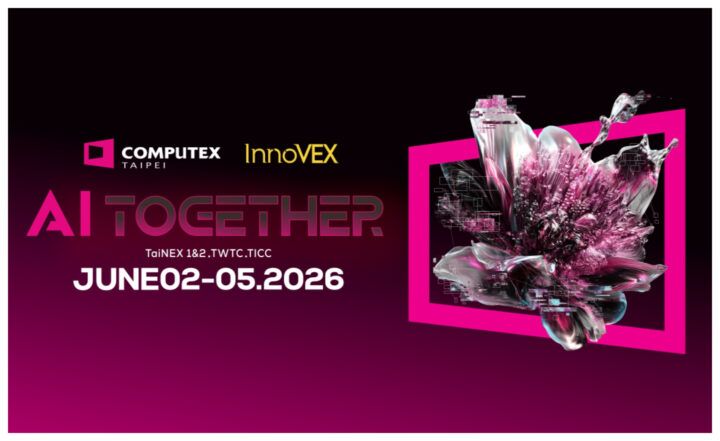
The signals given by the Taipei International Computer Exhibition in 2026 are clearer than the past year and are harder to encapsulate in a single phrase "AI boom continues." In 2025, the keyword for COMPUTEX was still "AI Next," with the industry discussing how AI infrastructure would expand; by 2026, the theme changed to "AI Together," shifting the fair's narrative from breakthroughs in chips, servers, and terminals to AI factories, robots, edge computing, AI PCs, and supply chain collaboration.
This is not just a simple change of slogan.
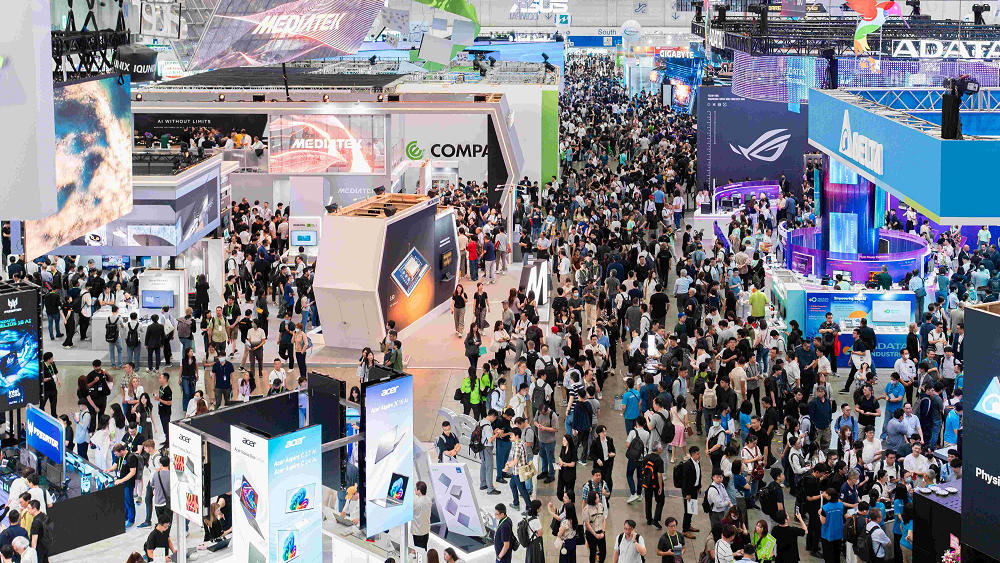
According to the organizer's information, COMPUTEX 2026 will be held in Taipei from June 2 to 5, with exhibition areas spanning the Nangang Convention Center Hall 1, Hall 2, Taipei World Trade Center Hall 1, and the Taipei International Convention Center, involving 1,500 exhibitors and 6,000 booths. Closing data shows that the four-day event attracted 111,312 buyers and visitors from 152 countries and regions. In comparison, the 2025 event was held at Nangang Hall 1 and Hall 2, with 1,400 exhibitors from 34 countries using 4,800 booths, closing statistics recorded 86,521 buyers.
The three main lines for 2025 were AI & Robotics, Next-Gen Tech, and Future Mobility, with new additions of the AI Services Technology Zone and Robotics & Drones Zone. For 2026, the organizer shifted focus to AI Computing, Robotics & Intelligent Mobility, and Next-Generation Technology, establishing an AI Robotics Zone at Taipei World Trade Center Hall 1, while also adding an E-paper Pavilion and TechXperience. This change in exhibition areas indicates that COMPUTEX is no longer just a PC and components exhibition; robotics, machine vision, data center power, cooling, connectivity, and edge AI are being positioned more prominently.
This shift is most concentrated in NVIDIA. In 2025, NVIDIA launched NVLink Fusion during COMPUTEX, attempting to bring more custom CPUs, ASICs, and accelerators into its NVLink ecosystem; that year it also released RTX PRO Servers and enterprise AI Factory designs, advancing the "GPU-ification of enterprise data centers." By 2026, NVIDIA announced at GTC Taipei that the Vera Rubin platform had entered full production, specifically naming Taiwanese server manufacturers and the global supply chain participating in the manufacturing process, including Foxconn, Quanta Cloud Technology, Wistron, Wiwynn, and others. It also launched the Spectrum-X Ethernet Photonics, incorporating CPO optical interconnects into the AI factory expansion narrative.
More controversially in the market is RTX Spark. NVIDIA and Microsoft packaged it as a Windows PC platform for personal AI agents, with partners including ASUS, Dell, HP, Lenovo, Microsoft Surface, MSI, and others. It allows NVIDIA to move closer from the data center to the PC ecosystem and introduces new competitive variables for Qualcomm, Intel, and AMD in the AI PC arena.
AMD's role in the two exhibitions was different. In 2025, it introduced the Radeon RX 9060 XT, Radeon AI PRO R9700, and Ryzen Threadripper 9000 at COMPUTEX, emphasizing local AI, workstations, and high-end desktop computing. In 2026, AMD highlighted platform lifespan and gaming products even more, announcing that AM5 support would be extended to 2029, with the launch of Ryzen 7 7700X3D and Radeon RX 9070 GRE. For investors, this leans more towards the PC and gaming ecosystem, with a lesser catalytic effect on data center AI compared to NVIDIA.
Intel's focus for 2026 was to reposition the CPU back at the center of AI infrastructure. The company released Xeon 6+, 800 Series Ethernet E835, and disclosed progress on the Crescent Island data center GPU, emphasizing the need for CPUs to handle orchestration, concurrency, and data movement for agentic AI workloads. Qualcomm this year themed the Computex narrative around "The Year of Agents," showcasing the Dragonwing robot reference design and Snapdragon X2 Elite mini-PC; MediaTek focused on edge-to-cloud, displaying Wi-Fi 8, 6G, satellite communication, data center ASICs, CPO, and MicroLED interconnect technologies.
The capital market's reaction to the 2025 COMPUTEX reminds investors that the excitement of the fair and stock price performance do not always align. According to a rough calculation based on Yahoo Finance's historical adjusted closing prices, from May 16 to May 23, NVDA fell approximately 3.0%, AMD dropped about 5.9%, INTC declined approximately 7.4%, QCOM decreased about 4.7%, and TSMC ADR fell about 1.2%. The Taiwanese AI server supply chain did not see broad increases either; Hon Hai, Quanta, MediaTek, and Wiwynn all had short-term pullbacks, while Wistron saw a slight rise.
However, if you extend the observation window to June 10, 2025, the market began to reselect segments with clearer fundamentals. NVDA rose approximately 6.3% compared to May 16, TSMC ADR increased about 9.4%, Wistron rose about 6.7%, and both Quanta and Wiwynn also switched to an upward trend. This process indicates that the short-term sentiment generated by press releases can quickly cool, and what truly supports valuations are orders, capacity utilization, customer lists, and profit margins.
Looking to 2026, there are many directions the market can pay attention to, but they need to be viewed hierarchically. AI server ODMs, advanced packaging, HBM, liquid cooling, power supplies, connectors, PCBs, high-speed switching, and optical interconnects remain the closest links to AI capital expenditures. TSMC's positioning comes from advanced processes and advanced packaging like CoWoS; Hon Hai, Quanta, Wistron, and Wiwynn undertake system manufacturing and cabinet-level integration; MediaTek seeks new growth curves in edge AI, ASICs, and high-speed interconnects.
AI PCs and robots require further validation. Platforms like RTX Spark, Snapdragon X2, Intel Core Ultra, and AMD Ryzen AI will drive hardware updates, but whether AI PCs bring about a genuine replacement cycle depends on enterprise procurement, software adaptation, and local inference usage rates. The imagination space for robots and Physical AI is broader and more easily themed for trading; what truly needs tracking are the mass deployments in industrial, logistics, medical, and retail scenarios, not the demo effects on exhibition stands.
The value of COMPUTEX 2026 lies not in proving once again that AI is a major theme in the tech industry, but in breaking down the main theme into more specific realization issues: who has advanced packaging capacity, who secures cabinet orders, who can address power and cooling issues, whose software ecosystem enables AI PCs to be used by customers, and whose robotic solutions can leave the exhibition area and enter factories and warehouses.
After the fair concludes, the market will not lack stories. What is truly scarce remains verifiable numbers. In the coming quarters, investors should focus not on the "AI Together" banners, but on cloud vendors' capital expenditures, TSMC's advanced packaging capacity expansions, HBM supply and demand, ODM monthly revenue, profit margin changes, customer concentration, and whether export controls and geopolitical risks disturb orders. COMPUTEX provides direction, but earnings reports provide the answers.
免责声明:本文章仅代表作者个人观点,不代表本平台的立场和观点。本文章仅供信息分享,不构成对任何人的任何投资建议。用户与作者之间的任何争议,与本平台无关。如网页中刊载的文章或图片涉及侵权,请提供相关的权利证明和身份证明发送邮件到support@aicoin.com,本平台相关工作人员将会进行核查。


