Key Takeaways:
- Senators urged regulators to revisit digital asset capital standards affecting banks.
- The disputed 1,250% risk weight can require capital equal to exposure.
- Potential rule changes could reshape institutional participation in bitcoin markets.
U.S. senators disclosed on June 4 a renewed push to overhaul bank capital rules governing digital asset exposure. At the center of the debate is a Basel framework that assigns certain cryptoasset exposures a 1,250% risk weight, a treatment critics say makes bank participation in bitcoin markets economically impractical.
For investors, banks, and crypto firms, the issue could influence how deeply traditional finance enters bitcoin markets.
A May 27 letter from Senators Cynthia Lummis (R-WY), Dan Sullivan (R-AK), Bill Hagerty (R-TN), Bernie Moreno (R-OH), Ted Budd (R-NC), and Jon Husted (R-OH) urged the Board of Governors of the Federal Reserve System, the Federal Deposit Insurance Corporation (FDIC), and the Office of the Comptroller of the Currency (OCC) to revisit digital asset capital standards. The lawmakers praised regulators’ recent treatment of tokenized securities, which bases capital requirements on the underlying asset.
The senators explained:
“A 1,250% risk weight, multiplied by the 8% minimum capital ratio, produces a capital requirement equal to 100% of the exposure—requiring banks to hold capital more than dollar for dollar equal to the amount of the digital assets.”
The Basel framework sorts bank crypto exposures into risk groups. Tokenized traditional assets and qualifying stablecoins can receive lower capital treatment. Unbacked assets, including bitcoin, can fall into a higher-risk bucket. That category receives the 1,250% risk weight when exposures fail the framework’s safeguards. The result ties bank capital costs to asset classification, market risk, liquidity, hedging, and operational controls.
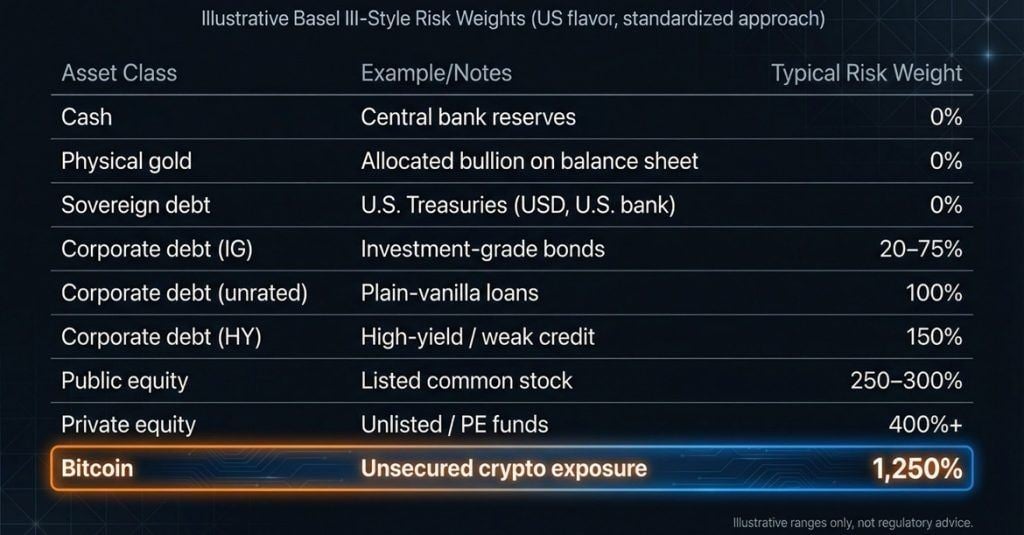
Under the Basel framework, bitcoin is generally subject to a 1,250% risk weight. Source: Strive Chief Risk Officer Jeff Walton.
The lawmakers said the Basel approach conflicts with the technology-neutral treatment regulators recently applied to tokenized securities. They argued that regulators should evaluate each asset’s underlying risk. That distinction could become increasingly important as banks explore BTC custody, balance-sheet exposure, settlement services, and other digital asset activities.
Recent actions by the Fed, FDIC, and OCC suggest regulators are already reassessing aspects of their digital asset approach. In March, the agencies clarified that eligible tokenized securities generally receive the same capital treatment as traditional securities. Regulators have also withdrawn or revised several supervisory expectations that previously required banks to obtain advance approval before certain permissible crypto-related activities.
The senators wrote:
“We encourage you to begin work on a new capital framework for digital asset activities.”
Critics outside the banking industry have raised similar concerns. The Bitcoin Policy Institute made a similar case in a recent paper titled Basel’s 1250% Mistake. The organization argued that Basel’s 1,250% risk weight applies a penalty designed for opaque securitization tranches to bitcoin, despite BTC trading in transparent global markets. It said bitcoin’s market, custody, and operational risks can be measured through existing Basel frameworks. The paper also argued that U.S. regulators should help shape Basel’s targeted review, rather than import a flawed standard as demand for regulated bitcoin services grows.
免责声明:本文章仅代表作者个人观点,不代表本平台的立场和观点。本文章仅供信息分享,不构成对任何人的任何投资建议。用户与作者之间的任何争议,与本平台无关。如网页中刊载的文章或图片涉及侵权,请提供相关的权利证明和身份证明发送邮件到support@aicoin.com,本平台相关工作人员将会进行核查。


