No matter how foolish, one can feel that the cryptocurrency industry is at a turning point.
In the past decade, the most core ability in the crypto space was asset issuance. Launch a chain, release a coin, issue a governance token, create an economic model, and using narratives, airdrops, liquidity incentives, and community consensus, push it in front of the market, passing the buck.
We once boldly assumed that blockchain would create a brand new asset system: new currencies, new financial protocols, new gaming assets, new social networks, and even new forms of organization.
However, now, these native assets are heading towards chronic decline, making every attempt to bottom out feel futile.
Draining liquidity and attention are the old assets: U.S. stocks, U.S. bonds, gold, crude oil, indices…
Say Bye Bye to all native assets, and Hi Hi to traditional assets
The protagonists on the chain have changed, native assets are overlooked, and mirrored assets are thriving.
In every bear market, someone says “ETH is done,” “altcoins are not bought,” “DeFi is not played,” but why is ETH at $2000 more despairing than it was at $200?
Because behind the complaints is no longer the fluctuation of price cycles or the replacement of narrative tracks, but rather a migration of industry functions, with the crypto industry shifting from being a “new asset factory” to a “global asset conduit.”
Stablecoins are the earliest and most successful examples. The large-scale adoption of USDT and USDC is evidently not about cryptocurrencies defeating the dollar, but rather the crypto space finding a more efficient circulation method for the dollar on-chain.
In the past decade, countless projects have shouted the slogan of “creating a new monetary system,” but in the end, only stablecoins are widely used by global users. Because aside from us gamblers, ordinary users do not cling to developing a new world currency; they only care if the dollar runs a bit faster, cheaper, or with less time and regional restrictions.
Reflecting on it, this has long foretold the fate of crypto-native assets.
The ability of blockchain to be validated on a large scale is not about value storage, governance, or any complex financial innovations, but is rooted in the original peer-to-peer transactions and global settlements, long live Satoshi Nakamoto.
Except for Bitcoin, the value storage functions of other coins have been disproven; these assets are highly volatile, have thin cash flows, ambiguous governance rights, and demand comes solely from speculation.
Going round and round, the market returns to the basic functions of the blockchain mother body: transfer, settlement, cross-border flow, collateral, and trading.
Altcoins? Even dogs don't play them
The embarrassment of native assets in the crypto space, that is, altcoins, also becomes clear in this logic.
When hot money pours in, we compare assets within the crypto space, picking one we like to gamble on. Public chains compare TPS, DeFi compares TVL, Meme coins compare community heat. Everyone is soaking in the same narrative pool, with little in terms of realistic anchor points, each story has imaginative space, and as long as packaged grandly enough, a new token can preemptively overdraw ten years of valuation.
But now, the internal narratives are exhausted, and external wealth effects are rampant; it’s no longer useful to bury one’s head in the sand.
On one side, real assets like U.S. stocks, gold, and crude oil are being placed into the same on-chain trading interface; on the other side, AI has burst into everyone's life in a nearly sci-fi way.
Previously, the crypto space excelled at talking about the future, gaining valuation premiums through “futuristic feelings,” discussing new networks, new finance, new organizations, and new production relationships. But years later, narratives remain in white papers, roadmaps, funding news, and token prices. Meanwhile, AI, beyond its strong narrative, has become a tool that everyone can open anytime on their computers and phones.
In the past, an altcoin only needed to tell a more compelling story than another altcoin, but now has to face two types of external competitors: one type consists of traditional assets with real cash flows, backed by assets, and a global pricing system; the other is a new technology cycle with AI, which has both future narratives and real products.
The worthless coins without revenue, demand, or value capture, standing beside Nvidia, Micron, crude oil, and AI applications, really look bad.
Ethereum, it's done
The recently discussed "Ethereum issue" should also be viewed within this framework.
Ethereum faces not only short-term pressures from its roadmap and liquidity but also the fact that the “native asset worldview” it once represented has been completely squeezed out.
On one hand, traditional mapped assets enter the chain; on the other hand, AI monopolizes global tech narratives.
Ethereum is still an important infrastructure for on-chain finance and asset issuance, but having lost the “native crypto universe” of innovation and the faith that comes with the worldview, ETH's ability to capture ecological value is severely diminished; users can pay on Base, trade on Arbitrum, transfer assets between Rollups, and also trade U.S. stocks on-chain, but surely do not need to hold ETH for this.
DeFi is the same. Its initial grand narrative was to rebuild the financial system, but the real demand that has settled down is quite limited.
Users don’t need a whole set of on-chain banks; they need cheaper dollar transfers, quicker settlements, deeper liquidity, and tradable price volatility. Lending, DEXs, yield aggregators certainly still exist, but they increasingly resemble part of the infrastructure, struggling to single-handedly sustain the industry’s imagination; the narrative of financial Lego has become a legacy of the previous cycle.
The protagonist has become the assets themselves
The crypto space has to admit that on-chain finance does not need to reinvent Nvidia, nor does it need to reinvent the dollar, and of course, we do not have that capability.
We just need to strive to allow these assets to be transferred, traded, used as collateral, shorted, leveraged, and combined into new financial structures more freely.
So when we say the crypto space is dead, we are referring to the era that relied on the continuous expansion of native assets has retreated.
No one dares to speak of crypto industry disrupting old finance anymore; practitioners are now busy installing new transmission layers onto traditional finance. U.S. stocks remain U.S. stocks, but through new infrastructure, they can have 24-hour trading, global liquidity, on-chain settlements, permissionless access, and composability; the industry is making every effort to produce a new API for the old world.
Actually, be it U.S. stocks going on-chain, RWA, or on-chain perpetual contracts, these are not new things.
This industry did not just start thinking about moving traditional assets onto the chain today, nor did it just think of trading everything with perpetual contracts today.
Years ago, the market had batches of Perp DEXs, synthetic assets, on-chain stocks, and attempted projects to move traditional assets to the chain. Looking back at some early protocol designs, we find they fundamentally do not differ from the underlying mechanisms of many popular projects today.
This is also why some old players look down on Hyperliquid and miss out on opportunities; Kyle Samani's ongoing pessimism towards Hyperliquid is a typical example.
He has seen this stuff; he has seen it too early and too often, and is now tired of it. Five or eight years ago, or even earlier, many people in the industry attempted to create on-chain contract exchanges, decentralized derivatives, and tried to trade all types of assets, but all ended up failing.
Recently, I came across a 2020 article we published on Odaily about PerpDEX projects, to be honest, there is no difference from today's mechanisms.
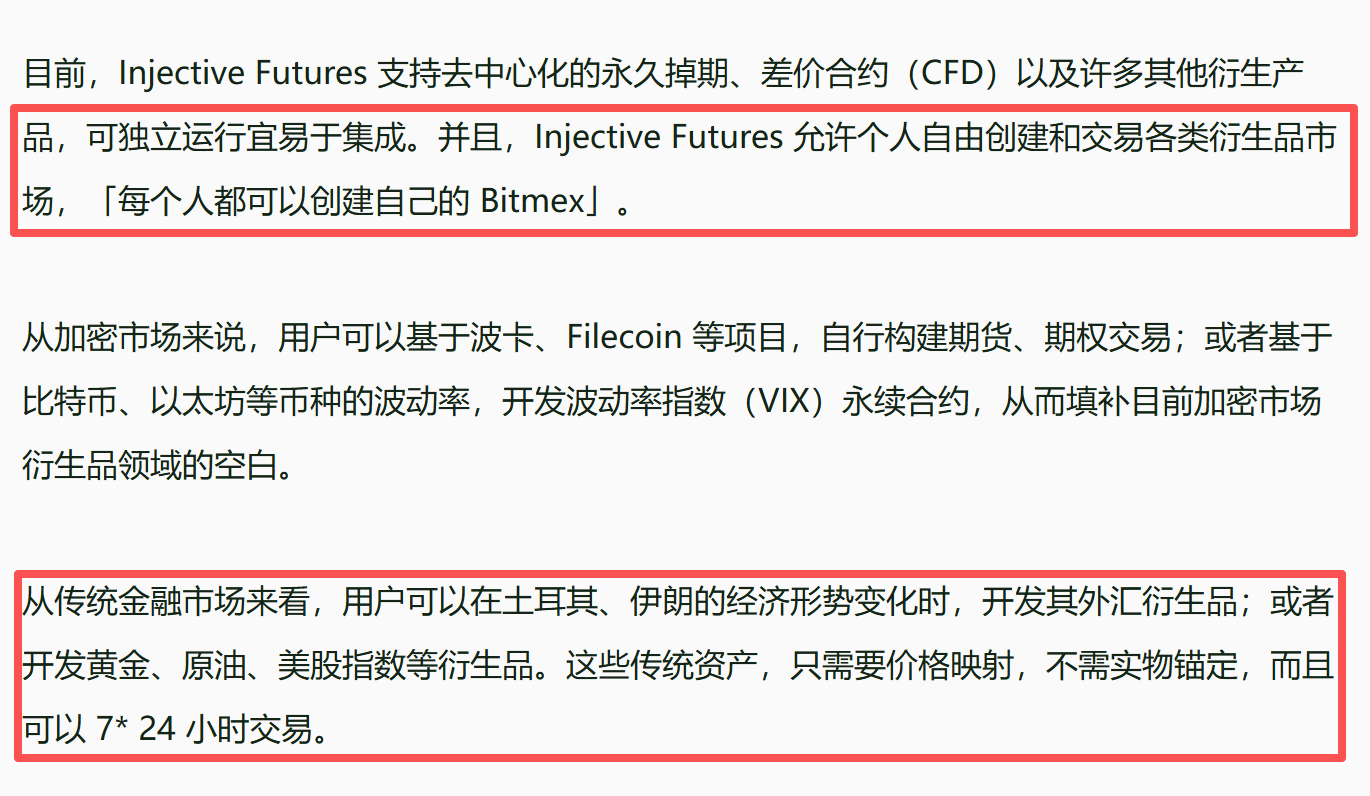 Screenshot of an article from 6 years ago
The problem is not in the direction, but always in the timing.
The light of the industry: Hyperliquid
Hyperliquid also experienced rough early days, mediocre liquidity, and faced regulatory risks that were heavily criticized, but it managed to ride the wave of change and became the biggest beneficiary, leaving later entrants in its dust.
The first wave was the CEX-ification of on-chain Perp; Hyperliquid's earliest highlight was not creating another Perp DEX but making on-chain contract trading less like DeFi and more resembling a centralized exchange. Order books, low latency, API, rebates, ecological front-end, HYPE airdrops, no VCs, community wealth effects—these elements combined propelled it from a chain protocol to a trading hub. This phase wasn’t necessarily glamorous, but it was crucial; the toughest part for a trading platform is acquiring the first bit of liquidity; when someone comes to trade, there will be market-making, and it will have the qualification to take on larger asset scales.
The second wave was the transfer of trust after 10.11. The hidden risks of centralized exchanges were exposed again; since then, many large whales prefer to publicly compete on-chain with everyone, rather than risk being silently killed in a dark forest system where they can’t see the true identities of their opponents. “Decentralization” is not just a slogan; it’s also a real demand from traders in extreme market conditions for clarity of demise.
The third wave is the volatility of macro assets like gold and crude oil. Wars and geopolitical conflicts have pulled the global market back into macro narratives, and users began to need a platform where they can trade global assets 24 hours a day. Traditional markets have opening and closing times, regional restrictions, and account limitations, while on-chain perpetual markets carry none of these burdens.
The fourth wave is the explosion of U.S. stock trading, which needs no further elaboration. When popular assets are placed in a 24-hour, global, low-threshold perpetual market, the assets themselves generate traffic, which in turn attracts B-end market makers and ecological front-ends; market-making and front-ends, in turn, enhance liquidity, leading to a snowball effect.
Therefore, just because one understands early on doesn't mean they can achieve big results; in fact, we all know that previously, on-chain users were insufficient, wallet experiences were not mature enough, market-making infrastructure was not perfect, and asset volatility didn’t have significantly external opportunities—building a big ship when there’s no wind means getting stuck in place.
The evil yet alluring perpetual contracts!
Finally, let’s talk about the greatest invention in the crypto space—perpetual contracts.
If you were to trade real U.S. stocks, you would have to deal with a whole set of complex issues like compliance, custody, underlying asset mapping, trading hours, settlement, equity rights, dividends, and corporate actions. Every step has to relate to the old financial system, and every step could become a bottleneck.
But if you do U.S. stock Perps, the platform only needs to build a contract pool around the price; liquidity can be provided by ecological partners, and users are trading price exposures without holding the underlying equity directly.
It sidesteps the heaviest parts and seizes the most demanding aspects of trading.
This is also where it becomes sinister; Perps simplify assets into a price symbol to bet on, compressing complex ownership relationships into directional positions and leverage multipliers. It doesn’t care if you own the stocks or if you understand the company's value; all it cares about is whether the price fluctuates, whether someone wants to go long, and whether someone wants to go short.
This is also what makes it most vibrant and enticing.
People may not really want to own Nvidia, but they want to trade Nvidia’s volatility; they may not necessarily want to hold gold, but they want to bet on the direction of gold; they may not need crude oil, but maybe they need the risk exposure brought by crude oil prices.
Perps distill this demand to the extreme. They do not create new assets, but create new gambling houses; they do not provide ownership, but provide risk exposure; their goal is not to reconstruct the financial world, but to turn all assets into a “price” that can be traded 24/7.
So if we look back at the entire crypto history in the future, the only product that truly remains might be Perps.
From a financial perspective, it seems almost absurd. Futures have delivery dates because past assets need to return to the real world eventually; perpetual contracts eliminate delivery, turning a product with a limited timeframe into one that exists eternally. This is likely the ultimate revelation after the crypto space has issued junk assets.
Traditional exchanges have opening and closing times because the market needs rest; perpetual contracts eliminate rest periods, keeping the market always online. Traditional finance relies on brokers, clearing institutions, and regional regulatory systems, while perpetual markets naturally transcend borders.
Perpetual contracts may be the most successful yet dangerous financial innovation in the entire crypto history; it truly resembles a financial monster unleashed by a demon. (Arthur Hayes: Is it my fault?)
Countless people have been liquidated because of it; countless wealth has evaporated due to it, amplifying humanity's most greedy side. But at the same time, it has also created unprecedented liquidity and price discovery efficiency.
Conclusion
Looking back over the years, the most successful currency in the crypto space is the dollar, the most successful asset is Bitcoin, and the most successful application is trading; today, the most “anticipated new growth” comes from U.S. stocks.
This is the failure of idealists, and more likely, the market has ultimately completed its filtering.
Once the story of the vast sea has become trite, humanity's pursuit of wealth, preference for risk, and infatuation with leverage have never changed. Thus, today’s crypto industry is no longer obsessed with inventing new assets but is attempting to transform existing assets into trading pairs that are perpetually online, globally accessible, and permissionless.
The crypto space is dead, but Perps remain eternal.
免责声明:本文章仅代表作者个人观点,不代表本平台的立场和观点。本文章仅供信息分享,不构成对任何人的任何投资建议。用户与作者之间的任何争议,与本平台无关。如网页中刊载的文章或图片涉及侵权,请提供相关的权利证明和身份证明发送邮件到support@aicoin.com,本平台相关工作人员将会进行核查。


