The future development of the cryptocurrency industry will decouple from Bitcoin prices.
Written by: Charlie
Translated by: Luffy, Foresight News
For a long time, the trends in the entire cryptocurrency market have revolved around Bitcoin. Now, this era is coming to an end.
The crypto economy is now divided into two major camps: endogenous assets and exogenous assets.
The so-called endogenous assets are the traditional cryptocurrency categories that the public is familiar with: the value of these tokens and projects entirely depends on the overall market fluctuation of crypto assets. Exogenous assets, on the other hand, nominally belong to the crypto space, but their value trends are becoming increasingly independent from the crypto market.
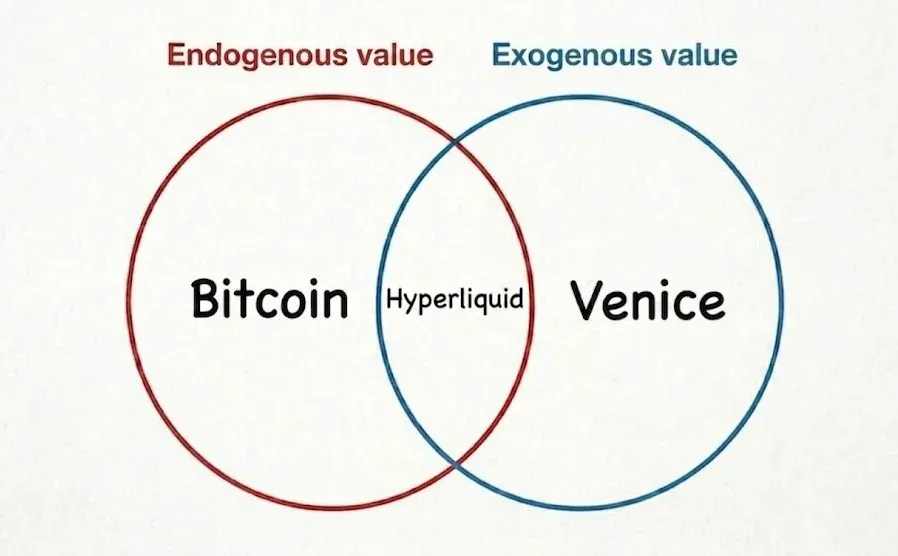
The value of Bitcoin comes from its inherent properties, which in turn is reflected in its price. When prices rise, it further strengthens the market's recognition of its value attributes. At the peak of a bull market, Bitcoin is revered as a "universal currency in the galaxy," the most scarce digital circulating asset in human hands; at the bottom of a bear market, it is belittled as a digital collectible with no cash flow support.
Hyperliquid exists between the two camps. The majority of its business still relies on the cryptocurrency market trends, but both the supply and demand sides are constantly expanding. Many on-chain financial infrastructures fall into this category, and the underlying assets are gradually shifting towards the tokenization of real-world assets.
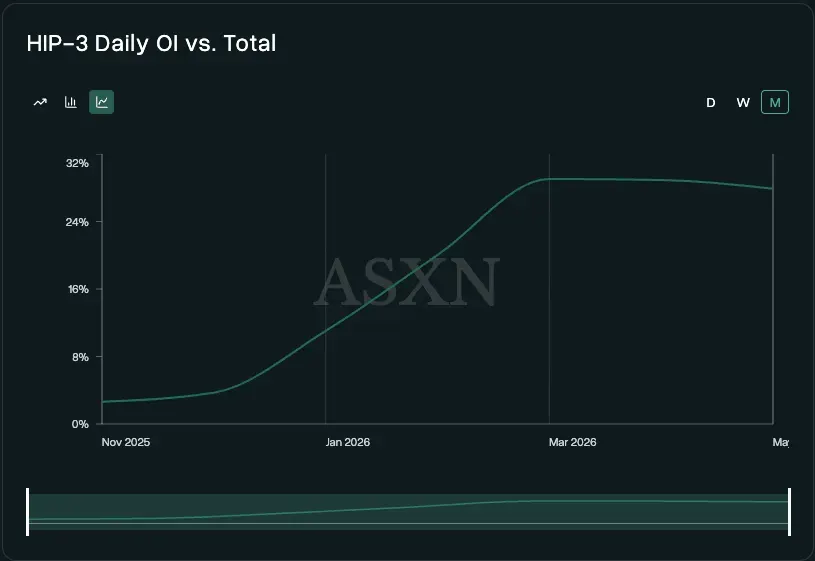
The open interest of the HIP-3 contracts roughly reflects the activity in non-crypto transactions. Currently, HIP-3 contracts account for about 30% of Hyperliquid's total open interest, while in November 2025, this proportion was only 4%. The upcoming HIP-4 prediction market is expected to further drive growth while also bringing in new trading users and trading subjects.
Projects like Venice, however, completely belong to the exogenous camp, and their development logic has completely detached from the crypto market. Although there is some overlap in user groups, its business model skews more towards consumer-level artificial intelligence, rather than native crypto products like Uniswap. The core business of Uniswap remains user trading of various endogenous assets, with performance naturally fluctuating alongside asset prices; Venice packages private multimodal inference services, adopting a "pay-as-you-go + subscription" fee model.
The only connection Venice has to the cryptocurrency space is using tokens as a value-bearing medium, and some of its computing power providers have backgrounds in the crypto industry. Project leader Erik Voorhees has deep roots in the crypto industry; he believes that if used properly, tokens can become excellent marketing tools.
Figure, among publicly listed companies, is also a typical example. This fintech lending company has developed its own blockchain, shortening the approval time for home equity loans to under 5 minutes. For it, blockchain is merely a supportive technology, with core value residing in the lending business itself.
Whether it's in the token market or the publicly traded company sector, the rise of exogenous tracks on a large scale has far-reaching significance. In the past, because the vast majority of business models were deeply tied to the prices of crypto assets, purely bottom-up fundamental investments were difficult to establish. The crypto industry has not been without the narrative trend of "heavy blockchain, light Bitcoin," but past cycles have ultimately returned to Bitcoin prices. The reason is that these tracks have never managed to form stable demand or generate continuous revenue; even if there is income, it cannot be transmitted to token value. Once token prices stop rising, projects lose support.
This round of market behavior is completely different from previous ones. Now we can clearly see the paying user base and payment logic, and the market demand in most tracks can be quantified; it is no longer merely reliant on emotional speculation; at the same time, the mechanism of tokens as value carriers is also continuously improving. Venice's revenue comes from users purchasing AI inference services for actual payment, and even as the overall cryptocurrency market declines, its business won't suffer significant impact because it does not rely on price fluctuations. This cycle possesses two core advantages not present in previous hype cycles: sustainable real-use demand and investors beginning to invest based on fundamentals, rather than purely market narratives.
The stablecoin track in the private equity market is also reflective of this. In March 2026, Mastercard announced it would invest up to $1.8 billion to acquire BVNK, a company that was valued at only $750 million 15 months earlier when it completed its Series B financing. Another stablecoin-related company, Bridge, was acquired by Stripe for $1.1 billion in February 2025, and according to Stripe's annual report, Bridge's current annual business growth rate has reached four times. The development of these companies has completely decoupled from the bull and bear cycles of the cryptocurrency industry.
This does not mean a bearish outlook on endogenous assets. Just like gold and small gold mining companies, they always have their allocation value in investment portfolios. Bitcoin and a number of endogenous crypto assets also have their reasons for existence. However, the performance-driving logic and market correlation of these two types of assets have fundamentally diverged, and data also supports this point.
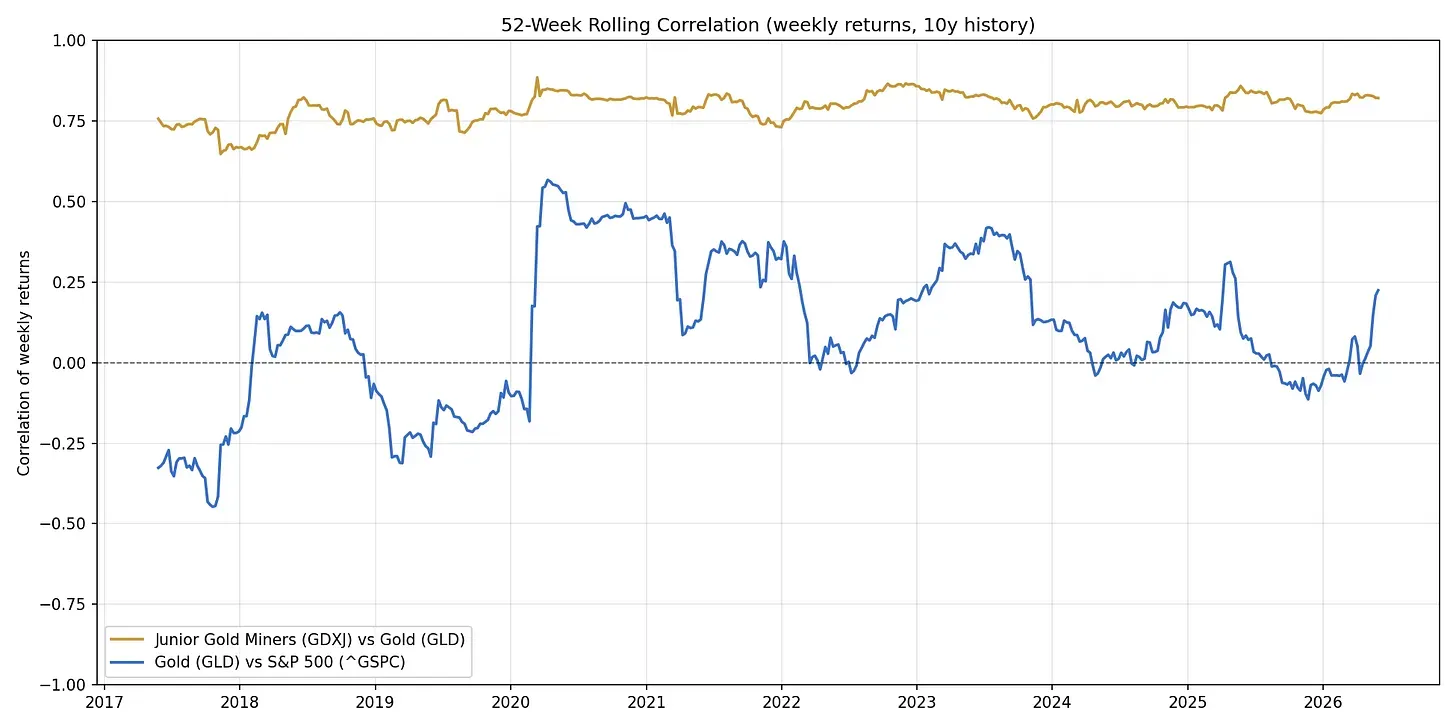
This analogy can be visualized: small gold mining stocks maintain a correlation coefficient with gold prices of around 0.75 year-round. This reflects the current state of the traditional cryptocurrency market — various crypto assets resemble small gold mines, while Bitcoin corresponds to gold, with the entire track representing leveraged investments against Bitcoin. The blue curve in the chart represents another relationship: gold and the S&P 500 index are influenced by macroeconomic factors and have weak correlations, but each possesses independent operating logic. This also reflects the future development direction of exogenous assets. In the long run, such assets will gradually break away from "following Bitcoin price fluctuations."
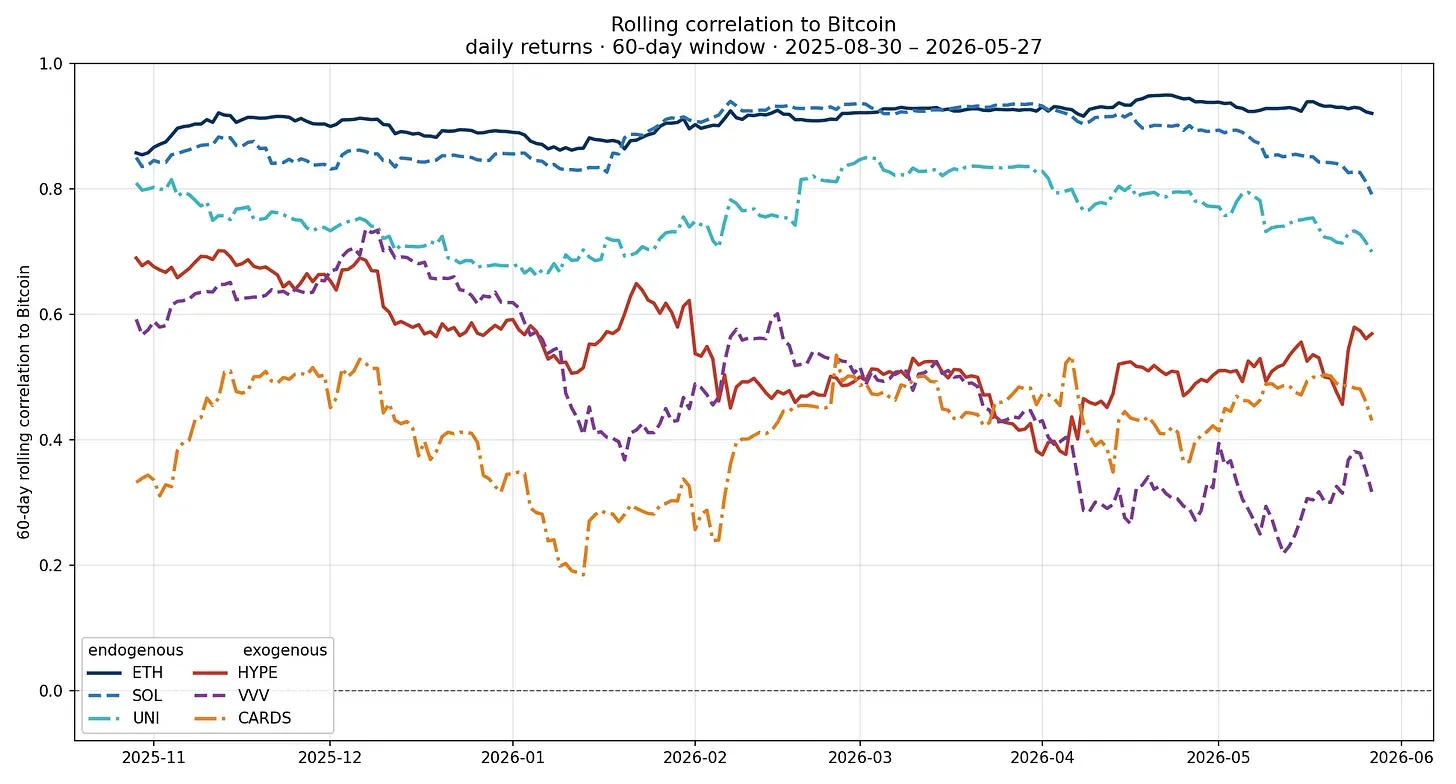
It should be noted that many exogenous projects also issue tokens, and this phenomenon both confirms the aforementioned trend and constitutes a special case.
Currently, the vast majority of endogenous assets are still highly synchronized with Bitcoin’s movements; few exogenous assets have seen reduced connectivity, but due to their short development cycle, they currently lack strong reference significance. The industry's laws suggest that fundamentals lead the way, with market correlational relations changing subsequently.
This transformation has completely rewritten the analysis logic of the industry. Researching exogenous assets requires conducting fundamental due diligence as if analyzing traditional companies: sorting the paying user groups, assessing the unit economic model, and evaluating industry moats. Bitcoin prices are no longer the primary reference indicator; analyzing such projects resembles a financial technology investor making judgments, merely with the additional special function of asset custody.
Below are the currently promising exogenous tracks:
- On-chain exchanges and brokerage service providers
- Clearing and redemption solutions for long-tail asset tokenization
- Integration of crypto and artificial intelligence (private inference, distributed open-source model training similar to Psyche of Nous Research, etc.)
- New types of digital banks (privacy-focused Payy and Raycash are worth noting; Aztec and Zama, which provide programmable privacy infrastructure, also have potential)
- Lending tracks (Morpho has become the mainstream choice for institutional repurchase markets; mid- to small-sized projects like Valinor and 3jane are delving into the private credit segment)
- Stablecoin issuers and real asset tokenization service providers
- Payment channels (in the universal payment field, Stripe and Tempo are industry benchmarks; in the smart agent payment field, Coinbase is currently leading)
- Non-financial crypto consumer products (represented by Venice and Collector Crypt, these projects assign real business value to tokens, promoting both product adoption and marketing empowerment)
- Agent economy (the core opportunity lies in the collaborative ecosystem of smart agents, service providers, and creators at the access layer, which has low substitutability. Cloudflare is a frontrunner in laying out this space, but it remains to be seen whether it will charge for traffic fees or only provide basic functionality)
At this stage, to establish a presence in the above tracks, investing in related companies' equity is still the most prudent approach, with quality token targets being exceptions. Only when the value-bearing mechanism of tokens continues to optimize will their role further enhance, which requires the cooperation of regulatory bodies and the entire industry. Relevant progress has already been made: on the regulatory front, the CLARITY Act is steadily advancing; on the industry front, institutions like Blockworks are also pushing for market transparency. The token mechanism still has a long way to go in terms of optimization.
However, these details do not change a core trend: the driving force behind the crypto market is shifting from a single factor to multiple factors. The focus of industry research is also transforming from interpreting Bitcoin price charts to delving into the fundamentals of businesses. In the next decade, there will be no reason to be puzzled as to why the "crypto market" no longer rises and falls in unison, as the industry landscape has undergone a complete transformation.
免责声明:本文章仅代表作者个人观点,不代表本平台的立场和观点。本文章仅供信息分享,不构成对任何人的任何投资建议。用户与作者之间的任何争议,与本平台无关。如网页中刊载的文章或图片涉及侵权,请提供相关的权利证明和身份证明发送邮件到support@aicoin.com,本平台相关工作人员将会进行核查。


