Original author: Long Yue, Wall Street Insight
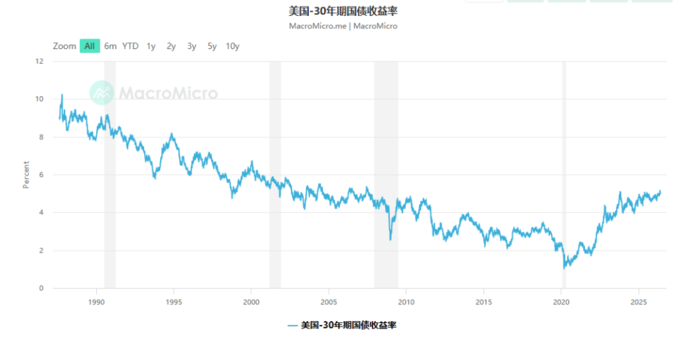
The 30-year U.S. Treasury yield has once again surpassed 5%, and this time the market's reaction is markedly different from 2023—investors are beginning to truly accept the reality that high interest rates will persist for a long time.
Analysis indicates that a deeper structural shift is underway: the three pillars that have supported the U.S. low inflation and low interest rates for the past 50 years—cheap capital, cheap labor, and cheap energy—are simultaneously breaking down. The direction of AI will be the biggest unknown in determining future inflation trends.
Recently, the 30-year U.S. Treasury yield has once again surpassed 5%. Rana Foroohar, a columnist for the Financial Times, noted that unlike the brief spike above 5% in 2023 followed by a rapid decline, this time the market's response is clearly different—investors seem to finally begin to accept a reality: the U.S. is bidding farewell to the era of low interest rates, entering a new phase characterized by more sustained and diverse inflation pressures.
The article cites a recent report from Torsten Sløk, chief economist at Apollo, sent to clients stating, "Investors should prepare their positions for a prolonged high interest rate environment in the short, medium, and long term."
Behind this is a larger structural story: the three cheap factors that have driven U.S. economic growth over the past 50 years—cheap capital, cheap labor, and cheap energy—are simultaneously reversing.
How did half a century of "cheap dividends" come about?
The yield on 30-year U.S. Treasury bonds fell from over a dozen percentage points in the early 1980s to around 1% during the pandemic, a nearly half-century-long downward trend that is not coincidental.
It is supported by a complete macroeconomic logic:
Cheap capital: Decades of globalization and technological advances in manufacturing have depressed commodity prices; oil-exporting countries have repatriated vast amounts of oil dollars back to the U.S., providing ample cheap funds; pension privatization reforms have spawned huge demand for various financial products; global investors scramble to buy U.S. Treasuries because no other country is safer than the U.S.
Cheap labor: Industrial outsourcing, dwindling unions, waves of automation, and a "shareholder-first" corporate culture (heavy on financial engineering, light on employee investment) have collectively suppressed wages, especially for non-college-educated workers, sustaining corporate profit margins.
Cheap energy: The petrodollar system has suppressed inflation to some extent; global energy trade is settled in dollars, which has further strengthened the dollar's global position.
These three pillars have collectively supported half a century of low inflation and low interest rate prosperity in the U.S.
The three pillars are simultaneously weakening
Rana Foroohar pointed out in the article that each of the supporting factors mentioned above is now undergoing change.
On the capital side: Every U.S. Treasury auction sees a decrease in international buyers rather than an increase. De-globalization and supply chain re-shoring will raise prices for goods and services in the short term. At the same time, the foundations of the petrodollar system are being eroded.
On the energy side: The ongoing tensions in the Middle East directly impact Asian energy-importing countries. However, in the longer term, this may instead accelerate major Asian countries' investments in clean energy—while the U.S. is withdrawing from climate commitments. This means that long-term capital flows may shift from the U.S. to major Asian countries.
On the labor side: In recent years, labor shortages, large-scale strikes (including successful workers' rights movements in the auto industry), tightened immigration restrictions, and the growth of union members in some sectors (especially white-collar industries) have all driven up wages. However, this trend has been partially offset by two factors: first, rising employer healthcare costs make companies inclined to suppress wages; second, the impact of artificial intelligence.
Another slow variable: debt, geopolitics, and populism
In addition to the explicit factors mentioned above, there are several "slow variables": rising government debt, escalating geopolitical tensions, and the spread of populism.
The combined effect of these risks is that lenders demand higher risk premiums before they are willing to lend money—especially for long-term loans.
This directly raises long-end interest rates, namely the 30-year U.S. Treasury yield.
AI: Savior or new source of inflation?
Among all variables, the trajectory of artificial intelligence is the hardest to judge, but its impact may be the most profound.
Rana Foroohar proposed two starkly different scenarios:
Optimistic scenario: AI's productivity benefits widely diffuse across various industries and individuals, creating new jobs and income sources. A model from Yale's Budget Laboratory indicates that in this scenario, the U.S. national debt would decrease significantly, and inflation would subsequently fall.
Pessimistic scenario: AI merely becomes a tool for companies to lay off workers, cut costs, and increase profits, while the construction of AI infrastructure itself (which heavily consumes chips, land, water, and electricity) creates new inflationary pressures, resulting in a net effect of raising rather than lowering costs. The government would also be compelled to intervene to aid displaced workers, leading to an increase in debt instead.
Currently, AI giants are gobbling up real estate, chips, water resources, and electricity, already driving up prices for these resources in the overall economy. The ultimate outcome will take years to clarify.
The real challenge facing investors
The conclusion of the article is direct and sobering: Most market participants have spent their entire careers in the "cheap era." Their intuitions, models, and expectations have all been calibrated in a low interest rate environment.
Now, this environment is changing.
"Expectation inertia" is a powerful force—after the 30-year U.S. Treasury yield broke 5% in 2023, many assumed it was just a temporary anomaly that would quickly recede. But this time, the market's reaction has changed.
Adjustment means letting go of old expectations. For investors accustomed to low interest rates, this is not an easy task.
免责声明:本文章仅代表作者个人观点,不代表本平台的立场和观点。本文章仅供信息分享,不构成对任何人的任何投资建议。用户与作者之间的任何争议,与本平台无关。如网页中刊载的文章或图片涉及侵权,请提供相关的权利证明和身份证明发送邮件到support@aicoin.com,本平台相关工作人员将会进行核查。


