In 2026, using stablecoins to purchase US stocks has become a mainstream trend. However, behind the phrase "buying US stocks with USDT," various products claim to provide users access to US stock market trends, but they actually sell completely different assets. Some products convert US stock economic exposure into on-chain tokens; others offer perpetual contracts that track US stock prices; and some provide actual trading services for real US stocks through licensed brokers. The risk-return characteristics, rights structure, and underlying logic of the three are completely different.
1. Overview of US Stock Trading Platforms
Currently, the mainstream solutions for "buying US stocks with USDT" can be clearly categorized into three types: Tokenized Stocks, Stock Futures, and Broker-Direct Connection Models.
1. Tokenized Stocks
Tokenized Stocks are usually held by the issuer or its SPV/custodial arrangements. Users hold the economic rights represented by on-chain tokens, rather than a direct shareholder identity in a traditional securities account. The most representative issuer, Ondo Finance, has surpassed a TVL of 1 billion USD, supporting over 200 mainstream stocks and ETFs; the overall market size has reached several billion USD.
2. Stock Futures
Stock Futures are the most efficient trading instruments but are the farthest from "holding US stocks"—the user buys a price contract with no legal connection to stock ownership.
In 2026, several mainstream trading platforms have launched stock-related perpetual/CFD products, with significant differences in the number of underlying assets, leverage multiples, and available regions (ranging from about 5× to 25×). On-chain platforms represented by Hyperliquid HIP-3/Trade.xyz are also expanding into the traditional asset perpetual contract market, with core value in allowing global traders to express long and short views on traditional asset prices using stablecoins.
3. Broker-Direct Connection Model
The Broker-Direct Connection Model operates similarly to traditional brokers: users execute trades for stocks or ETFs through Broker-Dealers, and assets are held through the US clearing and custody system, making it the only path among the three models that truly purchases the stocks themselves. However, it is worth noting that there are significant differences among different platforms under this model.
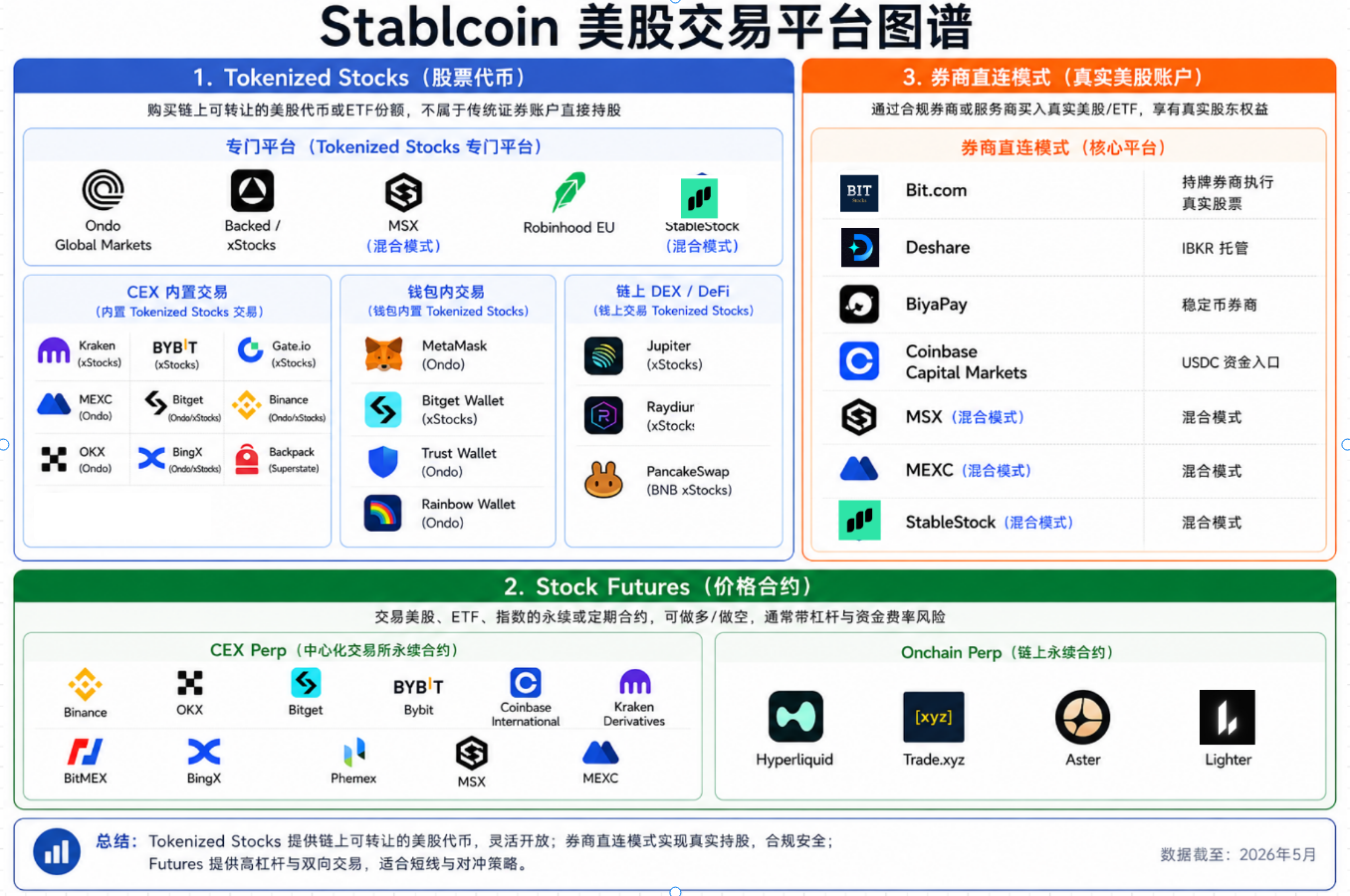
Source: Compiled from public information
2. Comparison of US Stock Trading Product Differences
The differences among the three models are reflected not only in the trading experience but also in the core dimensions of legal rights, holding cost structures, and regulatory protection.
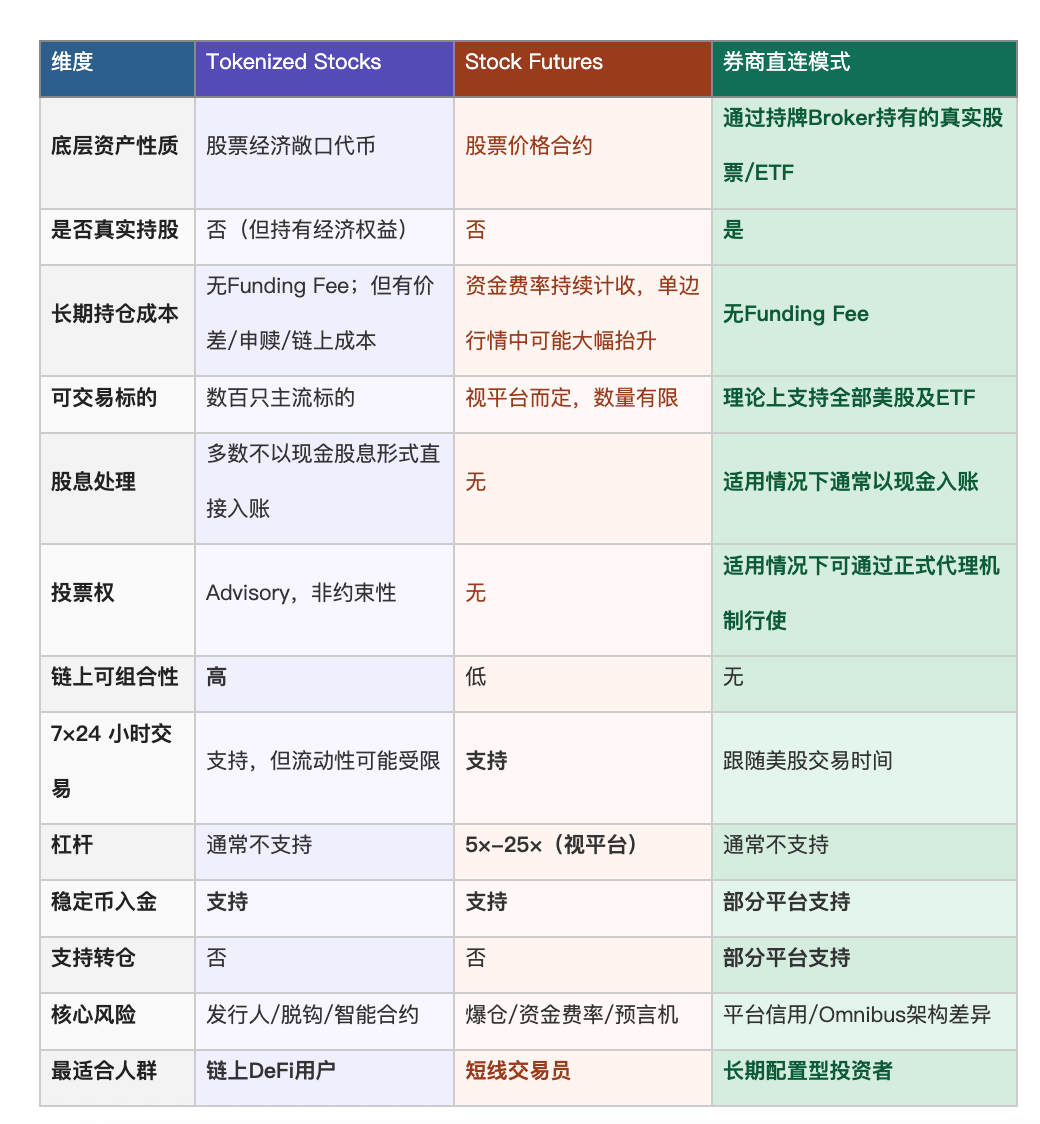
Source: Compiled from public information
(1) Tokenized Stocks
Tokenized Stocks are essentially the "on-chain shadow" of stocks—convenient, combinable, but the rights are incomplete, with shareholder status remaining at the issuer.
On-chain combinability is the true differentiated advantage of this model: tokens can act as collateral for DeFi lending protocols while earning additional returns, can circulate on-chain 24/7, and can be purchased fractionally—this is not possible with traditional securities accounts. The limitations are also apparent: shareholder status remains with the issuer, most platforms do not directly credit dividends in cash, and voting rights are advisory expressions without legal binding power. Although there is no funding fee, the redemption price difference, on-chain gas fees, and market-making price differences constitute holding costs.
(2) Stock Futures / Equity Perps
Stock Futures are the "price betting tool" for stocks—efficient, flexible, available 24/7, but the funding rates erode holding costs in the long term and have no relation to true stock ownership.
Stock Futures are the path that is closest to the habits of crypto traders—margin, take profit and stop loss, and two-way long and short positions, with operational logic and trading of BTC perpetuals being completely the same, just with a different underlying asset, trading continuously 24/7. The core cost is: funding rates can significantly increase in unidirectional market conditions, with annual costs reaching double digits or even exceeding 100%, leading to chronic bleeding for the "buy and hold" logic; and after closing contracts, there are no shareholder rights left, only the profit and loss in USDT.
(3) Broker-Direct Connection Model
The Broker-Direct Connection Model is the path closest to "buying stocks"—the rights are the most complete, and long-term holding costs are the cleanest, at the cost of sacrificing on-chain combinability and round-the-clock trading.
The Broker-Direct Connection Model offers the most complete rights path: real stocks, cash dividends credited directly, formal voting rights (where applicable), and coverage of thousands of underlying assets. The main limitation is that trading times follow US stock market hours, holdings are not on-chain, and connectivity to the DeFi ecosystem is not available. It is important to note that the differences in brokerage structures across different platforms directly impact the channels through which user rights are conveyed, and it is worthwhile to thoroughly understand the specific compliance structures before selecting a platform.
3. How to Define "Real Purchase of US Stocks"
The characteristics and target audiences of the three paths are somewhat differentiated, but for users who wish to conveniently use stablecoins for long-term US stock allocation, the advantages of the Broker-Direct Connection Model are very direct—it addresses each of the core shortcomings of the first two models, including:
Advantage 1: No Funding Fee, the Cleanest Long-Term Holding Cost Structure
Holding real US stocks does not involve the concept of funding rates; holding the same asset for a full year incurs no additional payment of funding rates, regardless of market sentiment.
Stock Futures may incur high double-digit annual holding costs in strong markets; Tokenized Stocks may lack a funding fee but incur redemption price differences and on-chain trading costs. In contrast, the holding cost structure of real US stock is the cleanest among the three.
Advantage 2: Depth of Coverage, Unmatched by the Other Two Models
The Broker-Direct Connection Model covers thousands of US-listed stocks and ETFs, far exceeding the approximately 200-260 stocks available in Tokenized Stocks and the limited underlying assets in Stock Futures. For users needing allocation to mid-cap companies, industry ETFs, or REITs, the Broker-Direct Connection Model is a more reliable way to enter with stablecoins.
Tokenized Stocks and Stock Futures mainly cover top popular assets, with virtually no options for mid-cap companies, industry ETFs, or REITs. In terms of the number of underlying assets, the Broker-Direct Connection Model currently has no comparable competitors.
Advantage 3: Real Shareholder Rights, a Difference in Nature, Not Degree
Holding real stocks typically credits dividends in cash; voting rights can be exercised through formal proxy voting mechanisms (specific rights can be affected by account structure and regional limitations).
Stock Futures have no shareholder attributes at all; the so-called voting rights of Tokenized Stocks are merely “expressing preferences to the issuer” and lack legal binding power. The Broker-Direct Connection Model is the only path among the three that legally recognizes shareholder rights.
Advantage 4: Stablecoin Deposits, Reducing Reliance on Traditional Banking Channels
Some brokerage platforms support USDT/USDC deposits and withdrawals, reducing reliance on traditional USD wire transfer paths, which significantly lowers the entry barrier for users without overseas bank accounts.
Traditional HK and US stock brokers generally require bank wires, which can be cumbersome without an overseas account. Supporting stablecoin deposits is the biggest practical advantage of platforms that currently offer this feature.
Advantage 5: Portability of Holdings, Open Exit Paths
In the Broker-Direct Connection Model, if the platform supports standard securities transfer mechanisms like ACATS/DTC, users can directly transfer positions to other licensed brokers without the need to sell and then rebuild positions. This means the exit path is open, and users will not be passively locked due to platform changes.
Tokenized Stocks can only be redeemed for stablecoins, and there is only USDT left after contract closure, with no option for position transfer. Being able to transfer positions means users are not passively bound to a specific platform.
However, the "Broker-Direct Connection Model" is not uniform. Platforms that also claim to offer "real US stocks" may have vastly different broker structures behind them—directly determining where user assets are held, how SIPC protection is conveyed, and whether users can effectively assert their rights if problems arise with the platform.
While US stock trading may seem to occur on the NYSE or NASDAQ, the true transition of ownership of funds and securities is governed by the SEC-regulated clearing and settlement system. The entirety of this system is centered around DTCC: DTC (depository for securities, holds over $100 trillion in assets) is responsible for the final settlement of nearly all US stock trades.
The core mechanism of this system is CCP novation (Central Counterparty contract replacement)—after any trade transaction, NSCC immediately becomes the central counterparty to all trades, reducing the direct counterparty risk caused by broker bankruptcies. The core is that the user assets that enter this clearing system share the same underlying infrastructure with large, established broker clients—not on any public chain, not in platform-defined accounts, and not reliant on the platform's own balance sheet.
Currently, there are four mainstream architectures for access to the clearing system, with certain differentiation in capital thresholds, customer identity disclosure, and SIPC transmission paths:
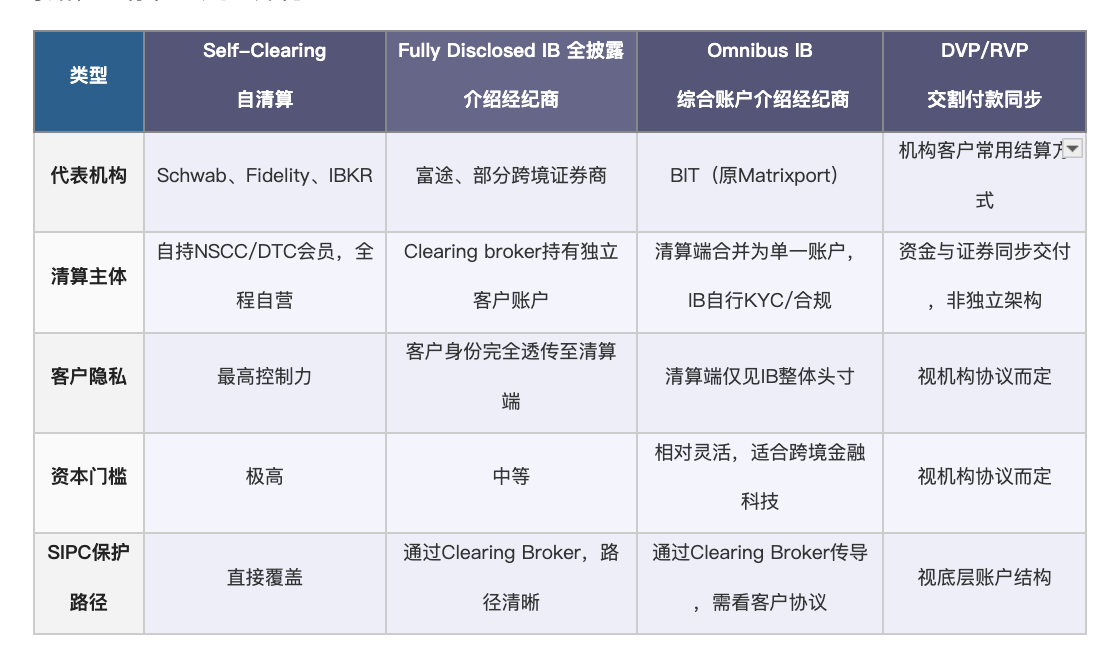
Source: Compiled from public information; DVP/RVP are commonly used settlement methods for institutional clients, not directly comparable to retail brokerage structures.
For users:
- Fully Disclosed IB: Customer identities are fully transmitted to the Clearing Broker, making the SIPC protection path the clearest and suitable for users who value legal certainty.
- Omnibus IB: The clearing end only sees the overall positions of the IB, with SIPC protection conveyed through the Clearing Broker, and the specific path depends on customer agreements—this is a more common access model in international cross-border securities services.
- Self-Clearing: Directly holds NSCC/DTC membership, offering the most direct protection, but has an extremely high capital threshold, typically met only by large established brokers like Schwab, Fidelity, or IBKR.
So, when a platform claims it offers “real US stocks,” a truly pertinent question is: through what architecture does it access the US clearing system? At what level are user assets protected?
Taking BIT (formerly Matrixport) as an example, its compliance architecture consists of three layers:
- The first layer, the GMC license, addresses the issue of "are user assets segregated?" The GMC license in Bhutan has strong cores in the separation of client funds and proprietary funds, which are held by an independent institution, ensuring that BIT cannot use users' stocks for its own financing or positions—this is the first institutional guarantee distinguishing it from opaque platforms and a prerequisite for "real holding."
- The second layer, the Omnibus IB structure, addresses the core issue of "where are user assets actually held?" BIT accesses NSCC clearing and DTC custody through two licensed Clearing Brokers in the US; these agencies can both be independently verified at FINRA BrokerCheck: the US stocks purchased by users through BIT are ultimately held by these two institutions, not in BIT's own accounts or internal ledgers. Assets share the same US securities clearing and custody infrastructure with Schwab and Fidelity clients.
- The third layer, SIPC protection, addresses the issue of "how to guarantee the worst-case scenario." Since BIT's clearing institutions are SIPC members, this layer of protection can be conveyed to terminal users through account structures and customer agreements by the Clearing Broker, providing a legal bottom-line guarantee (the specific transmission path depends on customer agreements).
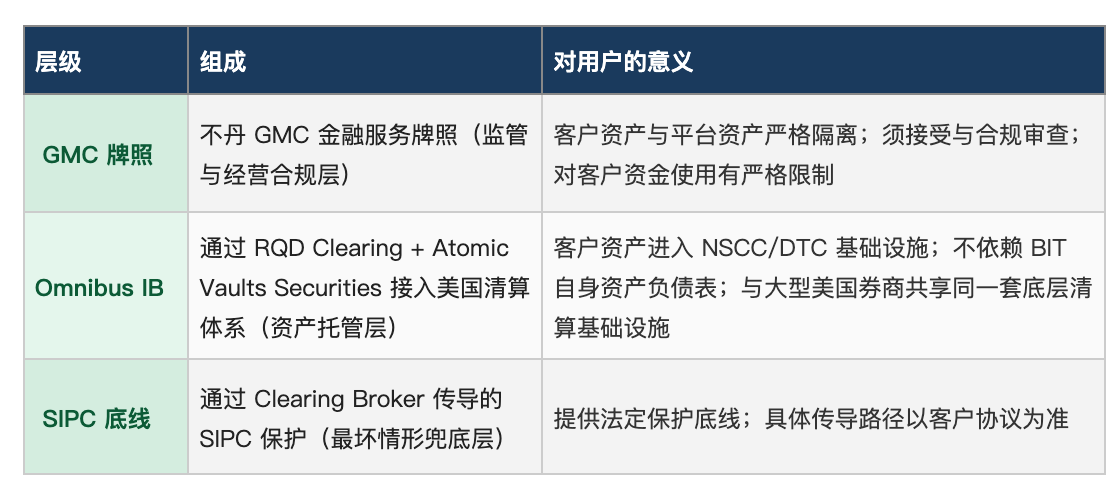
Source: Compiled from public information
4. Conclusion
Buying US stocks with USDT involves three paths, each representing a distinctly different asset. Tokenized Stocks hold an on-chain economic mapping, with shareholder status at the issuer; Stock Futures track prices and are unrelated to holding stocks; the Broker-Direct Connection Model is the true path to buying the stocks themselves—providing the most complete rights and the cleanest long-term holding costs. Even within the Broker-Direct Connection Model, structural differences determine the actual protection level of assets—whether the underlying clearing institutions and compliance structures are publicly verifiable is worth serious validation before choosing a platform.
This article is for educational and informational purposes only and does not constitute investment advice. It should not be interpreted as a recommendation to buy, sell, or hold any securities or financial instruments. All investments involve risks. Readers should conduct sufficient research and consult a licensed financial advisor before making any investment decisions.
免责声明:本文章仅代表作者个人观点,不代表本平台的立场和观点。本文章仅供信息分享,不构成对任何人的任何投资建议。用户与作者之间的任何争议,与本平台无关。如网页中刊载的文章或图片涉及侵权,请提供相关的权利证明和身份证明发送邮件到support@aicoin.com,本平台相关工作人员将会进行核查。


