

Author: Jae, PANews
In the past two years, the once simplest and most profitable initial bullish logic was to buy Nvidia, but this strategy is failing. When everyone knows the H100 is in short supply, and every financial report seems like a copy-and-paste of exceeding expectations, Alpha disappears.
The real smart money is starting to penetrate the software layer and PPT narratives, re-examining the physical foundations behind AI operations. This year, two distinctly different individuals have become the most watched new signposts in the AI investment field.
One is an anonymous trader hidden behind a female anime avatar on X platform, who claims to have rejected an offer from Nvidia, published papers in Nature, and has achieved an astonishing 45-fold return this year by breaking down the most basic components of the supply chain. No one knows his true identity; they only know he goes by Serenity;
The other is a 24-year-old "abandoned disciple" of OpenAI, who transformed from a disheartened researcher to founding a hedge fund that has now reached a management scale of
10 billion dollars, betting on the repricing of energy, computing infrastructure, and storage constrained by physical limitations. His name is Leopold Aschenbrenner, an oddity among Silicon Valley elites.
One seeks "bottleneck" points from a micro perspective, while the other bets on the reconstruction of "physical bottlenecks" from a macro perspective. Their rise to fame is not only a collision of two investment strategies but also a clarion call for the revaluation of underlying assets in the AI era.
Serenity: "Perilla Leaf" Theory Digging for Hidden Dark Horses
If you have been paying attention to the US stock community on X, you can hardly miss an account called Serenity (@aleabitoreddit). With a two-dimensional avatar, posting frequently, most of the information is about the research on semiconductor materials, optical module substrates, and edge computing boards, with little discussion of popular AI applications.
No one knows his true identity. He claims to have a programming and academic background, is an author of papers in Nature, a member of the RISC-V Foundation, and had once rejected an invitation from Nvidia to lead its AI team back in 2018 when Nvidia's stock price was only $6.
Serenity’s rise to fame began in early 2022 on the famous Reddit retail investor forum r/wallstreetbets (WSB). At that time, the edge indium phosphide substrate manufacturer AXTI was ignored. He posted a deep research thread under the account "AleaBito," pointing directly to it as a material base for AI optical modules. Subsequently, this little-known micro-cap stock surged from $12 to $70, an increase of nearly 6 times. However, his accurate prediction was silenced by the platform on the grounds of "inducing speculation." In July last year, he switched to the X platform and quickly grew to become an "AI supply chain detective" with over 400,000 followers, becoming a leading retail investor in the new AI investment circle on X, with some even creating research dashboards based on his tweets.
Compared to the increase itself, Serenity’s research method left a deep impression on the market. He distilled his investment philosophy into his self-created "Perilla Leaf Theory."
He likens it to a top sushi restaurant in Tokyo, where the most sought-after ingredient by customers is undoubtedly the fatty tuna. However, the presentation of the entire sushi plate completely relies on the perilla leaves supplied by certain specific small farms on the Izu Peninsula: to remove fishy smells, to decorate, both are indispensable. If these farms are cut off from supply due to weather or logistics reasons, even the finest tuna cannot be served, and high-end sushi restaurants will necessarily have to close.
In simple terms, the most expensive is the tuna, but what is indispensable is the perilla leaf.
Reflected in the AI supply chain, the perilla leaf represents those tiny market cap, thin liquidity, but possessing absolute technical monopoly in specific manufacturing processes' invisible manufacturers.
Compared to the conventional pile-up of financial report data, Serenity’s research methodology dives deep into the very bottom of the industry chain: chewing through material science papers, mastering physical laws, mapping the supply chain, and even inputting research drafts into multiple AIs for adversarial testing, all to lock down every "irreplaceable" chokepoint.
Over the past two years, Serenity has focused his main efforts on optical-electrical co-packaging technology (CPO). He believes that as AI clusters scale up, traditional copper wire connections and plug-in optical modules will hit the physical wall of power consumption and speed, and co-packaging optical devices and silicon chips on the same substrate via CPO will be the necessary path for the industry.
Based on this judgment, he continuously discovered and recommended three explosive chokepoint targets to the market: Sivers, Raspberry Pi, and Soitec.
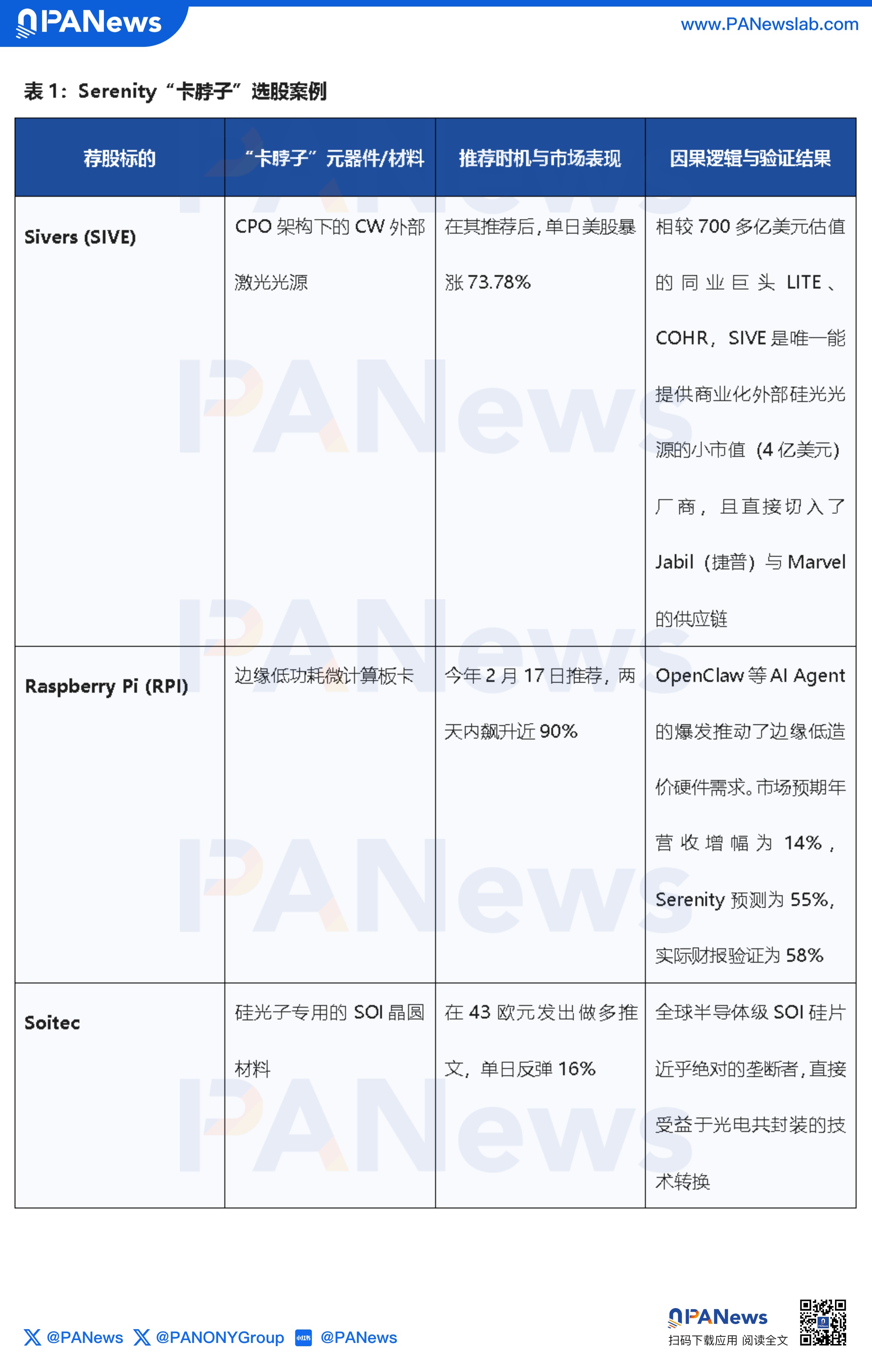
Serenity is still continuing to delve deeper into the most basic layer of the supply chain; he has also discovered a Japanese chemical company, NCI, that produces semiconductor-grade high-purity phosphorus and other precursor materials, pushing the "bottleneck point" down to the molecular material level.
Leopold: Turning 200 Million into 10 Billion, Focusing on Infrastructure Arbitrage Strategies
Unlike the hidden grassroots hunter Serenity in the depths of the internet, Leopold Aschenbrenner is a Silicon Valley genius standing in the spotlight, armed with billions of capital.
His resume is a "model of elitism." Graduating first in his class from Columbia University at 19, he successively worked at FTX Future Fund and the OpenAI Superalignment team. In April 2024, however, Leopold was fired from OpenAI due to suspected information leaks.
This turn of events prompted his transition to the investment world. In June 2024, he published a 165-page industry manifesto titled "Situational Awareness: The Next Decade." In it, Leopold boldly predicts that AGI will be realized around 2027, and superintelligence will arrive by 2030. The actual bottleneck to achieve all this, according to him, lies not in algorithms and models but in physical resources such as the power grid, land, data centers, and high-bandwidth storage.
Based on this highly visionary theory, he founded the hedge fund Situational Awareness LP. Silicon Valley bigwigs like Nat Friedman, Daniel Gross, and the Collison brothers, founders of Stripe, generously contributed, and $225 million in seed funding quickly came together.
The circle Leopold is in is also noteworthy. His fiancée, Avital Balwit, previously worked at the Future of Humanity Institute (FHI) at Oxford University, long researching transformative AI-related topics, before joining Anthropic as chief of staff to CEO Dario Amodei. FTX was one of the earliest and most important financial backers of Anthropic. Before the collapse of FTX, both Leopold and Avital were also core members of the FTX Future Fund charity.
Such a network provides Leopold with unique information flows, cognitive perspectives, and resources for his subsequent research framework and investment layout, which may be its greatest and most difficult-to-replicate Alpha.
On May 18, Situational Awareness LP submitted a Q1 13F filing report, revealing that Leopold's fund management scale had surpassed 10 billion dollars. This document first disclosed to the market its highly concentrated long positions in storage stocks, alongside a massive put option portfolio valued at nearly 8.5 billion dollars covering the entire semiconductor and chip manufacturing sector.
From the perspective of portfolio layout, Leopold adopts an infrastructure arbitrage strategy. On one hand, he aggressively purchased memory hardware manufacturer SanDisk and specialized computing cloud CoreWeave, firmly positioning himself against the physical storage's hard barriers.
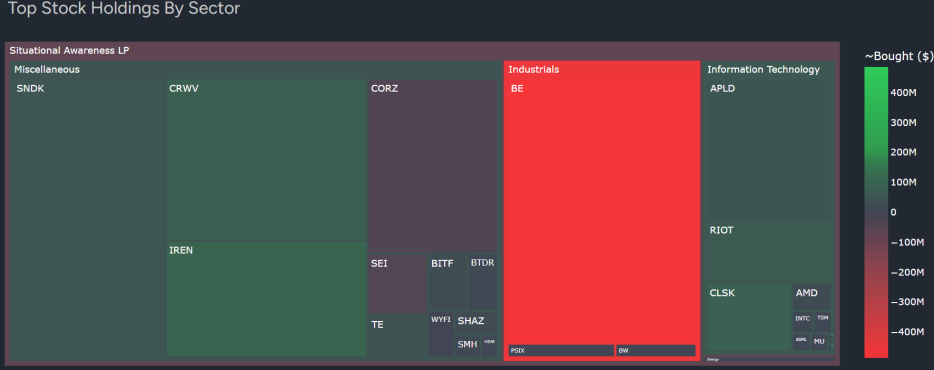
On the other hand, he invested billions into put options against Nvidia (NVDA), TSMC (TSM), Broadcom (AVGO), ASML, and semiconductor ETF (SMH), nearly shorting the entire semiconductor sector.
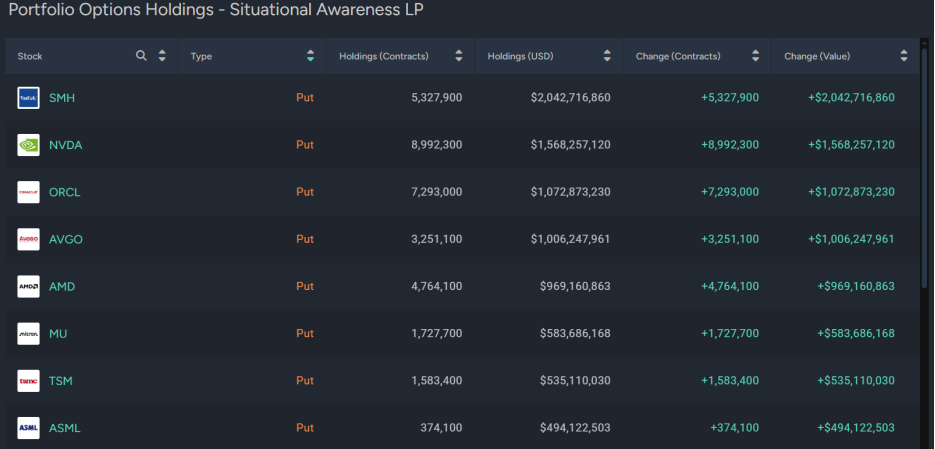
In his view, the current valuation of the chip sector has severely detached from the actual construction pace of physical infrastructures like the power grid and data centers. The deployment of AI computing clusters relies on stable electricity, sufficient land, and mature cooling systems, which have a construction cycle of 3-5 years, far slower than the shipping tempo of chips. In the short term, the growth of chip giants is difficult to sustain, and valuations may face a pullback, while put options will capture the short selling profits from the sector's downturn.
Cryptocurrency businesses are also part of Leopold's investment landscape, as he has heavily invested about $1 billion in long positions on Bitcoin mining companies, buying into IREN, Core Scientific, Riot, CleanSpark, and other targets. In his eyes, Bitcoin mining companies are undervalued alternative centers of AI computing power.
Abandoning Software, Focusing on Reality, AI Computing Power "Toll Road Money" Hidden Dangers
Although Serenity and Leopold's "toolboxes" are different, their core AI investment philosophies are highly similar: to abandon software layers lacking physical barriers and heavily invest in hardware constrained by physical laws.
Whether it is the external CW laser light sources and high-purity phosphorus in Serenity's eyes, or the substations and land in Leopold's, they reveal one point: No matter how innovative AI is at the model level, those who control the scarce resources in the physical world can levy the power of "toll road money" from tech giants in the AI era.
However, there is no perfect strategy in the world. Their strategies will face tests on different dimensions.
For Serenity, his greatest vulnerability lies in the "liquidity abyss" of micro-cap stocks. When he recommends micro-cap stocks with a market value of merely several hundred million dollars to his 400,000 followers on X, a small influx of retail funds is enough to push up the stock price. However, this type of "frenzy" is based on a low liquidity foundation. Once overall market liquidity tightens, or the recommended companies face setbacks in technological validation, the prices of these micro-cap stocks could plummet, leaving retail investors who rushed in at high prices at risk of losing their investments.
Additionally, while Serenity's supply chain research is thorough in technical details, his identity, background, and historical performance have not been verified. Investors should not take him as a "stock god" for blind replication and mirroring, as the risks are high. The "bottleneck" strategy for micro-cap stocks, though extremely explosive, is burdened by high capital expenditure, thin profits, and potential customer attrition risks, making this strategy suitable only as a "high beta catalyst" within asset allocation, supplemented by large-cap blue-chip stocks for risk hedging, with strict position management enforced.
For Leopold, his greatest enemy is the "time lag" in macro games. The physical infrastructure has significantly lagged behind computational demands, which is a fact that completely holds true in causality. However, capital markets often exhibit irrational emotions and longer lag effects, which might lead to the overvaluation of chip giants lasting longer. Faced with the strong financial reports and short squeezes from giants like Nvidia that exceed expectations, his massive short put options could suffer significant paper losses.
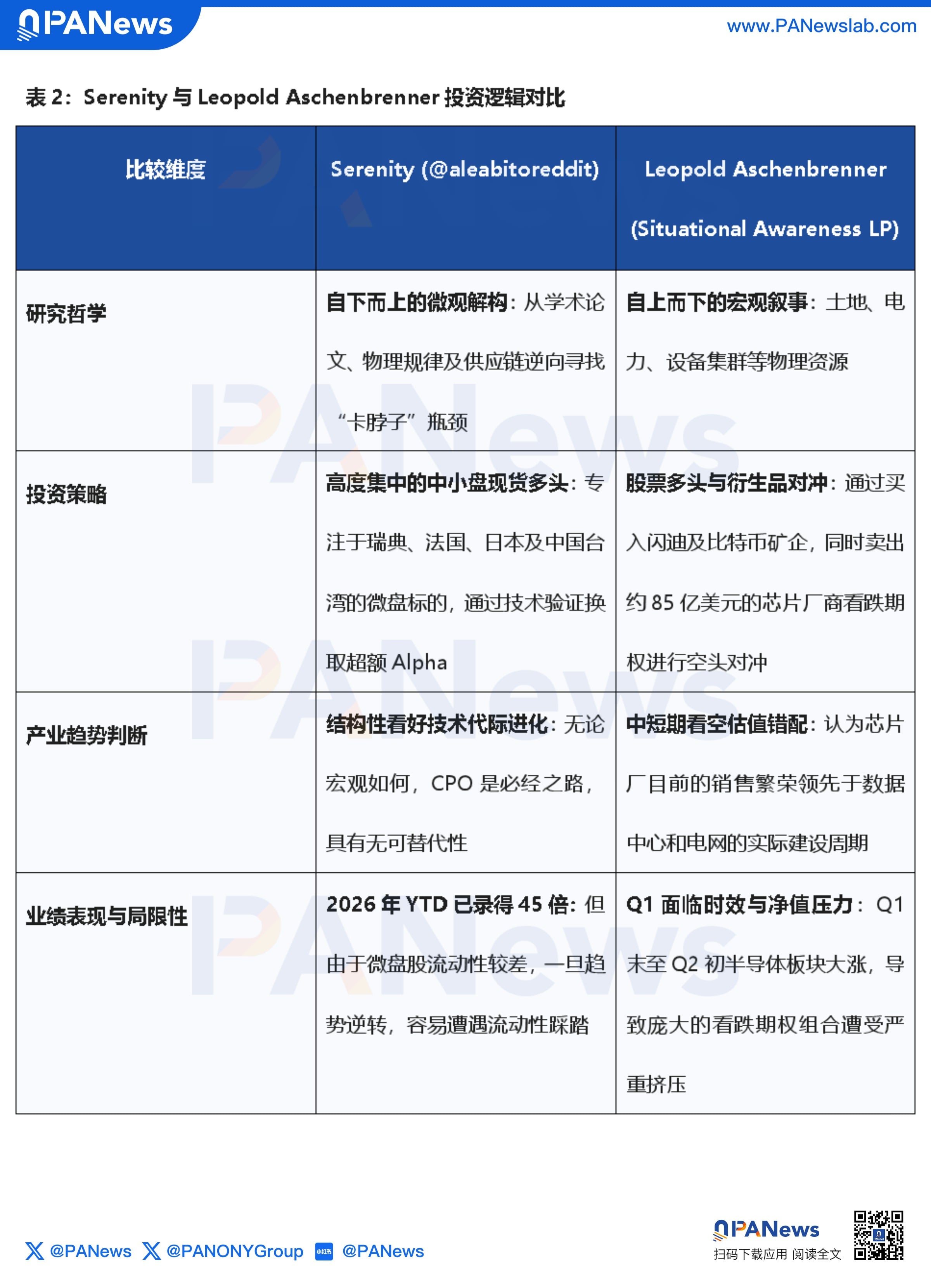
To some extent, Serenity and Leopold represent a new stage of AI investment logic. The value capture of the AI industry is transitioning from semiconductors themselves to the materials, equipment, electricity, and land behind the chips.
As model scales and computational demands continue to grow, key links in the AI industry characterized by scarcity, technological barriers, and supply conditions may receive more market attention in the future.
免责声明:本文章仅代表作者个人观点,不代表本平台的立场和观点。本文章仅供信息分享,不构成对任何人的任何投资建议。用户与作者之间的任何争议,与本平台无关。如网页中刊载的文章或图片涉及侵权,请提供相关的权利证明和身份证明发送邮件到support@aicoin.com,本平台相关工作人员将会进行核查。


