Original Title: The State of Prediction Markets: 2026
Original Author: Jack Haldorsson
Original Translation: Peggy
Editor’s Note: Prediction markets are moving from niche crypto applications to more mainstream financial and information markets.
The 2024 U.S. presidential election brought Polymarket and Kalshi into the public eye, but what truly changed the industry narrative was that the trading volume did not quickly vanish after the elections. Markets for sports, technology, and economics captured this traffic, proving that the long-term demand for prediction markets does not solely stem from political events.
This article outlines the core landscape of prediction markets in 2026: on one side, a duopoly formed by Polymarket and Kalshi, the former leveraging on-chain trading, USDC settlement, and media distribution to expand its influence, while the latter relies on CFTC compliance credentials and channels like Robinhood to enter mainstream financial scenarios; on the other side, a number of new platforms are looking for opportunities in short-cycle trading, sports prediction, media embedding, on-chain native indicators, and infrastructure layers.
More importantly, the competition in prediction markets is no longer just about trading volume, but a comprehensive contest of liquidity, distribution capability, and regulatory paths. At the same time, issues like wash trading, disputes over trading volume statistics, token airdrop expectations, and state-level regulatory pressures indicate that this field is still in a highly uncertain stage.
Prediction markets are no longer just DeFi experiments. They are becoming a new asset class at the intersection of financial trading, media content, and algorithmic strategies. Those that truly have the chance to break through in the future may not be generic replicants, but rather platforms with clear vertical scenarios and distribution advantages.
The original text is as follows:
Two platforms that few had heard of in 2022 saw their nominal trading volume exceed New Zealand's GDP last year.
In 2025, the total trading volume of Kalshi and Polymarket reached 44 billion dollars. In May 2026, Kalshi completed a 1-billion-dollar financing round at a valuation of 22 billion dollars. The parent company of the New York Stock Exchange, ICE, pledged to invest 2 billion dollars in Polymarket at a valuation of 9 billion dollars. AI Agents have executed over 30% of on-chain trades. Meanwhile, several new teams are building exclusive platforms in vertical fields on Base, Solana, Hyperliquid, and Arweave—betting on the judgment that these two giants cannot monopolize all categories.
This is probably the most comprehensive overview of the current ecosystem of prediction market builders.
Numbers That Rewrite the Narrative
2024 was a validating moment for prediction markets. The U.S. presidential election alone brought Polymarket 3.3 billion dollars in trading volume. During the campaign, almost all major financial news editorial offices began to report on the odds in prediction markets. Bloomberg, Politico, and FiveThirtyEight all cited this data in their analyses.
But what happened after November 5 surprised many: trading volume did not drop back to previous baseline levels. The sports market picked up this part of the traffic.
By the end of 2025, the sports market accounted for 85% of Kalshi's trading volume and 39% of Polymarket's trading volume. Technology and science-related markets grew by 1,637% year over year, while economic markets grew by 905%. The political market—which was once considered the core driving force of prediction markets—only grew by 43%.
Prediction markets have found their long-term engine, and it is not elections.
Duopoly Pattern
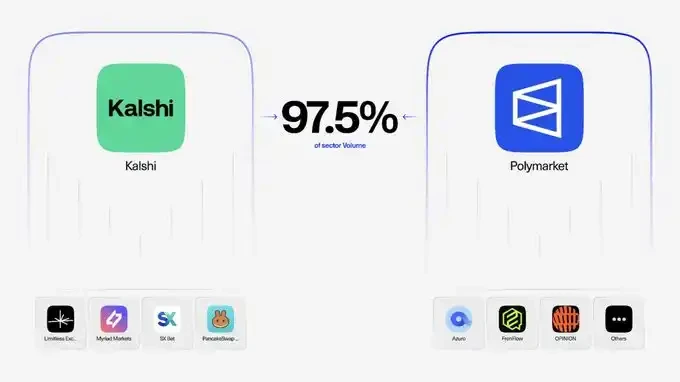
Polymarket operates on Polygon, settles in USDC, and intends not to charge fees in most markets, prioritizing trade volume advantages. In October 2025, ICE made a strategic investment of 2 billion dollars at a post-money valuation of about 9 billion dollars. In June 2025, X announced Polymarket as its official prediction market partner. In February 2026, Substack integrated Polymarket's real-time odds data natively; within a few weeks, one-fifth of the top 250 publications on Substack began using this data. The platform's CMO also confirmed that the POLY token and airdrop are on the way. Once complete functionality is launched, the projected annual fee revenue is expected to exceed 200 million dollars.
Kalshi, on the other hand, received CFTC designated contract market qualifications, becoming the first event contract platform to obtain such qualifications, converting it into a distribution barrier. It was this compliance credential that allowed Kalshi to enter Robinhood. In 2025 alone, Robinhood facilitated over 4 billion event contract trades. In January 2025, Kalshi launched markets related to the Super Bowl. In less than 12 months, the share of the sports market in its trading volume soared from about 10% to over 85%. In May 2026, Kalshi completed a 1-billion-dollar financing round, reaching a valuation of 22 billion dollars, led by Coatue, with investments from Sequoia, a16z, Paradigm, Morgan Stanley, and ARK. At the time of financing completion, Kalshi had approximately 2 million monthly active users, an annual trading volume of approximately 178 billion dollars, and an annual revenue of about 1.5 billion dollars.
In 2025, these two companies together controlled about 97.5% of the entire prediction market industry's trading volume.
Ecological Map
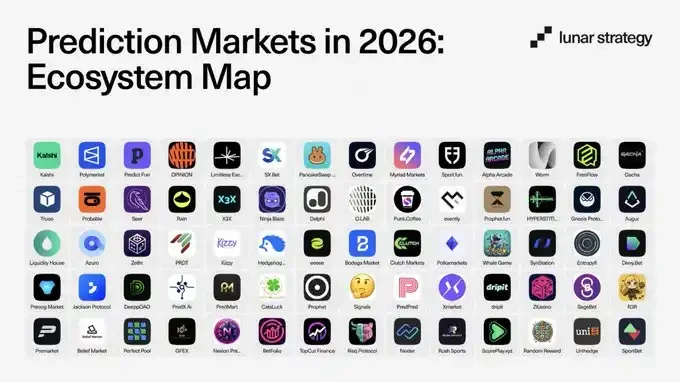
Challengers
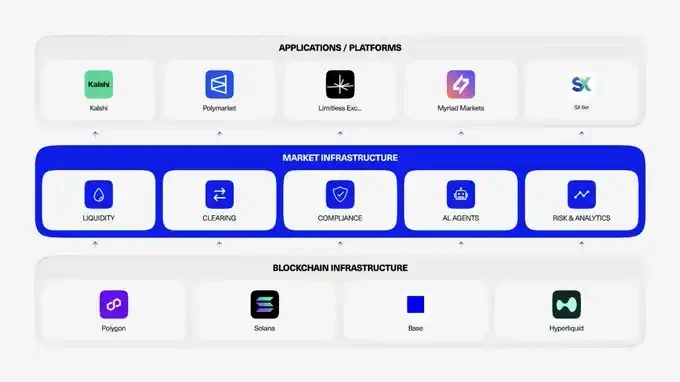
Outside of the duopoly, more than a dozen teams are building new prediction market platforms. They each target a specific gap.
@trylimitless is deployed on Base, focusing on short-cycle markets, including 15-minute, hourly, and daily markets, aimed at cryptocurrency and stock traders who want quick settlements. The project raised 10 million dollars from institutions like 1confirmation, Coinbase Ventures, F-Prime, DCG, and Arrington. In the first quarter of 2026, its monthly trading volume reached 1.1 billion dollars. The $LMTS token, when launched, had a fully diluted valuation once reaching 800 million dollars.
@MyriadMarkets runs on the Abstract chain and integrates with Linea, Celo, and BNB. It bets on a “media-native” prediction market. Its first distribution partnership occurred in December 2025, when the platform embedded prediction functionality into Trust Wallet. It currently has over 430,000 users and has completed over 1.7 million predictions. The project was founded by the team behind Decrypt and Rug Radio.
KASH, through @kash_bot, integrates into X, allowing users to create and trade prediction markets in reply threads. In February 2026, KASH raised 2 million dollars from Big Brain Holdings, Spartan, Coinbase Ventures, Animoca, and the Sui Foundation. Its core judgment is: whoever can enter the scenes where users are already staying with the shortest path will win the prediction market.
@DriftProtocol is built on the 500 million dollar liquidity pool of Drift Protocol on Solana. It supports over 30 collateral assets, allows cross-collateral positions, and offers FUEL rewards.
@HedgehogMarket targets on-chain native indicators, such as Base fees, funding rates, validator performance, and also offers general binary options on Solana and Eclipse. The platform supports permissionless market creation, with peak TVL reaching approximately 20 million dollars.
@HyperliquidX's HIP-4 was launched on May 2, 2026, co-designed by John Wang, the head of the cryptocurrency business at Kalshi. This mechanism uses USDH as collateral entirely, adopting the CLOB order book model, and does not charge opening fees. The first market was officially deployed by Hyperliquid, centered on BTC results, with trading volume reaching 6 million dollars on its first day. Currently, @Outcomexyz is the main frontend for HIP-4, contributing more than 10 times the trading volume of any other interface.
@azuroprotocol is more like an infrastructure layer than a frontend product aimed at general users. It provides a sports prediction market layer for other teams and employs a Liquidity Tree liquidity pool design. The project has raised 11 million dollars from institutions like Delphi Digital, Gnosis, and Arrington Capital.
@Overtime_io operates on Optimism, Arbitrum, and Base. All protocol revenues are directed towards repurchasing $OVER tokens.
@RobinhoodApp is supported by Kalshi's backend and facilitated over 2 billion event contract trades in the third quarter of 2025 alone.
The infrastructure layer is also starting to heat up. In August 2025, @theclearingco completed a 15 million dollar seed round financing, with investors including Union Square Ventures, Haun Ventures, Coinbase Ventures, and Variant. The company was founded by former executives of Polymarket and Kalshi. Capital beginning to flow toward the clearinghouse layer typically indicates that an asset class is maturing.
Core Drivers of 2026
Regulated platforms are seeking on-chain tracks. Kalshi tokenized markets and deployed on Solana, Polymarket advanced compliance with the U.S. CFTC through the acquisition of QCEX, and Hyperliquid's HIP-4 was co-designed by Kalshi—these moves are pointing in the same direction: the underlying layer is a global liquidity layer, with different regulatory shells overlaying it.
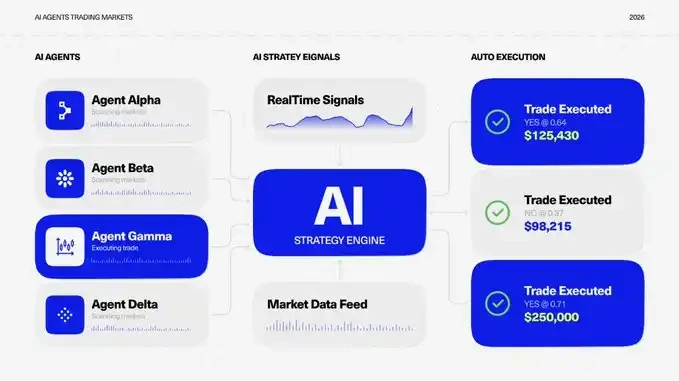
AI Agents have become an indispensable part of prediction market activities. According to data from the analysis platform LayerHub, over 30% of wallets on Polymarket are running AI Agents. Olas's Polystrat Agent executed over 4,200 trades in its first month, achieving a maximum single position return of 376%. Elastics also secured 2 million dollars in financing, attempting to create a natural language trading interface.
Whether the platform teams designed it this way from the start or not, prediction markets are transforming into algorithmic trading venues.
Media platforms are treating prediction odds as a form of high-sticky content. The official partner agreement with X, native integration with Substack, and Google Finance showcasing real-time odds essentially play the same role: turning financial issues into media events that can be collectively discussed, thereby driving natural customer acquisition.
Sports represent the most sustainable vertical track. The 2024 U.S. elections brought the first batch of users, while sports kept them retained. Any new platform that raises funds in 2026 without a sports strategy is either building deep foundational infrastructure or making highly concentrated bets in a particular segment.
Real Challenges
There are three risks worth pointing out directly.
First, the trading volume metrics are themselves controversial. An analysis released by Paradigm in December 2025 pointed out that Polymarket's NegRisk framework would lead to most third-party data tracking tools resulting in double-counting. CertiK estimated that in 2024, nearly 60% of Polymarket's trading volume involved wash trades at its peak. Therefore, the 44 billion dollar figure is more suitable as a directional reference rather than a rigorously audited accurate number.
Second, legal friction at the state level is very real. As of January 2026, there were already over 19 associated federal lawsuits. In March 2026, Ohio ruled that Kalshi's sports products amounted to gambling. Attorney General actions have also been initiated in Wisconsin and Arizona against the two major platforms. While there are tailwinds from the CFTC at the federal level, there is also strong resistance at the state level, and this tension is unlikely to disappear quickly.
Third, token speculation is driving up platform activity. A considerable portion of the trading volume in 2025 and early 2026 was related to market expectations regarding POLY airdrops. Any platform that only publishes attractive trading volume figures without explaining this context is misleading its readers.
Conclusion
Prediction markets made the leap from being “interesting DeFi experiments” to a financial asset class in 2024. By 2025, they began to establish institutional-level pipelines: strategic investments from exchange parent companies, related CFTC settlements, Robinhood integrations, and seed round financing at the clearinghouse level.
By 2026, the real question this track needs to answer has become: besides Kalshi and Polymarket, who else has the chance to win?
The current answer is: those teams who delve deeply into vertical fields, possess clear distribution advantages, and can find paths to regulatory protection or on-chain liquidity density.
The opportunity for generic replicas has ended. Other paths remain open.
If you are also building in this field and want to find suitable growth structures for your vertical track, feel free to reach out.
免责声明:本文章仅代表作者个人观点,不代表本平台的立场和观点。本文章仅供信息分享,不构成对任何人的任何投资建议。用户与作者之间的任何争议,与本平台无关。如网页中刊载的文章或图片涉及侵权,请提供相关的权利证明和身份证明发送邮件到support@aicoin.com,本平台相关工作人员将会进行核查。


