Original |Odaily Planet Daily (@OdailyChina)
Author|Golem (@web3_golem)
Last month, during the ceasefire between the US and Iran, Iran announced that it would charge passing fees for oil tankers through the Strait of Hormuz in the form of Bitcoin. After the news fermented, it sparked discussions among cryptocurrency enthusiasts, believing that Bitcoin had finally played the role of "electronic cash" in the most extreme geopolitical environment. At that time, Odaily analyzed that Iran's move might be a geopolitical tactic, likening Bitcoin in this game to a smoke bomb, with the core aim of openly provoking the US dollar system. (Related reading: Is Iran making empty threats by charging the Strait passage fee in Bitcoin?)
However, looking at it today, Iran has thrown out a real "financial bombshell." On May 18, Iran announced the launch of the state-supported digital marine insurance platform Hormuz Safe, which provides marine insurance for vessels passing through the Persian Gulf and the Strait of Hormuz, and offers settlement in Bitcoin and other cryptocurrencies.
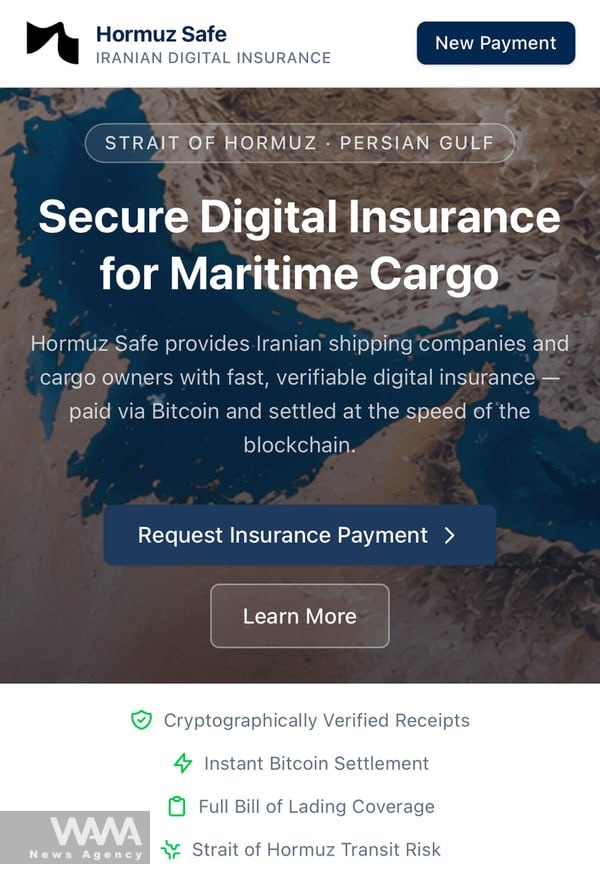
A Hormuz Safe official page has circulated online, which shows that Hormuz Safe's digital insurance services are aimed at Iranian shipping companies and cargo owners, with goods being insured from the moment they are confirmed for shipment, and a signed receipt will be provided to the cargo owner.
Although the website is currently inaccessible (possibly due to node restrictions), the plan to launch this platform itself proves that Iran's intention to charge the Strait passage fee in Bitcoin is no longer just empty talk but is actively establishing a "quasi-financial infrastructure" to gradually turn it into a practical, executable business reality.
Iran Aims to Restructure Financial Order in the Strait of Hormuz
When Iran first announced that it would collect passage fees for the Strait in Bitcoin, a comically absurd scene came to my mind: countless oil tankers are "stuck" in the Strait of Hormuz, and the reason for the congestion is that an elderly captain at the front is staring at the Bitcoin transaction on his phone that has not yet been picked up by the miners...
This rough, humorous imagination can amplify the characteristics and important position of Bitcoin, but if we genuinely consider the practicality of "paying passage fees in Bitcoin," Iran would not be foolish enough to collect fees on-site like highway tolls or garage parking fees, and it doesn't even need to be paid directly in the name of passage fees. Because modern international crude oil shipping is actually backed by insurance.
The Strait of Hormuz controls about 20% of the world's oil supply, and every oil tanker navigating this narrow route between Iran and Oman needs to purchase marine insurance. Without insurance, banks would not provide financing, and no owners or ports would dare send ships or offer docking services.
Traditionally, for the past few decades, this insurance has been underwritten and settled by Western financial institutions, with Lloyd's of London, European and American reinsurance companies, SWIFT, etc., jointly creating an interlocking international oil tanker insurance order, with Iran essentially excluded from these institutions.
Now, Iran is ready to tear open a gap in this insurance system from the payment perspective, as the digital marine insurance platform Hormuz Safe, supported by the Iranian Ministry of Economy, plans to use Bitcoin and cryptocurrencies to settle insurance policies directly, without the SWIFT network and without any Western intermediaries.
This is a scheme to evade sanctions, as the platform features instant blockchain settlements and digital signature receipts, creating a parallel insurance infrastructure that can operate without the approval of any Western regulatory agency. At the same time, it allows Iran to gain financial sovereignty, successfully bypassing the US dollar-based financial system and avoiding pressure exerted by the US through that system. The Iranian government believes that if this platform captures a significant share of the Persian Gulf shipping insurance market, it could generate more than $10 billion in revenue.
This could even become the starting point for Iran's "de-dollarization," transitioning from reconstructing the settlement system to the insurance system, ultimately shaking the entire financial order of the Persian Gulf region. However, rationally speaking, the resistance encountered in accomplishing this task is also immense.
Hormuz Safe attempts to utilize Bitcoin and blockchain technology to bypass the SWIFT network and Western intermediaries, reducing reliance on Western financial infrastructure. The ideal is good, but reality may not be recognized. Because the global trade system is not just a technical system, but also a power system built on credit and violence.
Therefore, to speak plainly, without a nod from the US, the insurance provided by Hormuz Safe may not be recognized by any institutions or ports. Even if ship owners are willing to accept Hormuz Safe, once they leave the Persian Gulf and the Strait of Hormuz, most ports, banks, insurance companies, and exchanges in the world still operate within the dollar system, making the insurance issued by Iran worthless. Even according to the US's "principle of dealing with matters," if ship owners, trading companies, or port management agencies dare to interact with Hormuz Safe, it may trigger the risk of secondary sanctions.
Thus, Hormuz Safe's actual customer base may only be limited to vessels operating in the gray area of US sanctions.
Iran is Financializing Geopolitical Control
However, even if Iran is at a disadvantage in the international financial system, the reality is that it still holds geopolitical control; at least, in terms of the opening of the Strait of Hormuz, the US can no longer have the final say unilaterally.
Regarding the current US-Iran situation, the Trump administration has consistently shown an optimistic and assertive attitude to the outside world, and on May 19, Trump canceled the planned strikes against Iran, stating that negotiations had made some "very positive progress." However, Iran has consistently displayed an unyielding attitude to the outside world; the military advisor to Iran's Supreme Leader, Rezaei, sternly stated in response to Trump's cancellation of the latest military strike, "The powerful armed forces combined with the great Iranian nation will force them to retreat and surrender."
Furthermore, on May 19, Iran's Supreme Leader, Mojtaba Khamenei, reiterated on social media that if "the state of war" persists, they would consider opening new fronts in areas where the enemy is not skilled, while emphasizing that "the enemy has very little experience in these areas and is extremely vulnerable." The core of what Iran is mentioning regarding these new fronts may lie in continuously financializing geopolitical control.
At the formation of the US-Iran standoff, Iran used the blockade of the Strait of Hormuz as a strategic bargaining chip, causing significant disturbances in international financial markets and US politics. However, "blockade" is merely the most primitive way to utilize geopolitical control, as completely closing the Strait would also impose a heavy toll on Iran. The truly advanced method is to directly convert this geographical advantage into sustainable financial returns and financial rules. The former only disrupts order, while the latter is about redefining order, with the overlap of geopolitical and economic threats making the opposing side even more anxious.
Iran is already doing this; in addition to establishing shipping passage rules on the surface, Iran is also focused on the submarine communication cables lying beneath the surface.
In early May, an Iranian military spokesperson, Ebrahim Zolfaghari, stated on Platform X that Iran "will charge fees for internet cables" (the specific method of charging has not yet been disclosed). Under the Strait of Hormuz lies a vast number of submarine cables connecting Arab countries with Europe and Asia, transmitting massive amounts of internet and financial data, which impact financial systems, AI, and people's daily lives, and the economic value created is immeasurable.
Moreover, Iran has threatened that if companies using the submarine cables do not pay the licensing fees, they may implement a "disconnection" strategy, targeting American tech giants like Google, Microsoft, Meta, and Amazon. After this news circulated, maritime intelligence and data provider Windward reported that Iran's statement has prompted one of the world's largest submarine cable installers, ASN (Alcatel Submarine Networks), to suspend all maintenance operations in the region.
From oil tanker insurance on the surface to fiber optic data beneath the surface, everything passing through the Strait of Hormuz is being redefined by Iran as a "chargeable asset," playing the role of "trick or treat"; the physical soft underbelly of capital and financial markets has become Iran's most handy weapon at this moment.
While the Strait of Hormuz appears calm on the surface, Iran has already put the knife to America's throat.
免责声明:本文章仅代表作者个人观点,不代表本平台的立场和观点。本文章仅供信息分享,不构成对任何人的任何投资建议。用户与作者之间的任何争议,与本平台无关。如网页中刊载的文章或图片涉及侵权,请提供相关的权利证明和身份证明发送邮件到support@aicoin.com,本平台相关工作人员将会进行核查。


