Author: Nancy, PANews
In just one week, Hyperliquid generated approximately $11 million in fee revenue. The profitability scale of a single protocol is already approaching half of the total fees from public chains like Ethereum and Solana.
This company, which can be considered the most efficient crypto startup in the world, once again verifies that perpetual contracts (Perps) have become a money-printing business. To grab a piece of this huge market pie, all parties are accelerating their布局.
Just a few days ago, Solana's official account set the Twitter account @Perps as an affiliated account, beginning to actively drive traffic and exposure for perpetual contract platforms within its ecosystem, aiming to re-bet on the Perp narrative. Although the Solana ecosystem is not lacking Perp players, it has yet to make a significant market impact.
The founder personally intervenes, accused of trying to ride on Hyperliquid's coattails
“Perps” account once again reveals Solana's ambition. For Solana, which is attempting to create the narrative of “on-chain Nasdaq,” a full-blown attack on the Perp DEX track is not surprising. However, as the ecosystem has not yet exploded, controversy and tension have already started to heat up.
Recently, Solana co-founder Anatoly Yakovenko re-tweeted several posts supporting Phoenix. These tweets emphasized that Phoenix is more competitive than Hyperliquid in terms of fees and execution speed.
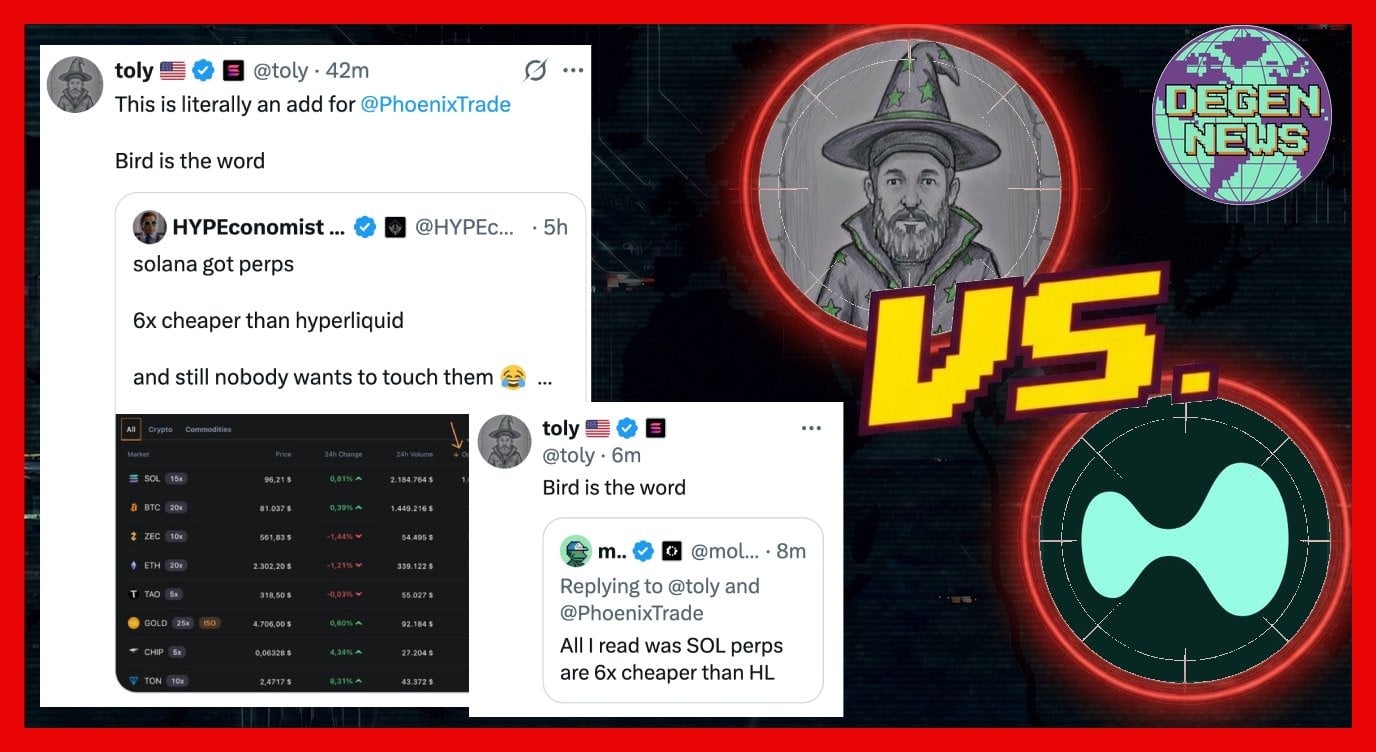
As Solana's native Perp DEX, Phoenix is still in beta stage; in terms of market recognition and user base, it is far from the industry leader, Hyperliquid. Therefore, Anatoly Yakovenko's personal involvement is seen by many as a high-profile attempt to draw attention, even sparking accusations of trying to ride on Hyperliquid's reputation.
Some community members frankly stated that they had rarely seen such a coordinated effort to hype. There will always be various narratives about Hyperliquid Killers in the market, but the reality is often that liquidity is difficult to rapidly siphon off. In this regard, Toly responded that even the strongest "killing machine" has its limits. Just like an automatic monster-spawning machine in games, when the kill counter reaches its limit, the system crashes. With countless low-cost competitors emerging, Hyperliquid will ultimately face the challenge of continuously diverting liquidity.
Some have pointed out that one of the important reasons for Hyperliquid's success lies in its token distribution and community airdrops, whereas Phoenix currently lacks similar advantages. Anatoly Yakovenko bluntly stated that if the token is Hyperliquid's differentiating advantage, it will never reach Binance's heights. The product is the most important thing, 100%.
At the same time, compared to the various incentive activities of some Perp DEXs boosting volume, Yakovenko believes that Open Interest (OI) and fee revenue are more valuable reference points. The reason is that trading volumes can easily be affected by high leverage and short-term incentive activities, making it difficult to reflect true activity levels; OI represents the true locked-in capital willing to take risks in the market, and even cross-platform hedging requires real capital investment, thus better reflecting the project’s real market trust level. Fee revenue is also another important reference indicator.
Chase, Growth Lead at the Solana Foundation, pointed out that the core of the Perp market competition lies in deep liquidity, and the essence of liquidity comes from whether market makers are willing to provide quotes frequently and for the long term. Compared to the community's long-standing debates on market microstructure, market makers are more concerned with whether order sorting is consistent, whether cancellations can be prioritized, and whether the overall execution environment is stable and predictable enough. He also acknowledged that Solana currently still has shortcomings in these areas, forcing market makers to widen spreads to hedge risks, even reducing market-making willingness, which in turn affects overall liquidity depth.
“That group of people at Hyperliquid seems to be a bit rattled,” Chase further stated, indicating that, to some extent, Solana's ecosystem has finally produced a sufficiently excellent Perp product that is starting to gain market attention. They should have stayed silent. Now, these FUDs (Fear, Uncertainty, Doubt) are precisely what Solana needs because such an environment is exactly when it excels in growth and explosion.
Development difficulty far exceeds CEX; reducing developmental barriers is urgent
In fact, as early as October last year, when the Perp DEX track entered a phase of explosive growth, Solana's official team began to intentionally布局 and support perpetual contract projects within the ecosystem.
However, compared to ecosystems like BNB Chain and Base that once produced star-level projects, Solana's side has not been able to create much buzz. In April this year, Solana's largest Perp DEX Drift Protocol was also attacked by hackers, with losses reaching as high as $285 million. This incident not only raised users' concerns about security but also further undermined market confidence in the Solana Perp ecosystem.
At this stage, the overall competitiveness of Solana’s Perp DEXs is still clearly insufficient. Data from DeFillama shows that as of May 14, among the top ten, only GMTrade and Pacifica originated from Solana's native ecosystem, and their market size is negligible, with the 24-hour trading volume of both combined being less than 15% of Hyperliquid's.
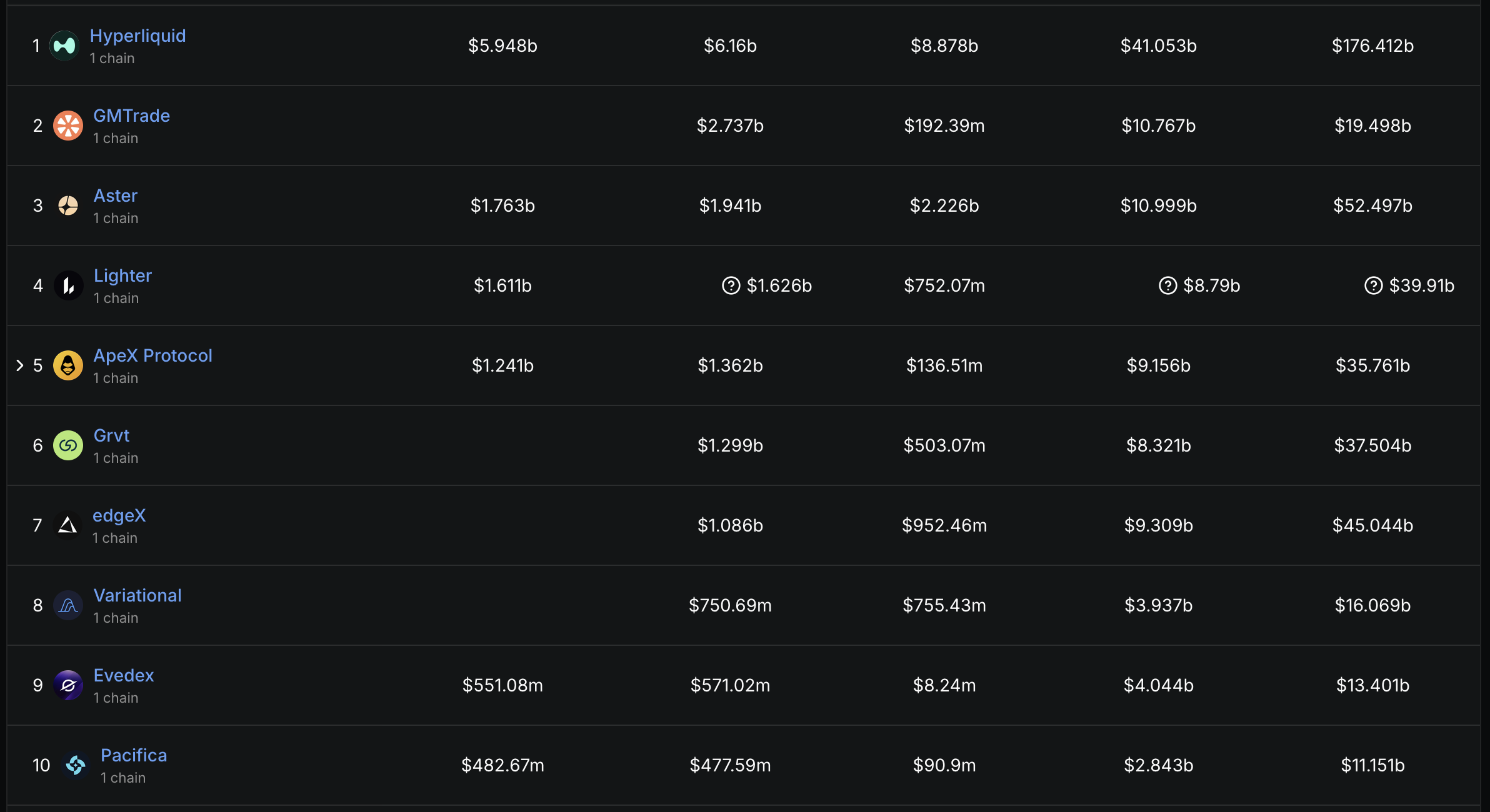
This also means that Solana's Perp track counterattack is not an easy task.
However, in Chase's view, Perps are the core track with the largest trading volume and deepest liquidity in the cryptocurrency market, and they are key to whether Solana can become a layer of global finance. If this piece of the puzzle can be filled in, Solana has the opportunity to support synthetic financial markets for global stocks, commodities, foreign exchange, and crypto assets.
He further stated that specialized chains/execution environments like Hyperliquid, Lighter, and Paradex can provide better experiences, but at the cost of sacrificing the core aspects of on-chain finance: composability, atomic interactions, and decentralization. Solana's opportunity lies in achieving optimal pricing and a complete ecological combination capability without sacrificing these characteristics. More importantly, what Solana currently lacks is actually retail users and trading volume; a large number of Meme, Spot, and DeFi users are already active on-chain, but what is missing is sufficiently excellent Perp products.
In order to better promote DEX development, Anatoly Yakovenko recently stated in response to community concerns that Solana's core task remains to reduce developmental barriers from a technical level.
He admitted that building a DEX that can approach Binance's price competitiveness on a permissionless L1 is much more difficult than building a centralized exchange; therefore, the development cycle is longer and the cost of failure is higher. Solana's spot spreads are already close to Binance levels, and the next target is to continue improving the Perp market's spread performance. As for how much market scale and product-market fit the relevant teams can ultimately achieve, it depends on market demand; the ecosystem's current main task is to reduce barriers for developers from a technical perspective.
For this reason, Solana is also preparing at the infrastructure level to fully compete in the Perp DEX track. Recently, Solana's largest consensus mechanism upgrade, Alpenglow, has officially launched its community testing cluster. This upgrade restructures validator communication and block confirmation processes, significantly shortening transaction final confirmation times and enhancing network response efficiency, thus providing solid support for the on-chain environment required by Perp DEX.
As Solana sounds the horn for a full-scale offensive on the Perp track, competition is rapidly heating up. This battle has progressed beyond just narrative and marketing layers, entering a phase of hard power competition centered around liquidity, performance, and infrastructure.
免责声明:本文章仅代表作者个人观点,不代表本平台的立场和观点。本文章仅供信息分享,不构成对任何人的任何投资建议。用户与作者之间的任何争议,与本平台无关。如网页中刊载的文章或图片涉及侵权,请提供相关的权利证明和身份证明发送邮件到support@aicoin.com,本平台相关工作人员将会进行核查。


