Key Takeaways:
Schumer’s comment came during what has been a turbulent stretch for U.S. crypto legislation. Earlier in the debate over the GENIUS Act (Guiding and Establishing National Innovation for U.S. Stablecoins Act), Schumer had told Democratic members not to commit to voting for the bill until changes were made. Despite that pressure, the Senate voted 68-30 to pass the GENIUS Act, with 18 Democrats crossing the aisle. The bill was signed into law in July 2025.
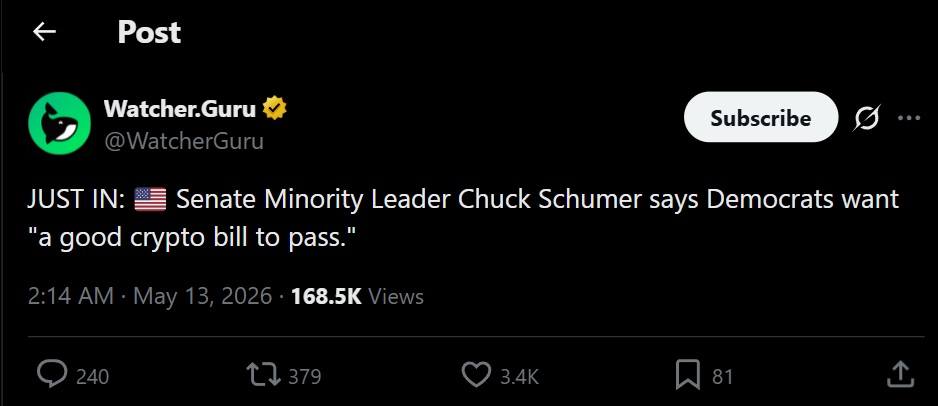
Image source: X
Now attention has shifted to the next major bill, i.e., the Digital Asset Market Clarity (CLARITY) Act, which covers the broader market structure for crypto assets beyond stablecoins. Schumer’s choice words in “good crypto bill” may carry a pointed qualifier given that the Democratic party’s resistance to the CLARITY Act has increasingly centered on an ethics provision that would bar senior government officials, including the president, from profiting off crypto markets while regulating the industry.
That provision was removed from the May 2026 draft of the bill, drawing swift pushback from Democratic senators who say the bill is “dead on arrival” without it. Senator Kirsten Gillibrand, one of the GENIUS Act’s original architects, has stated CLARITY cannot advance without such a safeguard.
This tension reflects a broader dynamic, given that the crypto industry has backed the yield compromise in the bill, which bans yield on stablecoins equivalent to bank deposits but allows “bona fide activities.” Even then, the ethics question remains unresolved. Coinbase and Circle both urged the Senate Banking Committee to advance CLARITY after the yield deal was struck.
The CLARITY Act would establish a comprehensive regulatory framework for the broader crypto market, addressing which tokens qualify as securities versus commodities and which regulators, the SEC or the CFTC, have jurisdiction. For exchanges, projects, and institutional players operating in the U.S., the law would be transformational.
Schumer’s signal, however cautious, suggests that Democrats are not looking to block crypto legislation outright but want specific guardrails. If the ethics provision finds its way back into the draft, a bipartisan path to passage before the end of 2026 begins to look more plausible. For an industry that has spent years navigating regulatory hostility, even that level of political openness is worth watching closely.
免责声明:本文章仅代表作者个人观点,不代表本平台的立场和观点。本文章仅供信息分享,不构成对任何人的任何投资建议。用户与作者之间的任何争议,与本平台无关。如网页中刊载的文章或图片涉及侵权,请提供相关的权利证明和身份证明发送邮件到support@aicoin.com,本平台相关工作人员将会进行核查。


